能源

Search documents
谈判毫无结果,特朗普突然翻脸,要求对伊朗贸易伙伴全部征收关税
Sou Hu Cai Jing· 2026-02-25 09:59
Group 1 - The indirect nuclear talks between Iran and the U.S. in Muscat, Oman, failed to achieve any substantial breakthroughs, with core differences remaining unresolved [1][3] - Following the talks, President Trump signed an executive order imposing additional tariffs on all countries engaging in direct or indirect trade with Iran, which undermines the negotiation foundation [1][3] - The U.S. aims for zero nuclear capability from Iran, while Iran insists that discussions should focus solely on nuclear issues without external pressures [3] Group 2 - The executive order states that any country purchasing goods or services from Iran will face up to 25% additional tariffs on exports to the U.S., targeting key sectors like energy and metals [5] - This policy represents a significant escalation of secondary sanctions, as the U.S. moves to penalize third-party trade partners to cut off Iran's international economic channels [5] - The U.S. Treasury Secretary indicated that the goal is to create a dollar shortage to exacerbate Iran's economic turmoil, continuing the strategy of maximum pressure [5] Group 3 - Iran's armed forces declared a state of maximum alert, emphasizing their commitment to defend national sovereignty and territorial integrity [7] - International oil prices rose in response to the escalating tensions, reflecting global capital's concerns over the deteriorating situation in the Middle East [7] - Major trading partners of Iran, such as China, Germany, India, and Turkey, face significant policy risks due to the U.S. tariff policy, creating a dilemma between maintaining trade relations and facing economic and diplomatic repercussions [7] Group 4 - The lack of strategic trust between the U.S. and Iran is exacerbated by the U.S.'s erratic behavior, making future dialogues increasingly difficult [9] - The U.S. approach of negotiating while applying pressure adds uncertainty to the regional situation, impacting global energy security and geopolitical balance [9] - Iran's display of military deterrence and heightened alert status may lead to a cycle of pressure and counter-pressure, complicating the regional dynamics further [9]

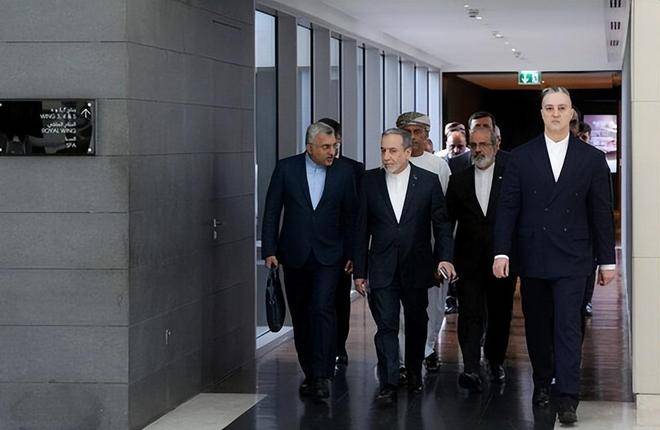
2026央国企大变天:五大领域加速优化,铁饭碗靠能力说话
Sou Hu Cai Jing· 2026-02-25 07:58
Core Viewpoint - The reform of state-owned enterprises (SOEs) in China is leading to significant changes in employment practices, moving away from the traditional "iron rice bowl" concept to a performance-based system where employees are evaluated on their abilities and contributions rather than their tenure or status [1][4][9] Group 1: Reform Overview - The current reform targets five key sectors: real estate, infrastructure, energy, logistics, and cultural tourism, primarily due to issues like overcapacity, outdated models, and technological disruptions [4] - Official data indicates that 6% of SOE management personnel have already undergone adjustments, which translates to tens of thousands of employees affected within the large SOE workforce [1][4] Group 2: Sector-Specific Impacts - In the real estate sector, companies are experiencing layoffs and restructuring, with a focus on retaining employees who can drive market engagement and secure financing [4][7] - The infrastructure sector is also facing significant changes, with traditional project-based employment being replaced by a need for employees to actively seek out work opportunities [4][7] - The energy sector is implementing a "competitive recruitment" system, emphasizing performance over seniority, leading to increased pressure on employees [4][7] Group 3: Employee Perspectives - Employees express a mix of anxiety and acceptance regarding the reforms, with some recognizing the necessity of adapting to new expectations and improving their skills to remain competitive [7][9] - The notion of the "iron rice bowl" is evolving from a guarantee of job security based on status to a merit-based system where skills and performance determine job stability [9]

启程访华前,默茨祝福并感谢中国
Xin Jing Bao· 2026-02-25 06:25
Group 1 - German Chancellor Merz's visit to China marks a significant shift in Germany's foreign policy towards pragmatic cooperation with China, moving away from earlier strategies of "systemic confrontation" and "de-risking" [2][4] - The visit is accompanied by a high-profile economic delegation from Germany, including executives from approximately 30 leading companies in sectors such as automotive, chemicals, and machinery, indicating a strong desire to deepen bilateral economic relations [2][6] - The bilateral trade volume between China and Germany is projected to reach €251.8 billion by 2025, with Germany importing €170.6 billion worth of goods from China, highlighting the importance of this relationship [6] Group 2 - Merz's government is facing internal challenges, including rising political fragmentation and the need to balance welfare state commitments with reform investments, which could impact the stability of the federal government [4][5] - The ongoing Ukraine conflict has exacerbated Germany's energy, economic, and social crises, prompting Merz to seek China's assistance in navigating these challenges [7][8] - The emphasis on cultural exchanges and people-to-people connections is seen as essential for stabilizing and enhancing the long-term strategic partnership between China and Germany [9]
资源品配置正当时,港股通红利ETF广发(520900)交投活跃
Xin Lang Cai Jing· 2026-02-25 06:09
Core Viewpoint - The article highlights the active trading of the Hong Kong Stock Connect Dividend ETF Guangfa (520900) and suggests that the first quarter is a crucial time for resource allocation, driven by recent global uncertainties and domestic economic factors [1] Group 1: Market Performance - The Hong Kong Stock Connect Dividend ETF Guangfa (520900) experienced a trading volume of 91.23 million yuan, with an intraday increase of over 1.5% and a current rise of 0.18% [1] - The ETF closely tracks the CSI Hong Kong Stock Connect Central Enterprise Dividend Index (931722.CSI), focusing on major state-owned enterprises such as the three major oil companies and telecommunications operators [1] Group 2: Economic Factors - The evolving situation between the US and Iran is identified as a significant factor influencing oil and precious metal prices [1] - The uncertainty surrounding US trade policies may provide strong support for precious metal prices [1] - Domestic factors, including the resumption of work after the Spring Festival and macroeconomic policies ahead of the Two Sessions, are crucial for the sustainability of resource products like coal [1] Group 3: Investment Strategy - The first quarter is deemed an opportune time for resource allocation, with the potential for a new round of catalysts in the resource market [1] - The ETF offers investors a convenient way to access Hong Kong dividend assets, balancing stable returns with long-term value [1]
银河期货每日早盘观察-20260225
Yin He Qi Huo· 2026-02-25 02:51
Report Industry Investment Rating No relevant content provided. Core Viewpoints of the Report - After the Spring Festival, the stock market showed a mixed performance with some sectors rising and others falling. The futures market also had different trends in various products, influenced by factors such as supply - demand, geopolitical situations, and policy changes [20][21][25]. - The bond market sentiment was not weak, but the market might become more cautious as the "Two Sessions" approached. The medium - term outlook for the bond market was relatively optimistic [25][26]. - In the agricultural product market, the supply and price trends of different products varied. For example, the supply of protein meal increased, and the price oscillated; the international sugar price bottomed out and oscillated [30][35]. - In the black metal market, steel faced post - holiday pressure, while the performance of coking coal and iron ore was affected by factors such as production resumption and supply - demand changes [62][65][71]. - In the non - ferrous metal market, precious metals like gold and silver were in high - level oscillations due to macro uncertainties, and other non - ferrous metals also had different price trends influenced by factors such as tariffs and supply - demand [76][79][84]. - In the shipping and carbon emission market, the container shipping market was in short - term oscillations, the dry bulk freight market showed a positive trend after the holiday, and the carbon price in the domestic market oscillated while the EU carbon price was affected by policies and public opinions [122][124][126]. - In the energy and chemical market, the prices of various products were affected by factors such as geopolitical situations, supply - demand, and cost. For example, crude oil was in high - level oscillations, and asphalt was supported by cost but with weak demand [132][136]. Summary by Relevant Catalogs Financial Derivatives Stock Index Futures - After the Spring Festival, the stock index rose across the board, but the trading volume was slightly insufficient. The market showed a clear differentiation, with some sectors rising and others falling. The trading strategy was to be bullish on the trend, buy on dips, and consider arbitrage and option strategies [20][21][23]. Treasury Bond Futures - On Tuesday, the bond futures contracts of various tenors generally strengthened. The central bank's large - scale net withdrawal of short - term liquidity after the holiday and the approaching of the "Two Sessions" affected the bond market sentiment. The trading strategy was to be neutral - bullish and wait and see for arbitrage [25][26][28]. Agricultural Products Protein Meal - The supply increased overall, and the price oscillated. The trading strategy was to short at high levels and wait and see for arbitrage [30][31]. Sugar - The increase in Indian sugar production was revised down, and the international sugar price bottomed out and oscillated. The domestic sugar market was in a bottom - oscillation trend. The trading strategy was to wait and see for arbitrage and sell put options in the short term [32][35][36]. Oilseeds and Oils - The domestic oil market made up for losses and maintained oscillations. The trading strategy was to wait and see for arbitrage and consider reverse arbitrage for some contracts [38][39][40]. Corn/Corn Starch - The spot price in the production area was stable, and the futures price was in high - level oscillations. The trading strategy was to buy on dips for the outer - market corn and short lightly on rallies for domestic corn, and consider expanding the spread between corn and starch [41][43]. Live Pigs - The supply increased gradually, and the price continued to decline. The trading strategy was to buy a small amount of the 05 contract and wait and see for arbitrage [44][46]. Peanuts - The spot price was stable, and the futures price oscillated in a narrow range. The trading strategy was to buy lightly on dips and sell put options [47][48]. Eggs - After the holiday, it entered the off - season, and the egg price was stable with a slight decline. The trading strategy was to short the June contract on rallies and wait and see for arbitrage [50][51][52]. Apples - The market performance varied after the year, with the western region performing slightly better than the eastern region. The trading strategy was to go long on the 5 - month contract on dips and consider a long - 5 short - 10 arbitrage [54][55][56]. Cotton - Cotton Yarn - The fundamentals changed little, and the cotton price was supported. The trading strategy was to go long on dips and wait and see for arbitrage [58][59][60]. Black Metals Steel - There was still pressure on steel after the holiday. The trading strategy was to maintain a weak - oscillation trend, hold short positions, and wait and see for arbitrage [62][63]. Coking Coal and Coke - Coal mines were gradually resuming production. The trading strategy was to consider going long on dips and wait and see for arbitrage [64][65][67]. Iron Ore - The fundamentals continued to weaken, and the ore price was in a weak - running state. The trading strategy was to be bearish and wait and see for arbitrage [70][71]. Ferroalloys - The cost support was strong, and it could be used as a long - position configuration on dips. The trading strategy was to go long on dips and wait and see for arbitrage [72][73][74]. Non - Ferrous Metals Gold and Silver - The macro uncertainties continued, and the prices were in high - level oscillations. The trading strategy was to hold long positions cautiously and consider option strategies [76][79][80]. Platinum and Palladium - Supported by macro and geopolitical factors, platinum could be bought on dips, and palladium could be traded in bands. Consider a long - platinum short - palladium arbitrage [80][81][83]. Copper - Affected by continuous tariff disturbances, the copper price was in a strong - oscillation state. The trading strategy was to be bullish in the long - term and consider option strategies [84][85]. Alumina - After the decline in the supply - side operating rate, the spot price was supported. The trading strategy was to be bullish in the short - term [86][87]. Electrolytic Aluminum - Tariff disturbances did not change the supply - demand support pattern. The trading strategy was to wait and see for both arbitrage and options [89][91][92]. Cast Aluminum Alloy - It oscillated with the aluminum price. The trading strategy was to wait and see for both arbitrage and options [93][95]. Zinc - After the correction stabilized, it could be bought on dips. The trading strategy was to wait and see for both arbitrage and options [96][97]. Lead - It oscillated in a range. The trading strategy was to go long lightly on dips and consider option strategies [99][100]. Nickel - The macro factors dominated the price fluctuations. The trading strategy was to hold long positions at low levels and wait and see for arbitrage [101][103][104]. Stainless Steel - Supported by cost, it followed the nickel price. The trading strategy was to hold long positions at low levels and wait and see for arbitrage [106]. Industrial Silicon - Attention should be paid to the resumption rhythm of large factories. The trading strategy was to rebound in the short - term and short on rallies in the medium - term [107][108]. Polysilicon - Driven by merger news, it might rebound in the short - term, and the spot price should be focused on in the medium - term [110][111]. Lithium Carbonate - The demand was good, and the price was at a high level. The trading strategy was to wait and see [113][115]. Tin - Attention should be paid to macro - policy trends. The trading strategy was to hold long positions at low levels and wait and see for arbitrage [118][120]. Shipping and Carbon Emissions Container Shipping - It was mainly in short - term oscillations, and attention should be paid to Maersk's opening - cabin price. The trading strategy was to wait and see for both single - side trading and arbitrage [121][122][124]. Dry Bulk Freight - After the holiday, the demand recovery drove the spot price to improve. Attention should be paid to the impact of the US Maritime Action Plan. The trading strategy was to wait and see [124][125][126]. Carbon Emissions - The domestic carbon price oscillated, and the EU carbon price was affected by policies and public opinions. The trading strategy was to wait and see [126][127][128]. Energy and Chemicals Crude Oil - The API inventory increased more than expected. The trading strategy was to be bullish on the trend, consider the bullish spread, and buy out - of - the - money call options [132][133]. Asphalt - The cost supported the spot price, but the rigid demand had not recovered. The trading strategy was to go long on the BU2606 contract on dips and wait and see for arbitrage [134][136][137]. Fuel Oil - The high - sulfur supply increased, and the low - sulfur price strengthened in the near - term. The trading strategy was to be bullish on the trend, consider expanding the spread between high - and low - sulfur fuel oil, and wait and see for options [139][140][141]. LPG - It was still dominated by geopolitical factors. The trading strategy was to wait and see for both single - side trading and arbitrage [142]. Natural Gas - It was waiting for geopolitical guidance. The trading strategy was to hold short positions on the HH second - quarter contract and wait and see for both arbitrage and options [145][146][147]. PX & PTA - Driven by cost. The trading strategy was to hold long positions, consider positive arbitrage, and wait and see for options [149][150]. BZ & EB - There was a supply vacuum in the overseas market. The trading strategy was to oscillate and consider reverse arbitrage [151][152]. Ethylene Glycol - There was obvious inventory - accumulation pressure. The trading strategy was to oscillate in a range and wait and see for both arbitrage and options [154][157]. Short - Staple Fiber - The polyester raw materials strengthened. The trading strategy was to be bullish on the price, consider narrowing the processing fee on rallies, and wait and see for options [158]. Bottle Chips - The supply was expected to be tight. The trading strategy was to be bullish on the price and wait and see for both arbitrage and options [160][162]. Propylene - The supply - demand support was acceptable. The trading strategy was to hold long positions and wait and see for both arbitrage and options [163]. Plastic PP - The L plastic was bullish on the trend, and the PP was to wait and see. The trading strategy was to go long on the L 2605 contract on dips and wait and see for both arbitrage and options [165][166]. Caustic Soda - The price was weakening. The trading strategy was to wait and see [168][169]. PVC - It was mainly in oscillations. The trading strategy was to go long on dips and wait and see for both arbitrage and options [170][173]. Soda Ash - The price was bullish on the trend. The trading strategy was to be bullish in the short - term, consider a long - soda - ash short - glass arbitrage, and wait and see for options [174][175]. Glass - The price was bearish on the trend. The trading strategy was to be bearish in the short - term, consider a long - soda - ash short - glass arbitrage, and wait and see for options [176][178]. Methanol - It was in a strong - oscillation state. The trading strategy was to go long on dips, consider a 5 - 9 positive arbitrage, and sell put options on corrections [179][180]. Urea - It was rising strongly. The trading strategy was to go long cautiously and wait and see for both arbitrage and options [182][183]. Pulp - The US dollar quotation increased, but the high inventory suppressed the rebound. The trading strategy was to hold long positions and consider option strategies [184][185][187]. Offset Printing Paper - The inventory was high, and the market rebound was limited. The trading strategy was to short on rallies and consider option strategies [188][189]. Logs - The supply and demand were both weak. The trading strategy was to wait and see and consider a 3 - 5 reverse arbitrage [190][192][193]. Natural Rubber and No. 20 Rubber - The gross profit of concentrated latex decreased for consecutive months. The trading strategy was to go long on the RU 05 contract and consider arbitrage strategies [194][196][197]. Butadiene Rubber - The growth rate of butadiene production slowed down. The trading strategy was to short the BR 04 contract lightly and wait and see for both arbitrage and options [198][200][201].
中国人民银行今日早评-20260225
Ning Zheng Qi Huo· 2026-02-25 01:42
Report Industry Investment Rating - Not provided in the report Core Viewpoints - The report provides short - term outlooks for various commodities and long - term government bonds, with most expected to show oscillatory trends, and some with specific directional tendencies such as natural rubber being oscillatory and bullish, and soda ash being oscillatory and bearish in the short - term [2][4][5] Summary by Commodity Precious Metals - **Silver**: Rare metal demand is supported, but silver follows gold's fluctuations. After the holiday, market risk appetite weakened, and the bullish force for silver is less than that of gold. In the medium - term, it is expected to oscillate at a high level [2] - **Gold**: Fed officials' remarks weakened market expectations for interest rate cuts, and the upward momentum of gold is insufficient. Considering US tariffs and geopolitical factors, it may oscillate at a high level in the medium - term [2] Ferrous Metals - **Manganese Silicon**: The manganese silicon market has a situation of strong supply and weak demand, with increasing upstream inventory. The futures price of the main contract is expected to oscillate around the cost [4] - **Iron Ore**: After the holiday, iron - making water production increases while steel enterprises digest inventory. The demand for iron ore is expected to be average. Considering the possible increase in arrivals at ports, there is still pressure for post - holiday inventory accumulation. In the short - term, the price is expected to oscillate [4] - **Rebar**: On the first day after the holiday, most downstream terminals have not started work, and trading volume is scarce. Affected by the decline in iron ore and coking coal futures, rebar futures weakened. In the short - term, steel prices are expected to oscillate [5] Non - ferrous Metals - **Copper**: Supply - side constraints are strengthened, while demand is not fully activated. High prices suppress procurement willingness, and US tariff policies cause market sentiment fluctuations. Copper prices are expected to oscillate at a high level, waiting for inventory inflection points and consumption verification [5] - **Aluminum**: There was a small supply surplus in the global aluminum market at the end of last year due to seasonal consumption decline. Supply has a rigid bottom - support, and the strength of demand recovery will determine the upward space. Aluminum prices are expected to oscillate [8] Energy - **Crude Oil**: The situation between the US and Iran is the short - term market focus. Non - OPEC+ production increases and the release of previously accumulated production by OPEC+ are driving the market into a re - balancing or inventory - accumulation cycle. Short - term trading is recommended [6] Chemicals - **Natural Rubber**: During the Spring Festival, overseas futures and raw material prices rose, and overseas production areas are entering the production - reduction period. Downstream enterprises are gradually resuming work. Natural rubber is expected to oscillate and be bullish [9] - **Asphalt**: Supply decreased, demand decreased, inventory increased, and production profit decreased. Affected by geopolitical factors, asphalt may be supported and run strongly [10] - **PVC**: Supply is abundant, and inventory may continue to accumulate after the holiday. The cost support is weakened. In the short - term, PVC market prices are expected to oscillate [10] - **Soda Ash**: The soda ash market has a situation of strong supply and weak demand, with new production capacity putting pressure on the market. In the short - term, it is expected to oscillate and be bearish [11] - **Methanol**: Domestic methanol production is at a high level, port inventory is high, and downstream demand has declined. After the holiday, some downstream enterprises are resuming work. In the short - term, it is expected to oscillate [12] Bonds - **Long - term Government Bonds**: The central bank's MLF incremental renewal continues, and the capital market is loose, which is beneficial for the bond market. Although the stock market had a good start, its impact on the bond market is limited. In the short - term, the upward momentum of the bond market is insufficient, and it may be bullish in the medium - term [12]
现金堆到3816亿美元却成净卖方?巴菲特“最后一季”持仓大揭秘
Jin Rong Jie· 2026-02-25 01:21
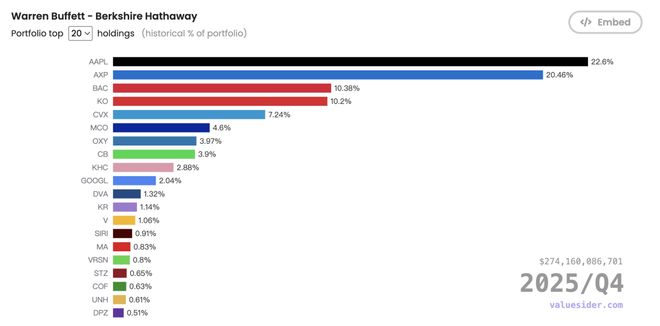
Core Insights - Berkshire Hathaway remains a net seller of stocks in Q4 2025, significantly reducing its positions in Apple, Bank of America, and nearly completely selling Amazon, while increasing holdings in Chevron and Chubb, and initiating a small position in The New York Times [1] Group 1: Portfolio Overview - The total market value of Berkshire's stock portfolio is approximately $274.16 billion [1] - The top five holdings are Apple Inc. (22.6%), American Express (20.46%), Bank of America (10.38%), The Coca-Cola Company (10.20%), and Chevron Corporation (7.24%) [3] - The financial sector dominates the portfolio with a 40.92% share, followed by technology at 24.64%, consumer staples at 14.87%, and energy at 11.21% [4] Group 2: Q4 Position Changes - Core sell-offs include: - Apple (AAPL) reduced by 4.3%, from 238.2 million shares to 227.9 million shares, decreasing in value by approximately $2.799 billion [5] - Bank of America (BAC) reduced by 8.9%, from 568.1 million shares to 517.3 million shares, with a value decrease of about $2.793 billion [5] - Amazon (AMZN) significantly reduced by 77.2%, from approximately 10 million shares to 2.28 million shares, resulting in a value decrease of about $1.783 billion [5][6] Group 3: Core Buys - Chevron (CVX) increased by 6.6%, from 122.1 million shares to 130.2 million shares, adding approximately $1.233 billion in value [7] - Chubb (CB) increased by 9.3%, from 31.33 million shares to 34.25 million shares, adding about $0.91 billion in value [7] Group 4: New Positions - A new position in The New York Times (NYT) was initiated with approximately 5.07 million shares, valued at about $0.352 billion, representing 0.13% of the total portfolio [8][9]


马年开工!左手抗风险,右手抓超额
Xin Lang Cai Jing· 2026-02-24 11:06
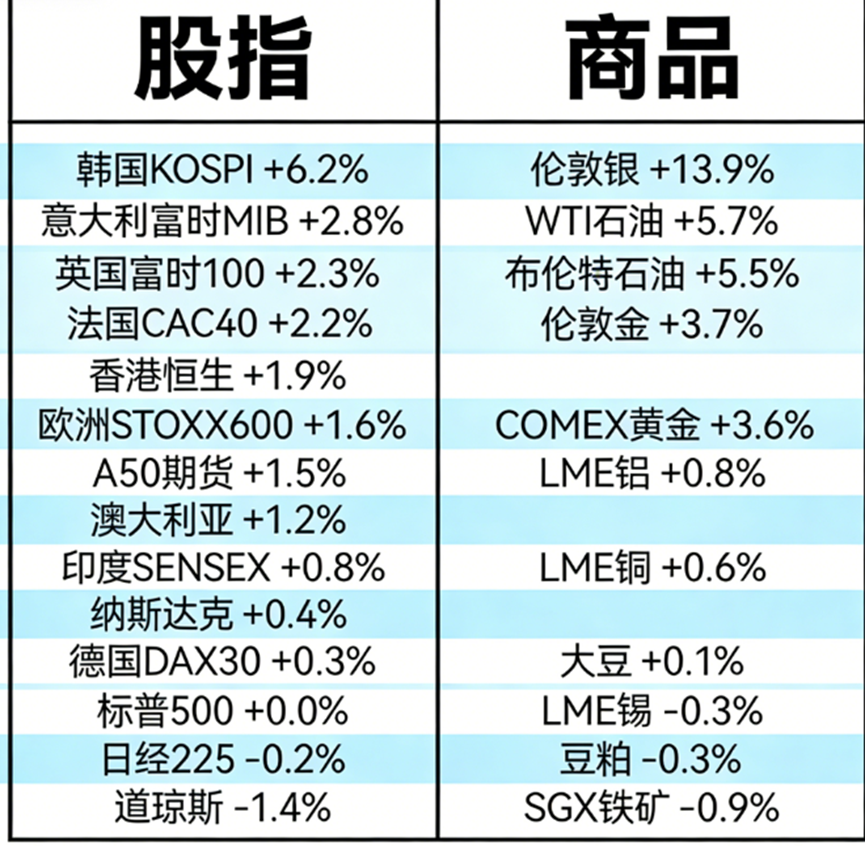
Global Market Performance - The U.S. Supreme Court ruled that the previous global tariffs imposed by the Trump administration were unconstitutional, leading to the cancellation of over $160 billion in tariffs, which could allow companies to claim refunds [1] - Following this, Trump announced a temporary 10% tariff on global goods, which was raised to 15% shortly after, set to take effect on February 24 [1] - The geopolitical tensions between the U.S. and Iran, along with the tariff fluctuations, contributed to a significant rise in gold prices, with international spot gold increasing nearly 6% over four days [1] Stock Market Performance - The South Korean KOSPI index surged by 6.2%, driven by strong performances in the semiconductor and AI sectors, with major companies like Samsung Electronics and SK Hynix reaching new highs [2] - European stock indices also saw gains, with France's CAC40 up 2.23%, the UK's FTSE 100 up 2.28%, and Germany's DAX up 0.31%, supported by economic recovery expectations and rising energy prices [2] - U.S. stock markets exhibited mixed results, with the Nasdaq up 0.36%, the S&P 500 nearly flat, and the Dow Jones down 1.4%, reflecting differing views on the U.S. economic recovery [2] Hong Kong Market Performance - The Hang Seng Index rose by 1.94%, aligning with the global stock market trends, while the Hang Seng Tech Index showed resilience with a slight increase of 0.47 [3] - The index experienced fluctuations during the holiday period, with a notable drop of 2.91% on February 20, followed by a rebound of 3.34% on February 23, driven by semiconductor and internet stocks [3] Commodity Market Performance - The commodity market emerged as the biggest winner during the holiday, particularly in precious metals and energy sectors, with silver prices soaring by 13.9% and gold prices increasing by 3.6% [4][14] - WTI crude oil rose by 5.57% and Brent crude by 5.5%, influenced by geopolitical tensions and OPEC+ maintaining production cuts, which raised concerns over energy supply [4][15] - Other commodities showed mixed performance, with LME aluminum up 0.8% and copper up 0.6%, while some commodities like LME tin and soybean meal experienced slight declines [5][15] Film Industry Performance - The 2026 Spring Festival box office totaled 5.752 billion yuan, marking a nearly 40% decline compared to the previous year, indicating a cooling trend in consumer sentiment [6][17] - The average daily box office fell below 1 billion yuan, reflecting a significant drop in performance during what is typically a peak season for the film industry [7][17] - The top film, "Fast Life 3," grossed 2.927 billion yuan, but overall performance was disappointing compared to previous years [8][18] Investment Insights - The investment landscape has shifted, emphasizing the importance of core assets and strategic allocation to navigate market cycles effectively [9][19] - Precious metals, particularly gold, are highlighted for their long-term investment value due to their safe-haven attributes and industrial demand [9][19] - The CTA strategy is gaining traction as a risk management tool, providing diversification and the ability to hedge against geopolitical and inflationary risks [10][20]
胜通能源:截至2026年2月13日公司股东总数为19478户
Zheng Quan Ri Bao Wang· 2026-02-24 10:10
Group 1 - The core point of the article is that Shengtong Energy (001331) reported a total of 19,478 shareholders as of February 13, 2026 [1]
关税政策大调整:美国终止 IEEPA 关税,全球贸易再迎变数
Sou Hu Cai Jing· 2026-02-24 07:45
Core Viewpoint - The U.S. Customs and Border Protection (CBP) announced the termination of additional tariffs imposed under the International Emergency Economic Powers Act (IEEPA), marking a significant shift in U.S. trade policy following a Supreme Court ruling that deemed these tariffs legally unfounded [1][2]. Group 1: Tariff Termination Details - The termination affects seven presidential executive orders, including tariffs aimed at illegal drug imports, synthetic opioids from China, punitive tariffs on Venezuelan oil, and tariffs designed to address the U.S. trade deficit [2]. - The CBP will update its Automated Commercial Environment (ACE) system, rendering all HTSUS numbers applicable to IEEPA tariffs ineffective from February 24, 2026 [2]. - The adjustment only pertains to IEEPA measures and does not alter other core U.S. trade protection policies, such as Section 232 and Section 301 tariffs [2]. Group 2: New Tariff Measures - Following the Supreme Court ruling, the Trump administration quickly introduced a temporary 10% import tariff on all goods from all countries, which was later raised to 15% [3]. - This new tariff will apply to all trade partners, including those with existing bilateral agreements, disrupting previous trade negotiation frameworks [3]. - The administration aims to offset the revenue loss from the IEEPA tariff termination and maintain overall tariff income for 2026 [3]. Group 3: Impact on U.S. Economy and Trade - The termination of IEEPA tariffs is expected to alleviate cost pressures on U.S. businesses, potentially enhancing profit margins and leading to a temporary rise in stock market indices [4]. - However, the new 15% global tariff raises concerns for industries reliant on global supply chains, leading to increased costs [4]. - The issue of refunding over $130 billion in previously paid IEEPA tariffs has emerged, with many companies seeking reimbursement, which could lead to prolonged legal disputes [4]. Group 4: Implications for U.S.-China Trade - The termination of certain tariffs signals a potential easing of trade tensions between the U.S. and China, allowing for increased trade volumes in specific sectors [5]. - Despite this, the Section 301 tariffs on Chinese goods remain unchanged, limiting the scope for improvement in U.S.-China trade relations [5]. Group 5: Global Trade System Effects - The termination of IEEPA tariffs may lower trade barriers in some sectors, benefiting global trade flows, particularly in energy and chemicals [6]. - However, the introduction of new tariffs creates uncertainty, prompting other nations to consider retaliatory measures, which could disrupt global trade recovery [6]. - The adjustment reflects broader domestic political dynamics and the ongoing struggle between protectionism and globalization [6]. Group 6: Long-term Trade Outlook - The recent changes in U.S. tariff policy introduce both opportunities and challenges for global trade, necessitating enhanced bilateral and multilateral cooperation to mitigate the impacts of unilateral trade actions [7]. - The emphasis on economic globalization and adherence to global trade rules is crucial for sustainable trade development [7].