
证券业

Search documents
央行预告,明日8000亿元
Zhong Guo Zheng Quan Bao· 2026-02-03 12:43
Core Viewpoint - The People's Bank of China (PBOC) is implementing measures to maintain ample liquidity in the banking system by conducting a 800 billion yuan reverse repo operation with a three-month term, marking the first increase in this type of operation since November 2025 [1][3]. Group 1: Liquidity Operations - On February 4, the PBOC will conduct a reverse repo operation of 800 billion yuan, with a term of 91 days, to inject medium-term liquidity into the banking system [1][3]. - The PBOC's liquidity injection aims to stabilize the funding environment ahead of the Spring Festival, as February is typically a month with concentrated bank credit issuance [4][5]. - The total medium to long-term liquidity maturing in February is 15,000 billion yuan, including 7,000 billion yuan in three-month reverse repos and 5,000 billion yuan in six-month reverse repos [3][4]. Group 2: Market Impact and Expectations - The net injection from the reverse repo operation will be 1,000 billion yuan, as 7,000 billion yuan in three-month reverse repos will mature on the same day [3]. - Analysts expect that the PBOC will continue to conduct six-month reverse repos around February 15, potentially maintaining or increasing the amount injected [4]. - The PBOC is also expected to conduct Medium-term Lending Facility (MLF) operations around February 25, likely maintaining or increasing the amount as well [4].

【笔记20260203— 暴跌31.5%,溢价89%】
债券笔记· 2026-02-03 10:55
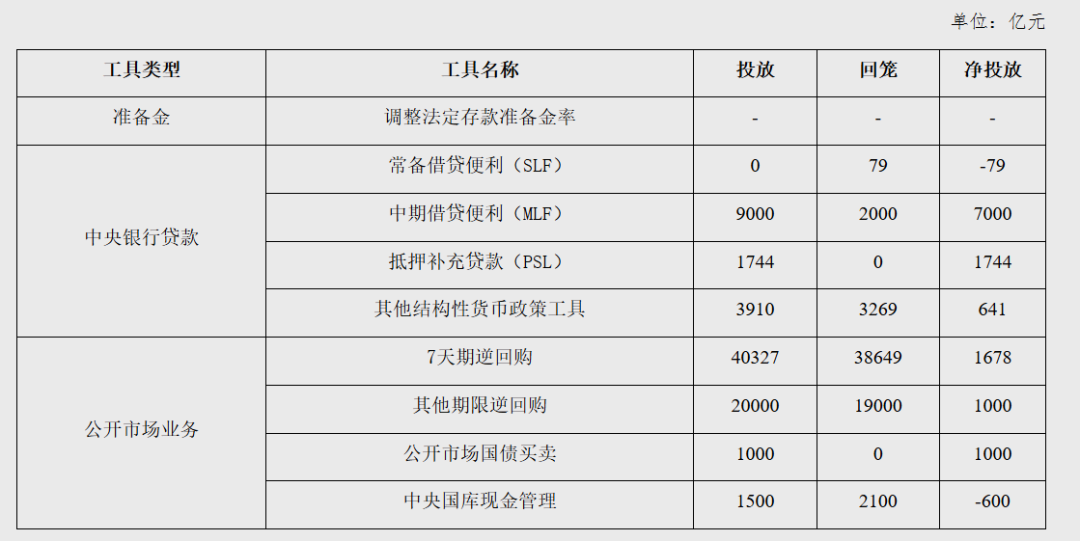
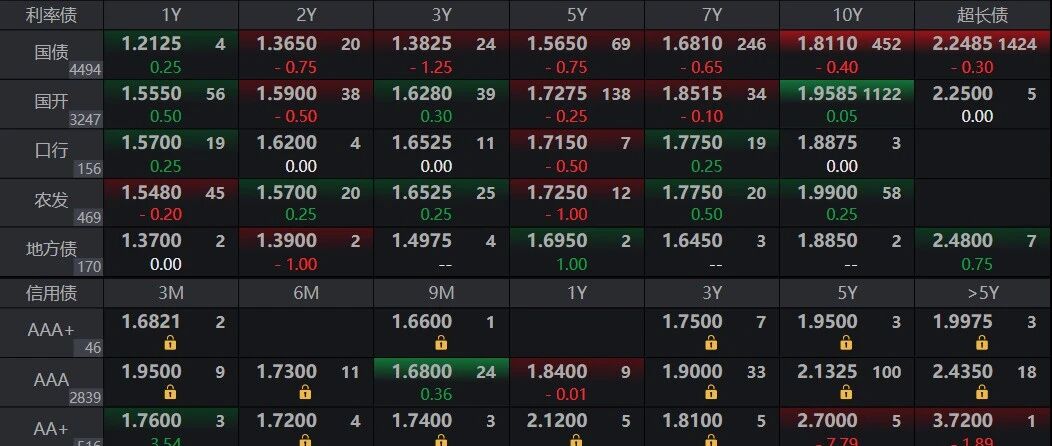
Core Viewpoint - The article discusses the dynamics of the capital market, highlighting that most participants believe they are smarter than the average investor and can predict market movements, yet the reality is that many end up losing money [1]. Group 1: Market Dynamics - The central bank conducted a 1,055 billion yuan reverse repurchase operation, with 4,020 billion yuan maturing, resulting in a net withdrawal of 2,965 billion yuan [3]. - The central bank announced an 8,000 billion yuan buyout reverse repurchase operation with a term of three months, indicating a proactive monetary policy stance [3]. - The market saw a mixed performance in long-term bond yields, with the 10-year government bond rate fluctuating around 1.815% [6]. Group 2: Interest Rates and Trading Volumes - The interbank funding rates remained stable, with DR001 around 1.32% and DR007 at approximately 1.50% [4]. - The weighted rates for various funding codes showed slight changes, with R001 at 1.40% and R007 at 1.55%, reflecting a decrease of 1 basis point [5]. - The trading volume for R001 was 79,433.25 million yuan, indicating a significant increase of 5,639.96 million yuan [5]. Group 3: Market Reactions - The stock market and commodities experienced a rebound, attributed to expectations of the central bank's bond-buying scale, with a threshold of 500 billion yuan considered a positive surprise [6][7]. - A notable event was the sharp decline of a popular silver LOF fund, which dropped 31.5%, marking a record single-day decline for public funds, while trading at a nearly 100% premium [7].
霍华德·马斯克最新炉边谈话:30倍市盈率对真正伟大公司而言不算昂贵,要担心的是标普500“七巨头”以外的那些……
聪明投资者· 2026-02-03 07:02
Core Viewpoint - The article emphasizes the importance of understanding risk, market cycles, and investor psychology in making investment decisions, highlighting that successful investing is not just about buying good assets but buying them at the right price [5][25][39]. Group 1: Understanding Risk - Risk is defined not as price volatility but as the probability of negative outcomes, emphasizing that true risk lies in uncertainty rather than price fluctuations [7][29][67]. - The experience of significant losses in the past has led to a strong aversion to risk, reinforcing the idea that investment success is more about the price paid than the quality of the asset [23][25]. - Investors should be cautious of relying solely on mathematical indicators to assess risk, as they may not capture the true nature of potential losses [8][26]. Group 2: Market Environment and Interest Rates - The long-term decline in interest rates over the past 40 years has significantly influenced asset valuations, making investments appear more attractive as borrowing costs decrease [42][44]. - Lower interest rates create a "double dividend" for investors using leverage, as both asset values increase and borrowing costs decrease, leading to inflated returns that may not reflect true investment acumen [46][49]. - The current market environment is characterized by high valuations, suggesting a need for a cautious and rational investment approach rather than an overly optimistic one [85][86]. Group 3: Investor Psychology and Market Cycles - Market prices often deviate significantly from intrinsic values due to investor sentiment, which swings between extreme optimism and pessimism [75][78]. - The article discusses the importance of recognizing when market sentiment is overly optimistic, as seen in the rapid price increases following a period of extreme pessimism in 2022 [82][84]. - A rational investment strategy involves understanding the relationship between price and intrinsic value, and making decisions based on market psychology rather than following the crowd [77][79].
黄金涨3%、白银涨5%,这轮回调稳了吗
Sou Hu Cai Jing· 2026-02-03 04:03
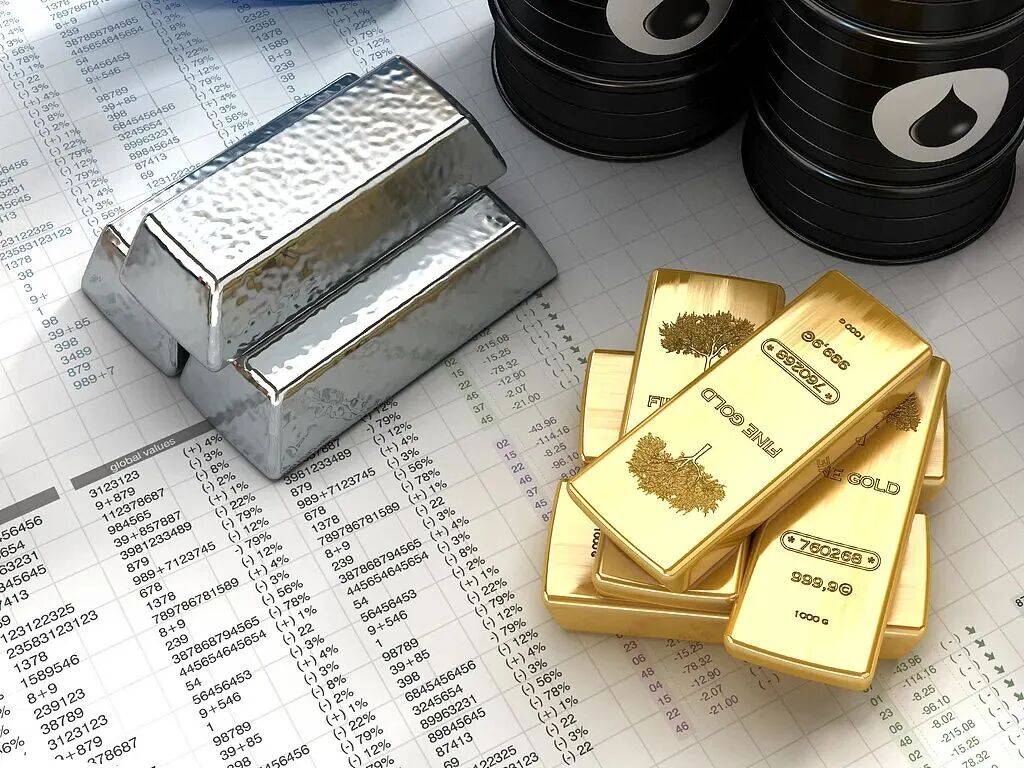
Core Viewpoint - The precious metals market has experienced significant volatility, with gold and silver prices rebounding after sharp declines, indicating a turbulent trading environment influenced by market sentiment and external factors [2][3]. Group 1: Market Performance - As of February 3, 2026, gold was priced at $4809.25, reflecting a daily increase of over 3%, while silver reached $83.808, with a daily rise exceeding 5% [2][3]. - On February 2, 2026, gold prices fell below $4800 per ounce, marking a daily decline of 3.35%, and silver saw a drop of 6% to $79.57 per ounce [2]. - The maximum intraday drop for gold on January 31, 2026, was 12%, reaching a low of $4682 per ounce, while silver experienced a historic intraday decline of over 36%, hitting $74.28 per ounce [3]. Group 2: Institutional Responses - Major state-owned banks have issued multiple risk warnings regarding precious metal price volatility, with the Industrial and Commercial Bank of China (ICBC) issuing four alerts within a week [4]. - ICBC advised investors to adopt a medium to long-term perspective and to diversify their investment strategies in light of increased market volatility [4]. - Several banks have raised the investment thresholds for precious metals and implemented limit management to help investors manage risks [5]. Group 3: Market Analysis - Analysts have noted that the extreme volatility in the precious metals market is partly due to increased leverage and positions, leading to a broader market sell-off [3][6]. - The nomination of Kevin Warsh as the next Federal Reserve Chairman by President Trump has created expectations of potential policy shifts, impacting market sentiment [6]. - Despite short-term pressures from a stronger dollar and liquidity contraction, some analysts believe that the long-term outlook for precious metals remains positive due to geopolitical factors and fiscal sustainability concerns [6][7].
黄金巨震下的积存金:有人连续补仓12次,银行纷纷出手防风险
Jing Ji Guan Cha Wang· 2026-02-03 03:43
Core Viewpoint - The recent volatility in the gold market has led to mixed reactions among investors, with some viewing price drops as buying opportunities while others face significant losses due to high entry points. Group 1: Investor Behavior - A notable investor, referred to as "Golden Egg Fried Rice," has made 12 buying operations since January 29, when gold prices peaked at over $5500 per ounce, and has continued to buy during price declines, averaging down his cost to 920.05 yuan per gram by February 2 [1][2][3] - Another investor, identified as Tong Tong, entered the market at high prices between 1237 and 1248 yuan per gram, only to panic and attempt to average down her costs as prices fell, resulting in a total investment of 55,400 yuan with an approximate loss of 5,600 yuan by February 2 [3][4] Group 2: Market Reactions and Institutional Responses - The recent fluctuations in gold prices have prompted banks to issue risk warnings and adjust their gold accumulation policies, with Postal Savings Bank advising clients to enhance risk awareness and avoid impulsive trading [5] - Industrial and Commercial Bank of China has raised the minimum investment amount for gold accumulation from 1000 yuan to 1100 yuan and announced limits on transactions during non-trading days starting February 7 [5] - China Construction Bank has also increased the minimum amount for personal gold accumulation to 1500 yuan as of February 2 [6] Group 3: Market Outlook - According to Galaxy Securities, the long-term logic for a bull market in precious metals remains intact, driven by factors such as central bank gold purchases, a weakening dollar, and shifts in global economic policies [7] - The potential nomination of Kevin Warsh as the Federal Reserve Chair could lead to a more hawkish monetary policy, which may reduce the short-term appeal of gold as a safe-haven asset [8]

2026年1月金融数据预测:社融增量或同比接近
Hua Yuan Zheng Quan· 2026-02-03 02:17
1. Report Industry Investment Rating - Not mentioned in the provided content 2. Core Viewpoints of the Report - Forecasts for January 2026: 4.9 trillion yuan in new loans, 7.07 trillion yuan in social financing increment; at the end of January, M2 reaches 345.1 trillion yuan with a YoY increase of 8.3%, new - caliber M1 YoY increase of 3.7%, and social financing growth rate of 8.1% [2] - New loans in January may be close to the same period last year, but the new loans in 2026 may still increase less year - on - year due to weak credit demand and non - negligible credit risks [3] - M1 growth rate may decline in January, and M2 growth rate may also decline slightly [3] - Social financing increment in January may be close to the same period last year, and the growth rate may decline slightly. The social financing growth rate may continue to decline in the next few months, and is expected to drop to around 7.5% by the end of 2026. The predicted social financing increment for 2026 is about 35 trillion yuan [3] - Long - term bonds may continue a small - scale rebound in February, and the yield of the active 30Y Treasury bond may return to around 2.2%. The yield of the 10Y Treasury bond is expected to fluctuate between 1.6% - 1.9% in 2026 [3] 3. Summary by Related Catalogs New Loans - It is expected that new loans in January will be 4.9 trillion yuan, with individual loans increasing by 450 billion yuan, corporate loans increasing by 4.5 trillion yuan, and non - bank inter - bank loans decreasing by 50 billion yuan [3] - Among individual loans, short - term loans are expected to increase by 50 billion yuan, and medium - and long - term loans are expected to increase by 400 billion yuan. Among corporate loans, short - term loans are expected to increase by 1.6 trillion yuan, medium - and long - term loans are expected to increase by 3.3 trillion yuan, and bill financing is expected to decrease by 400 billion yuan [3] M1 and M2 - The new - caliber M1 growth rate at the end of January is expected to be 3.7%, with a slight month - on - month decrease. The M2 growth rate at the end of January is expected to be 8.3%, with a slight month - on - month decline [3] Social Financing - The social financing increment in January is predicted to be 7.07 trillion yuan, close to the 7.05 trillion yuan in January 2025. The increment of RMB loans to the real economy is expected to be 4.95 trillion yuan, undiscounted bank acceptance bills to increase by 30 billion yuan, net corporate bond financing to be 50 billion yuan, and net government bond financing to be 110 billion yuan [3] - The social financing growth rate is expected to drop to 8.1% at the end of January, and may continue to decline in the next few months, reaching around 7.5% by the end of 2026. The predicted social financing increment for 2026 is about 35 trillion yuan [3] Bond Market - From November 20, 2025, to the end of January 2026, securities firms' proprietary trading, funds, and annuities significantly reduced their holdings of ultra - long - term interest - rate bonds, with a net sale of 349.8 billion yuan in total. Long - term bonds may continue to rebound in February, and the yield of the active 30Y Treasury bond may return to around 2.2%. The yield of the 10Y Treasury bond is expected to fluctuate between 1.6% - 1.9% in 2026 [3]
黄金续跌,投资者如何风控?
3 6 Ke· 2026-02-02 23:49
Core Viewpoint - The precious metals market, particularly gold and silver, has experienced significant volatility, with sharp declines in prices leading to concerns about market stability and investor risk management [2][3][4]. Price Movements - As of February 2, 2026, gold prices fell to $4421.31 per ounce, down over 9% for the day, while silver dropped to $72.21, down over 15% [2]. - Earlier in the day, gold had broken below $4800 per ounce, marking a 3.35% decline, and silver had seen a drop of 6% to $79.57 per ounce [2]. - The day also saw gold reach a new low of $4450 per ounce, the lowest since January 8, 2026, while silver approached levels that erased its gains for the year [2]. Market Analysis - Analysts noted that the sharp decline in precious metals prices indicates a potential market frenzy, with increased positions and leverage leading to widespread sell-offs [3]. - The volatility in precious metals has been accompanied by declines in other commodities, including WTI crude oil, palladium, copper, and platinum, with WTI oil dropping over 6% to $61.69 per barrel [3]. Risk Management by Financial Institutions - Major state-owned banks in China have issued multiple risk warnings regarding precious metals price fluctuations, with the Industrial and Commercial Bank of China (ICBC) issuing four warnings in a week [4]. - ICBC advised investors to adopt a long-term perspective and diversify their investments to manage risks effectively [4]. - Other banks, such as China Construction Bank, have raised the minimum investment amounts for gold accumulation and implemented limit management for gold investment products [4]. Influencing Factors - The precious metals market has been affected by liquidity issues and market expectations surrounding potential policy changes following the nomination of Kevin Warsh as the next Federal Reserve Chair by President Trump [5]. - Analysts believe that while the immediate impact of Warsh's nomination may be short-term, the long-term fundamentals for precious metals remain intact, with a focus on stable monetary policy and low inflation [5]. Long-term Outlook - Despite recent volatility, some analysts maintain a positive long-term outlook for precious metals, particularly gold, due to ongoing geopolitical shifts and concerns over fiscal sustainability [6]. - The World Gold Council reported that global gold demand is expected to exceed 5000 tons for the first time in 2025, with a significant increase in demand value, indicating strong market fundamentals [6].
金价一度大跌1000美元!金店被挤爆,有人买入近1斤,有人卖金还房贷,“木头姐”精准“预言”大跌:黄金是泡沫,美元一涨就会破
Mei Ri Jing Ji Xin Wen· 2026-02-02 13:53
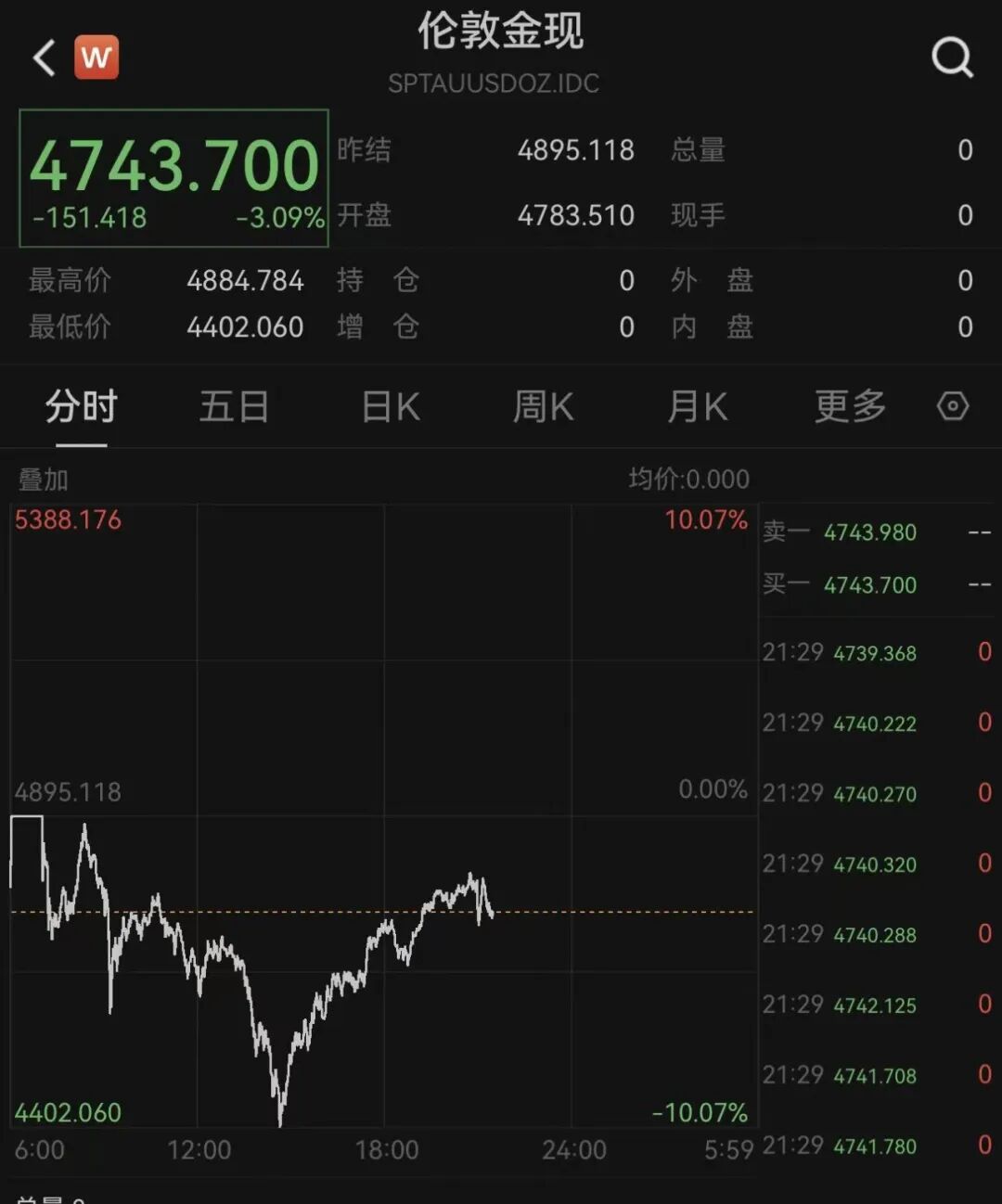
Group 1: Market Overview - International gold prices experienced a significant drop, falling by 10% to $4,402 per ounce, marking a new low since January 8, with a three-day decline exceeding 20% and a drop of over $1,000 from the January 29 peak [1] - International silver prices also saw a sharp decline, dropping over 16% to $71.31 per ounce, with a three-day decline reaching 40%, nearly erasing January's gains [1] - As of the latest update, gold and silver prices narrowed their declines, with gold down 3.09% and silver down 5.8% [1] Group 2: Market Drivers - The recent decline in precious metals began after the nomination of Kevin Warsh as the next Federal Reserve Chair, prompting a reassessment of the outlook for the dollar and dollar-denominated assets [4] - The market experienced its largest single-day drop since the early 1980s, with a total market value loss of $7.4 trillion [4] - Cathie Wood, a prominent fund manager, indicated that gold prices might be nearing a peak, suggesting that the current bubble is in gold rather than artificial intelligence [4] Group 3: Investor Behavior - There has been a surge in retail investors buying and selling gold, with reports of long queues at gold shops in Beijing as people rush to sell their gold for cash [10][11] - Many individuals are looking to liquidate their gold holdings to pay off debts or invest in other opportunities, reflecting a shift in consumer sentiment towards gold [10][11] - Banks have reported that physical gold bars are sold out due to increased demand from investors [11] Group 4: Risk Management - Banks like China Merchants Bank and Postal Savings Bank have issued risk warnings regarding the volatility in precious metal prices, adjusting margin requirements for gold and silver trading [12][14] - The adjustments include increasing the margin ratio from 60% to 70% for certain gold and silver contracts, indicating a proactive approach to managing market risks [12][14] Group 5: Future Outlook - Analysts predict that gold prices will experience significant volatility in the short term, advising investors to wait for market stabilization before making new investments [16] - The fundamental support for gold prices remains intact, driven by a weak dollar and declining trust in U.S. debt and dollar assets, suggesting a potential for long-term price recovery [16] - The market is expected to fluctuate around the $5,000 per ounce mark, with ongoing demand for gold as a safe-haven asset [17]
每日投行/机构观点梳理(2026-02-02)
Jin Shi Shu Ju· 2026-02-02 12:34
Group 1 - Macquarie Group strategist Thierry Wizman indicates that Trump's nomination of Kevin Warsh to lead the Federal Reserve helps stabilize the dollar, although concerns remain about potential pressure for interest rate cuts [1] - The Canadian dollar may face downward risks due to multiple pressures, including a potential rebound of the US dollar and rising unemployment in Canada, which could lead to expectations of further rate cuts by the Bank of Canada [2] - CreditSights highlights that Warsh's return intensifies the debate over the Fed's balance sheet, which could shift regulatory pressure to the Treasury, especially as the national debt exceeds $30 trillion [3] Group 2 - China International Capital Corporation (CICC) notes that gold prices above $5,500 per ounce represent a significant threshold, indicating a potential shift in the global monetary system [3] - CICC also states that Warsh's nomination has limited short-term impact on the interest rate path but may adjust expectations for dollar liquidity, potentially easing depreciation pressure on the dollar [4] - Huatai Securities reports that the recent performance of real estate stocks has outpaced market indices, driven by low valuations and improving fundamentals [5][6] Group 3 - Citic Securities predicts that gold could rise to $6,000 per ounce and silver to $120 per ounce by 2026, driven by strong demand and supply constraints [6] - The nomination of Warsh is seen as a representation of a shift towards a more tangible economic policy in the US, which could significantly impact global risk assets [8] - The real estate market in China is showing positive signals, with a recovery in operational assets and a potential stabilization in prices [8][9]
安永报告:改革与开放双轮驱动 中国金融体系迈向高质量发展新阶段
Xin Hua Cai Jing· 2026-02-02 12:03
Core Insights - The report by Ernst & Young highlights significant achievements in China's financial reform and opening-up by 2025, injecting new vitality into global economic growth and financial market prosperity [1][2]. Group 1: Financial Reform and Opening-up - By 2025, China's financial reform and opening-up have entered a new phase characterized by systematic deepening and accelerated institutional opening [1][2]. - The focus has shifted from "factor openness" to "institutional openness," emphasizing rules, systems, and infrastructure development [2]. - The capital market has seen steady progress in institutional dual-directional opening, with Hong Kong's new stock financing ranking first globally in 2025 [2]. Group 2: Market Dynamics and Foreign Investment - The pace of opening in banking, insurance, securities, and asset management has accelerated, with foreign financial institutions experiencing growth in asset scale and business revenue [3]. - The number of foreign institutions operating in China has reached new highs, fostering a complementary and competitive relationship with domestic institutions [3]. - The development environment in China remains vibrant and stable, enhancing the attractiveness and inclusiveness of the capital market [3]. Group 3: Asset Management Industry - As of Q3 2025, China's asset management industry reached approximately 179.33 trillion yuan, with foreign public funds increasing their investments and product offerings [4]. - The industry is evolving under regulatory norms and open policies, entering a phase of high-quality development [4]. - The combination of global experience from foreign institutions with local market insights is expected to further stimulate innovation within the industry [4].