云计算

Search documents
亚马逊 2025 年表现疲软,是为2026年布局铺路
美股研究社· 2025-11-28 11:06
Core Viewpoint - Amazon's recent performance has lagged behind its peers, presenting a potential investment opportunity as analysts believe its fundamentals are strengthening, particularly in artificial intelligence [1][2]. Financial Performance - Amazon's Q3 revenue reached $180.17 billion, a year-over-year increase of 14.55%, with adjusted diluted EPS of $1.95, up 36.36%, exceeding market expectations [4]. - The company's EBIT could have reached $21 billion if not for FTC-related expenses and severance costs, with AWS's backlog at $200 billion and annual recurring revenue around $132 billion [4]. Artificial Intelligence Developments - Amazon is enhancing its AI capabilities with infrastructure like Trainium chips and partnerships with Nvidia, aiming to reduce reliance on third-party GPUs [6][7]. - The upcoming AWS re:Invent conference is expected to showcase significant updates, including the Trainium3 chip, which is anticipated to double the computing power of its predecessor [6][7]. Market Position and Strategy - Amazon's investment in AI and cloud services for government clients, with a planned $50 billion investment, could significantly alter its market narrative and valuation [8]. - The company is leveraging AI to improve operational efficiency, with reported savings of 700,000 hours of labor, equating to the annual workload of 335 developers [9]. Valuation and Future Outlook - Analysts project a target price of approximately $270.48 per share based on a forward P/E ratio of 30, indicating an upside potential of over 18% in the next 12 months [10]. - Amazon's return on invested capital (ROIC) has improved from about 3% in 2016 to 16.5%, supporting the stability of its current valuation [9]. Conclusion - Despite a forward P/E ratio exceeding 30 appearing risky, analysts believe Amazon's growth prospects and competitive advantages justify this premium, especially if it successfully expands into new markets like government services [14].



美股异动丨甲骨文盘前跌逾1% 因AI计划过度举债引发市场担忧
Ge Long Hui· 2025-11-28 09:21
德意志银行分析师Brad Zelnick认为,尽管甲骨文因AI计划过度举债引发市场担忧,但当前看空观点或 为"看涨"信号;他重申对甲骨文的"买入"评级,目标股价375美元,认为AI投资回报可靠,甲骨文在AI 云基础设施部署方面具领先地位。(格隆汇) (原标题:美股异动丨甲骨文盘前跌逾1% 因AI计划过度举债引发市场担忧) 甲骨文(ORCL.US)盘前跌1.12%报202.66美元。消息面上,OpenAI的数据中心合作伙伴正在累积近1000 亿美元与这家亏损的初创公司相关的借款。根据英国金融时报的分析,软银、甲骨文和CoreWeave等公 司已借贷至少300亿美元用于投资这家初创公司或帮助建设其数据中心。知情人士透露,一个银行集团 正在洽谈再提供380亿美元的贷款给甲骨文和数据中心建设商Vantage,用于为OpenAI建设更多的站点。 预计该交易将在未来几周内敲定。 ...

2026年互联网传媒投资策略:国内AI纵深发展,悦己消费全球化
Shenwan Hongyuan Securities· 2025-11-28 07:46
Group 1 - The core opportunity in the internet and media sectors for 2025 is centered around AI revaluation, particularly in cloud computing, and the globalization and youth-oriented trends in self-consumption, such as trendy toys, music, and concerts [3][4] - AI cloud capital expenditure (capex) is expected to expand in its second year, with a focus on return on investment (ROI) from AI investments, making capex/operating cash flow a key metric for investors [3][4] - Major companies to watch in the AI cloud space include Alibaba, Baidu, and Kingsoft Cloud, which are focusing on domestic production and infrastructure [3][12] Group 2 - The AI application landscape is shifting from conceptual discussions to a focus on commercial viability, with significant developments in AI advertising and video monetization expected in 2026 [3][4] - Tencent, Bilibili, Meitu, Kuaishou, and Focus Technology are highlighted as key players in the AI application ecosystem, with a particular emphasis on the monetization of chatbot applications and the evolution of AI video tools into community platforms [3][4] - The gaming sector is seeing structural opportunities driven by Generation Z and international expansion, with a focus on companies like Giant Network, Century Huatong, and Xindong Company [3][4] Group 3 - The self-consumption trend is expected to continue, with gaming, music, and trendy toys being key areas of growth, particularly as the market adjusts post-2025 [3][4] - The video sector is anticipated to reach a turning point, with policy stabilization and diverse monetization strategies being crucial for growth [3][4] - Companies such as Mango Super Media, Shanghai Film, and Reading Group are positioned to benefit from these trends [3][4] Group 4 - The report indicates a recovery in companies like Focus Media, Vision Source, and educational publishing firms, suggesting a positive outlook for these sectors [3][4] - The report emphasizes the importance of continuous performance and valuation adjustments in the context of evolving market conditions [3][4] Group 5 - The domestic cloud computing market is witnessing increased capital expenditure from major internet companies, with Alibaba and Tencent leading the charge [18][19] - The report highlights the importance of measuring the health of cloud investments through the capex/operating cash flow ratio, with Tencent's ratio being notably lower than its peers [19][29] - AI-driven cloud services are expected to maintain higher profit margins compared to traditional cloud offerings, with a focus on internal workload efficiencies [29][30] Group 6 - The report outlines the competitive landscape of AI applications, noting that Chinese companies are making significant strides in the global market, particularly in productivity tools and content generation [34][35] - The emergence of ChatGPT as a multi-functional platform is reshaping the AI application ecosystem, with significant implications for user engagement and commercial applications [35][39] - Advertising remains a critical area for AI commercialization, with companies like Meta, Tencent, and Bilibili leveraging AI to enhance ad performance and efficiency [43][49]





亚马逊研究奖获奖名单出炉:王晋东等26位华人入选
机器之心· 2025-11-28 04:11
Core Insights - The Amazon Research Awards (ARA) announced 63 recipients, including 26 Chinese scholars from 41 universities across 8 countries, aimed at funding multidisciplinary research topics [1][2]. AI Information Security - Eight researchers in AI information security received awards, with three being Chinese scholars [3]. - Zhou Li from the University of California, Irvine, focuses on using LLM for precise and analyst-friendly attack tracing in audit logs [4]. - Yu Meng from the University of Virginia studies weakly supervised RLHF, modeling ambiguity and uncertainty in human preferences [5]. - Ziming Zhao from Northeastern University specializes in system and software security, network security, and human-centered security research [6]. Amazon Ads - Two awardees in the Amazon Ads research area are both Chinese [8]. - Xiaojing Liao from the University of Illinois Urbana-Champaign investigates attack methods on large language models, focusing on interpretable vulnerability detection and remediation [10][11]. - Tianhao Wang from the University of Virginia works on differential privacy and machine learning privacy, designing practical algorithms [14]. AWS Agentic AI - Thirty researchers were awarded in the Agentic AI category, including several Chinese scholars [16]. - Cong Chen from Dartmouth College aims to drive global energy transition through engineering methods based on optimization, economics, and modern machine learning [19]. - Chunyang Chen from the Technical University of Munich focuses on the intersection of software engineering, human-computer interaction, and AI [21]. Trainium Development - Twenty awardees are involved in research related to Amazon's Trainium AI chips, with several being Chinese researchers [49]. - Kuan Fang from the University of Minnesota works on NetGenius for autonomous configuration and intelligent operation of next-generation wireless networks [50]. - Shizhong Han from the Lieber Institute focuses on revealing the genetic basis of brain diseases and translating genetic discoveries into new treatments [55]. Think Big Initiative - Three researchers were awarded under the Think Big initiative, which supports transformative ideas in scientific research, including one Chinese scholar [85]. - Tianlong Chen from the University of North Carolina at Chapel Hill utilizes molecular dynamics to empower protein AI models [88].

“科技+港股红利”两手抓!盘中获资金抄底的创业板人工智能ETF华夏(159381)翻红,港股央企红利ETF(513910)四季度以来净流入超10亿
Ge Long Hui· 2025-11-28 03:57
Group 1 - The artificial intelligence ETF from the ChiNext market, managed by Huaxia, rebounded by 0.79% after a previous decline, with a net subscription of 12 million units and an estimated net inflow of 19.968 million yuan [1] - The technology and Hong Kong dividend strategies are seeing increased investment as they decline, with the ChiNext AI ETF experiencing a cumulative pullback of over 12% from October 29 to November 24, yet attracting a net inflow of 349 million yuan during this period [1] - The Hong Kong central enterprise dividend ETF has also seen a cumulative pullback of 4% since November 13, with continuous buying over 11 trading days, resulting in a net inflow of 307 million yuan, and over 1 billion yuan net inflow since the fourth quarter [1] Group 2 - The ChiNext AI ETF has a significant exposure to the Google chain, with 48% of its component stocks linked to it, providing a stable response to fluctuations between the Nvidia and Google chains [1] - The Hong Kong dividend strategy funds are favored due to their lower valuation compared to A-share dividend indices and higher dividend yields, making them attractive to institutional investors looking to secure profits towards year-end [1] - The ChiNext AI ETF has over 50% CPO content and the lowest fee rate among AI indices, with key stocks including Xinyiseng, Zhongji Xuchuang, Tianfu Communication, and Runze Technology [2]

开盘:沪指微跌0.11%、创业板指跌0.04%,贵金属、猪肉板块走高,影视院线及CPO概念股走低
Jin Rong Jie· 2025-11-28 02:12
Market Overview - On November 28, A-shares opened slightly lower, with the Shanghai Composite Index down 0.11% at 3870.94 points, the Shenzhen Component Index down 0.04% at 12869.66 points, and the ChiNext Index down 0.04% at 3029.98 points [1] - The market saw gains in sectors such as precious metals, while small metals and short drama games faced declines [1] - Notable stocks included Guosheng Technology, which opened up 1.23%, and Furi Shares, which opened down 4.00% [1] Company News - Dongxin Co., Ltd. signed a strategic cooperation framework agreement with a leading domestic cloud computing service provider to collaborate on various technology solutions [2] - Tianpu Co. applied for a stock suspension starting November 28, 2025, to protect investor interests [2] - Fule New Materials has successfully transitioned from a material supplier to a smart sensing solution provider with its "electronic skin" product [2] - Wantong Development is progressing with its strategic transformation involving Shudu Technology, which is currently in a loss-making state [2] - Moer Thread's recent share issuance saw 16.77 million shares subscribed, raising 1.917 billion yuan [2] Industry Insights - The AI glasses market is seeing growth with Alibaba's launch of the Quark AI glasses, which integrate various services from its ecosystem [5] - The AI unicorn "Moon's Dark Side" is nearing the end of its latest funding round, with a valuation expected to reach approximately $4 billion [6] - Chongqing's government has introduced policies to support the low-altitude economy, offering subsidies up to 20 million yuan [7] - The lithium battery supply chain is strengthening with long-term supply agreements totaling 159.5 thousand tons [8] - The consumer electronics sector is expanding, with a total of 230 million product varieties available in China [9] - The film industry is experiencing success with "Zootopia 2" achieving a record box office on its opening day [10] - The ice and snow economy is gaining traction, with increased flight bookings to popular destinations [11] Institutional Perspectives - Huatai Securities predicts rapid growth for satellite industry-related stocks due to advancements in reusable rockets and reduced launch costs [12] - Zhongyuan Securities highlights the solar industry entering a capacity clearing cycle, suggesting improved performance for existing companies [13] - Tianfeng Securities notes the rapid development of China's medical beauty market, with significant growth potential in various segments [14]
朝闻国盛:阿里巴巴-W(09988.HK):闪购减亏在即,AI 叙事持续铺开
GOLDEN SUN SECURITIES· 2025-11-28 00:59
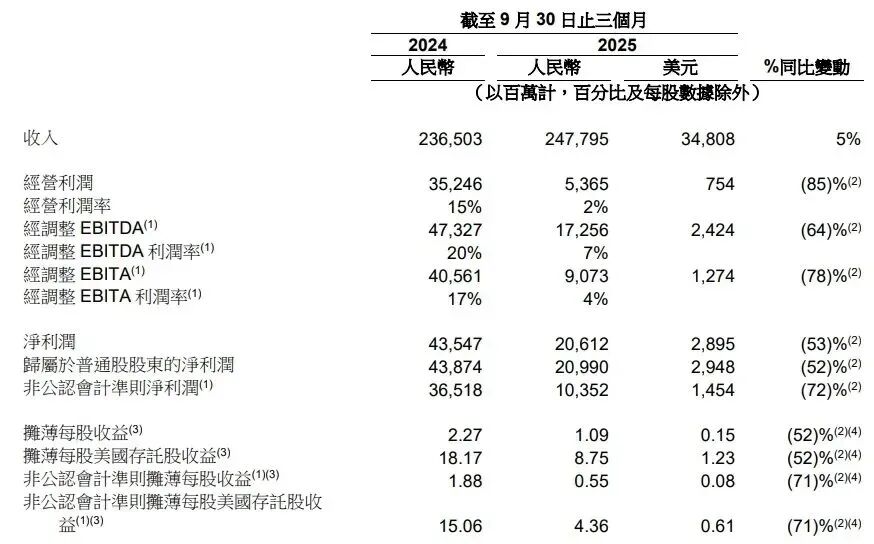
Group 1: Alibaba-W (09988.HK) - Alibaba reported total revenue of 247.8 billion yuan for FY2026 Q2, a year-on-year increase of 5% [4] - The Chinese e-commerce segment generated 132.6 billion yuan in revenue, up 16% year-on-year, while international commerce revenue reached 34.8 billion yuan, growing 10% [4] - Alibaba Cloud's revenue increased by 34% year-on-year to 39.8 billion yuan, with adjusted EBITA of approximately 3.6 billion yuan, a 35% increase [4][5] - Instant retail revenue surged by 60% year-on-year to 22.9 billion yuan, contributing to improved user engagement and customer management revenue [5] - Management indicated that the Capex target of 380 billion yuan over three years may be revised upwards due to high demand for servers [6] Group 2: Dongyangguang (600673.SH) - Dongyangguang is involved in a 100% equity acquisition of Qinhuai Data, with total investment reaching 11.2 billion yuan, of which Dongyangguang contributed 3 billion yuan [2] - The acquisition aims to transition Dongyangguang from a traditional materials supplier to an integrated digital ecosystem service provider focusing on green electricity and computing power [2] - The company anticipates significant revenue growth, projecting revenues of 15.7 billion yuan, 24.5 billion yuan, and 31 billion yuan for 2025, 2026, and 2027 respectively [3]

财联社11月28日早间新闻精选
Xin Lang Cai Jing· 2025-11-28 00:23
Group 1 - The Chinese government is promoting high-quality development and has approved the draft of the "National Reading Promotion Regulations" [1] - The number of humanoid robot companies in China has exceeded 150, with more than half being startups or companies from other industries, indicating a growing innovation landscape [6] - Morgan Stanley strategists suggest that a potential interest rate cut by the Federal Reserve could support the continued rise of emerging markets [17] Group 2 - Morgan Chase strategists predict a higher probability of significant gains in the Chinese stock market next year due to multiple positive incremental drivers, including broader AI applications and consumer stimulus measures, leading to an upgrade of A-shares to "overweight" [8] - The European Space Agency's budget for the next three years has reached a record $25.5 billion, indicating strong investment in aerospace projects [18] - The announcement of a strategic cooperation framework agreement between Shanghai Lishuan and a leading domestic cloud computing service provider highlights ongoing developments in the cloud computing sector [10]
8点1氪|罗永浩称没有被威胁,会公布录音;宗馥莉卸任娃哈哈董事长;多家手机厂商取消Air机型
3 6 Ke· 2025-11-27 23:52
Group 1 - Luo Yonghao confirmed he was not threatened and will release the recording related to his dispute with Hua Shan [2] - Zong Fuli officially stepped down as chairman of Wahaha, with Xu Simin taking over [2] Group 2 - Multiple smartphone manufacturers, including Xiaomi, OPPO, and vivo, have canceled their Air model projects, reallocating eSIM solutions to regular models [3] Group 3 - A major fire in Hong Kong resulted in 83 confirmed fatalities and 76 injuries, with rescue operations completed [3][4] - The Hong Kong government announced a relief fund of 300 million HKD for affected residents and immediate cash assistance of 10,000 HKD per household [4] Group 4 - HP announced a global layoff plan affecting 4,000 to 6,000 employees, approximately 10% of its workforce, to streamline operations and enhance productivity through AI [10] Group 5 - TSMC accused a former executive of leaking trade secrets to Intel, which Intel denied, asserting strict policies against such actions [7] - Asahi Group reported a data breach affecting over 1.91 million personal records due to a cyberattack [8] Group 6 - Sichuan province extended marriage leave from 5 to 20 days and increased maternity leave to a maximum of 120 days [5] Group 7 - NIO's CEO Li Bin stated that the automotive industry is entering a decisive phase, with a clearer competitive landscape expected by 2030 [13] - Huawei Cloud underwent organizational restructuring, appointing Zhou Yuefeng as CEO [13] Group 8 - Apple is challenging a potential $38 billion fine in India related to new antitrust laws [14] - YouTube is launching a cheaper, music-free subscription service in South Korea following antitrust investigations [14] Group 9 - Soul App submitted its IPO application to the Hong Kong Stock Exchange, with Tencent as a strategic investor [15][16] - Avita Technology also filed for an IPO in Hong Kong [15] Group 10 - DeepSeek launched a new math reasoning model, achieving high performance in competitive evaluations [18] - Alibaba's team won the Best Paper Award at NeurIPS 2025 for their research on attention mechanisms [18]
暴跌85%!马云开始交卷了
Xin Lang Cai Jing· 2025-11-27 22:16
Core Viewpoint - Alibaba is experiencing a "restart year" in 2023, as indicated by its mid-term financial results for the fiscal year 2026, which show mixed performance but also signs of resilience and potential growth in its core e-commerce and AI sectors [1][3]. Financial Performance - Alibaba reported revenue of 247.795 billion RMB for the fiscal year 2026, reflecting a 5% year-on-year increase [2]. - Operating profit decreased significantly by 85% to 5.365 billion RMB, while net profit attributable to ordinary shareholders fell by 52% to 20.990 billion RMB [2]. - The adjusted EBITDA also saw a decline of 64%, indicating challenges in profitability despite revenue growth [2]. E-commerce Business - The Chinese e-commerce segment generated 132.578 billion RMB in revenue, marking a 16% increase year-on-year, showcasing a stable recovery in this core area [4][5]. - Instant retail, particularly through Taobao Flash Sale, has shown remarkable growth, with revenue increasing by 60% [5][6]. - The integration of offline stores into the instant retail model has improved unit economics and user engagement, leading to a return of double-digit user growth on the Taobao app [6][8]. AI Development - Alibaba's cloud intelligence group reported revenue of 398.24 billion RMB, with a year-on-year growth rate of 34%, driven by increased adoption of AI-related products [9][11]. - The launch of the "Qianwen" AI application has gained significant traction, achieving over 10 million downloads within a week and becoming one of the fastest-growing AI applications globally [11][13]. - This strategic shift towards consumer-facing AI marks a departure from Alibaba's previous focus on B2B AI services, positioning the company to leverage its AI capabilities across various consumer applications [14][17]. Industry Trends - The e-commerce sector is undergoing a transformation with the integration of AI, as seen during the recent Double 11 shopping festival, where AI tools significantly enhanced user experience and sales efficiency [18][20]. - However, the rapid adoption of AI has also led to challenges, including issues with product authenticity and the emergence of gray market practices, prompting platforms to implement stricter regulations [28][29]. Conclusion - Alibaba is in a critical phase of transformation, aiming to evolve from a traditional e-commerce company into a comprehensive AI-driven entity, with ongoing challenges and opportunities in both its financial performance and market positioning [29].