有色金属

Search documents
中金岭南(000060.SZ):暂无金属锡资源
Ge Long Hui· 2026-02-03 06:57
Group 1 - The company currently has no cobalt resources in its Australian subsidiary [1] - The company also has no tin metal resources at this time [1]

上银基金:市场调整不改中期向上 可聚焦AI、国产出海等三大机会
Xin Hua Cai Jing· 2026-02-03 06:50
Core Viewpoint - The A-share market is experiencing significant volatility, but the medium-term upward trend remains intact according to Shangyin Fund, supported by three main factors [1]. Group 1: Market Trends - The global backdrop of "asset scarcity" continues, coupled with frequent geopolitical conflicts, which sustains the long-term trend of "patient capital" flowing into the stock market [1]. - Domestic policies aimed at reducing "involution" are being implemented, leading to improved expectations for corporate profitability, which provides a stabilizing effect on the capital market [1]. - The recent rapid adjustments in market sectors are primarily reactions to short-term market sentiment and trading dynamics, rather than fundamental changes, thus not undermining the medium to long-term upward trend [1]. Group 2: Investment Opportunities - Investment opportunities can be categorized into three areas: 1. AI-related industries, where domestic policies are supporting the AI industry chain, and capital expenditure in global computing power is expected to expand, with a focus on domestic computing chains and AI in gaming [2]. 2. The enhancement of Chinese brand competitiveness, transitioning from "cheap goods" to "high-quality and cost-effective" products, with notable advancements in sectors like innovative pharmaceuticals, power equipment, and construction machinery [2]. 3. Resource sectors, particularly copper and minor metals, which possess genuine scarcity and anti-inflation properties, forming stable supply alliances and showcasing significant long-term investment value [2]. - The adjustment in the non-ferrous metals sector, which has seen significant prior gains and high congestion, is viewed as a necessary period for digestion rather than a fundamental downturn, with potential for attractive buying opportunities post-adjustment [2].
超130亿元,“跑了”!
Zhong Guo Ji Jin Bao· 2026-02-03 06:49
Group 1 - The stock ETF market experienced a significant net outflow of 790 billion yuan in January, with broad-based ETFs being the main contributors to this outflow [2] - On February 2, the first trading day of the month, stock ETFs saw a net outflow of 13.771 billion yuan, influenced by a sharp decline in the three major stock indices [2] - Broad-based ETFs and the metals sector were the largest "bloodletting" categories, while sector-specific ETFs like semiconductors and pharmaceuticals attracted significant inflows [2][3] Group 2 - As of February 2, the total scale of 1,321 stock ETFs (including cross-border ETFs) was 4.09 trillion yuan, showing a notable decrease due to the market downturn [3] - Sector-specific ETFs and Hong Kong stock ETFs saw substantial inflows, with 3.715 billion yuan and 3.346 billion yuan respectively on the previous trading day [3] - The semiconductor sector had a remarkable net inflow of 2.61 billion yuan on February 2, with the Guolian An CSI All-Share Semiconductor ETF leading with a net inflow of 903 million yuan [3] Group 3 - Over the past five days, the SGE Gold 9999 index saw inflows exceeding 13.9 billion yuan, while the specialized chemical index attracted over 7 billion yuan [4] - Leading institutions like E Fund reported a total ETF scale of 642.71 billion yuan, with a net inflow of 800 million yuan on the previous day [4] - Notable single product inflows included 526 million yuan for the ChiNext ETF and 352 million yuan for the Hang Seng Technology ETF [4] Group 4 - Broad-based ETFs continued to experience significant outflows, with a net outflow of 23.778 billion yuan on the previous day, leading to a scale decrease of 68.672 billion yuan [5] - The CSI 500 ETF had the largest single-day outflow of 13.02 billion yuan, followed by the CSI 300 ETF with 7.2 billion yuan [5] Group 5 - The metals sector also faced notable outflows, with a net outflow of 4.39 billion yuan, influenced by expectations surrounding the Federal Reserve's monetary policy and profit-taking sentiments [6] - Despite short-term volatility, the long-term investment logic for the metals sector remains solid, supported by global manufacturing cycles and energy transition demands [6] Group 6 - Current market adjustments are viewed as providing better valuation windows for long-term investments, with a stable long-term market outlook supported by policy measures and improving economic fundamentals [7] - Key factors include ongoing policy support, marginal improvements in economic indicators, and a favorable funding environment with increasing allocations to A-shares from various institutional investors [7]


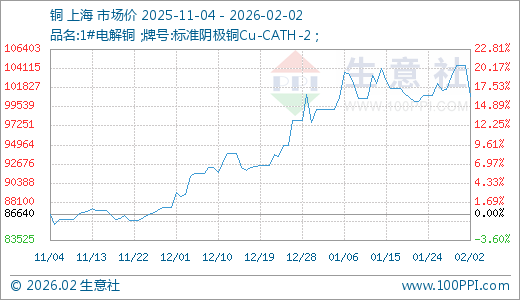
02月02日铜100853.33元/吨 60天上涨10.57%
Xin Lang Cai Jing· 2026-02-03 06:33
Group 1 - The latest copper price as of February 2 is 100,853.33 yuan per ton, reflecting a 10.57% increase over the last 60 days [2][5] - Relevant producers in the copper industry include companies such as Zhongjin Lingnan, Xinye Silver Tin, Tongling Nonferrous Metals, and Jiangxi Copper among others [2][5] Group 2 - Cyclical stocks refer to publicly listed companies in raw material production, whose profits are significantly affected by fluctuations in raw material prices [3][6] - Utilizing price fluctuation data from raw materials to identify buying signals for cyclical stocks is an important investment strategy [3][6]
金属概念午后爆发,湖南黄金涨停,有色金属ETF基金(516650)涨超5.7%
Sou Hu Cai Jing· 2026-02-03 06:32
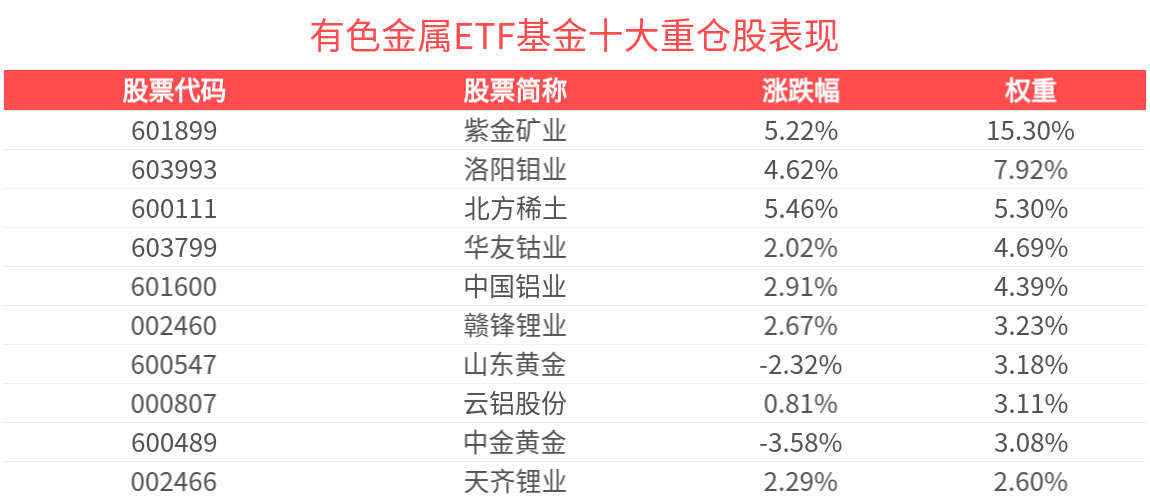
Core Viewpoint - The metal sector is experiencing a resurgence, with significant gains in various metal ETFs and stocks, indicating a potential shift in market sentiment and logic restructuring [1] Group 1: Market Performance - As of February 3, the non-ferrous metal ETF (516650) surged by 5.71%, with notable stocks like Hunan Gold hitting the daily limit and others like Zhong Rare Earth and Shenghe Resources rising by 8.77% and 7.23% respectively [1] - The trading volume for the non-ferrous metal ETF reached 50.03 billion yuan, with a turnover rate of 23.26%, reflecting active market participation [1] Group 2: Influencing Factors - The market is gradually stabilizing from extreme sentiments, suggesting a potential restructuring phase for the metal sector [1] - Central bank gold purchases and the increase in gold ETF holdings are expected to support gold prices [1] - Basic metals are likely to face macroeconomic adjustments, but ongoing narratives around AI and supply disruptions, particularly in copper, are expected to provide price support [1] Group 3: Sector Opportunities - Metals such as aluminum (lightweight), tin ("computing metal"), and lithium carbonate (energy storage and power batteries) are anticipated to benefit from the ongoing green industry and technological trends [1] - The CSI Non-ferrous Metal Industry Theme Index (000811) has its top ten weighted stocks, including Zijin Mining and Luoyang Molybdenum, accounting for 51.85% of the index [1]





湖南黄金触及涨停,南方基金旗下有色金属ETF(512400)大涨超5%,有色极端情绪释放,后续行情备受关注
Xin Lang Cai Jing· 2026-02-03 06:24
Core Viewpoint - The recent surge in the non-ferrous metals sector, particularly driven by precious metals, has led to a strong market performance, but a short-term correction is anticipated due to market sentiment reaching a peak [1][2]. Group 1: Market Performance - The Southern Fund's non-ferrous metals ETF (512400) rose by 5.13%, with a turnover of 29.53 billion yuan and a trading volume of 7.65% [1]. - Key stocks in the index, such as Hunan Gold, rose by 9.97%, while other stocks like Zhong Rare Metals and Shenghe Resources increased by 7.73% and 6.65%, respectively [1]. Group 2: Market Drivers - The strong performance since late December is primarily attributed to the acceleration in the precious metals sector, particularly the volatility of silver at historical highs, which has significantly influenced the risk appetite across the sector [1]. - The first phase of the commodity bull market may be nearing its end, but the fundamental basis for the next phase remains solid, particularly for copper and aluminum, which have favorable supply-demand dynamics [1]. Group 3: Future Outlook - Short-term opportunities may require waiting for clearer signals post-holiday, with a focus on whether gold prices stabilize at key support levels and the overall valuation recovery of the sector [2]. - Investors with strong trading capabilities may consider seizing institutional opportunities, while those with lower risk tolerance should gradually position themselves for potential post-holiday market movements [2]. Group 4: Index Composition - The CSI Shenwan Non-Ferrous Metals Index includes 50 listed companies to reflect the overall performance of the non-ferrous metals sector in the Shanghai and Shenzhen markets [2]. - The top ten weighted stocks in the index include Zijin Mining, Luoyang Molybdenum, Northern Rare Earth, and China Aluminum, among others [2].
有色ETF鹏华(159880)涨超4%,机构称短期调整不影响基本面格局
Xin Lang Cai Jing· 2026-02-03 06:17
Group 1 - The core viewpoint of the articles highlights the recovery of precious metals, particularly gold, which has seen a price increase of over 3%, returning to the $4,800 level [1] - Concerns regarding Kevin Warsh's potential interest rate cuts and the emphasis on monetary discipline by the Federal Reserve may lead to a strong dollar, impacting the long-term logic for gold price increases [1] - The market is currently pricing in two interest rate cuts by the Federal Reserve in 2026, influenced by Warsh's more dovish stance and the challenges of large-scale balance sheet reduction in the short term [1] - The demand for gold assets is increasing due to regional political instability, and despite recent price surges, liquidity easing by the Federal Reserve and escalating global conflicts are expected to support further gold price increases [1] Group 2 - The Zhongguo Securities Nonferrous Metals Industry Index (399395) has risen by 1.43%, with notable increases in stocks such as Hunan Gold (up 9.97%) and Dongyangguang (up 8.62%) [1] - The Penghua Nonferrous ETF closely tracks the Zhongguo Securities Nonferrous Metals Industry Index, which includes 50 prominent securities in the nonferrous metals sector, reflecting the overall performance of listed companies in this industry [2] - As of January 30, 2026, the top ten weighted stocks in the Zhongguo Securities Nonferrous Metals Industry Index account for 49.87% of the index, including companies like Zijin Mining and China Aluminum [2]
工业金属基本面韧性凸显,工业有色ETF万家(560860)强势反弹,午后上涨4.15%
Xin Lang Cai Jing· 2026-02-03 06:13
Group 1 - The industrial metal sector is experiencing a strong performance, with the industrial non-ferrous ETF Wan Jia (560860) rising by 4.15% and the CSI Industrial Non-Ferrous Metal Theme Index (H11059) component stocks showing significant gains, including Dongyang Sunshine up by 8.65% and Shenghe Resources up by 6.86% [1] - Recent industrial metal prices have shown a trend of rising and then retreating, but the fundamental support remains intact. Dongwu Securities noted a 5.74% increase in the industrial metal sector last week, despite a pullback in copper and aluminum prices due to unexpected U.S. inflation data and market sentiment shifts [1] - Supply-side pressures continue, with imported copper concentrate treatment charges (TC) dropping to -49.5 USD/ton, and Southern Copper Corporation forecasting a decline in copper production to 911,400 tons in 2026 [1] Group 2 - The CSI Industrial Non-Ferrous Metal Theme Index (H11059) top ten weighted stocks include Luoyang Molybdenum, Northern Rare Earth, and China Aluminum, accounting for a total of 55.71% of the index [2] - The industrial non-ferrous ETF Wan Jia (560860) closely tracks the CSI Industrial Non-Ferrous Metal Theme Index, covering strategic resources such as copper, aluminum, and rare earths, with off-market investors able to access it through linked funds [2]
有色金属ETF(512400)开盘涨3.99%,重仓股紫金矿业涨3.36%,洛阳钼业涨3.12%
Xin Lang Cai Jing· 2026-02-03 06:12
Core Viewpoint - The article highlights the performance of the Nonferrous Metals ETF (512400), which opened with a gain of 3.99% at 2.189 yuan, indicating a positive trend in the nonferrous metals sector [1] Group 1: ETF Performance - The Nonferrous Metals ETF (512400) opened at 2.189 yuan, reflecting a 3.99% increase [1] - The ETF's performance benchmark is the CSI Shenwan Nonferrous Metals Index return rate [1] - Since its establishment on August 3, 2017, the ETF has achieved a return of 123.28%, with a recent one-month return of 13.45% [1] Group 2: Major Holdings Performance - Major holdings in the ETF include Zijin Mining, which rose by 3.36%, and Luoyang Molybdenum, which increased by 3.12% [1] - Other notable performers include Northern Rare Earth (+2.41%), Huayou Cobalt (+2.33%), and China Aluminum (+2.99%) [1] - Conversely, Shandong Gold experienced a decline of 7.33%, and Zhongjin Gold fell by 8.16% [1]
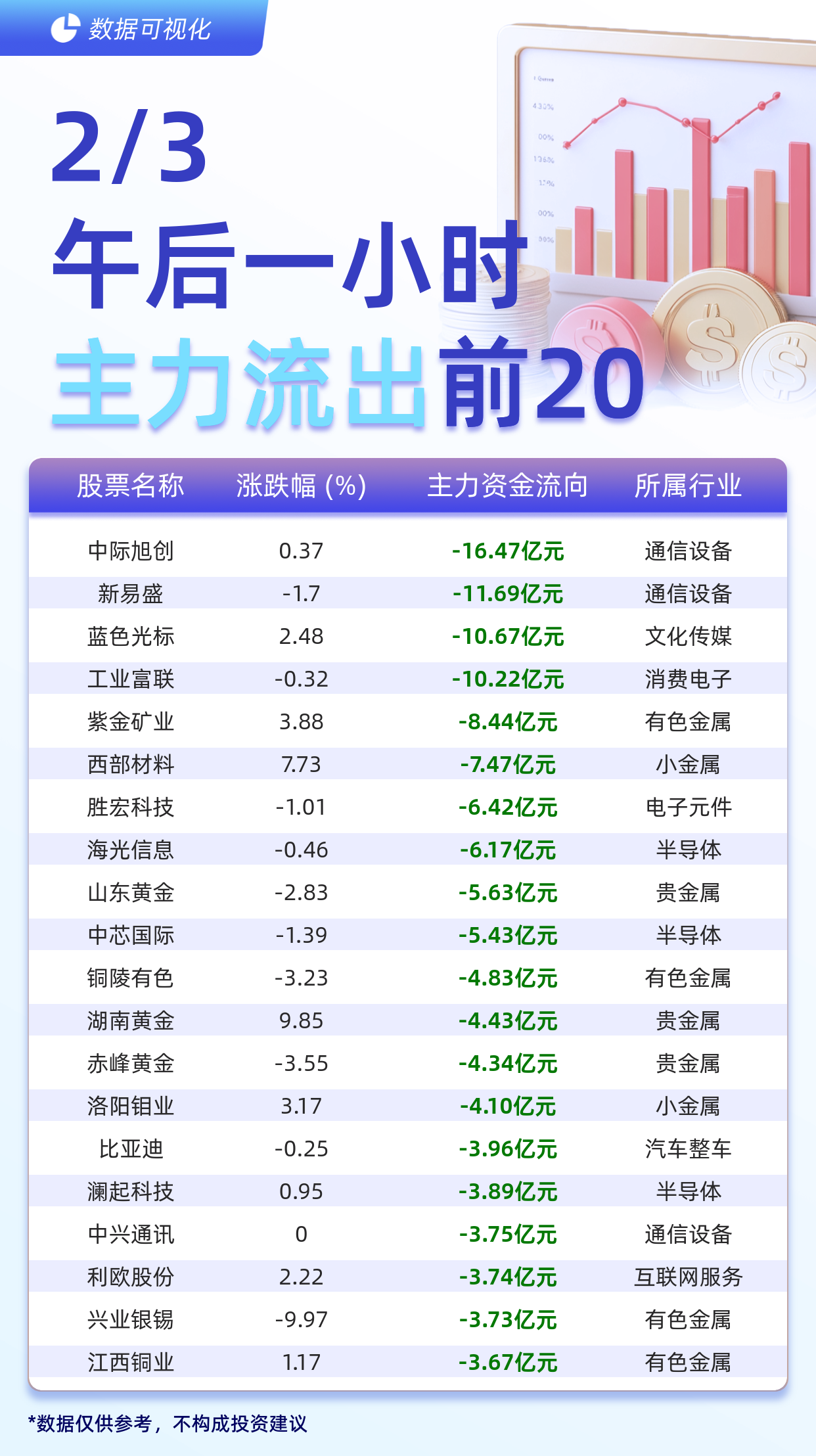
主力个股资金流出前20:中际旭创流出16.47亿元、新易盛流出11.69亿元
Jin Rong Jie· 2026-02-03 06:12
Core Viewpoint - The data indicates significant outflows of capital from various stocks, with notable amounts leaving the communication equipment and precious metals sectors [1][2][3] Group 1: Stock Performance and Capital Outflow - Zhongji Xuchuang experienced a capital outflow of 1.647 billion, with a slight increase in stock price of 0.37% [2] - Xinyi Sheng saw a capital outflow of 1.169 billion, with a decline in stock price of 1.7% [2] - BlueFocus Media had a capital outflow of 1.067 billion, with a stock price increase of 2.48% [2] - Industrial Fulian faced a capital outflow of 1.022 billion, with a decrease in stock price of 0.32% [2] - Zijin Mining reported a capital outflow of 0.844 billion, with a stock price increase of 3.88% [2] - Western Materials had a capital outflow of 0.747 billion, with a notable stock price increase of 7.73% [2] Group 2: Sector Analysis - The communication equipment sector is facing significant capital outflows, with Zhongji Xuchuang and Xinyi Sheng leading the outflows [1][2] - The precious metals sector, including companies like Shandong Gold and Zijin Mining, is also experiencing notable capital outflows [1][3] - The automotive sector, represented by BYD, has a capital outflow of 0.396 billion, with a slight decrease in stock price of 0.25% [3]