出行

Search documents
全省新就业形态劳动者集中入会活动举行
Liao Ning Ri Bao· 2025-07-30 01:04
Core Points - The "Flowing Warm New" event for new employment form workers was held in Shenyang, organized by the provincial federation of trade unions [1] - Over 200 new employment form workers from platform companies like Meituan, SF Express, Didi, and Ele.me joined the trade union [1] - A cooperation agreement was signed to boost cultural and tourism consumption, representing a collaborative effort for high-quality industrial development [1] Group 1 - The event featured various services such as a mobile sports event, mobile supermarket, and mobile stage to support new employment form workers [1] - The provincial, municipal, and district trade unions provided startup funds to support the newly established industry chain unions [1] - The "Flowing Warm New" brand was created to address the unique characteristics and needs of the mobile and dispersed new employment form worker group [1] Group 2 - Since last year, over 150 activities have been conducted under the "Flowing Warm New" initiative, focusing on assistance, health care, and cultural activities for workers [1]
“苏超”前六轮线下营收近380亿元
Xin Hua Ri Bao· 2025-07-29 23:54
Group 1 - The report highlights that the Jiangsu province's service revenue from five monitored scenarios related to the "Su Chao" events reached nearly 38 billion yuan, showing a year-on-year growth of 42.7% [1] - The report indicates that the service revenue from tourism, travel, dining, accommodation, and sports during the first six rounds of the "Su Chao" matches totaled 37.96 billion yuan, with significant contributions from out-of-province visitors [1] - The Jiangsu Provincial People's Congress Finance and Economic Committee acknowledged the positive impact of the "Su Chao" events on economic vitality and recommended the creation of more integrated experiences combining viewing, dining, and entertainment [1] Group 2 - The overall economic performance of Jiangsu province in the first half of the year was stable and showed progress, achieving a GDP of nearly 6.7 trillion yuan, which is over 10% of the national total, with a year-on-year growth of 5.7% [2] - Out of 41 planned indicators set at the beginning of the year, 22 indicators are progressing smoothly, with seven indicators, including GDP and revenue from the productive service industry, ahead of schedule [2] - The province's foreign trade import and export total and the proportion of high-tech industry output to the total industrial output have met or nearly met the scheduled progress requirements [2]
亚马逊拓展当日达、次日达;萝卜快跑与Uber合作丨出海周报
2 1 Shi Ji Jing Ji Bao Dao· 2025-07-21 03:18
Trade and Economic Data - In the first half of the year, China's goods trade import and export reached 21.79 trillion yuan, a year-on-year increase of 2.9%, with exports at 13 trillion yuan (up 7.2%) and imports at 8.79 trillion yuan (down 2.7%) [1] - China's industrial robot exports grew by 61.5% in the first half of the year, with significant increases in lithium batteries and wind turbine exports, both exceeding 20% growth [3] - China will implement zero tariffs for 53 African countries that have established diplomatic relations, leading to double-digit growth in imports from these nations in the first half of the year [4] Corporate Developments - Amazon plans to expand same-day and next-day delivery services to over 4,000 small cities and rural areas in the U.S. by the end of 2025, with a 30% increase in the number of items delivered within these timeframes compared to the previous year [5] - Loongrun has formed a strategic partnership with Uber to deploy thousands of autonomous vehicles globally, enhancing the availability of self-driving services [6] - TEMU aims to have 50% of its orders fulfilled by local merchants in the UK by the end of 2025, currently attracting 22 million users [7][8] - Cainiao's Hong Kong supply chain center has opened to global brands and merchants, providing integrated logistics services [9] Financial Performance - Cross-Border Communication expects a net profit loss of 4 to 7.5 million yuan for the first half of 2025, attributed to reduced promotional investments in its self-operated export platform [10] - Pop Mart anticipates a revenue increase of no less than 200% and a profit growth of no less than 350% for the six months ending June 30, 2025, compared to the same period last year [11] Market Expansion - Cha Bai Dao has opened its first two stores in Singapore, offering 18 beverage options priced between 2.5 to 6.9 Singapore dollars [12] - Jianlibao has established a regional headquarters in Hong Kong, planning to expand into Southeast Asian markets, including Indonesia, Malaysia, and Vietnam, while also targeting Australia, Canada, and the U.S. [13]
行业比较周跟踪:A股估值及行业中观景气跟踪周报-20250720
Shenwan Hongyuan Securities· 2025-07-20 15:29
Valuation Summary - The overall PE of the A-share market is 19.8 times, at the historical 79th percentile [2][5] - The PE of the Shanghai 50 Index is 11.4 times, at the historical 59th percentile [2][5] - The PE of the ChiNext Index is 33.9 times, at the historical 18th percentile [2][5] - The PE of the Science and Technology Innovation 50 Index is 139.8 times, at the historical 99th percentile [2][5] Industry Valuation Comparison - Industries with PE valuations above the historical 85th percentile include Real Estate, Steel, Power Equipment (Photovoltaic Equipment), National Defense, and Aviation [2][6] - The Passenger Vehicle industry has a PB valuation above the historical 85th percentile [2][6] - The Shipping and Port industry has both PE and PB valuations below the historical 15th percentile [2][6] Industry Midstream Prosperity Tracking New Energy - The price of polysilicon futures has risen by 8.2% to above 45,000 yuan, indicating a recovery in the market [2] - Battery cell prices increased by 7.7%, while prices for silicon wafers remained stable [2] Real Estate Chain - The price of rebar increased by 1.0%, while iron ore prices rose by 3.2% [2] - The national sales area of commercial housing decreased by 3.5% year-on-year in the first half of 2025 [3] Consumption - The average price of live pigs decreased by 3.6%, while the wholesale price of pork increased by 0.3% [3] - Retail sales grew by 5.0% year-on-year in the first half of 2025, with June's growth down to 4.8% [3] Midstream Manufacturing - Manufacturing investment grew by 7.5% year-on-year in the first half of 2025, while narrow infrastructure investment grew by 4.6% [3] - The production of industrial robots increased by 35.6% year-on-year in the first half of 2025 [3] Technology TMT - The production of integrated circuits increased by 8.7% year-on-year in the first half of 2025 [3] Cyclicals - The price of Brent crude oil futures fell by 2.0% to $69.23 per barrel [3] - The Baltic Dry Index rose by 23.4%, reaching its highest level since September 2024 [3]
高盛:上调中国自动驾驶出租车市场规模,看好云计算板块,荐买入滴滴、安踏、京东健康等个股
Zhi Tong Cai Jing· 2025-07-17 14:02
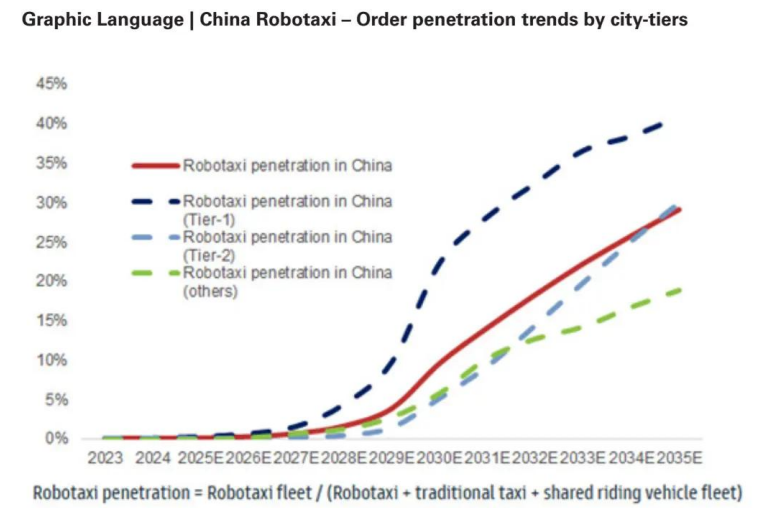
Economic Overview - China's GDP growth in Q2 was 5.2%, slightly above market consensus, with mixed economic activity data in June [1] - The average GDP growth for the first half of the year was 5.3%, leading to an upward adjustment of GDP growth forecasts for 2025/26 to 4.7% and 3.9% respectively [1] Focus Stocks - Didi received a "Buy" rating, with expectations of strong growth in its mobility business and advancements in autonomous driving, projecting a 12-month target price of $7.20 [4] - Anta's retail sales for 2025 are expected to align with forecasts, with a positive outlook for the second half of the year, maintaining a target price of HKD 117 [11] - MakeMy Trip is viewed as an attractive buy opportunity, with expectations of over 20% revenue growth starting in September, and a target price of $123 [12] - JD Health is favored over Alibaba Health due to higher sales growth trends and a target price of HKD 45.80, with a focus on its capital allocation strategy [13] Industry Focus - The market size for China's autonomous taxi sector is projected to reach $14 billion by 2030 and $61 billion by 2035, reflecting a 20% and 31% increase from previous estimates [5] - Improvements in chip supply are expected to positively impact China's cloud computing and data center sectors, with a cautious outlook on capital expenditures for 2025 [8]


抖音投亿级补贴发力连锁酒店;滴滴与海底捞实现会籍互通
Mei Ri Jing Ji Xin Wen· 2025-07-15 23:34
Group 1: Consumer Market Trends - The total retail sales of consumer goods reached 24,545.8 billion yuan in the first half of the year, with a year-on-year growth of 5.0%, accelerating by 0.4 percentage points compared to the first quarter [1] - Sales of basic living goods and certain upgraded consumer goods showed strong growth, with retail sales of home appliances and audio-visual equipment, cultural and office supplies, communication equipment, and furniture increasing by 30.7%, 25.4%, 24.1%, and 22.9% respectively [1] - The rapid growth of upgraded consumer goods reflects consumers' pursuit of quality of life and increased purchasing power, supported by the "old-for-new" policy [1] Group 2: Local Life Services - Douyin announced a significant platform subsidy to support chain brand hotels through live streaming and promotional activities, with discounts starting at 60% for hotel bookings [2] - This subsidy strategy is expected to enhance Douyin's market share in the local life service sector, particularly in hotel reservations, by offering competitive prices and services [2] Group 3: Strategic Collaborations - JD Technology signed a strategic cooperation agreement with Whale Robot Technology to promote the "AI + education robot" industry through product and technology collaboration [3] - The partnership aims to leverage both companies' strengths to enhance product competitiveness and accelerate the development of the education robot market [3] - Didi announced a strategic cooperation with Haidilao, enabling mutual membership benefits and exploring new value-added services in the "transportation + dining" scenario [4] - The membership integration is expected to enhance market competitiveness and user engagement for both Didi and Haidilao [4]

作为全国首批7个试点省份之一 四川扩大新就业形态人员职业伤害保障试点范围
Si Chuan Ri Bao· 2025-07-15 00:26
Group 1 - The core viewpoint of the news is the expansion of the occupational injury protection pilot program for new employment forms in Sichuan Province, which will include more platform companies and provide safety guarantees for workers in the gig economy starting from July 1, 2025 [1][2] - The new pilot program will merge the original food delivery and instant delivery industries into a new instant delivery industry, adding four major platform companies: Didi Chuxing, SF Express, Didi Freight, and Manbang [1] - By 2026, the pilot program will encompass platform companies in the ride-hailing, instant delivery, and same-city freight industries, with further expansions planned for 2027 to include other high-risk industries [1] Group 2 - Since the pilot program for occupational injury protection for new employment forms began in July 2022, Sichuan has been one of the first seven provinces to implement this initiative, focusing on the rights and interests of gig economy workers [2] - As of June 2023, over 2 million people have been covered by the insurance program in Sichuan, with more than 15,000 claims for benefits approved [2]
中国宏观周报(2025年7月第2周)-20250714
Ping An Securities· 2025-07-14 06:12
Industrial Sector - China's cement clinker capacity utilization rate increased by 1.3% this week[10] - The operating rate of petroleum asphalt rose by 3.2% this week[14] - The operating rate of automotive semi-steel tires increased by 3.6% this week[18] Real Estate - New home sales area growth rate increased by 0.7 percentage points year-on-year compared to last week[2] - The second-hand housing listing price index decreased by 0.29% in the last four weeks as of June 30[23] Domestic Demand - Retail sales of passenger cars from July 1-6 reached 238,000 units, a year-on-year increase of 1%[29] - The retail sales of major home appliances grew by 10.9% year-on-year in the last four weeks as of June 27[29] - The volume of postal express collection increased by 16.1% year-on-year as of July 6[31] External Demand - Port cargo throughput increased by 4.1% year-on-year as of July 6, up 3.4 percentage points from last week[34] - South Korea's export value increased by 9.5% year-on-year in the first ten days of July, up 5.2 percentage points from June[34]
我省启动新就业形态人员职业伤害保障试点
Da Zhong Ri Bao· 2025-07-11 00:59
Core Points - The pilot program for occupational injury protection for new employment forms will start on July 1, covering 11 platform companies in the ride-hailing, instant delivery, and local freight industries [1][2] - The payment standards for occupational injury protection fees are set at 0.01 yuan per order for the ride-hailing industry, 0.07 yuan and 0.25 yuan per order for the instant delivery industry, and 0.18 yuan per order for the local freight industry [1] - By 2027, the payment standards for platform companies will be subject to adjustments based on regulations [1] Industry Implementation - New employment personnel can report occupational injuries through a mobile app's "one-click reporting" feature, and claims for benefits must be submitted within a specified timeframe [2] - Medical expenses, rehabilitation costs, and other related expenses for occupational injuries will be covered by the work injury insurance fund [2] - Four commercial insurance companies have been selected to assist in the management of occupational injury claims and related processes [2] Current Status - Since the pilot program's launch, 595,000 new employment personnel have been included in the protection scheme, ensuring their legal rights are safeguarded [2]

9家消费公司拿到新钱;塔斯汀发生重大股权变动;抖音美妆类目6月GMV超200亿元|创投大视野
36氪未来消费· 2025-07-05 07:30
Investment Highlights - "Super Vitality Factory" received strategic investment from Yuetwen Group, acquiring a 10% stake in the company, which is known for its plush toy products and original IPs [3] - "Pengbei Station," an intelligent beverage retail brand, completed a financing round of 50 million yuan, aiming to become the leading brand in the smart beverage machine sector [5] - "Anya Enya," a sanitary napkin brand, secured several million dollars in seed funding and expects to double its revenue this year, with a projected revenue of over 10 million dollars next year [6] - "Zhijuxinlian" completed a Pre-A round financing of several million yuan, focusing on 3D spatial display technology applicable across various industries [7] - "Laimou Technology," a smart lawn mower manufacturer, achieved significant sales of 2.4 million dollars within 20 days of launching its product, with total sales expected to reach 10 million dollars by mid-2025 [8] - "Wandian Tongchuang" completed an angel round financing of 10 million yuan, focusing on digital e-commerce services [9][10] - "Yixi Decoration" completed an angel round+ financing of 10 million yuan, offering high-end decoration design services [11] - "Jingyue Hotel" completed several million yuan in financing, targeting the esports hotel market with a unique business model [12] - "Pinba Travel" completed a Pre-A round financing in the millions, focusing on AI-driven customized transportation services [13] Company Developments - "Tasting" experienced a significant equity change, with a new controlling shareholder potentially preparing for an IPO, having expanded to 9,600 stores [14][15] - "Wenxian DOCUMENTS," a Chinese fragrance brand, entered a partnership with Sephora, launching exclusive products to expand its market reach [16][19] - "Duo Wei," a new player in the sanitary napkin market, reported total sales exceeding 100 million yuan within a month of launch, indicating strong market validation [20] - "Three Duns Half" collaborated with Disney's "Zootopia" to launch a new coffee line, showcasing innovative product development [21] - "Mathematician Coffee" partnered with JOYCORN to introduce a new product line, emphasizing seasonal marketing strategies [22][23] - "Xingqi Ling" launched new healthy snack products on Dingdong Maicai, reflecting the trend towards clean ingredient sourcing [24][25] Market Insights - Douyin's beauty category generated over 20 billion yuan in GMV in June 2025, with skincare products accounting for 66.4% of the total [26] - Over 50% of gold investors are now from the post-90s generation, indicating a shift towards socialized investment trends among younger demographics [27]