
通讯

Search documents
关税博弈反转不断,三大高息港股板块受影响较少
Quan Jing Wang· 2025-06-09 11:43
Group 1 - The core viewpoint of the articles highlights the optimistic market sentiment driven by trade negotiations between China and the U.S., despite recent uncertainties regarding tariff commitments and export controls on rare earths [1] - The Hang Seng Index experienced a cumulative monthly increase of 5.29% in May, with a further rise of 2.33% in the first week of June, indicating a rebound in both A-shares and Hong Kong stocks [1] - The potential for policy stimulus in China is noted, as fiscal policies show signs of marginal easing, and the central bank has lowered the 7-day reverse repurchase rate to support market liquidity [1] Group 2 - The banking sector is highlighted for its strong performance, with analysts suggesting that the valuation levels still have room for growth, supported by high dividend yields and defensive characteristics amid tariff-related market volatility [2] - The energy sector has also shown positive performance, with international oil prices gradually recovering, although they are expected to remain within the range of 60-65 yuan in the short term due to fundamental constraints [2] - The telecommunications sector has gained attention due to the satisfactory first-quarter performance of major operators and optimistic long-term growth prospects for cloud services, leading to an overall increase in valuations in May [2] Group 3 - The Ping An Hong Kong Stock Connect Dividend Select Mixed Fund was established on March 26, 2024, and has achieved a net value increase exceeding 30 times within its first year, with the current net value of Class A shares at 1.2479 yuan [3] - The investment advisory team for the fund has over 12 years of practical experience in Hong Kong stock dividends, focusing on value investment and strategically allocating to high-growth sectors while avoiding structurally declining industries [3] - In the current uncertain domestic and international environment, investors are advised to consider a "dividend + technology barbell strategy," which involves allocating to both dividend assets and technology growth assets to achieve stable dividend income while capturing growth opportunities in the tech sector [3]
纷扰于外,求诸于内——策略周报 0607
Orient Securities· 2025-06-08 13:30
Market Performance - The A-share market experienced a rebound with the Shanghai Composite Index, CSI 300, CSI 500, and ChiNext Index rising by 1.13%, 0.88%, 1.60%, and 2.32% respectively during the week of June 2-6[5] - The PE (TTM) for CSI 300 is currently at 12.56 times, with a risk premium of 6.31%, which is above one standard deviation[5] - The PE (TTM) for ChiNext is at 30.92, below one negative standard deviation[5] Economic Indicators - The OECD has downgraded the U.S. economic growth forecast for 2025 from 2.2% to 1.6% and for 2026 to 1.5% due to tariff policies and increased uncertainty[5] - The global growth forecast for 2025 has been reduced from 3.10% to 2.9%[5] - The U.S. non-farm payrolls increased by 139,000 in May, above the market expectation of 130,000, while the unemployment rate remained at 4.2% for the third consecutive month[5] Policy Developments - The People's Bank of China conducted a 100 billion yuan reverse repo operation to maintain liquidity in the banking system[5] - The Shanghai Stock Exchange plans to encourage listed companies to increase dividend payouts and enhance market value management tools[5] Investment Strategy - The report suggests focusing on value dividend sectors and domestically supported technology industries such as AI, semiconductors, and defense[5] - The market is expected to maintain a wide fluctuation and structural trend, with short-term upward momentum lacking due to weak domestic economic fundamentals[5]
市销率超过70!如此妖股结局都不太好,Palantir能例外吗?
Hua Er Jie Jian Wen· 2025-06-06 12:34
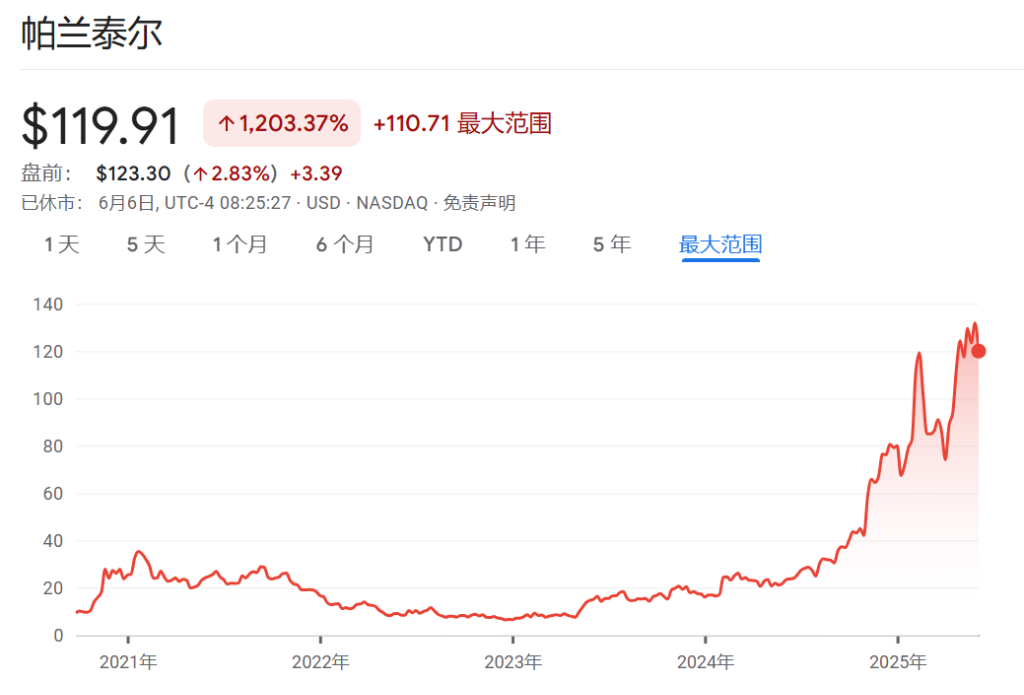
Core Insights - Palantir is at a critical valuation juncture, with a market capitalization of $314 billion and a price-to-sales ratio of 79.9, making it one of the highest-valued large-cap stocks in U.S. history [1][4] - The company's static price-to-earnings ratio is 565, while the dynamic ratio stands at 228, indicating extreme valuation levels [1] - Historical data suggests that a price-to-sales ratio exceeding 70 is often indicative of either a transformative tech giant or an impending bubble [10] Valuation Context - Trivariate Research's report highlights that only six U.S. companies have previously surpassed Palantir's current price-to-sales ratio, including MicroStrategy and Moderna [4] - The majority of companies on this "death list" faced dire outcomes, with Comverse Technology going bankrupt and Moderna's stock dropping 94% from its pandemic peak [5] Historical Precedents - Extremely high forward valuations have only been seen during the internet bubble and the pandemic's "free money" era [11] - Stocks reaching a 30 times price-to-sales ratio have historically underperformed the S&P 500 by an average of 22.5 percentage points in the following year [12] Market Dynamics - The upcoming rebalancing of the S&P 500 index is expected to increase Palantir's weight, prompting active managers to reassess its valuation [13] - Historical data indicates that no company can sustain growth rates sufficient to justify such extreme valuations, with many companies having faster growth expectations than Palantir [13]

【环球财经】2025年4月澳大利亚通胀率继续保持在2.4%不变
Xin Hua Cai Jing· 2025-05-28 02:19
Group 1 - The core consumer price index (CPI) in Australia for April 2025 shows a year-on-year increase of 2.4%, slightly above the market expectation of 2.3% [1] - The monthly inflation rate, excluding volatile items like fruits, vegetables, and automotive fuel, rose to 2.8% in April from 2.6% in March [1] - The trimmed mean inflation rate, a key indicator of core inflation, increased from 2.7% to 2.8%, remaining within the Reserve Bank of Australia's target range of 2-3% [1][2] Group 2 - Specific price changes in April include a 3.1% year-on-year increase in food and non-alcoholic beverages, down from 3.4% in March, and a decrease in tobacco and alcohol prices from 6.7% to 5.7% [1] - Housing prices increased from 1.8% to 2.2%, with rental prices decreasing from 5.2% to 5% and new housing prices rising from 1% to 1.2% [1] - Electricity prices shifted from a decline of 9.6% to a decline of 6.5%, while furniture and household equipment prices rose from 0.6% to 1% [2]
“关税战”后全球贸易再平衡:要给银行以缓冲|2025五道口金融论坛
Xin Lang Cai Jing· 2025-05-19 12:24
Group 1: Impact of Tariff Policies - The tariff policies introduced by the Trump administration have raised significant concerns regarding the cost-benefit balance in trade and investment, with new factors such as geopolitical and ideological considerations now influencing decisions [2][4] - The uncertainty surrounding these policies is expected to hinder the return of manufacturing to the U.S., as American competitiveness in labor-intensive industries remains weak [2] - The global trade rebalancing is anticipated to lead to profound adjustments in the economic structures of major economies, necessitating a focus on internal economic adjustments to effectively address trade imbalances [4] Group 2: Global Economic Outlook - The International Monetary Fund (IMF) has revised its global economic growth forecast for 2025 down from 3.3% to 2.8%, with a projected growth of 3% for 2026, largely due to the impact of U.S. tariff measures and policy uncertainties [6] - Foreign Direct Investment (FDI) has been in a state of low growth or stagnation since the financial crisis, particularly exacerbated by trade protectionism and the pandemic, with a notable decline in investment data over the past three years [6][7] Group 3: Resilience of Chinese Enterprises - Chinese enterprises have shown remarkable resilience, with over $3 trillion in foreign direct investment stock from 2014 to 2024, indicating strong participation in international markets [8][10] - The shift from labor-intensive industries to more technologically advanced enterprises has enhanced the investment capabilities of Chinese firms, contributing to local industrialization in host countries [10] - Chinese companies are increasingly establishing industrial parks abroad, fostering clusters of enterprises and contributing to local infrastructure development, which enhances their global investment footprint [10][11] Group 4: Strategies for Companies - Companies are advised to develop "immunity" through compliance with legal regulations, which is essential in uncertain environments [12] - Resilience in supply chains and the ability to self-develop core components are critical for companies to navigate external changes effectively [12] - Emphasizing digital transformation and resource linkage capabilities will enable companies to quickly adapt and seize market opportunities [12]

净值持续创新高!平安港股通红利精选基金经理丁琳:持续关注具备较高安全边际的红利策略
Quan Jing Wang· 2025-05-15 05:15
平安港股通红利精选混合型基金于2024年3月26日成立,平安基金担任基金管理人,平安资管(香港) 担任投资顾问。投资顾问平安资管(香港)拥有超过12年港股红利投资实盘业绩,管理产品历经多轮周 期,经得住时间考验。其中,为该产品提供投资建议的投顾团队,投资风格为偏价值风格,适时配置景 气度较高的⾏业,规避结构性下滑的行业;同时通过集中持股和⻓期持股力争获得持续性收益,投资团 队建立的核心能力圈范围包括通讯服务、消费、科技、互联网、医药、金融、能源、公用事业、航运和 汽车等板块。 丁琳表示,在当前国内外形势依旧复杂的背景下,平安港股通红利精选混合基金凭借其精选的高分红资 产和相对稳健的红利投资策略,为投资者提供了一个兼具防御性和成长性的投资选择。无论是作为中长 期配置的工具,还是阶段性防御的选项,该基金都值得关注。 5月14日,平安港股通红利精选混合基金净值再次突破新高,A类份额最新净值达1.2350。值一提的是, 该产品自2024年3月26日成立一年多时间以来,净值创新高已超30次,市场表现获得认可。 根据该基金2025年一季报显示,平安港股通红利精选混合基金前十大重仓仍然集中在港股红利资产中基 本面稳定且高分 ...
摩根士丹利:中国的新兴前沿-投资于不断变化的趋势
摩根· 2025-05-14 05:24
Investment Rating - The report provides an "In-Line" investment rating for the Chinese industrial sector, indicating a balanced outlook on investment opportunities within the industry [10]. Core Insights - The report emphasizes the importance of investing in emerging industries in China that possess structural competitive advantages, particularly in the context of challenges such as debt, deflation, demographic changes, and global multipolarity [3][8]. - It identifies significant opportunities in advanced supply chains and manufacturing, highlighting the potential for growth in sectors such as machinery, automotive, new energy, semiconductors, aerospace, artificial intelligence, software, pharmaceuticals, humanoid robotics, and eVTOL [4][30]. - The report outlines a framework consisting of six key elements that support industry upgrades, which include R&D investment, talent development, capital influx, government policy support, market demand, and supply chain robustness [31][34]. Summary by Sections Industry Investment Rating - The report rates the Chinese industrial sector as "In-Line," suggesting a cautious but optimistic view on investment prospects [10]. Key Industry Opportunities - The report identifies 28 stocks that are well-positioned to benefit from the ongoing industrial upgrades and emerging trends in China, focusing on companies that are either upstream in the supply chain or are key enablers in sectors like automation and AI [4][42]. Six Key Elements Framework 1. **R&D Investment**: China’s R&D expenditure is primarily concentrated in manufacturing, with a notable increase in investment in technology and emerging industries [15][31]. 2. **Talent Pool**: China produces the largest number of engineering graduates globally, with a focus on strategic emerging fields such as AI and data science [31][32]. 3. **Capital Influx**: Significant capital has flowed into advanced manufacturing sectors, particularly semiconductors and machinery, with a total of approximately RMB 20 trillion from 2021 to 2024 [32][33]. 4. **Government Support**: The Chinese government has implemented various strategic initiatives to support key industries, including AI, semiconductors, and aerospace, enhancing the investment landscape [33][34]. 5. **Market Demand**: The report highlights a positive feedback loop between rising demand and innovation, particularly in consumer electronics, automotive, and electrical machinery [34]. 6. **Supply Chain Development**: The report discusses the importance of moving up the value chain, particularly in sectors with low localization rates and strong downstream demand [34][35]. Emerging Industry Focus - The report underscores the potential of artificial intelligence to drive significant economic value in China, projecting that AI could contribute RMB 11 trillion to the labor value by 2035, representing 5.5% of nominal GDP [37][38]. - It also notes the expected growth in sectors such as autonomous vehicles and industrial AI applications, which are anticipated to enhance productivity and operational efficiency across various industries [39].
权益市场反弹行情启动,FOF基金热度延续,科技赛道再成焦点
Mei Ri Jing Ji Xin Wen· 2025-05-12 07:44
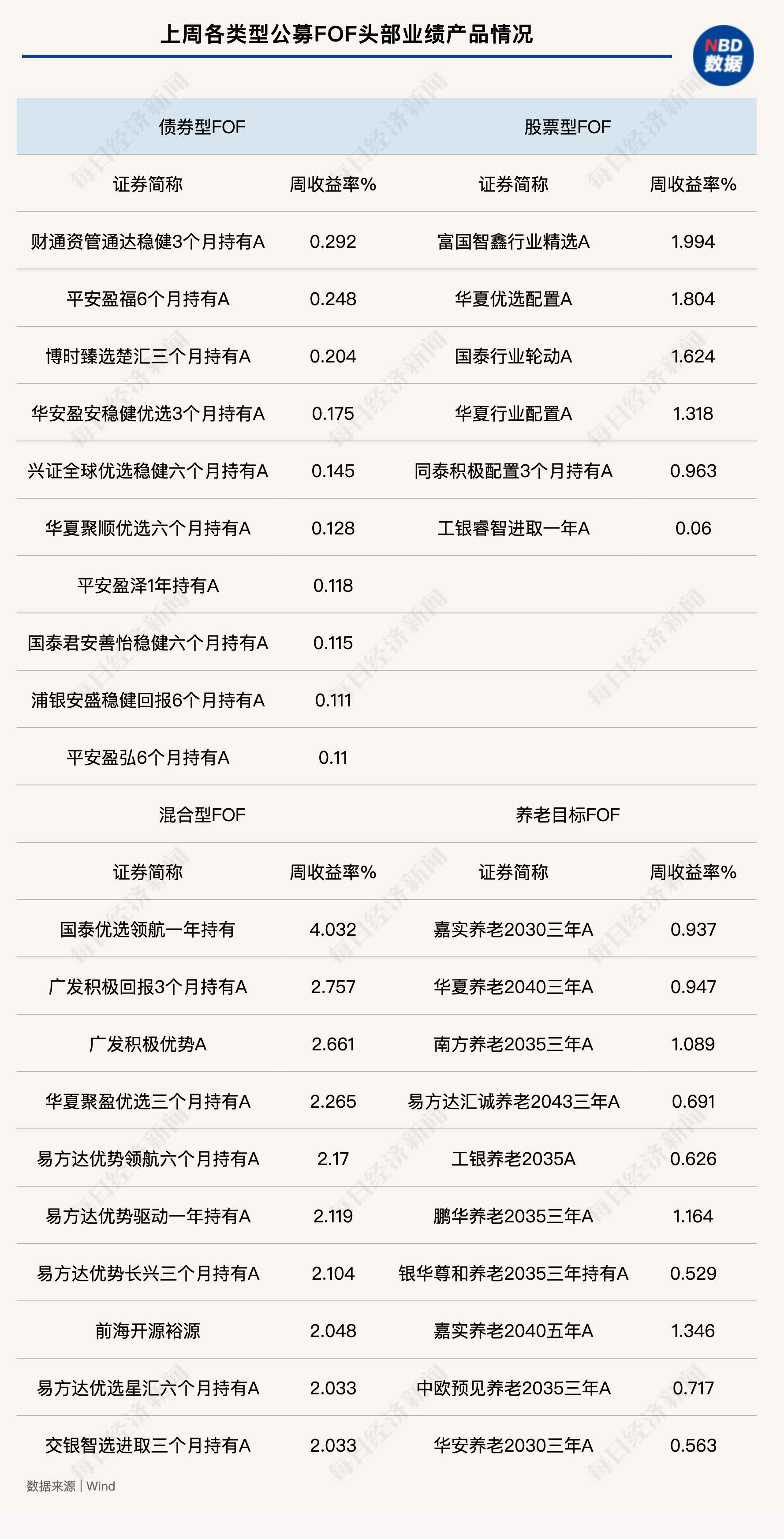
Group 1 - The equity market rebounded after the "May Day" holiday, influenced by the "interest rate cut and reserve requirement ratio reduction" events, leading to positive performance across equity assets [1][2] - Major indices such as the Shanghai Composite Index, CSI 300, and Wind All A Index saw increases of 1.92%, 2.00%, and 2.32% respectively during the week of May 5 to May 11 [2] - The overall performance of public FOF funds was strong, with all stock-type FOF funds achieving positive returns during the week [2] Group 2 - In Q1, a total of 16 new FOF funds were launched, with 14 being ordinary FOFs and 2 being pension-targeted FOFs, marking a quarter-on-quarter increase of 166.67% [2] - The total fundraising scale for newly launched FOF funds reached 14.147 billion yuan, an increase of 13.169 billion yuan from the previous quarter, representing a quarter-on-quarter growth of 1346.12% [2] - The strong sales performance of FOF funds is attributed to favorable market conditions and good performance, with the Guotai Fund's "Guotai Preferred Navigation" achieving a weekly return of 4.03%, leading all FOF funds [2][5] Group 3 - The "interest rate cut and reserve requirement ratio reduction" is expected to promote technology growth stocks, as lower financing costs will aid in technology research and development and capacity expansion [7] - The defense and communications sectors saw significant increases of 6.44% and 5.43% respectively, driven by sub-sectors such as weaponry and communication equipment manufacturing [7] - Fund managers are increasingly focusing on the AI industry, which is undergoing a new round of transformation, emphasizing the importance of commercial viability in investment selection [7][8] Group 4 - The AI industry is entering a new phase characterized by increased penetration rates and cost optimization, with a shift in demand from training to inference computing power [7] - Despite global leaders maintaining an edge in foundational models and ecosystem development, Chinese companies are rapidly catching up in engineering innovation and application scenarios [8] - Breakthroughs in models like DeepSeek indicate that as technology advances into the optimization phase, China's advantages in talent, data resources, and market demand will gradually be realized [8]
欣天科技(300615) - 2025年05月09日投资者关系活动记录表
2025-05-09 09:22
Group 1: Research and Development Investment - In 2024, the company invested 25.82 million yuan in technology research and development, resulting in 2 invention patents and 18 utility model patents [2][3]. Group 2: Business Growth and Financial Performance - In Q1 2025, the company achieved operating revenue of 79,499,368.25 yuan, a year-on-year increase of 98.45%, and a net profit attributable to shareholders of -3,779,585.78 yuan, an increase of 55.14% compared to the previous year [3][4]. - The company aims to stabilize its overseas market while aggressively expanding its domestic market and developing new customer applications [3]. Group 3: Strategic Focus and Market Expansion - The company plans to focus on its second main business—core components for new energy, which accounted for over 25% of its business by 2024 [3]. - The construction of overseas production bases in Hungary and Vietnam is a priority, with the goal of reducing losses and enhancing the overseas business framework [3]. Group 4: Cost Control Measures - The company has implemented several cost control measures, including locking in prices for key raw materials, centralized procurement, and optimizing production processes to improve efficiency [4]. Group 5: Future Profit Growth Drivers - Future profit growth will be driven by the demand for mobile data traffic in the telecommunications industry and the growth of the new energy business, which is expected to enhance profitability through economies of scale [5].

宏观日报:4月物流业景气上升-20250508
Hua Tai Qi Huo· 2025-05-08 03:09
Report Industry Investment Rating No relevant information provided. Core Viewpoints of the Report - In April, the sales of new energy vehicles increased. The estimated wholesale sales of new energy passenger vehicles by manufacturers nationwide in April were 1.14 million, a year - on - year increase of 42% and a month - on - month increase of 1%. The cumulative wholesale from January to April this year was estimated to be 4 million, a year - on - year increase of 42 [1]. - In the first quarter, under the support of a series of policies to expand domestic demand and promote consumption, large - scale light industrial enterprises achieved an operating income of 5.4 trillion yuan, a year - on - year increase of 4.8%, and a profit of over 300 billion yuan, a year - on - year increase of 1.4% [1]. - In April, the China Logistics Prosperity Index was 51.1%. The overall demand for logistics services maintained an expansion trend, with a significant recovery in the western region. The fixed - asset investment completion index reached a three - year high, and both railway and waterway investments maintained rapid growth [1]. - During the "May Day" holiday, consumption demand was strong. The sales revenue of national consumption - related industries increased by 15.2% year - on - year. Driven by the "trade - in" policy, the sales revenue of household appliances and audio - visual equipment increased by 167.5% year - on - year, communication equipment increased by 118% year - on - year, and furniture increased by 1.7 times year - on - year [1]. - The credit spreads of the pharmaceutical and chemical industries have recently declined slightly [3]. Summary According to Related Catalogs Industry Overview Upstream - Energy: International oil prices continued to fluctuate due to tariffs [2]. - Non - ferrous metals: The prices of copper, zinc, and nickel fluctuated due to tariffs [2]. - Building materials: The prices of cement and building materials continued to decline [2]. - Chemical industry: The prices of PTA and soda ash declined compared to the same period last week [2]. Midstream - Chemical industry: The operating rate of PTA recovered; the operating rate of PX declined recently; the operating rates of polyester and urea were at this year's high [2]. - Infrastructure: The operating rate of asphalt reached a three - year low [2]. Downstream - Real estate: The sales of commercial housing in first - and second - tier cities were the same as the same period last year, at a three - year low [2]. - Services: The number of international flights increased, while the number of domestic flights decreased compared to the same period [2]. Market Pricing - The credit spreads of the pharmaceutical and chemical industries have recently declined slightly [3]. Industry Credit Spread Tracking | Industry | Last Year's Same Period | One Quarter Ago | One Month Ago | Last Week | This Week | Quantile | | --- | --- | --- | --- | --- | --- | --- | | Agriculture, Forestry, Animal Husbandry, and Fishery | 69.91 | 82.75 | 79.77 | 76.10 | 77.76 | 9.80 | | Mining | 37.70 | 48.62 | 46.09 | 46.92 | 47.91 | 26.10 | | Chemical Industry | 68.63 | 69.46 | 66.11 | 62.01 | 63.09 | 3.30 | | Steel | 45.28 | 58.70 | 55.06 | 55.91 | 55.99 | 17.10 | | Non - ferrous Metals | 49.62 | 57.51 | 54.99 | 57.70 | 58.77 | 30.20 | | Electronics | 59.65 | 79.88 | 71.75 | 70.84 | 77.65 | 51.60 | | Automobile | 65.91 | 77.15 | 48.35 | 51.29 | 51.29 | 2.50 | | Household Appliances | 46.53 | 54.97 | 47.18 | 51.64 | 53.02 | 17.80 | | Food and Beverage | 44.33 | 44.75 | 44.82 | 45.90 | 45.51 | 14.70 | | Textile and Apparel | 51.60 | 63.87 | 52.58 | 54.15 | 55.00 | 12.90 | | Light Industry Manufacturing | 80.48 | 191.11 | 199.42 | 167.39 | 165.50 | 9.10 | | Pharmaceutical and Biological | 59.52 | 67.28 | 69.00 | 72.61 | 73.82 | 33.80 | | Public Utilities | 27.75 | 33.02 | 33.01 | 33.96 | 33.99 | 28.80 | | Transportation | 35.15 | 37.54 | 36.21 | 37.50 | 38.14 | 16.80 | | Real Estate | 417.18 | 333.93 | 158.87 | 126.02 | 125.70 | 8.70 | | Commerce and Trade | 51.18 | 53.14 | 49.64 | 51.14 | 51.36 | 15.20 | | Leisure Services | 70.79 | 103.17 | 111.30 | 124.07 | 127.15 | 100.00 | | Banking | 28.82 | 22.57 | 26.31 | 20.39 | 19.75 | 6.80 | | Non - banking Finance | 34.34 | 35.93 | 34.43 | 35.19 | 35.76 | 19.10 | | Comprehensive | 67.08 | 52.21 | 47.75 | 50.35 | 51.02 | 7.70 | | Building Materials | 38.98 | 47.52 | 45.49 | 46.85 | 47.38 | 25.60 | | Building Decoration | 47.99 | 57.41 | 54.00 | 55.04 | 56.84 | 19.00 | | Electrical Equipment | 60.42 | 85.96 | 82.28 | 80.41 | 83.45 | 48.10 | | Machinery and Equipment | 38.80 | 45.15 | 42.70 | 45.46 | 48.31 | 37.00 | | Computer | 72.69 | 73.92 | 64.40 | 62.63 | 62.98 | 2.00 | | Media | 229.75 | 46.00 | 46.89 | 46.31 | 46.41 | 4.60 | | Communication | 232.58 | 39.43 | 32.45 | 29.14 | 28.75 | 3.60 | [46] Key Industry Price Index Tracking | Industry Name | Index Name | Frequency | Unit | Update Time | Current Value | Year - on - Year | Past 5 - day Trend | | --- | --- | --- | --- | --- | --- | --- | --- | | Agriculture | Spot price of corn | Daily | Yuan/ton | 5/7 | 2282.9 | 1.33% | | | | Spot price of eggs | Daily | Yuan/kg | 5/7 | 6.6 | 2.22% | | | | Spot price of palm oil | Daily | Yuan/ton | 5/7 | 8584.0 | - 2.01% | | | | Spot price of cotton | Daily | Yuan/ton | 5/7 | 14124.3 | - 1.04% | | | | Average wholesale price of pork | Daily | Yuan/kg | 5/7 | 21.0 | 2.09% | | | | Spot price of copper | Daily | Yuan/ton | 5/7 | 78520.0 | 0.46% | | | | Spot price of zinc | Daily | Yuan/ton | 5/7 | 22758.0 | - 1.85% | | | Non - ferrous Metals | Spot price of aluminum | Daily | Yuan/ton | 5/7 | 19630.0 | 2.26% | | | | Spot price of nickel | Daily | Yuan/ton | 5/7 | 125683.3 | 0.52% | | | | Spot price of aluminum | Daily | Yuan/ton | 5/7 | 16637.5 | - 1.41% | | | | Spot price of rebar | Daily | Yuan/ton | 5/7 | 3177.2 | 0.81% | | | Ferrous Metals | Spot price of iron ore | Daily | Yuan/ton | 5/7 | 781.4 | - 0.23% | | | | Spot price of wire rod | Daily | Yuan/ton | 5/7 | 3377.5 | 1.43% | | | | Spot price of glass | Daily | Yuan/square meter | 5/7 | 15.2 | 2.57% | | | Non - metals | Spot price of natural rubber | Daily | Yuan/ton | 5/7 | 14578.3 | 0.76% | | | | China Plastic City Price Index | Daily | - | 5/7 | 833.0 | - 0.86% | | | | Spot price of WTI crude oil | Daily | US dollars/barrel | 5/7 | 59.1 | 2.20% | | | | Spot price of Brent crude oil | Daily | US dollars/barrel | 5/7 | 62.2 | - 1.79% | | | Energy | Spot price of liquefied natural gas | Daily | Yuan/ton | 5/7 | 4282.0 | 0.23% | | | | Coal price: coal | Daily | Yuan/ton | 5/7 | 788.0 | - 0.38% | | | | Spot price of PTA | Daily | Yuan/ton | 5/7 | 4552.8 | 1.38% | | | Chemical Industry | Spot price of polyethylene | Daily | Yuan/ton | 5/7 | 7500.0 | - 0.88% | | | | Spot price of urea | Daily | Yuan/ton | 5/7 | 1906.7 | 1.60% | | | | Spot price of soda ash | Daily | Yuan/ton | 5/7 | 1462.5 | - 2.66% | | | | National cement price index | Daily | - | 5/7 | 144.9 | - 2.24% | | | Real Estate | Building materials composite index | Daily | - | 5/7 | 116.1 | - 0.96% | | | | National concrete price index | Daily | Point | 5/7 | 100.3 | 0.00% | | [47]