
航空

Search documents
中庚基金刘晟:坚守价值投资 以选股阿尔法应对波动
Shang Hai Zheng Quan Bao· 2025-11-02 14:37
Core Viewpoint - The core viewpoint emphasizes the importance of stock selection alpha as a key support for navigating market cycles and achieving long-term returns through a low-valuation value investment strategy [1][2]. Group 1: Investment Strategy - The investment strategy is centered around low-valuation value investing, focusing on "valuation + fundamentals" to identify high cost-performance targets [2][3]. - The company maintains a balanced approach in asset and industry allocation, avoiding excessive deviation while leveraging stock selection alpha to convert previous negative excess returns into positive ones [2][3]. - The investment team evaluates valuation levels, implied returns, and risk-reward characteristics of targets, adjusting positions when risk-reward ratios become unbalanced [3]. Group 2: Market Outlook - The company views both A-shares and Hong Kong stocks as part of Chinese equity assets, highlighting the value of scarce assets in Hong Kong and the significant discounts (up to 50%) of certain stocks compared to A-shares [4]. - The focus areas for investment include sectors with strong growth potential such as new energy, AI, and pharmaceuticals, as well as attractive pricing in domestic demand sectors like steel structures and real estate [5]. - The company acknowledges potential short-term market adjustments but maintains a long-term perspective, emphasizing high implied returns and a cautious approach to emerging industries and market opportunities [5].
A股分析师前瞻:历史上的11月风格更偏向炒小、炒题材?
Xuan Gu Bao· 2025-11-02 13:55
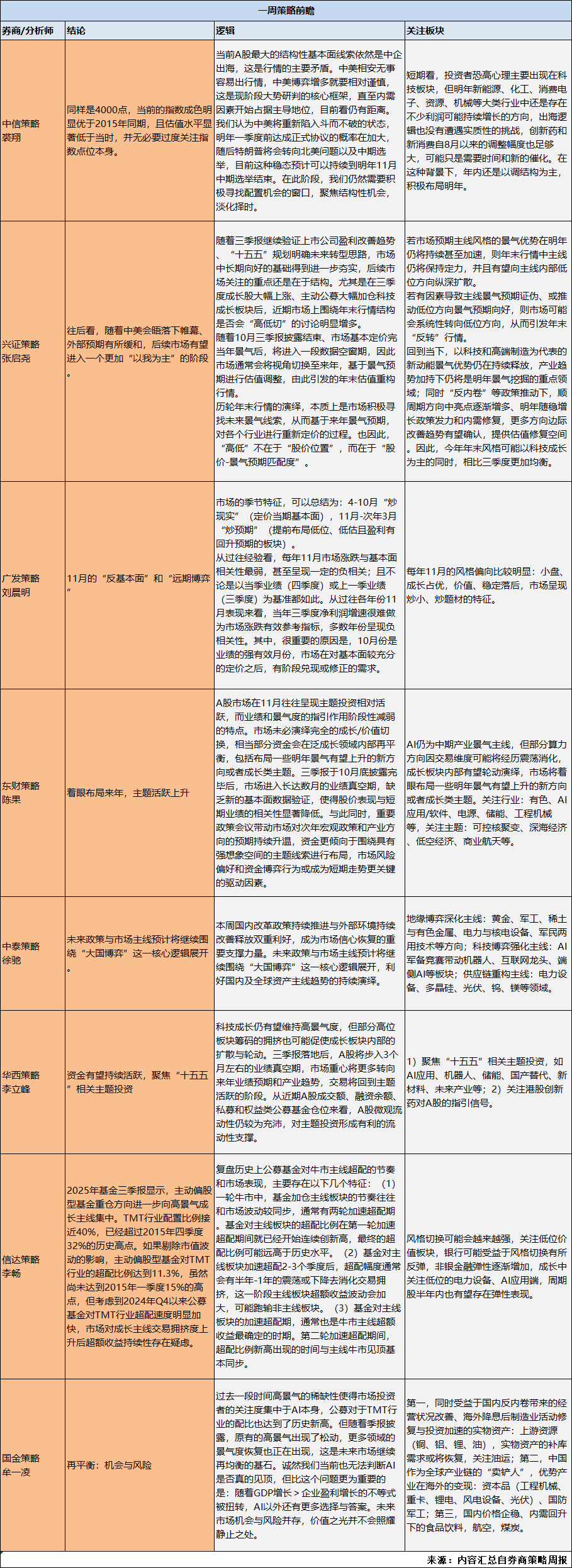
Group 1 - The core viewpoint of the articles discusses the historical market trends in November and year-end, highlighting a shift from "pricing current fundamentals" from April to October to "pricing expectations" from November to March of the following year [1][5] - Historical data indicates that the correlation between market performance in November and fundamentals is weak, often showing a negative correlation, as October is a strong earnings month leading to a need for market correction [1][5] - The market style in November tends to favor small-cap and growth stocks while value and stability lag behind, reflecting a trend of speculative investments in smaller themes [1][5] Group 2 - The year-end market performance is characterized by a search for future economic clues, leading to a revaluation of various industries based on next year's economic expectations [2][3] - The technology and high-end manufacturing sectors are expected to continue their growth momentum, becoming key areas for economic exploration in the coming year [2][3] - The "anti-involution" policies are expected to enhance cyclical sectors, with more areas showing marginal improvement trends, providing room for valuation recovery [2][3] Group 3 - The market is anticipated to enter a more balanced phase with a focus on technology growth, compared to the previous quarter [3] - The scarcity of high-growth sectors has led to increased investor focus on AI, with public funds heavily weighted towards the TMT sector, reaching historical highs [3][6] - As earnings reports conclude, the market is expected to shift focus towards next year's performance expectations and industry trends, leading to a more active thematic investment phase [5][6]

TikTok东南亚月活用户突破4.6亿;淘宝出海双11全球上新210万新品|36氪出海·要闻回顾
36氪· 2025-11-02 13:35
Core Insights - TikTok's monthly active users in Southeast Asia have surpassed 460 million, with Indonesia leading at 160 million, followed by Vietnam at 70 million and Thailand at 50 million, marking the highest user growth in the region [3] - Taobao has launched 2.1 million new products globally for this year's Double 11 shopping festival, aiming to enhance the international competitiveness of Chinese brands [3] - Anker Innovations reported a revenue of 21.02 billion yuan for the first three quarters of 2025, with overseas business accounting for over 96% of total revenue [5] - Geely has officially entered the UK market with the launch of its first pure electric SUV, aiming to sell 100,000 units by 2030 [5] - ByteDance is set to launch an overseas gaming distribution platform called GameTop, similar to Steam, to cater to international gaming needs [6] Group 1 - TikTok's Southeast Asia monthly active users reached 460 million, with Indonesia at 160 million, Vietnam at 70 million, and Thailand at 50 million, leading regional growth [3] - Taobao's Double 11 event features 2.1 million new products launched globally, with over 1 million participating merchants and more than 400 million items eligible for free shipping [3] - Anker Innovations achieved a revenue of 21.02 billion yuan in the first three quarters of 2025, with 96.7% of revenue coming from overseas markets [5] Group 2 - Geely launched its first pure electric SUV in the UK, with plans to establish 100 sales and service outlets by 2026 [5] - ByteDance is launching GameTop, a new gaming platform for overseas markets, providing personalized gaming content and tools for creators [6] - JBD completed over 1 billion yuan in financing, focusing on MicroLED display technology for AR glasses, with applications in nearly 50 smart glasses [8] Group 3 - Meituan's international delivery brand Keeta has officially launched in Abu Dhabi, expanding its presence in the UAE [5] - Source Biological received strategic investment from Toyota Tsusho, aiming to enter the automotive supply chain with a focus on recycling PET [7] - The China Council for the Promotion of International Trade will release a directory of key cross-border e-commerce enterprises to enhance global business connections [9]





Q2 earnings, macro data, global trends key drivers for stock markets this week: Analysts
BusinessLine· 2025-11-02 07:56
Core Insights - The Indian stock markets are expected to be influenced by quarterly earnings, macroeconomic data announcements, and global trends during a holiday-shortened week [1][2] Macroeconomic Data - Key macroeconomic indicators to be released include the final readings of the HSBC manufacturing PMI, as well as the HSBC services and composite PMI data, which will provide insights into domestic growth momentum [2][5] Corporate Earnings - Major companies set to announce their quarterly results include Bharti Airtel, Titan Company, Adani Enterprises, Adani Ports, InterGlobe Aviation, Mahindra & Mahindra, State Bank of India, Lupin, Bajaj Auto, and Hindalco [3] Foreign Investment Activity - Foreign investors have turned net buyers with a net infusion of ₹14,610 crore in October after three months of withdrawals, indicating a potential shift in market sentiment [4] Market Trends - The BSE benchmark dropped by 273.17 points or 0.32%, while the NSE Nifty decreased by 73.05 points or 0.28% last week, reflecting profit-booking by investors after a sustained rally [6][7] Global Influences - Developments related to trade deals and trends in major international markets will be closely monitored for directional cues, alongside the ongoing corporate earnings season which has shown mixed results [3][7]

信达军工E周刊第201期:2025Q3行业持续改善,商业航天提速
Xinda Securities· 2025-11-02 07:05
Investment Rating - The industry investment rating is "Positive" [2] Core Viewpoints - The report emphasizes a "景气反转" (economic recovery), "价值重估" (value reassessment), and "事件催化" (event-driven catalysts), suggesting that 2025 could be a significant year for military investment, characterized by a "双周期共振" (dual-cycle resonance) and a major turning point in the industry [5][48][49] Summary by Sections Industry Performance - The defense and military industry index decreased by 0.22% during the week of October 27-31, 2025, underperforming the broader market by 0.33 percentage points, ranking 21 out of 29 sectors [3][26] - Year-to-date, the defense and military index has increased by 17.72%, slightly underperforming the broader market indices [29][32] Key Developments - The successful launch of the Shenzhou 21 manned spacecraft on October 31, 2025, marks a significant milestone in China's space exploration efforts, contributing to the country's transition from a space power to a space strong nation [3][15] - The domestic liquid rocket industry is advancing rapidly, with the Tianlong 3 rocket expected to make its maiden flight by the end of 2025, and the Zhihang 1 rocket entering the final assembly phase [4][19][21] Financial Performance - The report indicates that the military sector's performance is improving, with notable profit increases for companies such as Hongyuan Electronics and Hangyu Technology, with year-on-year profit growth of 437% and 26% respectively in Q3 2025 [5][49] - The military sector's valuation is becoming more attractive, with a PE-TTM ratio fluctuating between 76-80, closing at 79.0 on the last trading day of the week [42] Investment Focus - The report suggests focusing on "新质战斗力" (new quality combat capabilities) and "景气反转、低估值" (economic recovery and undervalued stocks) as key investment themes [6][48] - Recommended stocks include major players in the new generation combat systems, unmanned equipment, satellite internet, and commercial aerospace sectors [6][48][49]
政策助力科创品牌升级
Jing Ji Ri Bao· 2025-11-01 21:58
Group 1 - The core viewpoint of the news is the launch of the Qiuzhi Innovation Bay in Wuhu, Anhui Province, aimed at integrating government, industry, academia, research, finance, and application to enhance innovation and R&D capabilities [1] - The Qiuzhi Innovation Bay features a cluster of R&D platforms, including the Chery Kaiyang Laboratory and a national key laboratory established by Conch Group, focusing on carbon reduction technologies [1] - The initiative aims to address the shortage of R&D space for enterprises and promote the upgrade from manufacturing clusters to R&D clusters, enhancing core competitiveness and fostering future industrial growth points [1] Group 2 - Wuhu City has established a "1+1+N" policy system to ensure the sustainable development of the Qiuzhi Innovation Bay, which includes city-level general policies, talent-specific policies, and park support policies [2] - Key policy highlights include a maximum subsidy of 100 million yuan for building global R&D centers and up to 10 million yuan for recruiting global partners [2] - Support for high-level talent teams in innovation and entrepreneurship can reach up to 3 million yuan [2]
美两军机连续坠入南海,最新调查曝光
中国能源报· 2025-11-01 11:30
Core Viewpoint - The recent incidents involving the crash of two U.S. military aircraft in the South China Sea have raised concerns about potential fuel quality issues, although investigations have yet to confirm this as a cause [1][3]. Group 1: Incident Details - Two aircraft, an MH-60R Seahawk helicopter and an F/A-18F Super Hornet, from the USS Nimitz aircraft carrier crashed into the South China Sea within 30 minutes of each other [1]. - The U.S. Navy is currently investigating the circumstances surrounding the crashes, with initial speculation pointing towards fuel quality as a possible factor [1][3]. Group 2: Fuel Analysis - A fuel sample from the storage tank used to refuel the crashed aircraft has been sent to a specialized laboratory for analysis, which has been ongoing for three days without any reports of poor fuel quality [3]. - Personnel from the fuel support team confirmed that the crashed aircraft used the same fuel as other operational aircraft, which did not experience any issues during flight [3]. Group 3: Expert Commentary - Military experts have commented that the simultaneous technical failures of two aircraft are unlikely to be coincidental, suggesting that operational practices in the South China Sea may pose risks to navigational safety [3].

美国制造业回流:真相大白,日韩肠子都悔青了!中国该怎么办?
Sou Hu Cai Jing· 2025-11-01 09:21
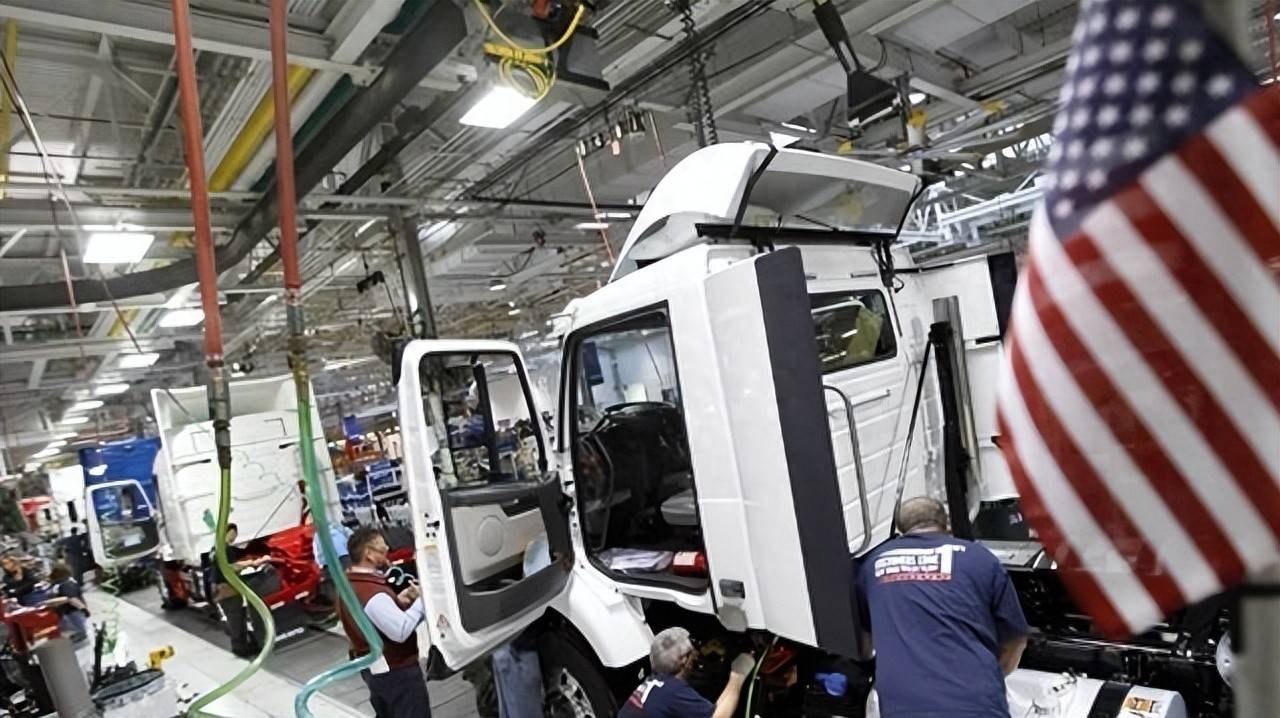
Core Viewpoint - The U.S. manufacturing sector's attempts to return to domestic production have not yielded significant improvements, with the manufacturing GDP share declining from 12% in 2009 to 10.3% in 2022, and projected to remain around 10% by 2025 [2][4][21] Group 1: U.S. Manufacturing Policies - The U.S. government has invested heavily in manufacturing revival, with initiatives like the $23 billion infrastructure investment and $390 billion for chips during the Obama administration, followed by tax cuts and tariffs under Trump, and further subsidies under Biden [2][4] - Despite these efforts, the manufacturing sector's contribution to GDP has not significantly improved, indicating a slow recovery [2][12] Group 2: Employment Trends - Employment in manufacturing has dropped from 24.5% in 1970 to 8.5% currently, with new job creation primarily in the service sector [4][12] - Reports indicate that while over $3 trillion in investment has been announced, job creation has been modest, with Boeing facing significant operational challenges [4][12] Group 3: Global Supply Chain Impact - The U.S. strategy to reduce reliance on overseas manufacturing, particularly from China, has disrupted global supply chains, leading countries like Japan and South Korea to attempt similar moves, which resulted in increased costs and delays [6][10] - Japan's manufacturing costs rose by 30% due to supply chain disruptions, while South Korea's profits fell by 15% as they struggled with a lack of skilled labor and components from China [6][10] Group 4: Lessons from Japan and South Korea - Japan and South Korea's experiences highlight the challenges of relocating manufacturing back home, including rising costs and labor shortages, leading some companies to reconsider their decisions and move production back to China [8][10] - The aging workforce and low birth rates in these countries exacerbate the labor shortage, impacting their manufacturing capabilities [8][10] Group 5: China's Response - In response to U.S. tariffs and the manufacturing shift, China is focusing on high-tech industries, with projections indicating that by 2025, it will produce 60% of the world's electric vehicle batteries and increase its self-sufficiency in chips [10][12][17] - China's strategy includes investing in high-tech sectors and enhancing its workforce's skills to remain competitive globally [12][17] Group 6: Future Outlook - The U.S. manufacturing revival is slow, with significant challenges remaining, while China is leveraging the situation to upgrade its manufacturing capabilities [21] - The global manufacturing landscape is shifting, with Southeast Asia gaining an advantage as companies reassess their supply chains in light of U.S. policies [21]
特斯拉或年内发布飞行汽车原型
财联社· 2025-10-31 23:26
Core Viewpoint - Elon Musk plans to unveil a flying car prototype by the end of 2025, which he claims could be the "most memorable product launch in history" [1][3]. Group 1: Product Development - Tesla aims to complete and showcase a functional flying car prototype within a few weeks before the end of 2025, with Musk emphasizing the significance of this event [3]. - Musk acknowledges the tight timeline but insists that Tesla has a "realistic chance" of meeting the deadline, comparing the flying car's innovation to that of iconic James Bond vehicles [3]. Group 2: Market Impact - If Tesla successfully demonstrates the flying car prototype, it could significantly impact the market, potentially boosting Tesla's stock price and prompting competitors in the automotive and aviation industries to accelerate their own development efforts [4]. - Currently, no other brand has garnered the same level of attention and influence in the flying car sector as Tesla, despite several companies investing in this technology [5]. Group 3: Challenges - The commercialization of flying cars faces substantial technological and regulatory challenges, with strict safety standards imposed by aviation regulatory bodies like the FAA [5]. - Additional practical difficulties include battery range, noise, urban environments, and the construction of takeoff and landing infrastructure [6].


蓄力赋能促航空产业“高飞”
Jing Ji Ri Bao· 2025-10-31 22:01
Core Insights - The Chinese aviation industry has made significant progress but still faces complex operational environments and intense international competition, necessitating improvements in industrial policy, corporate innovation, and talent cultivation to enhance high-quality development levels [1][3]. Group 1: Industry Development - The Chinese aviation industry is entering a fast track with continuous enhancement in independent innovation capabilities and a more complete industrial system, leading to a steady increase in international competitiveness [2]. - As of the first three quarters of this year, passenger transport volume reached 580 million, and cargo transport volume reached 7.395 million tons, representing year-on-year growth of 5.2% and 14% respectively [2]. - The domestically developed C919 large passenger aircraft has safely transported over 2 million passengers since its commercial operation, indicating a significant advancement in civil aviation [2]. - The general aviation and low-altitude economy sectors are also rapidly developing, with the number of registered general airports reaching 475, an increase of 26 from the previous year [2]. Group 2: Challenges and Areas for Improvement - Despite advancements, the aviation industry still faces challenges such as "bottleneck" issues in core technology autonomy, insufficient innovation capabilities in key areas, and a lack of tight coordination between upstream and downstream enterprises [3]. - There is an imbalance in talent supply, with a shortage of composite talents and skilled craftsmen, indicating a need for better alignment between talent structure and industry demands [3]. Group 3: Policy Recommendations - It is essential to improve industrial policies and regulations, strengthen resource integration, and establish a comprehensive legal framework for new aviation business models such as urban air mobility and green aviation [4]. - Establishing special funds to incentivize innovation in core technology research and development is crucial, particularly in overcoming "bottleneck" technologies in new materials and high-end equipment [4]. - Encouraging collaboration between government, enterprises, and educational institutions to create technology innovation centers can optimize resource allocation and stimulate innovation [4]. Group 4: Innovation and Talent Development - Enhancing the independent innovation capabilities of aviation enterprises is vital, focusing on a research and development system driven by national strategy and market demand [5]. - A collaborative ecosystem involving upstream and downstream enterprises, research institutions, and financial entities should be established to foster innovation and improve global competitiveness [5]. - Developing a talent cultivation mechanism that aligns with industry needs and enhancing practical training programs will ensure a steady supply of qualified professionals for the aviation sector [5].