创新药

Search documents
港股收评:指数全天低迷!恒科指跌1.8%,黄金板块逆势上涨
Ge Long Hui· 2025-11-07 08:43
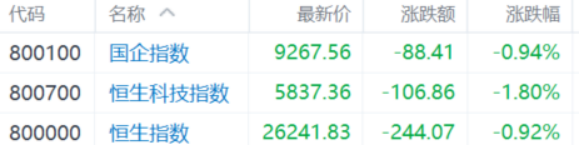
Market Performance - The Hong Kong stock market showed weak performance on November 7, with the Hang Seng Index down 0.92% to 26,241 points, the Hang Seng China Enterprises Index down 0.94% to 9,267 points, and the Hang Seng Tech Index down 1.8% to 5,837 points [1][2]. Sector Performance - Major technology stocks experienced declines, with Kuaishou down nearly 6%, Alibaba and Xiaomi down nearly 3%, and JD.com down over 2% [4][5]. - The semiconductor and automotive sectors also saw declines, while the education and wind power sectors fell [2]. - The polysilicon industry showed signs of a turning point, leading to a surge in the new energy materials sector, with Fulete Glass rising 9%, Xinyi Solar up over 7%, and GCL-Poly Energy up over 6% [2][7]. - The gold sector continued to rise, with Zhenfeng Gold up over 5% and several other gold stocks also increasing [8][9]. - The construction materials sector saw gains, with MOS HOUSE rising over 12% and Huai Bei Green Gold up over 4% [10][11]. Industry News - The photovoltaic industry may be facing the largest restructuring plan in history, with a proposed fund of approximately 70 billion yuan aimed at facilitating acquisitions [6]. - State Street Global Advisors raised its gold price forecast, predicting prices between $3,700 and $4,100 per ounce under the base case scenario [8]. Company News - Huanxin Cement reported a revenue of 25.033 billion yuan for the first three quarters of 2025, a year-on-year increase of 1.27%, with net profit rising 76.01% [10]. - Zai Ding Pharmaceutical reported third-quarter earnings that fell short of market expectations, with revenue 18% lower than anticipated [12][13]. - Lehua Entertainment's stock dropped over 9% following news that popular artist Wang Yibo would not renew his contract, which significantly impacts the company's revenue [14][15]. - The education sector continued to decline, with Tianli International Holdings down over 15% and other education stocks also falling [16]. Capital Flow - Southbound funds recorded a net inflow of 7.523 billion HKD, with net purchases of 3.686 billion HKD through the Shanghai-Hong Kong Stock Connect and 3.837 billion HKD through the Shenzhen-Hong Kong Stock Connect [18]. Market Outlook - CITIC Securities believes that the current market focus on brokerage stocks may be overly concentrated on short-term trading pressures, with expectations for fourth-quarter trading activity to be lower than anticipated [18][19].

被基金经理反复提及的“哑铃型配置”,究竟是何方神圣?
Sou Hu Cai Jing· 2025-11-07 08:26
Core Insights - The recent volatility in the A-share market has led to a focus on style rebalancing, with several well-known balanced fund managers preparing their holdings in advance for the third quarter [1] - Fund managers have indicated that the recent rotation expectations in the market are increasing, with the strength of cyclical sectors reflecting a balance between performance and valuation considerations, making the "barbell strategy" a core approach to balance risk and return [1] What is the "Barbell Strategy" - The "barbell strategy" is a diversified multi-asset allocation approach that incorporates both low-risk and high-risk assets to balance the portfolio's risk and return [2] - This strategy can be visualized as a dumbbell, where one end represents low-risk stable assets and the other end represents high-risk high-return assets, creating a "heavy on both ends, light in the middle" structure [2] Investment Structure and Market Adaptability - This investment structure sacrifices potential returns from mid-risk assets in exchange for resilience in extreme market conditions, allowing investors to respond to black swan events and seek returns in stable markets [3] - Investors should avoid mid-risk assets that lack highlights, such as traditional consumer electronics and homogeneous manufacturing industries [7] Practical Implementation of the Barbell Strategy - In practical terms, investors should select conservative assets on the left end of the barbell, such as high-dividend, low-volatility stocks from sectors like utilities and energy [5] - On the right end, the focus should be on high-growth, high-volatility assets, such as innovative technology and new energy sectors [6] - Historical data shows that the CSI Bank Index and the STAR 50 Index can form a basic barbell strategy, as they exhibit a negative correlation [8][10] Dynamic Weight Adjustment - The barbell strategy does not require equal weight on both ends but should be adjusted based on market conditions and individual risk preferences [10] - In optimistic markets, the aggressive end can be increased to 70%, while in pessimistic markets, the defensive end can be raised to 60% [10] ETF Configuration for the Barbell Strategy - The ETF market offers a variety of options across sectors, broad indices, bonds, and overseas investments, with a simple approach being the combination of stock ETFs and bond ETFs to achieve balance [11] - Recent high-performing ETFs include those focused on technology themes, which have shown returns exceeding 80% in the past year [11] - Defensive tools such as dividend ETFs and bond ETFs can provide stable returns and are essential for liquidity management [11]

申万金工ETF组合202511
Shenwan Hongyuan Securities· 2025-11-07 08:13
Group 1: Report Overview - The report focuses on the construction methods and performance of various ETF portfolios in November 2025, including macro-based, macro + momentum, core - satellite, and trinity style rotation portfolios [2] Group 2: ETF Portfolio Construction Methods Based on Macro Approach - Calculate macro - sensitivity of indices tracked by broad - based, industry - themed, and Smart Beta ETFs according to economic, liquidity, and credit variables, and select ETFs monthly. Also consider adding momentum indicators. Traditional cyclical industries are suitable for economic up - periods, TMT for weak - economic but liquid - abundant times, and consumption benefits from credit expansion. Three ETF portfolios are constructed and rebalanced monthly [5] Trinity Style Rotation - Build a mid - to long - term style rotation model centered on macro - liquidity, compared with the CSI 300 index. Combine three models (growth/value, market - cap, and quality) to get 8 style preference results, then screen target - style - exposed ETFs with controlled industry exposure and set allocation limits [6] Group 3: Macro Industry Portfolio - Select industry - themed ETFs with over 1 - year establishment and over 200 million current scale. Calculate sensitivity scores, adjust according to economic, liquidity, and credit indicators, and select the top 6 industry - themed indices. Currently, with economic indicators rising and liquidity/credit tightening, the portfolio turns to value with high bank and cyclical proportions. November holdings are mainly bank and energy - related ETFs, each with a 16.67% weight. The portfolio has large fluctuations and was close to the CSI 300 in October [7][9][11] Group 4: Macro + Momentum Industry Portfolio - Combine macro and momentum methods to address the left - side bias of macro - based strategies. Use clustering to select one product with the highest 6 - month gain from each of 6 industry - themed groups. The portfolio includes many pro - cyclical industries. November holdings have multiple ETFs, with weights like 16.67% for some and 8.33% for others. The portfolio performed well this year and was close to the CSI 300 in October [12][14][15] Group 5: Core - Satellite Portfolio - Designed to address the high volatility and fast industry rotation of industry - themed ETFs. Use the CSI 300 as the core. Construct three sub - portfolios (broad - based, industry, and Smart Beta) and combine them at 50%, 30%, and 20% respectively. November holdings are mainly mid - to large - cap biased. The portfolio performed steadily this year, outperforming the index almost every month, including in October [16][17][21] Group 6: Trinity Style Rotation ETF Portfolio - The model favors small - cap growth + high - quality segments this period. The portfolio's factor exposure and historical performance are provided. November holdings include ETFs such as Southern CSI 500 ETF and Southern CSI 1000 ETF. The portfolio had significant fluctuations in monthly returns and outperformed the index in most months this year, including in October [22][23][26]
创新药发生了什么,后续怎么看?
雪球· 2025-11-07 08:05
Core Viewpoint - The article discusses the recent pullback in the innovative drug sector, emphasizing the fragility of market expectations driven by business development (BD) activities and the potential for valuation bubbles to form when these expectations are not met [2][5][6]. Group 1: Market Dynamics - The innovative drug sector has experienced significant volatility, with companies facing declines due to various BD-related factors, indicating weak market expectations [2][4]. - The phenomenon of "betting on BD" has evolved from a rational approach to a speculative one, leading to inflated valuations based on anticipated deals rather than actual performance [4][6]. - The market's focus on BD has overshadowed the fundamental improvements in the performance of innovative drug companies, which have shown significant growth in revenue and profit [7][11]. Group 2: Valuation Concerns - Prolonged periods without actual BD transactions can lead to valuation bubbles, with stock prices facing sharp corrections when BD progress falls short of expectations [5][6]. - The allure of BD transactions, often involving substantial upfront payments, can create a misleading perception of immediate value increase, diverting attention from the lengthy and complex drug development process [6][9]. - The article highlights that many high-value BD deals do not fully materialize, with only a fraction of the total deal value being realized, which can lead to disillusionment among investors [6][9]. Group 3: Long-term Outlook - The current "bubble clearing" phase is viewed positively, as it allows for the differentiation between fundamentally strong companies and those relying on speculative narratives, providing a better entry point for long-term investors [9][11]. - Historical trends suggest that the aftermath of a market correction often presents the best opportunities for identifying and investing in companies with solid fundamentals and long-term growth potential [9][11]. - The innovative drug sector has evolved significantly over the past four years, moving from a focus on high-end generics to a more diverse landscape of innovative therapies, indicating a maturation of the industry [11].

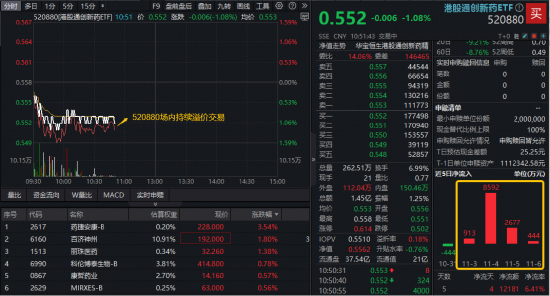
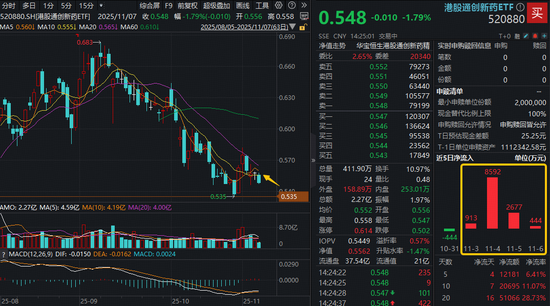
港股通创新药午后走低,再鼎医药重挫10%,520880下探2%跌落10日线,场内溢价飙升!
Xin Lang Ji Jin· 2025-11-07 06:42
Core Viewpoint - The Hong Kong stock market for innovative drugs is experiencing a downturn, with significant declines in several key companies, while the innovative drug ETF is seeing increased investment interest despite the market drop [1][3]. Group 1: Company Performance - Zai Lab reported a third-quarter product revenue net of $115.4 million, a year-on-year increase of 13%, with a net loss of $36 million, which is an improvement compared to the same period last year [3]. - BeiGene, known as the "king of innovative drugs," achieved a remarkable third-quarter revenue of 10.077 billion yuan, marking a year-on-year growth of 41.1%. The total revenue for the first three quarters reached 27.595 billion yuan, up 44.2% year-on-year, surpassing the total revenue of the previous year, with a net profit attributable to shareholders of 1.139 billion yuan [3]. Group 2: ETF Insights - The Hong Kong Stock Connect Innovative Drug ETF (520880) exclusively tracks the Hang Seng Hong Kong Stock Connect Innovative Drug Select Index, which has three unique advantages: it is purely focused on innovative drugs, has a high concentration of leading companies, and offers better risk control by reducing the weight of less liquid stocks [4][5][6]. - As of the end of October, the top ten holdings in the index accounted for 71.51% of the total weight, indicating a strong representation of leading innovative drug companies [7]. - The ETF has surpassed 2 billion yuan in total assets for the first time, with an average daily trading volume of 474 million yuan, making it the largest and most liquid ETF tracking this index [8].
东方证券:首次引入商保目录 创新药支付端政策趋暖愈发明确
智通财经网· 2025-11-07 06:40
Core Viewpoint - The introduction of the commercial insurance innovative drug directory is expected to address the accessibility and affordability issues of high-priced innovative drugs by guiding market forces [1][3]. Group 1: Policy Changes - The National Medical Insurance Administration organized a 5-day negotiation for the medical insurance drug directory and commercial insurance innovative drug directory, with 120 domestic and foreign companies participating [2]. - The new directory is set to be released in early December and will officially take effect on January 1 of the following year [2]. Group 2: Market Opportunities - The commercial insurance innovative drug directory aims to open market space for high-cost or rare disease medications, particularly for rare disease treatments and high-value innovative drugs [3]. - Notably, five CAR-T drugs have been submitted for approval, which could significantly benefit patients due to their high annual treatment costs [3]. Group 3: Drug Submission Strategies - The introduction of the "dual directory" submission allows companies to choose between submitting for both the basic medical insurance directory and the innovative drug directory, providing more strategic options [4]. - For example, BMS's O drug (Nivolumab) opted for dual submission after previous failures, while competitors like Merck's K drug (Pembrolizumab) have not submitted any applications [4]. Group 4: Competitive Landscape - Domestic innovative drugs are becoming major competitors to imported drugs, with examples like the TROP2 ADC drug Gosituzumab (Gilead) and its domestic counterpart [5]. - The increasing support for innovative drugs from the government and the diversification of the medical insurance payment system are expected to create new market demand for innovative drugs [5]. Group 5: Investment Recommendations - The medical insurance bureau is encouraging the high-quality development of innovative drugs, indicating a warming trend in payment policies [6]. - Relevant investment targets include companies such as Heng Rui Medicine, Kelun Pharmaceutical, and others that are actively transitioning towards innovation [6].

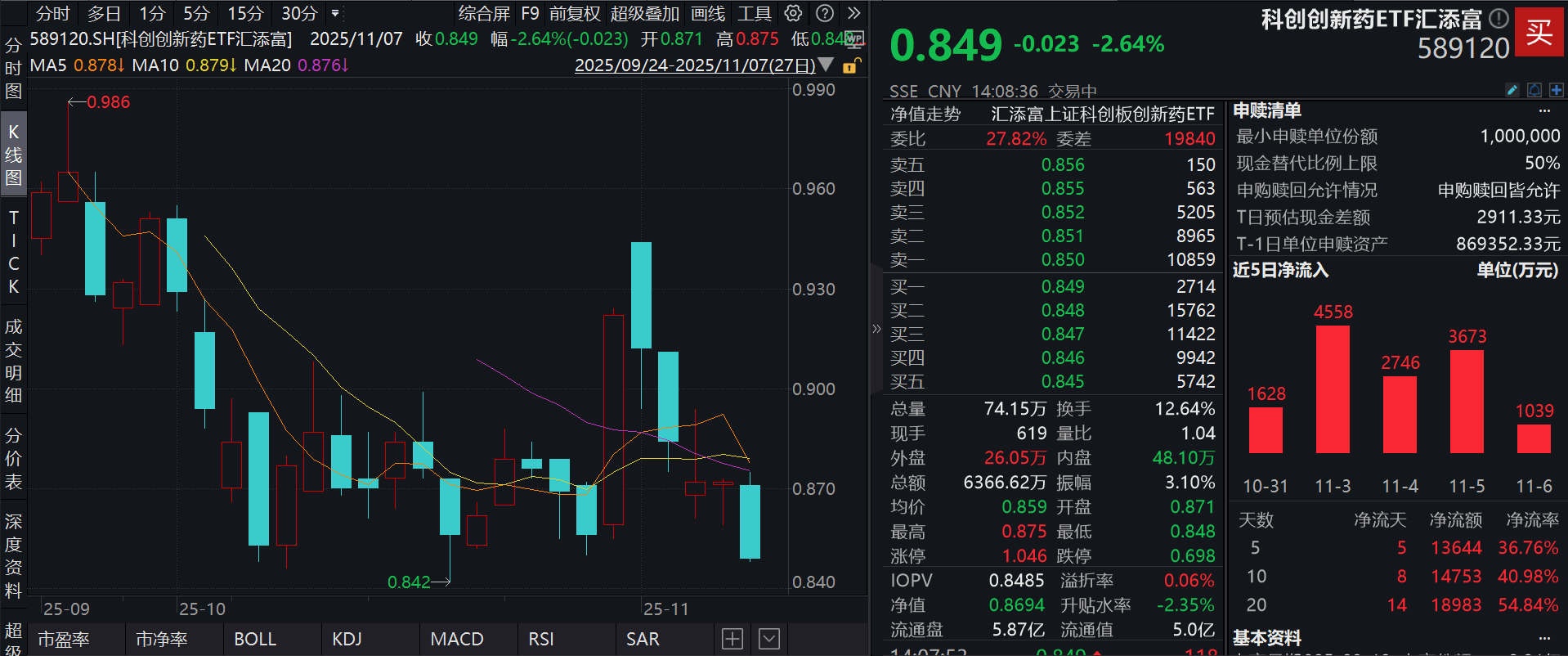
科创创新药再度回调!百利天恒跌逾3%,科创创新药ETF汇添富(589120)跌超2%,溢价坚挺,连续8日获资金加仓!重庆发布创新药发展支持政策
Sou Hu Cai Jing· 2025-11-07 06:28
Core Insights - The Shanghai Stock Exchange Sci-Tech Innovation Board's innovative drug index has decreased by 2.09% as of November 7, 2025, with mixed performance among constituent stocks [1] - The Huatai-PineBridge Sci-Tech Innovation Drug ETF has seen a recent increase in scale and shares, reaching a new high of 510 million yuan and 587 million shares respectively [3][4] - The ETF has experienced continuous net inflows over the past eight days, totaling 157 million yuan, with a peak single-day inflow of 45.58 million yuan [4] Market Performance - The ETF's trading volume was active, with a turnover rate of 11.02% and a transaction value of 55.6 million yuan [1] - Over the past week, the ETF has recorded a cumulative increase of 1.87%, ranking in the top half among comparable funds [1] Policy and Industry Support - The National Healthcare Security Administration has initiated a pilot program for intelligent review processes in medical insurance, integrating AI technology [5] - The Chongqing Municipal Government has issued measures to support the high-quality development of innovative drugs, aiming for 1 to 3 new drug approvals annually by 2027 [5] Investment Outlook - Analysts from China Galaxy Securities highlight a structural recovery trend in the pharmaceutical sector, with optimism for continued investment in innovative drugs and a potential revival in financing [5] - Guotai Junan Securities emphasizes that the main investment opportunities in the pharmaceutical sector for 2025-2026 will be in innovative drugs, particularly in areas addressing unmet clinical needs [6]
瑞银全球金融市场部中国主管房东明:期待2026年成为配置型国际投资者投资中国的大年
Zheng Quan Ri Bao Wang· 2025-11-07 04:04
Core Insights - China's capital market has significantly opened up, with approximately 90% to 95% of the foreign investment access goals achieved, indicating a mature and complete foreign institutional access mechanism [1] - The focus should now be on improving risk management tools, expanding interconnectivity targets, and enhancing capital utilization efficiency to further increase the international appeal of the Chinese market [1] - The provision of predictable macro policies and robust growth fundamentals of listed companies are crucial for attracting long-term international investors [1] Group 1: International Investor Trends - International investors are increasingly active in China, with a notable rise in trading-type investors contributing significantly to market liquidity since September of the previous year [1] - In contrast, allocation-type investors are extending their research efforts and closely monitoring developments in Chinese listed companies, policies, and technological innovations [1] - As of November 7, 2023, foreign institutions have conducted 8,406 research sessions involving 770 A-share companies, focusing on sectors such as telecommunications, pharmaceuticals, semiconductors, and robotics [2] Group 2: Investment Preferences and Growth Sectors - International investors show a preference for large-cap blue-chip stocks with good liquidity and attractive valuations, while also focusing on high-growth sectors like technology, AI, innovative pharmaceuticals, and new consumption [4] - The attractiveness of growth sector companies is often linked to specific events and timing, with recent developments enhancing international recognition of China's technological innovation capabilities [4] - Companies with strong fundamentals, favorable industry policies, and global competitiveness are more appealing to overseas investors, who prioritize long-term strategies over short-term performance [4] Group 3: Globalization and Future Outlook - As Chinese companies expand internationally, sectors like new consumption and innovative pharmaceuticals are gaining increased attention from international investors [5] - Companies must focus on continuous product or model innovation to maintain competitiveness in overseas markets, emphasizing the importance of talent acquisition and local partnerships [5] - The attractiveness of Chinese assets to international investors is expected to rise further by 2026, despite potential market volatility in late 2025, with expectations of sector rotation enhancing overall asset valuations [5]
第一创业晨会纪要-20251107
First Capital Securities· 2025-11-07 03:52
Group 1: Semiconductor Industry - Huahong Semiconductor reported Q3 2025 revenue of $635.2 million, meeting expectations with a year-on-year growth of 20.7%, achieving a historical high [4] - Gross margin was 13.5%, exceeding guidance and increasing by 1.3 percentage points year-on-year and 2.6 percentage points quarter-on-quarter, primarily driven by an increase in average selling price (ASP) [4] - The company expects Q4 revenue to be between $650 million and $660 million, with a gross margin range of 12%-14%, indicating a continued improvement trend in the semiconductor industry [4] Group 2: Biotechnology Industry - BeiGene reported Q3 2025 revenue of 10.077 billion yuan, a year-on-year increase of 41.1%, with a net profit of 689 million yuan compared to a loss of approximately 900 million yuan in the same period last year [4] - The significant growth was mainly driven by sales of self-developed products such as Baiyueze and licensed products, with Baiyueze achieving global revenue of $1 billion, a 51% year-on-year increase [4] - The company raised its 2025 revenue forecast lower limit from 35.8 billion yuan to 36.2 billion yuan, maintaining a gross margin in the high range of 80%-90%, indicating the increasing realization of domestic innovative drug R&D capabilities in overseas markets [4] Group 3: Automotive Industry - In October, the national retail sales of passenger cars reached 2.387 million units, a year-on-year increase of 6%, with the new energy vehicle (NEV) market retailing 1.4 million units, up 17% year-on-year [7] - The penetration rate of NEVs reached 58.7%, with all growth in passenger cars coming from NEVs as fuel vehicles continued to decline [7] - The average price of NEVs in September was 158,000 yuan, down 8% year-on-year, indicating a potential weak price trend despite strong volume in November and December [7] Group 4: Robotics Industry - The production of industrial robots reached 595,000 units, and service robots reached 13.5 million sets in the first three quarters, exceeding the total production for 2024 [7] - The revenue of the national robotics industry grew by 29.5% year-on-year, driven by automation in manufacturing and multi-scenario applications [7] - With supportive policies like the "Guidance on the Innovative Development of Humanoid Robots," the robotics industry is expected to maintain structural high prosperity, particularly for companies with system integration and software capabilities [7] Group 5: Entertainment Industry - Damai Entertainment announced a profit forecast for the first half of the fiscal year, expecting net profit to exceed 500 million yuan, with a growth rate exceeding 48%, significantly surpassing market expectations [9] - The core driver of this performance was the explosive growth of the Alibaba IP business, particularly from new IPs like Chiikawa, which significantly boosted related business revenue and profits [9] - There is a growing market expectation that the reopening of Korean group performances in China will become a core catalyst for growth in Damai's ticketing business next year [9]
“创新药一哥”绩后逆市上涨!第三季度营收突破百亿,上调全年业绩指引!机构:积极把握创新药调整后的机会
Xin Lang Ji Jin· 2025-11-07 03:07
Group 1: Company Performance - BeiGene reported a significant revenue increase, with Q3 revenue reaching 10.077 billion yuan, a year-on-year growth of 41.1% [1] - For the first three quarters, BeiGene's revenue totaled 27.595 billion yuan, up 44.2% year-on-year, surpassing the total revenue of the previous year [1] - The net profit attributable to shareholders for the first three quarters was 1.139 billion yuan, with product revenue growing by 43.9% to 27.314 billion yuan, driving the overall revenue growth [1] Group 2: Financial Guidance and Market Reaction - BeiGene raised its financial guidance for 2025, projecting annual revenue between 36.2 billion yuan and 38.1 billion yuan, an increase of 400 million yuan from previous estimates [1] - Following the earnings report, BeiGene's stock opened higher on November 7, showing resilience in a generally declining market for innovative drug stocks [1] Group 3: Market Trends and Investment Opportunities - The Hong Kong Stock Connect innovative drug sector has seen recent adjustments, attracting low-buying funds, with over 1.25 billion yuan flowing into the ETF over four consecutive days [3] - Analysts suggest that the current stock price levels are more reasonable after a period of adjustment, indicating potential investment opportunities in the innovative drug sector [3] Group 4: ETF Overview - The Hong Kong Stock Connect Innovative Drug ETF (520880) tracks the Hang Seng Hong Kong Stock Connect Innovative Drug Select Index, which includes only pure innovative drug companies [4][5] - The top ten innovative drug leaders account for over 71% of the ETF's weight, highlighting the strength of leading companies in the sector [5][7] - As of November 3, the ETF's scale surpassed 2 billion yuan, making it the largest and most liquid ETF tracking this index [8]