
房地产

Search documents
览富年度数据盘点:870上市公司董秘变动,浙股占比超10%
Sou Hu Cai Jing· 2025-12-31 10:31
Core Insights - In 2025, a total of 870 companies in the A-share market experienced changes in their board secretaries, with a significant concentration in the manufacturing and financial sectors, which together account for 60% of the changes, indicating a close relationship with economic cycles [1][2] Group 1: Company Changes - The majority of changes in board secretaries occurred in the second half of 2025, aligning with annual management adjustment cycles [6] - Approximately 40% of the companies reported a year-on-year increase in net profit attributable to shareholders in the third quarter, while the average stock price increase for the year reached 12.47%, suggesting a neutral to positive market reaction to these changes [2] Group 2: Regional Distribution - The East China (Shanghai, Zhejiang) and South China (Guangdong) regions accounted for over 50% of the changes, reflecting regional economic vitality [2] Group 3: Characteristics of Board Secretaries - The tenure of board secretaries varies widely, with some having served since 1999; 70% of them are male, with an average age of 56 years [2] - 30% of the changes were due to retirement, indicating a need for governance structure optimization, while 40% were attributed to job adjustments [2][8] Group 4: Industry Focus - The changes were particularly concentrated in the real estate, electronic equipment, and energy sectors, reflecting the current economic structure of Zhejiang, where real estate and energy are pillar industries, and electronic equipment benefits from technological innovation [7][8]


年底了,果然开始有更多好消息了
大胡子说房· 2025-12-31 10:17
Group 1 - The core message of the article emphasizes the positive impact of recent policy changes on the real estate market, particularly the reduction of the value-added tax (VAT) for housing sales, which aims to lower transaction costs and stimulate consumption [1][2] - The VAT exemption for properties held for over two years and the reduction from 5% to 3% for properties held for less than two years will significantly decrease the financial burden on home sellers, potentially saving them tens of thousands of yuan [1] - The government's focus on stimulating consumption is further supported by the early allocation of 625 billion yuan in special bonds for consumer goods, indicating a strong commitment to boosting domestic demand [2][4] Group 2 - The article highlights the importance of increasing income levels as a fundamental solution to enhance consumption, with major companies like JD, ByteDance, and BYD announcing salary increases, signaling a positive trend in wage growth [2][4] - The establishment of national venture capital funds targeting hard technology sectors is expected to inject substantial capital into the market, with a focus on artificial intelligence, quantum technology, and other advanced fields, potentially mobilizing trillions in social capital [4][5] - The article notes a shift in the economic landscape, moving from reliance on real estate and manufacturing to a focus on technological innovation and industrial upgrades, reflecting a broader transformation in wealth accumulation and economic growth strategies [24][32]

华润置地获授20亿元可持续发展挂钩定期贷款融资
Zhi Tong Cai Jing· 2025-12-31 09:54
Group 1 - The core point of the article is that China Resources Land (01109) has announced a sustainable development-linked loan agreement with a bank for an amount of RMB 2 billion [1] - The loan financing agreement has a term of 36 months starting from the date of the first withdrawal or intended withdrawal of funds [1]

2.00亿元资金今日流入房地产股
Zheng Quan Shi Bao Wang· 2025-12-31 09:54
Market Overview - The Shanghai Composite Index rose by 0.09% on December 31, with 15 industries experiencing gains, led by defense and military industry at 2.13% and media at 1.54% [1] - The real estate sector ranked third in terms of daily gains, increasing by 1.13% [2] - The communication and agriculture sectors saw the largest declines, with drops of 1.35% and 1.10% respectively [1] Capital Flow Analysis - The main capital outflow from the two markets totaled 32.27 billion yuan, with 22 industries experiencing net outflows [1] - The defense and military industry had the highest net inflow of 6.06 billion yuan, followed by the media industry with 4.44 billion yuan [1] - The electronics sector faced the largest net outflow, totaling 11.20 billion yuan, followed by the power equipment sector with 7.25 billion yuan [1] Real Estate Sector Performance - The real estate sector had a net capital inflow of 200 million yuan, with 73 out of 100 stocks in the sector rising [2] - Notable gainers included Zhangjiang Hi-Tech with a net inflow of 394 million yuan, and Chengjian Development and Hefei Urban Construction with inflows of 231 million yuan and 159 million yuan respectively [2] - The sector also had 17 stocks declining, with the largest outflows from Shoukai Co. at 449 million yuan, Hualian Holdings at 149 million yuan, and Wantong Development at 97 million yuan [3] Top Gainers in Real Estate - Zhangjiang Hi-Tech: +6.63%, 66.9% turnover, 393.85 million yuan inflow [2] - Chengjian Development: +9.98%, 66.5% turnover, 231.06 million yuan inflow [2] - Hefei Urban Construction: +10.04%, 31.1% turnover, 159.26 million yuan inflow [2] Top Losers in Real Estate - Shoukai Co.: -4.06%, 137.1% turnover, -448.58 million yuan outflow [3] - Hualian Holdings: -2.08%, 96.2% turnover, -148.67 million yuan outflow [3] - Wantong Development: -4.58%, 47.5% turnover, -96.75 million yuan outflow [3]


12月高频数据跟踪
LIANCHU SECURITIES· 2025-12-31 09:54
Production Side - In December, the operating rates for blast furnaces and electric furnaces were 78.88% and 60.10%, respectively, both lower than the previous month[3] - The rebar operating rate was 38.03%, and the grinding machine operating rate was 31.72%, both showing a decline from last month[3] - The average operating rates for PVC and PTA were 78.73% and 73.75%, respectively, indicating a general decrease in chemical product operating rates[3] - The inventory levels for asphalt, rebar, cold-rolled, hot-rolled, and float glass showed a decrease, with respective month-on-month growth rates of -3.77%, -10.26%, -4.73%, -6.82%[3] Demand Side - The average transaction area for commercial housing in 30 cities increased by 22.48% month-on-month but decreased by 31.93% year-on-year[4] - The average transaction area for land in 100 cities increased by 93.96% month-on-month, with a year-on-year decrease of 4.50%[4] - The average daily sales of passenger cars were 61,883 units, reflecting a month-on-month decline of 20.18% and a year-on-year decline of 26.34%[4] - The average box office revenue for movies was 675 million yuan, down 7.67% month-on-month but up 45.47% year-on-year[4] Price Side - The wholesale price index for agricultural products increased by 3.32% month-on-month and 6.94% year-on-year, with notable increases in vegetable and fruit prices[5] - The price of gasoline and diesel saw year-on-year declines of 6.82% and 5.20%, respectively[6] - The price of copper and aluminum increased by 5.28% and 1.26% month-on-month, with year-on-year increases of 21.31% and 7.28%[6]
A股2025市值增长九强省盘点:广东TOP5企业市值增长均超千亿 工业富联贡献全省市值增量的19%
Xin Lang Cai Jing· 2025-12-31 09:36
Core Insights - In 2025, the market capitalization increment of A-share listed companies in Guangdong Province reached 42.7 billion, representing a growth of 27.95% compared to the beginning of the year [1] Group 1: Market Capitalization Growth - The top five companies contributing to market capitalization growth all exceeded 100 billion, with Industrial Fulian leading at an increment of 805 billion, marking a growth rate of 188.46% and contributing 18.85% to the total market capitalization increase in the province [1] - The remaining four companies in the top five, namely China Ping An, Shenghong Technology, Luxshare Precision, and Shunyi Technology, each had market capitalization increments below 300 billion, with their contributions to the overall growth rate not exceeding 7% [1] Group 2: Market Capitalization Decline - The companies experiencing the most significant market capitalization decline in Guangdong Province included Mindray Medical, Haitian Flavoring, Huali Group, Poly Development, and Transsion Holdings [1] - Mindray Medical's market capitalization decreased by 78.3 billion, which is significantly higher than the other four companies, each of which saw declines not exceeding 40 billion [1]





A股2025年收官,沪指全年上涨18.41%
Sou Hu Cai Jing· 2025-12-31 09:03
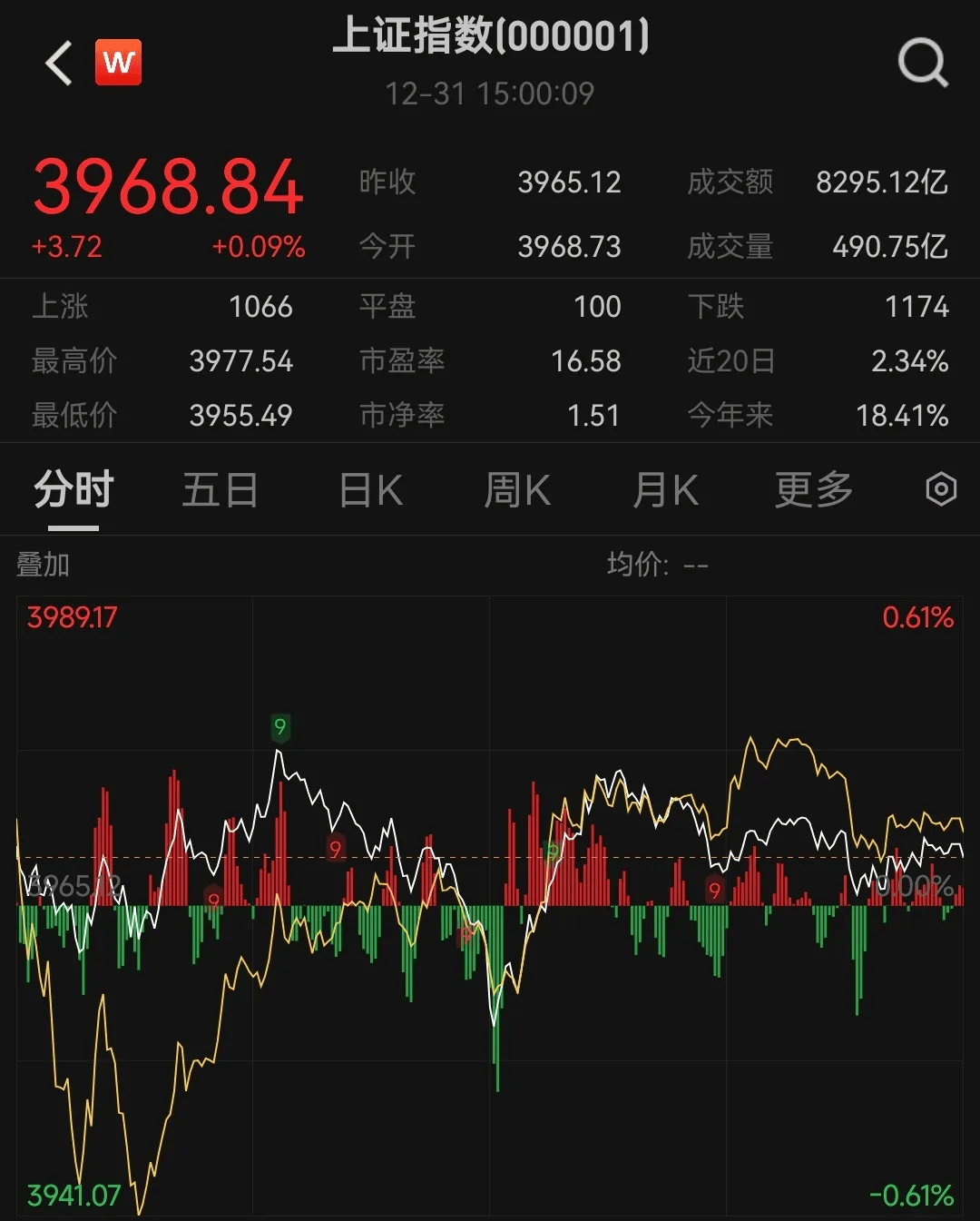
Wind统计显示,两市及北交所共2470只股票上涨,2768只股票下跌,平盘有221只股票。 沪深两市成交总额20451亿元,较前一交易日的21423亿元减少972亿元。其中,沪市成交8295亿元,比上一交易日8875亿元减少580亿元,深市成交12156 亿元。 据大智慧VIP,两市及北交所共有86只股票涨幅在9%以上,16只股票跌幅在9%以上。 A股三大股指12月31日集体高开。早盘两市震荡走低,创指更是跌超1%。午后一度回暖,但市场情绪不佳重返跌势。 至收盘,上证综指涨0.09%,报3968.84点;科创50指数跌1.15%,报1344.2点;深证成指跌0.58%,报13525.02点;创业板指跌1.23%,报3203.17点。 至此,2025年沪指全年上涨18.41%,科创50指数涨35.92%,深成指涨29.87%,创指则暴涨49.57%。 东莞证券认为,近期A股市场呈现连续上涨态势,市场期待已久的跨年行情已逐步启动。值得注意的是,在国内外基本面未发生重大变化的背景下,这一 轮反弹的核心驱动,实则是前期分母端流动性紧缩预期的边际缓和,进而引发全球风险资产的共振修复。与此同时,年初历来是保险、年金等绝 ...
2025年十大牛股盘点!看看这一年你都错过了几个?
Jin Rong Jie· 2025-12-31 08:58
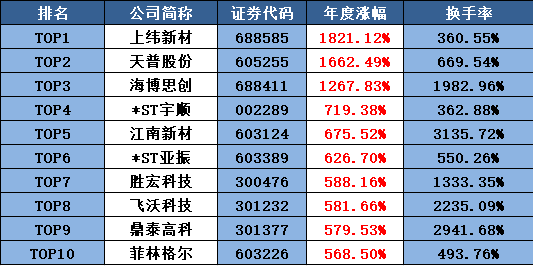
Core Viewpoint - The A-share market concluded 2025 with a historic breakthrough, characterized by "policy-driven, technology-led, and structural differentiation" trends, with a total market value exceeding 109 trillion yuan and annual trading volume surpassing 400 trillion yuan [1] Market Performance - The major indices of the A-share market all showed positive performance, with significant differentiation among them [1] - The ChiNext Index led with an annual increase of 49.57%, followed by the Sci-Tech 50 Index at 35.92%, the Shanghai Composite Index at 18.41%, and the Shenzhen Component Index at 29.87% [1] Sector Performance - Various sectors such as computing hardware, non-ferrous metals, banking, battery supply chain, innovative pharmaceuticals, commercial aerospace, and robotics contributed to the market's performance, with the Shanghai Composite Index briefly surpassing 4000 points [1] - A total of 4073 stocks in the market recorded positive annual growth, indicating a shift from "real estate-driven" to "innovation-driven" market dynamics [1] Top Performing Stocks - The top 10 stocks by annual growth rate (excluding new listings and the Beijing Stock Exchange) showcased significant price increases, reflecting market trends and speculative interests [1] - Notable performers included: - Top 1: Shangwei New Materials (688585) with a growth of 1821.12% and a turnover rate of 360.55% - Top 2: Tianpu Co., Ltd. (605255) with a growth of 1662.49% and a turnover rate of 669.54% - Top 3: Haibo Lichuang (688411) with a growth of 1267.83% and a turnover rate of 1982.96% [1]


绿地控股近期新增诉讼案件1237件 累计金额56.58亿元
Zhong Guo Jing Ji Wang· 2025-12-31 08:53
Group 1 - The core point of the news is that Greenland Holdings has disclosed a significant increase in litigation cases, with a total of 1,237 new lawsuits amounting to 5.658 billion yuan from December 3 to December 27, 2025 [1] - Among the lawsuits, 1,148 cases involve the company as a defendant, totaling 4.391 billion yuan, with the majority being construction-related disputes [1] - The company is also facing 89 lawsuits as a plaintiff, amounting to 1.267 billion yuan, with a significant portion related to construction disputes [1] Group 2 - The real estate and infrastructure industry, where the company operates, is still in an adjustment phase, leading to considerable pressure from ongoing litigation [2] - The company is taking proactive measures to address these lawsuits, including forming specialized teams and enhancing oversight mechanisms to mitigate the impact on its operations [2] - There is uncertainty regarding the potential impact of these lawsuits on the company's future profits, which will depend on the outcomes of court rulings [2]

长城基金苏俊彦:展望2026年,对A股市场潜在空间依然乐观
Xin Lang Cai Jing· 2025-12-31 08:47
Core Viewpoint - The A-share market is expected to transition from a valuation-driven growth to a dual-driven growth model of both profit and valuation, with a shift from external demand to a resonance of both external and internal demand in 2026 [1][4]. Group 1: Market Outlook - The market is anticipated to show optimism, with a potential turning point for profit growth expected in 2026, supported by a gradual recovery in demand and a slowdown in supply growth [1][4]. - Internal demand is projected to recover due to two main factors: the current low proportion of household consumption in GDP, which has significant room for improvement, and the expected increase in fiscal spending in 2026 to support consumption [1][4]. Group 2: Key Investment Areas - Focus on the semiconductor and military industries, as the semiconductor sector is at a critical turning point, with domestic computing chips expected to achieve technological breakthroughs and performance realization [5]. - Attention to "anti-involution" related industries, where policies aimed at eliminating backward production capacity are expected to optimize supply-demand dynamics in chemicals and new energy sectors, leading to price stabilization and rebound [5]. - Emphasis on consumer sectors, particularly service consumption, which is a key area for future policy support, with fiscal subsidies likely to favor the recovery of the restaurant and service industries, further boosting food and beverage consumption [5]. - Real estate sector is expected to gradually stabilize as new construction areas are projected to fall below long-term equilibrium levels by the end of 2026 [5].