
服务业

Search documents
新华时评·人文经济激活消费新动能丨消费活力何以在“体验”中生发
Xin Hua Wang· 2026-01-21 11:16
新华社成都1月21日电 题:消费活力何以在"体验"中生发 新华社记者李倩薇 车窗外,是零下20摄氏度的林海雪原,银装素裹;车窗内,是暖意融融的茶香与欢歌,乘务员带着 学剪窗花……近日,满载400多名旅客、串联起南北多地的"熊猫专列·什邡号",结束了为期13天的"冰 雪之旅"。这趟融观景、社交、文化感知为一体的沉浸式旅行,顺应人们从"观光式"到"体验式"的需求 变化,催生消费新活力。 从"买商品"到"买体验",从为"功能"花钱到为"开心"付费,消费活力在"体验"中蓬勃生发。国家统 计局最新数据显示,2025年我国服务零售额比上年增长5.5%,快于商品零售额1.7个百分点。作为服务 消费的重要内容,体验经济和情绪消费规模不断扩大。有机构预测,2029年我国情绪经济市场规模将突 破4.5万亿元,未来空间广阔。 也要看到,消费并非无源之水、无本之木,体验消费也并非建立在虚无缥缈的感觉之上,其基础和 载体仍然是商品与服务。所不同的是,这些商品与服务除了实用价值,还必须包含文化底蕴、审美情 趣、精神满足等体验价值,这实际上对消费供给的内容和品质提出了更高要求。 "要加快培育服务消费新增长点,支持新业态新模式新场景竞相涌现 ...
财政部及央行新闻发布会解读:财政金融协同,助力“开门红”
Shenwan Hongyuan Securities· 2026-01-21 10:07
Group 1: Policy Signals - The Ministry of Finance and the central bank are focusing on stimulating domestic demand, enhancing support for technological innovation, and activating private investment as key areas for policy collaboration[1] - Personal consumption loan interest subsidies have increased significantly, with the maximum subsidy per loan rising from 500 yuan to 3000 yuan, and credit card installment payments now included[1] - The central bank has lowered the interest rates on various structural monetary policy tools by 0.25 percentage points to guide financing costs down[1] Group 2: Addressing Key Issues - In 2025, new household loans dropped to 360 billion yuan, a decrease of 22,910 billion yuan from 2024, indicating a significant decline in consumer credit growth[2] - The overall credit growth rate fell to 6.4% in 2025, with a 1.0 percentage point decline attributed to the drop in household loans[2] - Fixed asset investment decreased by 3.8% in 2025, with equipment purchases being a major growth driver, increasing by 11.8%[3] Group 3: Expected Outcomes - Fiscal interest subsidies are expected to stabilize financial data and stimulate domestic demand, despite banks facing challenges in expanding loan volumes due to low net interest margins of 1.4%[4] - The expansion of consumer loan interest subsidies is anticipated to support stable consumer spending, particularly in service consumption, as households shift their spending patterns[4] - New policy financial tools, if further enhanced, could provide an additional 1.5 percentage points in fiscal interest subsidies, thereby boosting investment in new infrastructure projects[4]
12月经济数据点评:稳中提质在路上
LIANCHU SECURITIES· 2026-01-21 09:27
Economic Growth - The actual GDP growth in Q4 was 4.5%, achieving an annual growth rate of 5.0%, meeting the annual target[3] - Nominal GDP grew by 3.8% year-on-year, with an annual cumulative growth of 4.0%[3] - The GDP deflator index was -1.0%, slightly narrowing compared to previous figures[3] Investment Trends - Fixed asset investment saw a significant decline, with a cumulative year-on-year decrease of 3.8% for 2025, a drop of 7.0 percentage points from the previous year[4] - Infrastructure investment (narrow and broad) fell by -2.2% and -1.5% respectively, marking a notable slowdown compared to 2024[4] - Manufacturing investment increased by only 0.6% in December, down 1.3 percentage points from the previous month and down 8.6% from 2024[4] Consumer Behavior - Retail sales of consumer goods grew by 3.7% year-on-year for 2025, a slight increase of 0.2 percentage points from 2024[5] - December retail sales showed a year-on-year growth of 0.9%, down 0.5 percentage points from the previous month, indicating a slow recovery[5] - Subsidized consumption remained a key support, with household appliances and furniture seeing annual growth rates of 11.0% and 14.6% respectively[6] Real Estate Market - Real estate development investment decreased by 17.2% year-on-year, with December's decline expanding to 35.8%[4] - New construction area in December fell by 19.4%, but the decline was less severe than the previous month, indicating potential stabilization[4] - The sales area and sales revenue of commercial housing showed a narrowing decline of -15.6% and -23.6% respectively in December, suggesting marginal improvement[4]
焦点精选!东京股市下跌 日经股指五连跌
Xin Hua She· 2026-01-21 09:14
Core Viewpoint - The Tokyo stock market experienced a slight decline on January 21, with both major indices falling, influenced by a significant drop in the New York stock market the previous night [2] Market Performance - The Nikkei 225 index closed down by 0.41%, while the Tokyo Stock Exchange Price Index fell by 0.99% [2] - The Nikkei index has now recorded five consecutive days of decline, marking the first occurrence of such a streak since mid-January 2025 [2] Influencing Factors - The Tokyo stock market opened lower due to the comprehensive decline of the three major indices in New York [2] - Despite the downward trend, some investors increased their buying activity at lower prices, which helped to narrow the overall decline [2] Closing Figures - At the close, the Nikkei index was down by 216.46 points, settling at 52,774.64 points; the Tokyo Stock Exchange index decreased by 35.90 points, ending at 3,589.70 points [2] Sector Performance - Most of the 33 industry sectors on the Tokyo Stock Exchange saw declines, with the banking, insurance, and service sectors experiencing the largest drops [2] - Conversely, sectors such as non-ferrous metals, petroleum and coal products, and electric and gas industries showed gains [2]


东京股市下跌 日经股指五连跌
Xin Hua Wang· 2026-01-21 08:29
Core Viewpoint - The Tokyo stock market experienced a slight decline on January 21, with both major indices falling, marking the Nikkei index's fifth consecutive day of losses, a first since mid-January 2025 [1] Market Performance - The Nikkei 225 index closed down by 0.41%, while the Tokyo Stock Exchange index fell by 0.99% [1] - The Nikkei index dropped by 216.46 points, ending at 52,774.64 points; the Tokyo Stock Exchange index decreased by 35.90 points, closing at 3,589.70 points [1] Influencing Factors - The decline in the Tokyo stock market was influenced by a significant drop in the three major U.S. stock indices the previous night, leading to a gap down at the market opening [1] - Despite the overall decline, some investors increased their buying activity in response to the recent downturn, which helped to narrow the extent of the market's losses [1] Sector Performance - Among the 33 industry sectors on the Tokyo Stock Exchange, most sectors experienced declines, with banking, insurance, and services sectors showing the largest drops [1] - Conversely, sectors such as non-ferrous metals, petroleum and coal products, and electric and gas industries saw gains [1]
高盛:未来几年中国出口仍具韧性 看好盈利改善驱动股市上涨
Sou Hu Cai Jing· 2026-01-21 03:59
近日,高盛发布的2026年中国宏观经济展望和中国资本市场动态展望显示,高盛预测中国2026年实际 GDP将增长4.8%,MSCI中国指数和沪深300指数将分别上涨20%和12%,并在亚洲市场中维持高配中国 股票的投资建议。 在消费领域,预计2026年服务消费增速仍将领先于商品消费增速,从政策角度看,由于服务业相较于制 造业的劳动密集程度往往更高,提振服务消费可以促进"扩大就业、提高收入、拉动消费"的良性循环。 看好盈利改善驱动股市上涨 在人工智能(AI)、"反内卷"政策和中国企业"出海"的支持下,高盛预计,今年中国上市公司盈利增速 有望明显提高,而股市上涨正需要以盈利改善为前提。 "2025年A股上涨的动力主要来自于估值修复,目前估值正常化的过程可能已近尾声,但今年股市上涨 的推动力预计更多来自盈利改善。" 高盛首席中国股票策略师刘劲津称,得益于2025年的低基数以及 AI、企业"出海"和"反内卷"这三大特有驱动因素所带来的增长动力,我们预计,2026年MSCI中国指数 和沪深300指数盈利将增长14%。 其中,在企业"出海"方面,刘劲津认为,上市公司海外收入占比的提升有利于提高企业的利润率。 "我们对中国2 ...
盐城2025年GDP 突破8000亿元,战略新兴产业规模全部超百亿
Yang Zi Wan Bao Wang· 2026-01-21 03:21
扬子晚报网讯(记者陈燃)1月21日,盐城市第九届人民代表大会第七次会议开幕,盐城市市长严汉平在做政府工作报告时介绍,2025年盐城市地区生产总 值连跨三个千亿台阶、突破8000亿元、年均增长5.7%左右,人均地区生产总值突破12万元,一般公共预算收入突破500亿元。 值得注意的是,2025年盐城各县市区经济总量全部超500亿元,东台跻身千亿县,大丰、盐都、射阳、建湖、阜宁突破800亿元,盐城经开区、盐城高新区 在全国排名前进10位以上,县域经济持续提升。 促使盐城实现这一发展成果的原因主要有:工业经济的持续壮大。2025年盐城全口径工业开票过万亿,"5+2"战略性新兴产业规模全部超千亿,汽车产业 规模重返千亿,规上工业增加值年均增长8%,高新技术产业产值占规上工业比重达47%、五年提高8.4个百分点。农业基础持续夯实。整市入选国家农业 绿色发展先行区,粮食总产连续11年超140亿斤,成为长三角地区唯一农业总产值超1500亿元城市。蓝色种业黄海实验室成功落户,新增国家重点农业龙 头企业5家,银宝集团主营收入率先突破百亿元。服务业贡献持续扩大。服务业增加值占地区生产总值比重超50%,规上服务业营收超千亿,年接待游 ...
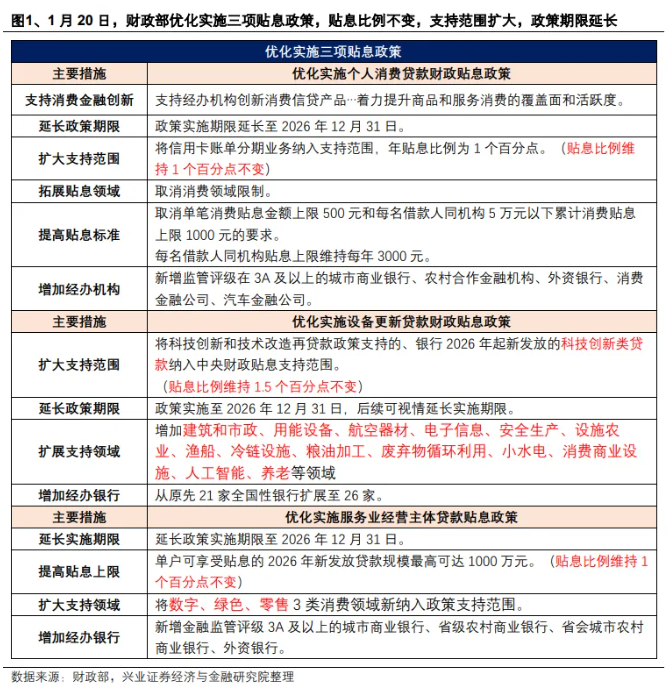
配合央行!财政部五项政策落地:托底而非强刺激,贴息与产业政策深度绑定
Hua Er Jie Jian Wen· 2026-01-21 00:41
Core Viewpoint - The recent policy package from the Ministry of Finance, released on January 20, includes four interest subsidy policies and one special guarantee plan aimed at reducing financing barriers and costs, particularly targeting consumption recovery, equipment upgrades, small and medium-sized enterprises (SMEs), and private investment [1] Group 1: Policy Extensions - The most significant change is the extension of the interest subsidy policy until the end of 2026 for personal consumption loans, equipment upgrade loans, and service industry loans, maintaining the subsidy rate but expanding the coverage and limits [2] - The policy aims to provide a stable financial support environment for economic recovery rather than a short-term stimulus, with a focus on increasing accessibility [2] Group 2: Equipment Upgrades and Technological Transformation - The equipment upgrade loan subsidy policy has been optimized, maintaining a 1.5% subsidy rate for two years and expanding support to include technology innovation loans across various sectors [3] - This policy is directly linked to the central bank's increase in the quota for technology innovation and transformation loans, facilitating lower financing costs for enterprises [3] Group 3: New Policies Targeting SMEs and Private Investment - The new interest subsidy policy for SMEs offers a 1.5% annual subsidy for fixed asset loans in specific sectors, with a maximum subsidy of 50 million yuan per enterprise [4][5] - The special guarantee plan for private investment, with a total scale of 500 billion yuan over two years, aims to alleviate banks' reluctance to lend to SMEs and private enterprises [5] Group 4: Fiscal Policy Outlook - The fiscal policy for 2026 is expected to focus on increasing total spending while optimizing structure and efficiency, rather than merely expanding expenditure [6] - The current policies reflect a structural support approach, leveraging subsidies and guarantees to stimulate social financing without imposing significant fiscal pressure [7] Group 5: Market Implications - The policies signal that the toolbox for stabilizing growth remains open, emphasizing structural and coordinated efforts rather than a broad-based stimulus [8] - The combined effect of fiscal subsidies and structural monetary policies is expected to strengthen the bottom constraints on economic performance, stabilizing expectations and supporting the economy without creating short-term volatility [8]
中外学者纵横谈:中国经济将继续是全球经济增长最大引擎
Ren Min Ri Bao· 2026-01-20 23:51
Core Viewpoint - In 2025, China's economy is projected to grow by 5.0%, reaching over 140 trillion yuan, demonstrating resilience and innovation amid complex international challenges [1][2]. Group 1: Economic Performance and Resilience - China's economy shows strong resilience and adaptability, achieving a growth rate of 5.0% despite external geopolitical tensions and rising global economic uncertainties [2][3]. - The evaluation of China's economic performance is shifting from a singular focus on growth rates to a multidimensional assessment that includes ecological improvement and public welfare [1][2]. - The government's strategic planning and policy coordination are crucial for maintaining economic stability and facilitating structural adjustments [2][4]. Group 2: Innovation and High-Quality Development - Innovation is positioned as the core driver of China's long-term economic growth, with a focus on enhancing total factor productivity as traditional growth factors diminish [5][6]. - China maintains a strong momentum in sectors like artificial intelligence, robotics, and renewable energy, with its global innovation index ranking entering the top ten for the first time [6][10]. - The establishment of a complete industrial system and a robust talent cultivation framework supports China's innovation capabilities [6][5]. Group 3: Global Economic Cooperation and Trade - China's trade resilience is attributed to a comprehensive industrial system, innovation-driven growth, and institutional openness that enhances trade dynamics [7][8]. - The country is actively expanding its global market presence and optimizing trade structures, which helps mitigate external shocks [2][7]. - China's commitment to high-level openness and the establishment of free trade zones are designed to attract global resources and enhance international economic cooperation [9][10]. Group 4: Long-Term Economic Outlook - China's contribution to global economic growth remains significant, with a consistent contribution rate of around 30% in recent years [10][11]. - The long-term positive trend of China's economy is supported by its vast market size, complete industrial system, and ongoing innovation and green transformation efforts [11][12]. - Despite challenges during the transition from old to new growth drivers, maintaining stability and providing green products and innovations will be crucial for both domestic and global economic support [11].
书写中国经济的不凡答卷
Jing Ji Ri Bao· 2026-01-20 22:43
Core Insights - In 2025, China's economy demonstrated unexpected resilience amidst global economic challenges, achieving reasonable quantitative growth and significant qualitative improvements, marking a successful conclusion to the "14th Five-Year Plan" and laying a solid foundation for the "15th Five-Year Plan" [1][3] Group 1: Stability - The "14th Five-Year Plan" was successfully completed, with China's GDP surpassing 140 trillion yuan in 2025, reflecting a 5% year-on-year growth [3][4] - Urban employment targets were achieved ahead of schedule, with an average of over 12 million new urban jobs created annually during the "14th Five-Year Plan" [3] - The Consumer Price Index (CPI) rose by 0.8% year-on-year in December 2025, the highest level since March 2023, indicating a moderate recovery in price levels [3] - China's total goods trade value exceeded 45 trillion yuan in 2025, maintaining growth for nine consecutive years, with foreign exchange reserves reaching 33,579 billion USD by the end of December 2025 [4] Group 2: Resilience - The term "resilience" was selected as the representative word for 2025, highlighting China's ability to adapt and recover amidst external pressures [6] - China's economic resilience is attributed to its large-scale market and effective macroeconomic control, allowing for significant self-repair capabilities [6][7] - The focus on expanding domestic demand became more prominent in 2025, enhancing the reliability of domestic circulation [7] Group 3: Innovation - Technological innovation significantly reshaped production and daily life in 2025, with advancements in AI and robotics leading to practical applications across various sectors [11][12] - China ranked 10th in the global innovation index in 2025, maintaining the highest number of top 100 technology innovation clusters globally for three consecutive years [12] - Major technological breakthroughs were achieved in AI, biomedicine, and robotics, positioning China at the forefront of global innovation [12] Group 4: Green Development - China established the world's largest and fastest-growing renewable energy system, with one-third of electricity consumption coming from green energy [13] - The green industry, exemplified by the rapid growth of electric vehicles, played a crucial role in driving industrial upgrades [13] Group 5: Reform and Opening Up - In 2025, China advanced the construction of a unified national market, streamlining regulations to promote fair competition and resource allocation [14][15] - The implementation of the new law promoting the development of the private economy aimed to support the healthy growth of the private sector [14] - The Hainan Free Trade Port began full operations, enhancing China's openness and providing a platform for global enterprises [15]