
创新药

Search documents
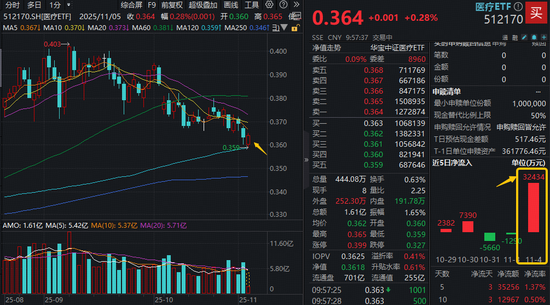
半年线支撑显现?A股最大医疗ETF盘中翻红,最新单日狂揽3.2亿元!创新药局部活跃,520880延续高溢价
Xin Lang Ji Jin· 2025-11-05 02:11
Group 1 - The core viewpoint of the articles highlights a rebound in the pharmaceutical sector, particularly in innovative drugs and medical devices, amidst a broader market adjustment [1][4][5] - A-shares saw a notable recovery in innovative drug concepts, with stocks like Baile Tianheng and Shenzhou Cell rising over 3%, and the only drug ETF in the market (562050) showing significant gains [1][4] - The medical sector experienced a quick recovery after a low opening, with Lepu Medical leading with a rise of over 5% and WuXi AppTec increasing by over 1% [1][4] Group 2 - The Hong Kong market showed localized activity in innovative drugs, with stocks like Connoa-B and Kangfang Bio performing well, while the Hong Kong Stock Connect innovative drug ETF (520880) experienced high premiums and significant capital inflow [3][4] - Open-source Securities noted that most innovative drugs included in medical insurance are in the early stages of volume growth, with policies supporting these drugs expected to enhance revenue rapidly [4][5] - Dongwu Securities reported that China's innovative drugs are gaining international competitiveness, with a surge in business development (BD) overseas, particularly in new generation ADCs and small nucleic acids [4][5] Group 3 - The innovative drug market is projected to grow significantly, with global innovative drug market size expected to reach $1.1 trillion in 2024 and potentially $1.5 trillion by 2030 [4][5] - The recent negotiations for medical insurance and commercial insurance drug pricing concluded with participation from 120 companies, indicating a robust engagement in the sector [4][5] - The second-tier market performance suggests that the recent adjustments in innovative drugs are relatively healthy, with the industry fundamentals remaining positive and a strong potential for upward movement in the pharmaceutical sector [5][6]

赛力斯,上市首日大跌
Di Yi Cai Jing· 2025-11-05 01:57
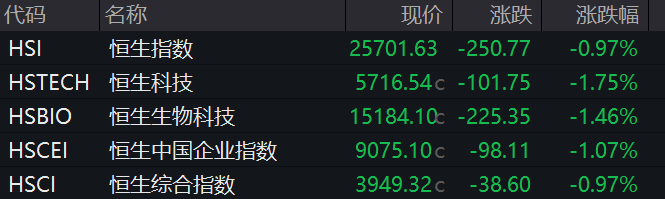
11月5日,香港恒生指数开盘跌0.97%,恒生科技指数跌1.75%。创新药、半导体板块走弱,华虹半导体跌逾3%,中芯国际跌逾2%。 | 代码 | 名称 | 现价 涨跌 | 涨跌幅 | | --- | --- | --- | --- | | Hill | 恒生指数 | 25701.63 -250.77 -0.97% | | | HSTECH 恒生科技 | | 5716.54c -101.75 - -1.75% | | | HSBIO | 恒生生物科技 | 15184.10c -225.35 -1.46% | | | HSCEI | 恒生中国企业指数 | 9075.10c -98.11 - -1.07% | | | HSCI | 恒生综合指数 | 3949.32c -38.60 -0.97% | | 赛力斯上市首日开盘跌1.98%,截至发稿,跌幅超6%。 | 编辑丨瑜见 | | --- | ...

东吴证券晨会纪要-20251105
Soochow Securities· 2025-11-05 01:54
Macro Strategy - The core view is that actual interest rates remain the key anchor for gold prices, with fluctuations in actual rates dominating the market dynamics for gold [1][22] - In October, gold prices experienced a "rise first, then fall" pattern, influenced by U.S. government shutdown concerns and subsequent economic data recovery [1][22] - The outlook for November suggests that gold prices will be driven by geopolitical situations, trade negotiations, and macro policies, with a potential for continued high-level fluctuations [1][22] Fixed Income Strategy - The report discusses a trading strategy of "long old bonds and short new bonds" based on the behavior of active bond spreads during the cutting process [2][23] - The active bond spread is expected to remain profitable, with the maximum spread observed at 9.8 basis points since the switch in 2023 [2][23] - The next active bond switch is anticipated around early January 2026, providing an opportunity to leverage the characteristics of active bond spreads for trading [2][23] Retail Industry - Baima Tea, a leader in the high-end tea market, has recently listed on the Hong Kong Stock Exchange, focusing on high-quality tea products and targeting younger consumers [4][26] - The company's revenue growth has been accompanied by a decline in profit margins, with a slight decrease in gross and net profit margins reported [4][26] - The online sales channel is increasingly significant, with its contribution to total revenue rising from 19% in 2020 to 35% in the first half of 2025 [4][26] Food and Beverage Industry - The report highlights a divergence in growth within the snack sector, with leading companies showing more sustainable growth due to channel changes and consumer shifts [5][27] - Companies like Salted Fish and Wei Long are recommended for their strong channel layouts and significant contributions from key products [5][27] - The report emphasizes the importance of continuous growth and valuation switching certainty in investment recommendations, particularly for companies like Ba Bi Food and Guo Quan [5][27]
证券市场周刊-第40期2025
2025-11-05 01:29
Summary of Key Points from the Conference Call Industry or Company Involved - The conference call discusses the A-share market and its dynamics, particularly in the context of the 20th Central Committee's Fourth Plenary Session and its implications for various sectors, including technology and manufacturing. Core Insights and Arguments 1. **Economic Growth Resilience**: China's economy achieved a growth rate of 5.2% in the first three quarters, indicating strong resilience and a stable recovery trend [7][14][49]. 2. **Policy Support from the Fourth Plenary Session**: The session outlined a development blueprint that provides solid support for the market's stability and long-term growth, emphasizing the construction of a modern industrial system and the importance of securing the manufacturing supply chain [2][8][11]. 3. **Investment Opportunities in Manufacturing**: Companies with significant market share and technological advantages in manufacturing are expected to benefit from the focus on supply chain security and domestic substitution policies [8][9]. 4. **Sector Performance**: The technology sector, particularly in electronics and media, showed strong performance in the third quarter, while industries like steel and non-ferrous metals also saw a recovery in profitability [9][10]. 5. **Market Dynamics**: The A-share market has rebounded, with the Shanghai Composite Index surpassing 4000 points, marking a significant milestone since 2015. This reflects a broader market recovery and increased investor confidence [9][49]. 6. **Long-term Investment Strategy**: The emphasis on strategic resources and industries with competitive advantages suggests a shift in investment focus towards sectors that align with national policy directions outlined in the five-year plan [8][9]. Other Important but Potentially Overlooked Content 1. **Technological Independence**: The call highlighted the need for technological self-reliance as a response to external uncertainties, particularly in AI and data-driven sectors [10]. 2. **Market Sentiment and External Factors**: The ongoing U.S.-China trade negotiations and their impact on market sentiment were noted, with expectations of improved conditions following recent discussions [7][42]. 3. **Investment Risks**: Despite the positive outlook, the call acknowledged the inherent uncertainties in technology investments and the need for careful risk management [22]. 4. **Fund Performance**: The performance of various funds and their alignment with market trends was discussed, indicating a cautious yet optimistic approach to equity investments [26][31]. This summary encapsulates the key points discussed in the conference call, providing insights into the current state of the A-share market, economic growth, and strategic investment opportunities.
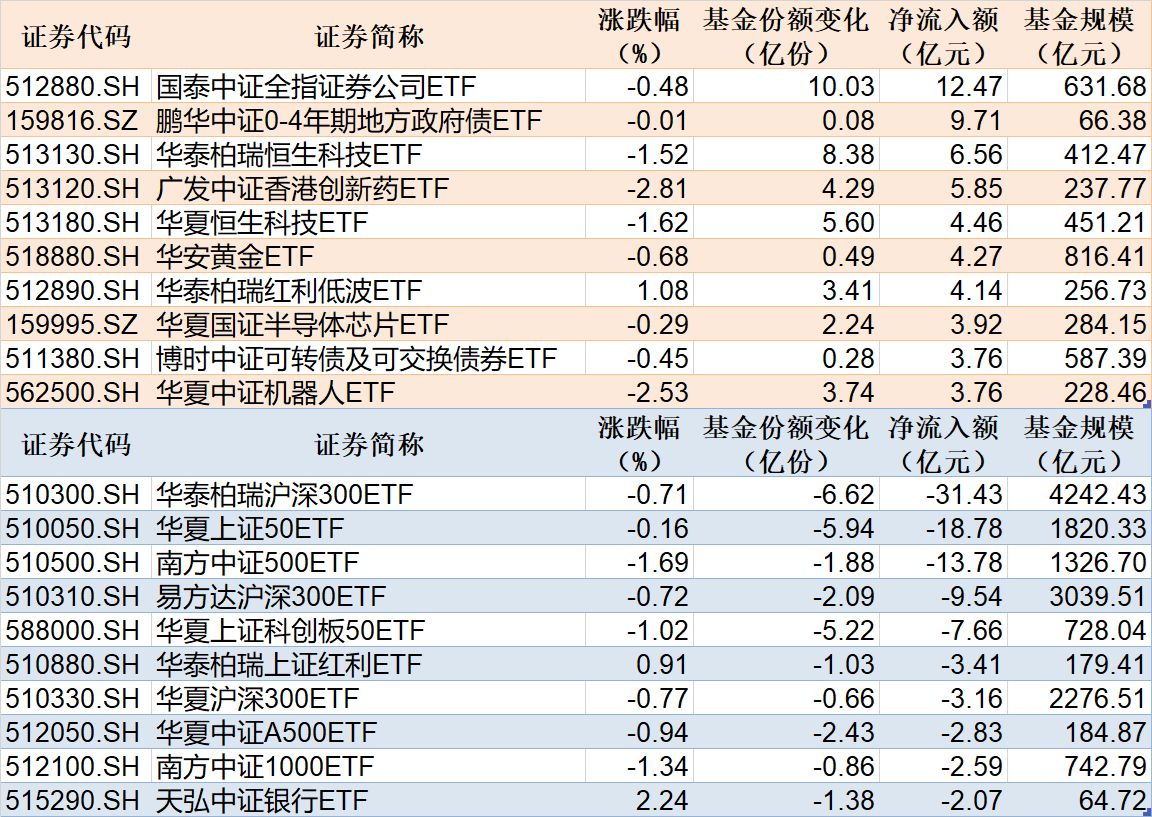
ETF规模速报 | 证券ETF净流入超12亿元,沪深300ETF净流出超31亿元
Mei Ri Jing Ji Xin Wen· 2025-11-05 01:05
Market Overview - The market experienced a volume contraction with the ChiNext Index dropping nearly 2% [1] - The Fujian sector rose against the trend, while the nuclear power sector showed repeated activity, and the coal sector strengthened again [1] - Conversely, innovative drug concept stocks underwent fluctuations, and precious metal concept stocks collectively declined [1] ETF Market Activity - On November 4, significant inflows were observed in the non-monetary ETF market, with the following notable changes: - The Guotai CSI All Share Securities Company ETF saw an increase of 1.003 billion shares with a net inflow of 1.247 billion yuan [1] - The Penghua CSI 0-4 Year Local Government Bond ETF increased by 0.08 billion shares with a net inflow of 0.971 billion yuan [1] - The Huatai-PineBridge Hang Seng Technology ETF increased by 0.838 billion shares with a net inflow of 0.656 billion yuan [1] Fund Performance - The following ETFs experienced the largest net inflows as of November 4: - Guotai CSI All Share Securities Company ETF: 2.345 billion yuan net inflow, total fund size of 63.168 billion yuan [4] - Penghua CSI 0-4 Year Local Government Bond ETF: 1.801 billion yuan net inflow, total fund size of 6.638 billion yuan [4] - Huatai-PineBridge CSI A500 ETF: 1.134 billion yuan net inflow, total fund size of 26.046 billion yuan [4] Fund Size and Trends - As of November 4, the total market ETF shares amounted to 31,415.96 billion shares, with a total scale of 56,735.25 billion yuan [4] - The financial sector saw the largest increase in shares, with 25 funds tracking it [4] - The largest thematic increase was in the CSI Medical Index, tracked by 4 funds [4] - The Hang Seng Technology Index had the largest increase in shares, with 12 funds tracking it [4]
【百强透视】南向资金“爆买”!港股仍获青睐,哪些方向值得看好
Sou Hu Cai Jing· 2025-11-04 23:48
Core Viewpoint - The Hong Kong stock market has shown remarkable resilience and growth in 2025, with the Hang Seng Index increasing over 30% year-to-date as of November 3, 2025, and the Hang Seng Tech Index rising nearly 33%, outperforming the Nasdaq [2][4]. Market Performance - The Hang Seng Index experienced a significant drop of over 13% in early April due to trade tensions but quickly recovered, demonstrating strong market resilience [2]. - As of November 3, 2025, the average daily trading volume for the Hang Seng Index reached a record high of 257.943 billion HKD, the highest since 1969 [2]. - The average daily trading volume for the Hang Seng Tech Index also hit a new high of 79.729 billion HKD since its inception in 2020 [4]. Capital Flows - There has been a substantial inflow of passive overseas funds into the Hong Kong market, with over 26.9 billion USD flowing in since the beginning of the year, doubling compared to the same period last year [6]. - Despite a net outflow of over 9.7 billion USD from active overseas funds, the outflow has slowed significantly, particularly in the second half of the year [6]. - As of September 2025, the proportion of overseas active funds allocated to the Chinese market reached a year-to-date high of 7.2% [6]. Southbound Capital - Southbound capital has significantly contributed to the Hong Kong market, with net purchases through the Stock Connect mechanism reaching nearly 807.9 billion HKD in 2024, a year-on-year increase of over 150% [10]. - By November 3, 2025, the cumulative inflow of southbound capital exceeded 1.26 trillion HKD, setting a new annual record since the Stock Connect's inception [10]. - The daily trading volume of southbound capital has increased from approximately 25% of the main board's trading volume at the end of 2024 to around 30% [10]. Sector Performance - The financial sector has been the primary beneficiary of southbound capital inflows, with technology and energy sectors also performing strongly [13]. - Notable stocks such as Tencent Holdings, Agricultural Bank of China, and Alibaba have seen significant price increases, with Tencent rising over 52% and Alibaba soaring 96% year-to-date [14]. Future Outlook - Analysts remain cautiously optimistic about the Hong Kong market, with expectations of continued inflows and a favorable environment for sectors like renewable energy, innovative pharmaceuticals, and AI technology [15][16]. - The valuation of Hong Kong stocks is considered attractive compared to global peers, providing potential for further upward movement [16]. - The upcoming "Hong Kong 100 Strong" selection will focus on companies in cutting-edge fields such as 5G, innovative pharmaceuticals, and artificial intelligence, reflecting current industry trends [17].






机构研判港股2026年前景:基本面“接棒”驱动行情
Zhong Guo Zheng Quan Bao· 2025-11-04 23:27
Core Viewpoint - The outlook for the Hong Kong stock market in 2026 is optimistic, driven by fundamental improvements and the potential for AI industry catalysis to enhance net asset return rates, leading to higher market valuations [1][3][4]. Market Performance - The Hong Kong stock market has shown strong performance in 2025, with major indices reaching new highs, including the Hang Seng Index, which rose by 29.37%, the Hang Seng Tech Index by 30.22%, and the Hang Seng China Enterprises Index by 25.83% as of November 4 [2][3]. - Despite a notable adjustment in April and a recent high in October, the market is currently in a phase of high-level fluctuations, raising questions about its ability to maintain upward momentum into 2026 [2][3]. Fundamental Improvements - Predictions indicate that the revenue growth rate for non-financial Chinese companies listed overseas could reach 4% in 2026, with operating profit growth expected to be 13%, driven by cost reduction, efficiency improvements, and AI applications [3][4]. - Current valuations of the Hong Kong stock market are considered low, particularly in the tech sector, providing ample room for upward movement [3][4]. Capital Inflows - There is a high certainty of incremental capital inflows into the Hong Kong stock market in 2026, with net inflows from southbound funds exceeding 1.27 trillion HKD in 2025, marking a historical high [4][5]. - The inflow of foreign capital is expected to improve, as foreign investors are currently underweight in Chinese equity assets, and signs of a return of foreign capital are emerging [4][5]. Sector Focus - The technology sector is anticipated to be the main focus for the Hong Kong stock market in 2026, benefiting from industry development and policy support, particularly in AI [6][7]. - There is also a recommendation to pay attention to innovative pharmaceuticals and brokerage firms, as the innovative drug sector is transitioning from investment to realization of results, and brokerages are expected to maintain high growth due to ongoing industry consolidation [6][7].
机构研判港股2026年前景:基本面“接棒”驱动行情 看好四类资产配置价值
Zhong Guo Zheng Quan Bao· 2025-11-04 22:35
Core Viewpoint - The outlook for the Hong Kong stock market in 2026 is optimistic, driven by fundamental improvements and the potential for AI industry catalysis to enhance net asset returns in related sectors, particularly the Hang Seng Tech Index [1][3][6]. Market Performance - The Hong Kong stock market has shown strong performance in 2025, with major indices reaching new highs. As of November 4, 2025, the Hang Seng Index, Hang Seng Tech Index, and Hang Seng China Enterprises Index have increased by 29.37%, 30.22%, and 25.83% respectively [2][3]. - Despite recent adjustments, the market is expected to continue its upward trajectory into 2026, with investor focus on whether new highs can be achieved [2][3]. Fundamental Improvements - Predictions indicate that the revenue growth for non-financial Chinese companies listed overseas could reach 4% in 2026, with operating profit growth expected at 13%. This is attributed to cost reduction, efficiency improvements, and AI applications enhancing profitability [3][4]. - Current valuations of Hong Kong stocks are considered low, particularly in the tech sector, providing room for upward movement [3][4]. Capital Inflows - There is a high certainty of incremental capital entering the Hong Kong market in 2026, with net inflows from southbound funds exceeding 1.27 trillion HKD since 2025, marking a historical high [4][5]. - The inflow of foreign capital is expected to improve, driven by a low allocation to Chinese equity assets and potential easing of monetary policy by the Federal Reserve [4][5]. Sector Focus - The technology sector is anticipated to be the main driver of market performance in 2026, benefiting from industry development and policy support [6]. - Investment in innovative pharmaceuticals and brokerage firms is also recommended, as these sectors are expected to see significant growth and improved performance [6][7].
科创板打造 “硬科技”企业成长新天地
Zhong Guo Zheng Quan Bao· 2025-11-04 20:40
Core Viewpoint - The Sci-Tech Innovation Board (STAR Market) has evolved into a preferred platform for "hard technology" companies in China, supporting high-level technological self-reliance and innovation since its establishment seven years ago [1][2]. Group 1: Growth and Development of STAR Market - The STAR Market has seen over 590 companies listed, raising more than 900 billion yuan through IPOs, including various special types of enterprises [2][3]. - The STAR Market has become the primary domestic financing platform for many technology companies that previously could not meet profitability requirements for listing abroad [3][4]. - The introduction of the "1+6" reform policy has led to the establishment of the Sci-Tech Growth Layer, allowing more companies to access capital markets [4][6]. Group 2: Financial Performance and R&D Investment - Companies in the Sci-Tech Growth Layer reported a 35.1% year-on-year increase in revenue, while net profit losses decreased by 45.4%, with a median R&D intensity of 44.3% [5]. - The STAR Market has facilitated significant financing activities, with 18 new IPO applications and nearly 150 industry mergers and acquisitions since the "1+6" policy was introduced [6]. Group 3: Support for Emerging Industries - The STAR Market is expanding its support for emerging industries, including artificial intelligence and commercial aerospace, by allowing more companies to meet the fifth set of listing standards [7]. - The expansion of the fifth set of standards is expected to attract more technology-driven companies to the STAR Market, enhancing their access to long-term funding [7].



机构研判港股2026年前景: 基本面“接棒”驱动行情 看好四类资产配置价值
Zhong Guo Zheng Quan Bao· 2025-11-04 20:37
Core Viewpoint - The outlook for the Hong Kong stock market in 2026 is optimistic, driven by fundamental improvements and the potential for AI industry catalysis, which may enhance the net asset return (ROE) of related sectors, particularly the Hang Seng Technology Index [1][2][3]. Market Performance - The Hong Kong stock market rebounded significantly since early 2024, with major indices reaching new highs in 2025. As of November 4, 2023, the Hang Seng Index, Hang Seng Technology Index, and Hang Seng China Enterprises Index have increased by 29.37%, 30.22%, and 25.83% respectively this year [1][2]. Market Adjustments - The market experienced notable adjustments in April and October 2023, leading to a high-level consolidation phase. Investors are particularly focused on whether the market can maintain its upward momentum and set new highs in 2026 [2][3]. Earnings Growth - It is predicted that the revenue growth rate for non-financial overseas Chinese companies will reach 4% in 2026, with operating profit growth expected to be 13%. This profit growth is attributed to cost reduction, efficiency improvements, and advancements in AI applications [2][3]. Valuation Insights - Current valuations of the Hong Kong stock market are considered low, especially in the technology sector, providing ample room for further upward movement. Historical comparisons indicate that the market is undervalued, suggesting significant potential for valuation recovery [3][4]. Capital Inflows - There is a high certainty of incremental capital inflows into the Hong Kong market in 2026, with net inflows from southbound funds exceeding 1.27 trillion HKD since 2025, marking a historical high. The inflow structure is expected to become more balanced [4][5]. Domestic and Foreign Investment - Domestic institutional investors, including public funds and insurance companies, are increasingly influencing the pricing power in the Hong Kong market. It is anticipated that net inflows from southbound funds could exceed 1.5 trillion RMB in 2026 [5][6]. Sector Focus - The technology sector, particularly driven by AI advancements, is expected to be the main focus for the Hong Kong market in 2026. Additionally, there is a recommendation to pay attention to innovative pharmaceuticals and brokerage firms, which are anticipated to perform well due to favorable market conditions [6].