半导体

Search documents
未来10年,这18个赛道将带来48万亿美元收入
创业家· 2026-02-14 09:33
Core Insights - McKinsey's report identifies 18 industry sectors likely to reshape the global business landscape, predicting revenues of $29 trillion to $48 trillion by 2040, contributing 18-34% to global GDP growth [2]. E-commerce - By 2040, e-commerce's share of global retail revenue is expected to rise to 27%-38%, up from approximately 20% currently [3]. - Growth drivers include market expansion in developing countries and new product categories in developed nations, such as healthcare and emotionally valuable products [4]. - Significant investments are anticipated in customer acquisition and last-mile delivery across e-commerce platforms [5]. Electric Vehicles - Electric vehicles (EVs) are projected to exceed 50% of global passenger car sales by 2040 [6]. - Breakthroughs in battery technology and smart algorithms will significantly influence this sector, prompting increased R&D investments from both EV manufacturers and traditional automakers [7]. Cloud Services - The demand for higher storage and computing capabilities is driven by a more interconnected world and the need for AI products requiring substantial computing power [9]. - The cloud services industry experienced a compound annual growth rate (CAGR) of 17% from 2005 to 2020, with similar growth expected in the coming decades [10]. Semiconductors - The semiconductor industry is essential for the digital world, with demand from computing, data storage, automotive, communication, and industrial electronics driving growth [11]. - A sustained CAGR of 6%-8% is forecasted for the semiconductor sector over the next decade [11]. AI Software Services - The rapid development of AI has led to its classification as a distinct sector, with increasing usage of AI assistants [12]. - Companies in the AI space are engaged in a competitive race to develop advanced foundational models and applications [13]. Digital Advertising - Digital advertising, through search, social media, and media services, is expanding in value as internet usage among the middle class increases [14]. - Continuous algorithm improvements enhance platforms' abilities to target customers and track advertising costs, although competition for user attention necessitates increased investment in engaging content [15]. Streaming Video - Investment in customer acquisition and content production is rising, prompting streaming platforms to seek new revenue models [17]. - Developing countries may provide incremental growth in subscription and advertising revenue for streaming services, with projections indicating over 1 billion households subscribing to long-form video services by 2040 [18]. Shared Autonomous Vehicles - The advent of autonomous driving technology may reduce the necessity for personal vehicle ownership [19]. - By 2040, shared autonomous vehicles could account for 25%-51% of shared mobility revenue [20]. Space Economy - The world is on the brink of entering a space economy era, with advancements in reusable rocket technology transforming the aerospace industry [21][22]. Cybersecurity - Cybercrime caused direct economic losses of approximately $950 billion in 2020, with indirect losses potentially reaching $4-6 trillion [24]. - Increasing awareness of cybersecurity has led companies to enhance their investments in this area [25]. Batteries - Significant advancements in battery technology have tripled energy density over the past few decades [26]. - The global energy transition is driving demand for batteries, particularly in electric vehicles, energy storage, and consumer electronics, with EVs expected to represent over 80% of the battery market by 2040 [28]. Video Games - By 2030, an estimated 40% of the global population may become video game players [30]. - New gaming models, such as mobile and cloud gaming, are accelerating market growth, with free-to-play games generating substantial revenue [32]. Robotics - The integration of AI with robotics is creating significant expectations for humanoid robots, which are anticipated to become "ultimate intelligent agents" [33]. Industrial and Consumer Biotechnology - Breakthroughs in gene editing and other technologies are expected to accelerate the application of biotechnology in agriculture, alternative proteins, consumer products, and bio-materials [37]. Modular Construction - Modular construction methods, which involve prefabricating building components for on-site assembly, can significantly enhance construction efficiency [38]. Nuclear Fission Power - The development of safer, smaller modular reactors may complement renewable energy sources, with commitments from over 20 countries to double nuclear energy production by 2050 [40]. Air Traffic - Electric vertical takeoff and landing vehicles and delivery drones represent significant technological changes in air traffic [41]. Obesity Treatment Drugs - The prevalence of obesity is projected to rise from 15% in 2020 to 24% by 2035, indicating a potential market for effective weight loss products [43].


中芯国际CEO警告:世界并没有想清楚3万亿美元建设数据中心的用处
Sou Hu Cai Jing· 2026-02-14 09:23
Core Viewpoint - The global rush to invest $3 trillion in AI infrastructure raises questions about the necessity and effectiveness of such investments, as highlighted by Zhao Haijun, co-CEO of SMIC, during the company's 2025 annual financial report [1][3]. Investment Trends - Global AI infrastructure investment is projected to exceed $650 billion this year, with cumulative investments potentially surpassing $3 trillion by 2028, which is larger than Germany's GDP in 2025 [3]. - The urgency to invest stems from a fear of falling behind in the AI "second industrial revolution" [3]. Industry Concerns - Major tech companies like Alphabet, Meta, Microsoft, and Amazon are preparing for future competition using resources accumulated over the past decade, indicating a trend of blind expansion driven by collective panic [5]. - The rapid obsolescence of high-performance GPUs, which can cost tens of thousands of dollars, poses a significant economic challenge, as their effective lifespan is much shorter than anticipated [5][7]. Economic Misalignment - The economic lifespan of chips is often only half of their physical lifespan, leading to faster depreciation and longer payback periods for investments in data centers [10]. - This phenomenon of "rapid obsolescence" is becoming a norm in the industry, raising concerns about the sustainability of such investments [8][10]. Planning and Utilization Issues - There is a lack of strategic planning regarding the deployment of data centers, including site selection, chip deployment, energy consumption, and maintenance [12]. - The current investment climate is driven more by hot money, political performance, and industry trends rather than sound planning and rational decision-making [12]. Financial Risks - The largest tech companies have easier access to financing, which allows them to absorb risks that smaller investors cannot, potentially leading to a misalignment of financial burdens [13]. - Questions remain about who will ultimately bear the $3 trillion cost of these investments and whether they will yield the expected revenue growth [13][15]. Call for Rational Investment - Zhao Haijun emphasizes the need for rationality in technology investments, warning against the potential for future investments to become a financial joke if not approached thoughtfully [15][17]. - The industry must consider how much to invest and whether current projects will remain relevant in the future, as the current enthusiasm may lead to a bubble if not managed properly [15][17].


洪泰基金2025年度回顾:在冰与火之间,看见中国科技的未来
Xin Lang Cai Jing· 2026-02-14 09:15
来源:洪泰Family —— 洪泰基金创始合伙人、董事长 盛希泰 NO.1 洪泰基金年度总结 01/ 募投退全方位提升 募 新成立股权投资基金基金5只,投资方向涵盖人工智能应用、智能制造、数字经济、半导体和硬件、超 导、新材料、能源等领域,获得了包括险资、母基金、国有企业、民营企业等多元投资人的信赖和支 持。 投 HONGTAI Aplus "当2026年春节的脚步临近,我总忍不住回望过去一年的波澜壮阔。深耕投行、证券与投资领域三十 载,我亲历过中国资本市场的潮起潮落,见证过互联网产业从萌芽到崛起、从迭代到重构的完整周期, 却从未有哪一年,像2025年这样,让我如此真切地感知:一个划时代的转折,正以滚烫而坚定的姿态, 扑面而来。" 投资项目27个,主要聚焦在半导体和硬件、具身智能机器人、智能制造、商业航天、人工智能等新星技 术方向的高成长性项目,其中超过70%的项目在交割当年申报IPO或者完成新一轮融资 退 退出项目数量42个,2025年完成IPO或者正在IPO中的项目超过20个,包括摩尔线程等明星项目,在辅 导中计划1年内提交IPO申请的项目20余个,投资退出持续有活水。 融 据相关统计,44家洪泰Faml ...

全球富豪榜前十生变:黄仁勋跌出,沃尔玛三兄妹挤进
Sou Hu Cai Jing· 2026-02-14 09:09
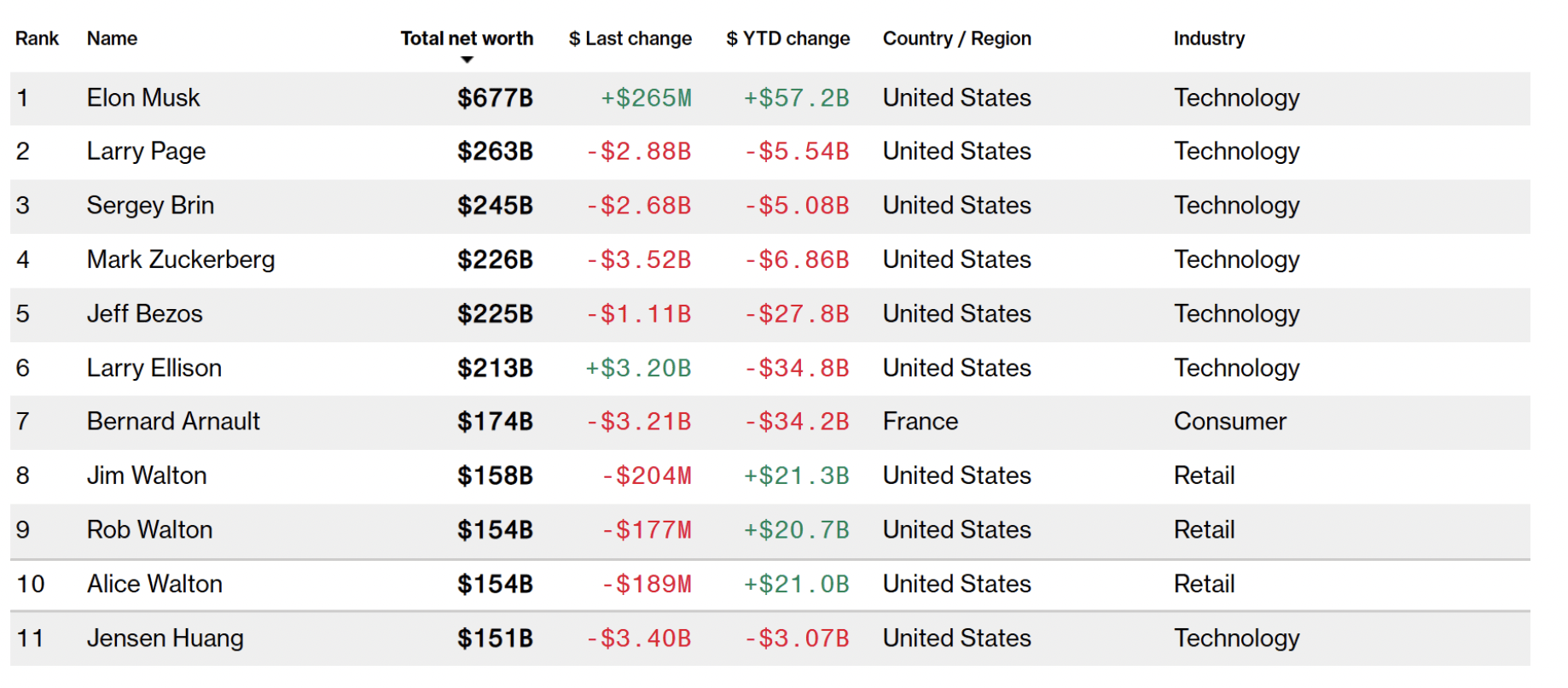
Core Insights - The wealth of tech billionaires has generally decreased, with notable declines among major figures like Jensen Huang, Larry Page, Sergey Brin, and Larry Ellison, while Elon Musk's wealth has increased due to the merger of SpaceX and xAI [1][2] Group 1: Wealth Changes Among Billionaires - Jensen Huang, CEO of Nvidia, has fallen out of the top ten billionaires, with a current net worth of $151 billion, down over $3 billion year-to-date [1][2] - Larry Ellison, chairman of Oracle, has experienced the largest decline in wealth this year, down $34.8 billion to $213 billion [1][2] - The founders of Google, Larry Page and Sergey Brin, have both seen their fortunes drop by over $5 billion this year [1][2] Group 2: Stock Performance of Tech Companies - Nvidia's stock has entered a downward trend since late October, with a current price of $182.81 per share, down over 10% from $202.49 per share [4] - Other tech companies like Meta Platforms, Alphabet, Microsoft, and Amazon have also seen stock price declines despite increased capital expenditures [4] - Concerns are growing that the returns on artificial intelligence investments may not keep pace with the announced capital expenditures, potentially leading to market saturation [4] Group 3: Walmart's Performance and Strategy - Walmart's stock is on an upward trend, with a current price of $133.89 per share, up over 20% year-to-date, and a market capitalization of $1.07 trillion [4] - Walmart is accelerating its digital transformation, including partnerships in China and the launch of new store formats [4][5] - For the third quarter of fiscal year 2026, Walmart reported revenues of $179.5 billion, a 5.8% year-over-year increase, with e-commerce sales growing by 27% [5]
本周,“AI颠覆一切”的狼终于来了
Hua Er Jie Jian Wen· 2026-02-14 09:07
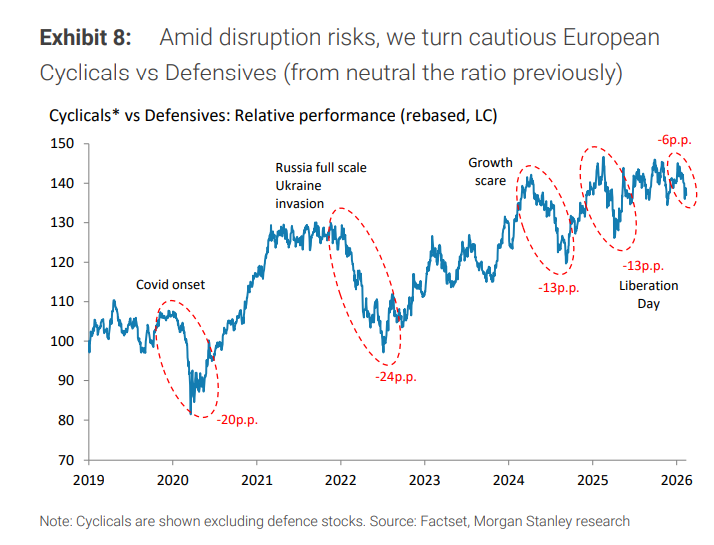
Core Insights - The market is increasingly recognizing the imminent threat of AI disruption, with the perceived risk in the MSCI Europe index rising from 4% to 24% in just over a month, including the banking sector [1][9] - Morgan Stanley has shifted its stance from neutral to cautious regarding cyclical stocks versus defensive stocks, highlighting opportunities in the European credit market for downside protection [1][15] AI Capability Advancements - The latest AI model, GPT-5.2, has achieved human expert-level performance in 71% of professional tasks, marking a significant leap in AI capabilities [5][8] - The speed of AI advancements is accelerating, with predictions that upcoming models in 2026 will far exceed current capabilities due to increased computational power [8] Market Disruption Dynamics - Initial concerns about AI's impact on the software industry have rapidly expanded to broader economic disruption risks, reminiscent of market reactions during the early COVID-19 pandemic [9][10] - Approximately 10% of the MSCI Europe index (excluding banks) is now viewed as facing substantial AI disruption risks, with this figure rising to 24% when including banks [9][10] Valuation Trends - The valuation of "disruption stocks" has decreased from a peak P/E ratio of 24x to 16.4x, with further downward potential indicated by comparisons to "uncontested disruption stocks" [10] Resilience Assessment Framework - Morgan Stanley proposes a framework to evaluate sectors and stocks based on five dimensions of risk exposure, identifying utilities, semiconductors, defense, and tobacco as the most resilient sectors [11] - Sectors such as software, commercial services, and banking are identified as facing the highest disruption risk [11] Non-AI Replicable Assets - The report emphasizes the rising value of assets that cannot be replicated by AI, including physical assets, regulatory barriers, and unique human experiences [4][12][14] Credit Market Insights - Despite AI disruption concerns affecting some credit markets, European investment-grade spreads remain low, presenting opportunities for investors to hedge against potential downturns [15] Computing Power Demand - There is a significant and growing demand for computing power, with projections indicating that the growth rate of demand will outpace current supply forecasts [16][21] - The intensity of computing requirements for AI queries is increasing rapidly, with predictions that companies may need to double their computing power every six months [19][21]



芯片设备巨头,全面备战2nm
半导体芯闻· 2026-02-14 08:56
Core Viewpoint - Applied Materials has launched new deposition, etching, and material modification systems to enhance AI computing capabilities through atomic-scale improvements in transistors as the semiconductor industry transitions to 2nm and advanced nodes [1] Group 1: New Technologies and Innovations - The introduction of GAA (Gate-All-Around) transistors is a significant shift in the semiconductor industry, enabling higher energy efficiency and supporting more powerful AI chip computations [1] - The Producer™ Viva™ radical treatment system allows for atomic-level engineering of the surfaces of GAA transistor nanosheets, which is crucial for improving electron mobility and overall chip performance [2] - The Centris™ Sym3™ Z Magnum™ etching system enhances the uniformity and performance of silicon nanosheets by achieving precise 3D trench profiles, essential for advanced transistor manufacturing [4][5] Group 2: Performance Enhancements - The Viva system, when combined with the Producer Pyra™ thermal annealing process, can reduce copper wire resistance, extending the application of copper in low-layer metal interconnects at advanced nodes [3] - The Sym3 Z Magnum system utilizes second-generation pulsed voltage technology (PVT2) to achieve cleaner and more precise trench etching, which improves transistor switching speed and overall chip efficiency [5] - The Centris™ Spectral™ molybdenum atomic layer deposition system selectively deposits single-crystal molybdenum to reduce contact resistance by up to 15%, addressing the challenges of traditional tungsten contacts at the nanoscale [6]

事关安世,商务部回应
半导体芯闻· 2026-02-14 08:56
Group 1 - The Dutch court has ordered an investigation into ASML Semiconductor for alleged mismanagement, emphasizing the need to restore global semiconductor supply chain stability, which is a common interest for the international industry, including China and the Netherlands [1] - The Chinese Ministry of Commerce has stated that it hopes the Netherlands will create favorable conditions for constructive resolution of internal disputes between companies, highlighting the importance of maintaining stability in the global semiconductor supply chain [1] - The Chinese Ministry of Foreign Affairs has reiterated its position on the ASML Semiconductor issue, attributing the root cause of the problem to improper administrative intervention by the Netherlands in corporate operations [1]

这类DRAM,成为新研究方向
半导体芯闻· 2026-02-14 08:56
Core Viewpoint - Samsung Electronics and SK Hynix are accelerating the development of the next-generation 3D Dynamic Random Access Memory (DRAM), specifically the vertical structure "4F² DRAM," aiming to complete and test early prototypes by the end of this year [2][3]. Group 1: 4F² DRAM Development - The 4F² DRAM architecture overcomes the limitations of traditional planar DRAM by utilizing a vertical stacking method, which is expected to enhance performance, data transfer rates, and energy efficiency [2]. - Samsung and SK Hynix plan to validate the commercial viability of the 4F² DRAM prototype before advancing to 3D DRAM development [3]. - Micron Technology has opted to skip the 4F² DRAM stage and move directly into 3D DRAM development [3]. Group 2: Industry Challenges and Innovations - The transition to vertical structure designs is seen as essential to overcome the challenges posed by the shrinking of planar DRAM, which has led to increased complexity and manufacturing costs [4]. - Samsung anticipates launching the 4F² DRAM following its seventh-generation 10nm products, while SK Hynix may introduce its 4F² series in the next generation [4]. - The performance of the 4F² DRAM is projected to improve by nearly 50% compared to existing models, with a potential for mass production within three years if development progresses smoothly [4].
三星,终于逆袭?
半导体芯闻· 2026-02-14 08:56
Core Viewpoint - Samsung Electronics has begun shipping its sixth-generation high-bandwidth memory (HBM4), becoming the first manufacturer to mass-produce this crucial storage chip for artificial intelligence, marking a significant turnaround in its competitive position in the AI-driven semiconductor market [1][3]. Group 1: Product Features and Performance - Samsung's HBM4 memory offers a stable processing speed of up to 11.7 Gbps, a 46% increase over the industry standard of 8 Gbps, and a 1.22 times improvement over its predecessor HBM3E's maximum speed of 9.6 Gbps [3][4]. - The total memory bandwidth per stack has increased by 2.7 times compared to HBM3E, reaching up to 3.3 TB/s [4]. - Samsung has integrated advanced low-power design solutions to address the challenges posed by the increase in I/O pin count from 1024 to 2048, achieving a 40% improvement in energy efficiency and a 30% enhancement in heat dissipation [4]. Group 2: Market Strategy and Future Plans - Samsung anticipates that its HBM product sales will triple in 2026 compared to 2025 and is actively expanding HBM4 production capacity [5][6]. - The company plans to introduce HBM4E samples in the second half of 2026 and customized HBM samples based on specific customer requirements in 2027 [7]. - Samsung's integrated design and manufacturing capabilities provide a competitive edge in the HBM market, allowing for optimized production processes and reduced supply chain risks [6][7]. Group 3: Competitive Landscape - Samsung's HBM4 is expected to create a turning point in the competitive landscape, particularly against SK Hynix, which has dominated the HBM market due to its exclusive orders from NVIDIA [10][13]. - The differentiation in manufacturing processes between Samsung and SK Hynix has led to significant performance disparities, with Samsung's HBM4 achieving higher data transfer rates and scalability [13][14]. - Analysts believe that Samsung's performance-first strategy may set new market standards, especially as NVIDIA has raised its specifications to 13 Gbps [14].

MSCI中国指数大调仓,37只股票新纳入,高盛测算14亿美元净流入居全球首位
Jin Rong Jie· 2026-02-14 08:49
Group 1 - MSCI announced the results of its quarterly index review on February 11, 2026, which included the addition of 37 stocks to the MSCI China Index and the removal of 16 stocks [1] - The adjustments will take effect after the market closes on February 27, 2026 [1] Group 2 - Goldman Sachs estimated that the MSCI core index adjustment will trigger over $17 billion and $14 billion in two-way passive trading in the Asia-Pacific and global emerging markets, with net inflows of approximately $1.6 billion and $450 million respectively [3] - Chinese stocks are expected to receive about $1.4 billion in net passive fund inflows, leading globally, while markets in France, the UK, and the US are projected to experience significant outflows [3] Group 3 - In the Asia-Pacific region, the main beneficiaries of passive fund inflows include technology hardware and semiconductors (+$2.2 billion), capital goods (+$930 million), and software and services (+$480 million), while sectors like consumer, transportation, and travel services are facing passive reductions [3] - In the Chinese market, the main paths for fund inflows are through semiconductors and related hardware, AI software and autonomous driving applications, and upstream resources and materials [4] Group 4 - Goldman Sachs predicts that newly added stocks such as SenseTime, Changfei Optical Fiber, Hesai Technology, and Pony.ai will each see at least $200 million in potential net passive fund inflows [4] - Historical data shows that stocks added to the MSCI index or with increased free float factors typically outperform those removed or with decreased factors between the announcement and effective dates [4]