创新药

Search documents
2025年基金三季报划重点!泓德基金于浩成:未来市场风格或从科技成长一枝独秀走向更加均衡
Xin Lang Ji Jin· 2025-11-03 05:33
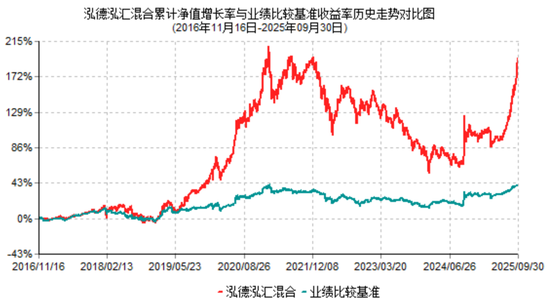
Core Insights - The performance of the Hongde Honghui Mixed Fund has shown significant growth, with a net value increase of 45.46% in Q3 2025, compared to a benchmark return of 8.21% [1] - The Chinese stock market experienced a strong performance in Q3, with the Shanghai Composite Index rising by 12.73% and the Hang Seng Index increasing by 11.56%, while the ChiNext Index surged by 50.40% [3] - The technology sector, particularly the AI industry chain, has been a major driver of growth, with companies in software, chips, and new materials benefiting from a favorable market environment [3] Fund Performance - The Hongde Honghui Mixed Fund has achieved a cumulative net value growth rate of 195.46% since its inception on November 16, 2016, significantly outperforming the benchmark return of 41.54% [1] - The fund manager, Yu Haocheng, has focused on sectors such as AI, new energy, and consumer electronics, which have performed well, leading to substantial net value increases [4] Market Trends - The Q3 performance of various sectors showed significant divergence, with electronics, communication, and innovative pharmaceuticals leading the gains, while banking and petrochemical sectors lagged behind [3] - The AI industry chain is expected to continue driving growth, with a favorable valuation environment providing a strong buying opportunity for investors [3] - The outlook for Q4 suggests a potential shift towards a more balanced market style, with a focus on leading companies in AI and new energy, as well as cyclical sectors like chemicals and new materials [4]

淳厚基金陈印:力争挖掘现金流可持续增长带来的估值抬升机会
Zhong Guo Zheng Quan Bao· 2025-11-03 04:54
Core Insights - The article emphasizes the importance of identifying intrinsic commonalities in investment logic to construct portfolios amidst volatile capital markets [1] - The focus is on sustainable future cash flow, particularly in sectors like internet platforms, innovative pharmaceuticals, maritime trade, and export chains [2][5][6] Investment Philosophy - The investment principle revolves around future cash flow that balances growth potential and risk control, with a broader definition of cash flow beyond just financial statements [3] - The manager tracks the ultimate destination of funds post-central bank release, indicating a macro perspective on cash flow sustainability [3] Sector Focus - The internet sector is highlighted for its increasing reliance in daily life, providing stable and growing cash flow opportunities [5] - The innovative pharmaceutical sector is noted for its potential due to overseas companies acquiring early-stage options in China, enhancing cash flow stability [6] - The maritime sector is expected to benefit from enduring trade habits, with increased trade volumes supporting cash flow in shipping and port operations [6] - The export chain is positioned favorably due to the disparity between low actual growth and high nominal growth overseas, allowing domestic exporters to gain revenue advantages [6] Valuation and Portfolio Management - The investment approach includes a balanced industry allocation with slight tilts towards favored sectors, while also seeking undervalued reversal opportunities [4] - Valuation is a primary consideration in selecting specific stocks, with a focus on dynamic tracking to assess the reasonableness of valuations [4] - The manager is cautious about participating in high-valuation opportunities unless justified by performance growth or order matching [4]
2026年港股策略展望:迈向新高度
Haitong Securities International· 2025-11-03 04:34
Group 1 - The current valuation of Hong Kong stocks has significant upward potential, with the Hang Seng Index PE at 11.9 times and the Hang Seng Tech PE at 23.3 times, indicating they are at 84% and 32% historical percentiles respectively, suggesting room for recovery [6][7][11] - Hong Kong stocks are positioned as a gathering place for innovative assets in China, with sectors like internet, new consumption, innovative pharmaceuticals, and dividends expected to support the ongoing bull market [5][6][59] - The correlation between Hong Kong and A-share markets is increasing, indicating that future driving factors for Hong Kong stocks will increasingly come from domestic influences [14][16] Group 2 - The inflow of incremental funds into Hong Kong stocks is highly certain, with expectations of over 1.5 trillion yuan in southbound capital inflows in 2026, driven by public funds, insurance capital, and retail investors [28][43][52] - Foreign capital has shown signs of stabilization and potential return, with a significant portion of foreign investment in Chinese assets currently at a low allocation level, suggesting room for recovery [29][30][39] - Domestic capital has been gaining pricing power, with southbound funds expected to continue flowing into Hong Kong stocks, driven by the attractiveness of innovative and scarce assets [43][46][59] Group 3 - The scarcity of quality assets in Hong Kong stocks is a strong support factor for the market, with historical periods of outperformance linked to the presence of unique assets that attract incremental capital [55][61] - The current economic transition in China is creating opportunities for sectors like AI technology, new consumption, and innovative pharmaceuticals, which are expected to outperform [59][60][61] - The trend of Chinese companies returning to Hong Kong for listings is expected to enhance the accumulation of quality assets in the market, further narrowing the valuation gap with A-shares [61][62] Group 4 - The technology sector in Hong Kong is anticipated to be the main focus in 2026, driven by the AI wave and supportive policies, with expectations of improved fundamentals and valuation uplift [65][66][68] - The valuation of Hong Kong technology stocks is currently attractive, with potential for significant appreciation as the sector benefits from AI-driven growth and increased foreign investment [68][69]
“商保创新药目录”首次纳入医保国谈,港股创新药逆市走强
Sou Hu Cai Jing· 2025-11-03 03:11
Core Viewpoint - The Hong Kong stock market's innovative pharmaceutical sector is showing resilience, with the China Securities Hong Kong Stock Connect Pharmaceutical and Health Comprehensive Index rising by 1.40% as of November 3, 2025, driven by positive developments in the industry [1]. Group 1: Market Performance - The index's performance is highlighted by significant gains in constituent stocks, including 康诺亚-B (02162) up 5.73%, 先声药业 (02096) up 5.66%, and 康方生物 (09926) up 5.29% [1]. - Other stocks such as 一脉阳光 (02522) and 平安好医生 (01833) also experienced upward movement, indicating a broader positive trend in the sector [1]. Group 2: Industry Developments - The introduction of the "Commercial Insurance Innovative Drug Directory" marks a significant policy shift, as it is the first time this mechanism has been officially included in the national discussions on medical insurance [1]. - Pfizer has initiated two global Phase III clinical trials for its PD-1/VEGF bispecific antibody SSGJ-707 (PF-08634404), targeting first-line treatment for non-small cell lung cancer and colorectal cancer, which is expected to enhance the sector's growth prospects [1]. Group 3: Future Outlook - Research indicates that the pharmaceutical and biotechnology industry is entering a new upward cycle, with accelerated overseas orders and strong upward momentum, particularly benefiting biopharmaceutical companies with robust international capabilities [1].

2025国家医保谈判收官日,高弹性港股通创新药ETF(520880)逆转冲高3%!基金经理:创新药行情可能再次启动
Xin Lang Ji Jin· 2025-11-03 03:02
Group 1 - The Hong Kong Stock Connect innovative drug sector experienced a significant rebound on November 3, with the innovative drug ETF (520880) showing a volatility of over 4.4% and a trading volume exceeding 500 million yuan, indicating strong bullish sentiment [1] - Key stocks such as Kangfang Biotech, Xiansheng Pharmaceutical, and Kangnuo Ya-B saw increases of nearly 6%, while other companies like Yuanda Pharmaceutical and Rongchang Biotech also experienced substantial gains [1] - The National Medical Insurance negotiation, which began on October 30, is expected to conclude with results announced in early December, introducing a new "commercial insurance innovative drug catalog" mechanism for the first time [1] Group 2 - Fund manager Feng Chen indicated that the innovative drug market could see a resurgence, suggesting that now may be a high-probability period for medium to long-term investments in innovative drugs [2] - The recent meeting between US and Chinese leaders has alleviated previous risks that suppressed the sector's performance, potentially allowing previously withdrawn funds to re-enter the market [2] - The current earnings season has shown strong performance from companies like Innovent Biologics and Hengrui Medicine, boosting confidence in the sector [2] Group 3 - The Hong Kong Stock Connect innovative drug ETF (520880) passively tracks the Hang Seng Hong Kong Stock Connect Innovative Drug Select Index, which focuses entirely on innovative drug R&D companies, with over 70% of its holdings in large-cap innovative drug leaders [3] - As of the end of September, the index has seen a year-to-date increase of 108.14%, outperforming other innovative drug indices [3] - The ETF has a fund size of 1.806 billion yuan and an average daily trading volume of 493 million yuan, making it the largest and most liquid ETF tracking this index [3]

英大证券晨会纪要-20251103
British Securities· 2025-11-03 02:32
Market Overview - The A-share market experienced a collective decline last Friday, with nearly 4,000 stocks rising, indicating a structural adjustment and redistribution of funds among sectors and market capitalizations [2][5][15] - The technology sector showed increased internal differentiation, with previously popular segments like computing hardware and storage chips declining, while AI applications and the new energy sector performed well [2][6][15] Short-term Market Dynamics - The market is expected to oscillate around the 4,000-point mark, reflecting a healthy correction rather than a trend decline, as it digests profit-taking and trapped positions [3][16] - The recent fluctuations are seen as a return to a more balanced market structure rather than a complete shift from growth to value investing [15][16] Investment Strategies - Investors are advised to maintain a cautious and steady approach, focusing on three main investment lines: 1. Technology growth sectors, including AI, semiconductors, and robotics, with an emphasis on stocks supported by actual or future performance [4][17] 2. High-dividend defensive sectors such as banking, utilities, and transportation, which can provide a safety margin during market volatility [4][17] 3. Cyclical sectors like photovoltaics, batteries, and chemicals, which are expected to benefit from policy changes aimed at reducing competition and improving profitability [4][17] Sector Highlights - The pharmaceutical sector is showing signs of strength, with potential for recovery as it has been lagging in the current market cycle [8] - The AI theme remains active, with significant investment opportunities emerging as the industry evolves and matures [9][10] - The new energy sector is also gaining traction, driven by ongoing demand for lithium, photovoltaics, and energy storage solutions, supported by government policies [11][12] Conclusion - The market is currently in a phase of structural adjustment, with a focus on selective investment in sectors that show resilience and growth potential, particularly in technology and new energy [15][17]
策略周报:先破后立等“春躁”-20251103
Bank of China Securities· 2025-11-03 02:20
Core Insights - The report indicates that the short-term adjustment in the technology sector is a preparatory phase for the next "spring rally" in the market [1] - The overall market remains in a slow bull pattern despite short-term corrections, with a focus on style rotation and opportunities for cyclical stocks [2][10] - The report highlights the importance of macro policy expectations and the performance of small-cap stocks during periods of volatility in large-cap technology stocks [10] Market Overview - In October, the Shanghai Composite Index rose by 1.85%, reaching a ten-year high, while the ChiNext and STAR 50 indices experienced fluctuations [10] - The market is entering an earnings window period in November, with mixed signals regarding domestic demand recovery [10] - The report notes that while corporate revenue and profits showed significant recovery in September, the October PMI indicated a marginal decline [2][10] Industry and Sector Analysis - The technology sector, particularly AI hardware, has faced adjustments due to underwhelming earnings reports from companies in the optical communication and PCB sectors [20][34] - Despite the adjustments, domestic computing and storage chip manufacturers have shown strong performance, with significant revenue growth reported [36] - The AI application sector is experiencing a reversal in performance, with increasing penetration rates and initial signs of commercialization in various vertical applications [37][38] Fund Allocation Insights - The report discusses the allocation of active equity funds to the pan-technology manufacturing sector, noting a high configuration ratio of 63.2% and an overweight ratio of 22.1% as of Q3 2025 [22][24] - Historical data suggests that once active equity funds show a significant bias towards a leading industry, this configuration tends to remain elevated for several quarters [29] - The report emphasizes the need to monitor the sustainability of these allocations in light of ongoing economic conditions and sector performance [28][29]


创新药行情可能再次启动,当下处于高胜率区间
Xin Lang Ji Jin· 2025-11-03 02:18
Group 1 - The core viewpoint is that the innovative drug market may soon restart due to reduced geopolitical risks between China and the US, positive earnings reports from companies like Innovent Biologics and Hengrui Medicine, and supportive policies for innovative drugs [1][2] - Recent quarterly reports from the pharmaceutical sector have confirmed the performance of innovative drug companies, indicating a potential recovery in the market [1][2] - The innovative drug sector has experienced a correction since August 2025, which is considered sufficient in duration, with leading stocks entering an absolute return zone [1][2] Group 2 - In the medical device sector, leading companies are showing signs of performance turning points, and attention should be paid to their issuance in the Hong Kong stock market [2] - The current environment is viewed as a high-probability zone for medium to long-term investments in the biopharmaceutical sector, with recommendations for balanced allocations across different market segments [2] - The Hong Kong Stock Connect Innovative Drug ETF (520880) and its associated funds track the Hang Seng Hong Kong Stock Connect Innovative Drug Select Index, which includes leading innovative drug companies [2][3] Group 3 - The first drug ETF (562050) launched this year focuses on leading companies in the pharmaceutical sector, including chemical drugs, biological drugs, and traditional Chinese medicine [3] - The Medical ETF (512170) is the largest in its category, focusing on medical devices and services, with significant holdings in companies like Mindray Medical and Aier Eye Hospital [3] - These ETFs are becoming effective tools for investors to capture opportunities in the pharmaceutical and medical sectors, each with its specific focus [3]

中信证券:建议继续关注热度较高的科技方向,端侧AI预计成为新的催化线索
Xin Lang Cai Jing· 2025-11-03 00:30
Core Viewpoint - The report from CITIC Securities indicates that with the successful conclusion of the Fourth Plenary Session and the clarity of the "14th Five-Year Plan," along with the resumption of Sino-U.S. economic negotiations, the market is likely to return to an earnings-driven structural market after the Shanghai Composite Index breaks through 4000 points and the third-quarter reports are disclosed [1] Group 1: Market Outlook - The market is expected to shift back to an earnings-driven structure following key events [1] - The Shanghai Composite Index has surpassed 4000 points, indicating positive market sentiment [1] - The completion of third-quarter earnings reports suggests a clearer view of company performances [1] Group 2: Investment Recommendations - Focus on sectors such as non-ferrous metals and new energy, which have sustained growth and reasonable valuations [1] - Emphasis on the importance of converting market share advantages into profit advantages, particularly in China's scarce resources and quality production capacity [1] - Continued attention on high-interest technology sectors, with edge AI expected to become a new catalyst [1] Group 3: Specific Opportunities - Identification of investment opportunities in brokerage firms, innovative pharmaceuticals, and logistics sectors [1]

淳厚基金陈印:挖掘现金流可持续增长带来的投资机会
Zhong Guo Zheng Quan Bao· 2025-11-03 00:18
Core Insights - The article emphasizes the importance of sustainable future cash flow as a key investment principle, focusing on sectors that are expected to benefit from this trend [1][3]. Investment Philosophy - The investment philosophy centers around the principle that future cash flow should balance growth potential and risk control, with a broader definition that includes tracking the ultimate destination of funds [3]. - The analysis of cash flow is not limited to financial statements but considers macroeconomic factors that influence cash flow sustainability [3]. Sector Focus - The investment manager identifies four key sectors for potential investment opportunities: 1. **Internet Sector**: Increasing reliance on internet platforms for work and life is expected to provide stable cash flow advantages [6]. 2. **Innovative Pharmaceuticals**: The trend of overseas pharmaceutical companies acquiring early-stage options in Chinese innovative drugs is anticipated to create stable cash flow [6]. 3. **Shipping Industry**: Global trade volumes are not decreasing, and the shipping industry is expected to benefit from increased trade activities [6]. 4. **Export Chain**: Export companies are positioned to benefit from nominal growth in overseas markets while maintaining cost advantages domestically [7]. Valuation Assessment - The investment strategy involves a balanced industry allocation with slight tilts towards favored sectors, while also seeking undervalued opportunities that have not yet been recognized by the market [5]. - Valuation is a primary consideration in selecting specific stocks, with a focus on ensuring that performance growth aligns with current valuations [5]. Policy Influence - The investment manager closely monitors policy impacts, particularly in sectors that may benefit from government subsidies, which can provide additional cash flow [4].