纺织服装

Search documents
关税对就业,影响有多大?
2025-05-12 01:48
Summary of Key Points from Conference Call Records Industry or Company Involved - The discussion primarily revolves around the impact of tariff policies on the Chinese employment market and the broader economic implications. Core Points and Arguments - **Tariff Impact on Employment**: The estimated impact of tariff policies on China's employment market is between 1% to 1.5%, which is lower than the initial expectation of 3%. The actual employment reduction is estimated to be between 6 million to 10 million jobs [1][3] - **Export Contribution to Economy**: Exports contribute more to the economy than their share of employment due to rising labor productivity, a shift towards capital and technology-intensive industries, and the creation of new job opportunities in emerging sectors [1][4] - **Simplified Tariff Impact Assessment**: Key assumptions for assessing the impact of tariffs include that tariffs only affect goods trade, with manufacturing exports accounting for over 90%, and a baseline tariff level of an additional 34% [1][6] - **Non-Significant Employment Impact**: The non-significant impact of exports on employment is noted, with estimates suggesting a reduction of only 0.16% to 0.2% in employment due to tariffs, indicating that current employment pressures are not as severe as portrayed by some media [1][7] - **Sector-Specific Effects**: Light industries such as leather, wood furniture, and electronics are significantly affected by tariffs, especially those reliant on U.S. revenue. However, their overall impact on total employment is relatively small due to their low share in domestic employment [1][7] - **Economic Environment and Employment**: The slowing GDP growth in China has led to rising unemployment rates, with a structural contradiction arising from industries with high external circulation having stronger job absorption capabilities compared to those with high internal circulation [1][8] Other Important but Possibly Overlooked Content - **Challenges in Service Industry Development**: The service industry faces challenges such as demand hierarchy, non-linear growth, and regional disparities, necessitating policy support and structural adjustments to increase its share in the economy [2][9] - **Artificial Intelligence Impact**: The development of artificial intelligence is changing employment demand, with some jobs being replaced, while a significant number of job seekers, particularly youth, face high unemployment rates [11] - **Labor Market Supply Changes**: Changes in labor market supply are influenced by generational wealth transfer, rising educational levels, and a preference for stable jobs, leading to mismatches in the job market [12] - **Policy Measures for Employment Stability**: Current policies to stabilize growth and employment include economic development, service industry enhancement, education reform, and improved job matching through information platforms [13] - **Pathways for Service Industry Development**: The service industry can develop through deregulation, allowing outstanding companies to thrive, while addressing potential structural unemployment among traditional industry workers [14]
山东规模以上纺织企业数字化转型覆盖率超九成
Da Zhong Ri Bao· 2025-05-12 00:56
山东规模以上纺织企业数字化转型覆盖率超九成 工厂流水线上的机械臂已不是新鲜事物,但放到服装织材这种应用场景,传统机械臂大多难以适应 高度精巧且小批量、多品类的柔性化生产需求。在魏桥纺织绿色智能化车间,国家重点研发计划"织材 行业机器人"项目去年已顺利通过中期验收,今年下半年将完成结项验收。已建成的机织示范线上,14 类机器人带动实现93.5%的产线自动化率,专用末端执行器可完成织材柔性对象的繁杂作业,专用机器 人则可在织材产线中的不同工序和设备间进行高效衔接,确保长流程跨工序的智能管控。 近几年,即发集团的新产品产值率一直保持在50%以上,今年新建的纺织先进技术概念验证中心, 将进一步加速科技成果向市场化产业化迈进。即发集团有限公司副总经理于慎添表示,数字化变革牵引 着制造商主导的规模化流水线生产模式,转向产业链、供应链到终端客户的全链路协同。目前,即发集 团自主建立的"衣链云"采购贸易平台,已链接200余家上下游配套企业、近1000家供应商,形成集中采 购、协同制造、贸易运营持续优化的新优势,有效促进了产销链供需对接。 三阳服装科技集团董事长王晓英透露,近两年,企业投资6亿元建造了数字时尚文化创意中心,将 ...
中金:红利风格怎么配?
中金点睛· 2025-05-11 23:45
中金研究 红利风格作为过去3年A股和港股市场持续性较好的主线之一,从去年"924"之后至今年3月,相对收益一度下降。4月初随着美国关税政策带来外部不确 定性,A股整体企业盈利景气行业预期受到影响,投资者对业绩稳定性和确定性的要求上升,红利风格关注度阶段回升。近期2024年年报披露结束, 2024年A股上市公司提升分红意愿进一步提升,在上市企业盈利增速同比有所下降的情况下,分红总额同比增长5%左右,成为高股息投资的重要支 撑。本报告结合2024年年报,重点梳理当前A股市场分红特征的变化情况,并对相关红利选股模型进行进一步优化与更新。 点击小程序查看报告原文 2024年A股上市公司的分红特征 A股上市公司现金分红总额创历史新高,约九成盈利企业进行现金分红。 2024年4月"新国九条"出台以来,监管层持续强化对现金分红的鼓励和支持力 度,叠加A股上市公司自由现金流改善,A股整体现金分红水平进一步提高。具体来看:1)2024年A股上市公司累计现金分红金额2.3万亿元,同比增速 5%;现金分红公司数量占比69.1%,剔除亏损上市公司后2024年分红公司数量占比89.3%。2)A股整体分红比例(现金分红/净利润)提升2. ...


浙江着力提升民营企业核心竞争力(奋勇争先,决战决胜“十四五”)
Ren Min Ri Bao· 2025-05-11 22:24
Group 1: Overview of Zhejiang's Private Economy - Zhejiang's private enterprises are a significant force in promoting modernization and high-quality development, with a total of 3.5053 million registered private enterprises, accounting for 92.06% of the total [1] - The province ranks high in the number of companies listed in the 2024 China Private Enterprises Top 500 [1] - The "Eight Eight Strategy" initiated by Xi Jinping emphasizes the development of various ownership economies alongside public ownership [1] Group 2: Government Support and Policy Initiatives - The government aims to create a favorable environment for private enterprises, focusing on legal protections and precise services for entrepreneurs [4] - In 2023, Zhejiang plans to implement measures to optimize the business environment and support private enterprises in participating in global industrial division [1][4] - The province's economic policy for 2025 includes significant financial support for small and medium-sized enterprises, with plans for 400 billion yuan in new loans and the cultivation of 1,000 specialized small and medium enterprises [6] Group 3: Innovation and Technological Development - Private enterprises in Zhejiang are increasingly contributing to technological innovation, accounting for over 70% of the country's technological achievements [8] - The establishment of the "Double Ten Platform" aims to enhance technological innovation, with 41 technology parks and 141 enterprises benefiting from it [8] - Companies like Transfar Chemical are breaking the reliance on imported materials, showcasing the potential for domestic innovation [7] Group 4: International Trade and Market Expansion - Zhejiang's export scale is projected to exceed 5 trillion yuan in 2024, with private enterprises leading the charge [10] - The province is focusing on diversifying international markets and enhancing the capabilities of cross-border e-commerce [10] - Companies like Zhejiang Jinchai Fabric Co., Ltd. are leveraging international markets, achieving a 25% increase in cross-border sales [11] Group 5: Future Directions and Goals - Zhejiang aims to strengthen its modern industrial system and enhance its high-level openness, focusing on the high-quality development of the private economy [12] - The government is committed to facilitating the integration of domestic and international markets, ensuring that private enterprises can thrive [12]
纺织品和服装行业周报:美国关税预期有所缓和;滔搏牵手专业户外品牌Norrna
SINOLINK SECURITIES· 2025-05-11 12:23
Investment Rating - The report suggests a positive outlook for the textile manufacturing sector due to the easing of US tariff expectations, which is expected to benefit textile manufacturers [1][10][11]. Core Insights - The easing of US tariffs is favorable for textile manufacturing companies, as recent statements from US officials indicate a potential reduction in tariffs on Chinese goods, which could lead to increased orders from overseas clients and improved domestic factory utilization rates [1][10][11]. - The partnership between Taobo and the professional outdoor brand Norrøna is expected to enhance Taobo's position in the outdoor segment, leveraging Norrøna's brand strength and Taobo's operational capabilities to drive growth in the Chinese market [2][13][15]. - The apparel retail sector showed a year-on-year growth of 3.6%, which is below the overall consumer market performance, primarily affected by unusual weather in March [3][16]. Industry Data Tracking - In April, the export value of clothing and accessories decreased by 1.17% year-on-year, with a significant decline in order visibility for manufacturers following the introduction of new US tariff policies [1][11]. - Raw material prices remained stable, with fluctuations in cotton and synthetic fiber prices, indicating a mixed outlook for input costs in the textile industry [3][19][20]. Investment Recommendations - For apparel brands, companies like Hailan Home are recommended due to their adaptability to consumer trends and strong profitability potential. Taobo is expected to benefit from the recovery of major brands like Adidas and Nike [4][22]. - In the upstream manufacturing sector, leading textile manufacturers are advised as they possess strong risk resilience and are likely to gain market share amid ongoing tariff adjustments [4][22]. Market Review and Company News - The textile and apparel sector saw a weekly increase of 3.47%, ranking sixth among 28 major industry sectors, with notable stock performances from companies like Huafang Co. and Yingfeng Co. [5][23][29]. - Recent announcements include Taizhou New Material's guarantee for its subsidiaries, indicating ongoing financial activities within the sector [6][32].
4月出口仍显韧性,Q1全球AI眼镜倍增
Huafu Securities· 2025-05-11 10:40
Investment Rating - The report maintains an "Outperform" rating for the light industry sector [3] Core Insights - In April, China's overall exports showed resilience, with a year-on-year increase of 8.1% in export value, although exports to the U.S. declined by over 20% [8] - The global sales of AI smart glasses reached 600,000 units in Q1 2025, marking a 216% year-on-year growth, driven primarily by the success of Ray Ban Meta smart glasses [8] - The report continues to recommend sectors benefiting from new consumer trends, particularly in personal care and trendy toys [8] Summary by Sections Light Industry Manufacturing - The light industry manufacturing sector outperformed the market with a 3.02% increase in the index from May 6 to May 9, 2025, compared to a 2.00% increase in the CSI 300 index [17] - Sub-sectors such as entertainment products (+3.91%) and home goods (+3.30%) showed strong performance [17] Home Furnishing - In March, the furniture retail sales increased by 29.5% year-on-year, while the furniture export value decreased by 7.8% in April [45] - The report highlights the potential for recovery in the home furnishing sector as consumer confidence gradually improves [6] Paper and Packaging - As of May 9, 2025, the prices of various paper products showed mixed trends, with double glue paper at 5,250 CNY/ton (-56.3 CNY/ton) and boxboard paper at 3,506.6 CNY/ton (+2.4 CNY/ton) [55] - The paper industry experienced a cumulative revenue decline of 1.4% in the first quarter of 2025, with a sales profit margin of 2.7% [69] New Consumer Trends - The report emphasizes the growth in the AI smart glasses market, with expectations of 5.5 million units sold in 2025, driven by new product launches from various brands [8] - Recommendations include focusing on companies like Mingyue Optical and Kangnai Optical, which are positioned to benefit from this trend [8] Textile and Apparel - The textile and apparel sector also outperformed the market, with a 3.47% increase in the index from May 6 to May 9, 2025 [27] - The report suggests monitoring leading brands in apparel and outdoor products as domestic consumption policies begin to take effect [27]
美护、纺织服装25Q1板块表现总结:25Q1消费需求整体平稳,建议关注后续国家消费刺激政策
Hua Yuan Zheng Quan· 2025-05-09 13:16
Investment Rating - The industry investment rating is "Positive" (maintained) [4] Core Viewpoints - Overall consumer demand remains stable in Q1 2025, with a recommendation to pay attention to subsequent national consumption stimulus policies [4] - The beauty and personal care sector showed a mixed performance, with the personal care segment performing the best [9][10] - The textile and apparel sector maintained stable growth, with outdoor brands performing well [18][21] Summary by Relevant Sections Beauty and Personal Care Sector - In Q1 2025, the retail sales of cosmetics in China grew by 3.2% year-on-year, lower than the overall consumer goods retail sales growth of 4.6% [5][6] - The beauty sector's revenue and net profit reached 13.5 billion and 1.89 billion respectively, with year-on-year changes of +0.2% and -12.3% [9][10] - The cosmetics segment saw a revenue of 9.62 billion, down 3% year-on-year, and a net profit of 1.06 billion, down 20.7% [10] - The medical beauty segment's revenue was 2.43 billion, down 0.2%, with a net profit of 0.71 billion, down 0.5% [10] - The personal care segment achieved a revenue of 1.45 billion, up 29.4%, and a net profit of 0.13 billion, up 12.6% [10] Textile and Apparel Sector - The retail sales of clothing, shoes, hats, and textiles grew by 3.4% year-on-year in Q1 2025, below the overall consumer goods retail sales growth of 4.6% [13][18] - The textile and apparel sector's revenue and net profit saw year-on-year changes of +1.66% and -10.72% respectively [18] - The OEM segment's revenue grew by 13.02% year-on-year, while the brand segment's revenue decreased by 3.90% [19][21] - The home textile segment's revenue decreased by 3.98% year-on-year, with a net profit decline of 12.35% [21]
行研精选丨银行股价值凸显;纺织服装企业或迎机遇
第一财经· 2025-05-09 11:20
Group 1: Banking Sector Insights - A comprehensive financial policy package has been launched, highlighting the value of bank stocks. The People's Bank of China announced measures including a 0.5 percentage point reduction in the reserve requirement ratio and a 0.1 percentage point cut in policy interest rates [3][4] - China Galaxy Securities indicates that the implementation of these policies will enhance liquidity and support credit structure optimization, which is expected to positively impact the banking sector's fundamentals and accelerate the realization of bank stock value [3] - CITIC Securities notes that while interest rate cuts may affect banks' asset yields and interest margins, the smaller-than-expected cuts suggest a balanced approach to managing bank margins, with supportive policies for key sectors likely to stabilize asset risk expectations [4] Group 2: Textile and Apparel Industry Opportunities - The Ministry of Industry and Information Technology and the Ministry of Commerce have initiated the "2025 Textile and Apparel Quality Supply Promotion and Upgrade" activity, aiming to enhance the quality of textile and apparel supply and promote industry upgrades through consumption [9] - In the first quarter of this year, China's textile industry showed stable growth, with industrial added value increasing by 5.3% year-on-year, and total revenue reaching 110.16 billion yuan, a 1.0% increase [9] - Ping An Securities suggests that apparel manufacturing and export-related companies may benefit from the recovery in discretionary consumption, while brand companies may see new market opportunities following valuation adjustments [10] - According to Founder Securities, the ongoing effects of domestic demand expansion policies are expected to improve consumer sentiment, making brand apparel and home textile sectors attractive for investment [10]

市场震荡,板块轮动主导行情
格隆汇APP· 2025-05-09 09:58
流动性释放:降准预计释放长期资金约 1 万亿元,直接降低银行负债成本,广发证券测算此举 可提升上市银行净息差 0.06bp ; 政策协同:招行、中信银行等获批设立金融资产投资公司( AIC ),进一步强化对科技企业 的股权投资支持,推动银行向综合金融服务转型。 2 、 纺织服装:政策催化与出口预期改善 一、主要指数表现: 三大指数集体调整 截至收盘, A 股三大指数呈现 集体调整 态势。上证指数 下跌 0.28% , 收于 33 4 2.00 点;深证成指 下跌 0. 69 % 至 101 26 . 83 点;创业板指 下跌 0.87 % ,收于 20 11 . 77 点。 另外 ,从日内波动看,市场情绪仍显谨慎,沪深两市成交额较前一日缩量 1 014 亿 元,降至 1 1920 亿元,显示资金观望情绪浓厚。 全球市场方面,美股隔夜表现分化,道琼斯指数上涨 0.62% ,纳斯达克指数涨 1.07% ;显 示全球市场在美联储政策预期与经济数据博弈下呈现复杂格局。 二、领涨板块解析:政策驱动与行业利好共振 1 、 银行板块:降准降息提振估值 银行板块逆势走高,兴业银行、青岛银行等个股涨幅超 2% 。核心驱动来自 ...

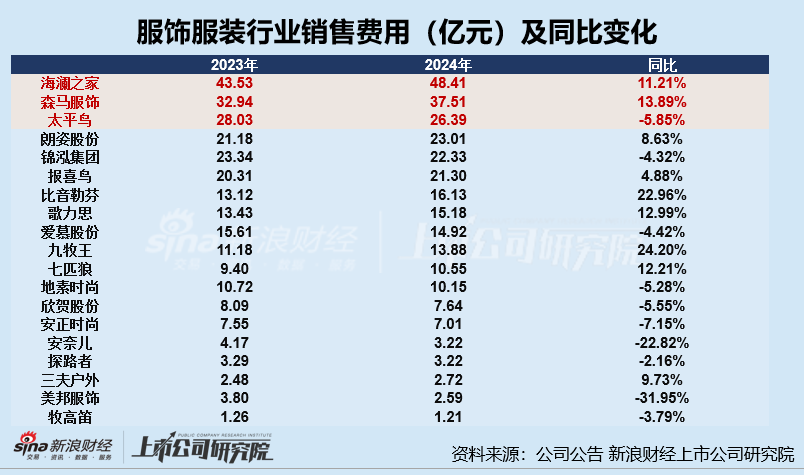
服饰年报|重营销侵吞利润 欣贺股份、锦泓集团、安奈儿超5成收入用作营销
Xin Lang Zheng Quan· 2025-05-09 08:33
Core Viewpoint - The textile and apparel industry is experiencing high marketing expenditures, with several companies significantly increasing their sales expenses, which raises concerns about the balance between marketing and research and development investments [1][4]. Sales Expenses Overview - The top three companies in terms of sales expenses for 2024 are Haier Home (48.41 billion), Semir Apparel (37.51 billion), and Taiping Bird (26.39 billion) [1][2]. - Sales expenses for Haier Home and Semir Apparel have increased by 11.21% and 13.89% respectively compared to the previous year [1][2]. - Notable increases in sales expenses are observed in Jiuwang (13.88 billion, up 24.2%), Biyinlefen (16.13 billion, up 22.96%), and Semir Apparel (37.51 billion, up 13.89%) [1][2]. Sales Expense Ratios - In 2024, companies like Xinhe (54.36%), Jinhong Group (50.8%), Annail (50.42%), and Geli Si (50%) are allocating over 50% of their revenue to marketing expenses, indicating high marketing spending [2][3]. - Jiuwang's sales expense ratio is 43.64%, reflecting a significant increase from the previous year [3]. Marketing vs. R&D Investment - The industry shows a trend of high marketing expenses compared to low R&D investments, with Xinhe's sales expense ratio at 54.36% and R&D expense ratio at only 4.4% [4]. - This imbalance contributes to product homogeneity and insufficient innovation, leading to inventory issues and price wars among brands [4].