
债券

Search documents
主流券商债市观点汇总
2025-08-07 05:18
Summary of Key Points from Conference Call Records Industry Overview - The records primarily discuss the bond market in China, focusing on the impact of recent policy changes, particularly the adjustment of value-added tax (VAT) on bond investments and its implications for government bonds, local government bonds, and financial bonds. Core Insights and Arguments 1. **Market Expectations and Interest Rates** - The July PMI data showed a decline, but corporate expectations are improving, suggesting that interest rates may remain volatile. The 10-year government bond yield is expected to fluctuate between 1.65% and 1.80% in the coming months [2][2][2]. 2. **Government Bond Supply and Monetary Policy** - The bond market may face significant pressure in August and September due to high government bond supply. If market adjustments worsen, the central bank may resume bond purchases to stabilize liquidity [2][2][2]. 3. **Impact of VAT on Bonds** - The new VAT policy will not affect existing bonds but may lead to increased demand for older bonds due to their tax advantages. This could push down the interest rates on these bonds, counteracting the tax impact on newly issued bonds [2][2][2]. 4. **Phased Repricing of New and Old Bonds** - The adjustment of VAT is expected to lead to a three-phase repricing of new and old bonds: - Phase 1: Narrowing of the spread as demand for older bonds increases - Phase 2: Widening of the spread due to reduced liquidity of older bonds - Phase 3: Long-term narrowing as tax benefits expire [5][5][5]. 5. **Market Volatility and Risk Factors** - The bond market is anticipated to remain volatile due to seasonal factors, government bond supply, and geopolitical uncertainties. The market is currently in a "hard mode" of trading, with the 10-year government bond yield expected to stabilize around 1.65% to 1.75% [3][3][3]. 6. **Investor Behavior and Market Dynamics** - Investors may shift their focus to older bonds due to the new tax regulations, which could lead to a temporary surge in demand for these securities. However, the overall sentiment remains cautious as the market adjusts to the new tax landscape [4][4][4]. Other Important but Potentially Overlooked Content 1. **Long-term Market Trends** - The bond market's recovery is contingent on fundamental economic conditions and the overall demand for bonds. A sustained recovery may require lower interest rates to support both supply and demand dynamics [4][4][4]. 2. **Credit Spread Adjustments** - The new VAT policy is expected to have a limited impact on credit spreads for non-financial corporate bonds, as their tax structure remains unchanged. This could lead to a narrowing of credit spreads in the market [5][5][5]. 3. **Future Policy Directions** - The focus of monetary policy is likely to shift from fiscal measures to monetary easing, which could further influence bond yields and market dynamics in the second half of the year [2][2][2]. 4. **Market Sentiment and Investment Strategies** - Investors are advised to remain flexible and consider tactical adjustments in their bond portfolios, especially in light of upcoming economic events and policy announcements that could impact market sentiment [2][2][2].
中信期货晨报:国内商品期货多数上涨,焦煤、硅铁涨幅居前-20250807
Zhong Xin Qi Huo· 2025-08-07 03:37
1. Report Industry Investment Rating - Not mentioned in the provided content 2. Core Viewpoints of the Report - For domestic assets, there are mainly structural opportunities; in the second half of the year, the policy - driven logic will be strengthened, and the probability of incremental policy implementation is higher in the fourth quarter. Overseas, concerns about the decline in US employment and economic slowdown are rising, increasing the expectation of Fed rate cuts in the second half of the year, which is beneficial to gold. In the long - term, the weak US dollar pattern continues, and non - US dollar assets should be watched while being vigilant against volatility jumps [5]. 3. Summary by Relevant Catalogs 3.1 Macro Highlights - **Overseas Macro**: In the early part of the week, the market's bets on Fed rate cuts decreased due to better - than - expected Q2 GDP, tariff easing, hawkish signals from the Fed's July meeting, and an increase in June PCE. However, the non - farm payrolls in July were below expectations, with significant downward revisions in May and June, and a rise in the unemployment rate under the backdrop of a three - month decline in the labor participation rate, increasing concerns about US economic downturn and Fed rate cuts. Attention should be paid to US inflation data on August 12, Fed Chair Powell's speech at the Jackson Hole meeting from August 21 - 23, August non - farm payrolls, and the selection of the Bureau of Labor Statistics director and Fed leadership changes [5]. - **Domestic Macro**: Against the backdrop of stable and progressive domestic economic operation in the first half of the year, the overall tone of the Politburo meeting in July was to improve the quality and speed of using existing policies, with relatively limited incremental policies. The comprehensive PMI in July was still above the critical point. The progress of negotiations between the US and economies such as China and Mexico should be monitored [5]. - **Asset Views**: For major asset classes, domestic assets present mainly structural opportunities. Overseas, concerns about US employment and economic slowdown are rising, increasing the expectation of Fed rate cuts, which is favorable for gold. In the long run, the weak US dollar pattern persists, and non - US dollar assets should be focused on while being cautious of volatility jumps [5]. 3.2 Viewpoint Highlights 3.2.1 Financial - **Stock Index Futures**: After events are settled, the crowding of funds is released. With insufficient incremental funds, the short - term judgment is oscillatory upward [6]. - **Stock Index Options**: The collar strategy strengthens the volatility structure. With upward - trending volatility, the short - term judgment is oscillatory [6]. - **Treasury Bond Futures**: The market continues to digest the information from the Politburo meeting. Concerns include unexpected tariffs, unexpected supply, and unexpected monetary easing. The short - term judgment is oscillatory [6]. 3.2.2 Precious Metals - **Gold/Silver**: As the US fundamentals weaken and the market returns to the logic of restarting the rate - cut cycle, precious metals are oscillating strongly. Concerns include Trump's tariff policy and the Fed's monetary policy. The short - term judgment is oscillatory upward [6]. 3.2.3 Shipping - **Container Shipping to Europe**: Attention should be paid to the game between the peak - season expectation and the implementation of price increases. Concerns include tariff policies and shipping companies' pricing strategies. The short - term judgment is oscillatory [6]. 3.2.4 Black Building Materials - **Steel**: With disruptions in coking coal supply, the futures price shows a strong performance. Concerns include the progress of special bond issuance, steel exports, and molten iron production. The short - term judgment is oscillatory [6]. - **Iron Ore**: With a healthy fundamental situation, the price is oscillating. Concerns include overseas mine production and shipment, domestic molten iron production, weather conditions, port ore inventory changes, and policy dynamics. The short - term judgment is oscillatory [6]. - **Coke**: The fundamentals have not changed significantly, and there is no expectation of price increases in the near future. Concerns include steel mill production, coking costs, and macro sentiment. The short - term judgment is oscillatory [6]. - **Coking Coal**: Supply disruptions continue, and the futures price has risen. Concerns include steel mill production, coal mine safety inspections, and macro sentiment. The short - term judgment is oscillatory [6]. - **Silicon Ferroalloy**: Market sentiment has improved, and the futures price is strongly oscillatory. Concerns include raw material costs and steel procurement. The short - term judgment is oscillatory [6]. - **Manganese Ferroalloy**: The sentiment in the black chain is positive, and the futures price is strongly oscillatory. Concerns include cost prices and foreign quotes. The short - term judgment is oscillatory [6]. - **Glass**: Spot sales and production are weak, and prices in Hubei are continuously decreasing. Concerns include spot sales and production. The short - term judgment is oscillatory [6]. - **Soda Ash**: Some soda ash plants have resumed production, and freight rates have declined. Concerns include soda ash inventory. The short - term judgment is oscillatory [6]. 3.2.5 Non - ferrous Metals and New Materials - **Copper**: The US non - farm payrolls data was below expectations, putting pressure on the copper price. Concerns include supply disruptions, unexpected domestic policies, less - than - expected dovishness from the Fed, less - than - expected recovery in domestic demand, and economic recession. The short - term judgment is oscillatory downward [6]. - **Alumina**: The number of warehouse receipts has increased, and the alumina price is under oscillatory pressure. Concerns include unexpected delays in ore resumption, unexpected over - recovery of electrolytic aluminum production, and extreme sector trends. The short - term judgment is oscillatory downward [6]. - **Aluminum**: Attention should be paid to the height of inventory accumulation, and the aluminum price is oscillating. Concerns include macro risks, supply disruptions, and less - than - expected demand. The short - term judgment is oscillatory [6]. - **Zinc**: With the rebound of black - series prices, the zinc price has slightly recovered. Concerns include macro - turning risks and unexpected increases in zinc ore supply. The short - term judgment is oscillatory downward [6]. - **Lead**: There is still support at the cost end, and the lead price is oscillating. Concerns include supply - side disruptions and a slowdown in battery exports. The short - term judgment is oscillatory [6]. - **Nickel**: The LME nickel inventory has exceeded 210,000 tons, and the nickel price is weakly oscillatory. Concerns include unexpected macro and geopolitical changes, Indonesian policy risks, and less - than - expected supply release. The short - term judgment is oscillatory downward [6]. - **Stainless Steel**: The price of nickel iron has continued to rise, and the stainless - steel futures price has closed up. Concerns include Indonesian policy risks and unexpected demand growth. The short - term judgment is oscillatory [6]. - **Tin**: The market atmosphere has improved, and the tin price has slightly rebounded. Concerns include the expectation of Wa State's resumption of production and changes in demand improvement expectations. The short - term judgment is oscillatory [6]. - **Industrial Silicon**: Market sentiment is fluctuating, and the silicon price is oscillating. Concerns include unexpected supply - side production cuts and unexpected photovoltaic installations. The short - term judgment is oscillatory [6]. - **Lithium Carbonate**: The market direction is unclear, and the lithium carbonate price is oscillating. Concerns include less - than - expected demand, supply disruptions, and new technological breakthroughs. The short - term judgment is oscillatory [6]. 3.3 Energy and Chemicals - **Crude Oil**: Geopolitical expectations are fluctuating, and attention should be paid to Russian oil risks. Concerns include OPEC+ production policies and Middle - East geopolitical situations. The short - term judgment is oscillatory [8]. - **LPG**: Supply pressure continues, and the cost end dominates the rhythm. Concerns include the progress of crude oil and overseas propane costs. The short - term judgment is oscillatory [8]. - **Asphalt**: The pressure on the spot market has increased, and the high - valued asphalt price has finally declined. Concerns include unexpected demand. The short - term judgment is downward [8]. - **High - Sulfur Fuel Oil**: High - sulfur fuel oil is regarded as weak. Concerns include crude oil and natural gas prices. The short - term judgment is downward [8]. - **Low - Sulfur Fuel Oil**: The price of low - sulfur fuel oil futures has weakened following crude oil. Concerns include crude oil and natural gas prices. The short - term judgment is downward [8]. - **Methanol**: The rebound of the coal end has had some impact, and methanol is oscillating. Concerns include macro - energy and upstream - downstream device dynamics. The short - term judgment is oscillatory [8]. - **Urea**: Domestic supply and demand cannot provide strong support, and export - driven effects are less than expected. Urea will oscillate in the short term. Concerns include export policy trends and the elimination of production capacity. The short - term judgment is oscillatory [8]. - **Ethylene Glycol**: Typhoons have affected the arrival rhythm, and the expectation in August has shifted to inventory accumulation. Concerns include the inflection point of port inventory accumulation and device recovery. The short - term judgment is oscillatory [8]. - **PX**: Market sentiment has cooled, and the price has returned to fundamental pricing. Concerns include the maintenance rhythm of downstream PTA and seasonal changes in gasoline profits. The short - term judgment is oscillatory [8]. - **PTA**: Multiple devices have unexpectedly shut down briefly, and the processing fee is still under pressure. Concerns include the planned shutdown of mainstream devices and the intensity of polyester joint production cuts. The short - term judgment is oscillatory [8]. - **Short - Fiber**: The improvement in downstream demand is limited, and there is an expectation of continuous inventory accumulation for short - fiber. Concerns include the procurement rhythm and start - up of downstream yarn mills. The short - term judgment is oscillatory [8]. - **Bottle Chip**: The production cut scale in August will continue to exceed 20%, and the support below the processing fee has increased. Concerns include the future start - up of bottle chips. The short - term judgment is oscillatory [8]. - **Propylene**: It mainly follows market fluctuations and oscillates in the short term. Concerns include oil prices and domestic macro factors. The short - term judgment is oscillatory [8]. - **PP**: The support from oil and coal still shows differences, and PP is oscillating. Concerns include oil prices and domestic and international macro factors. The short - term judgment is oscillatory [8]. - **Plastic**: There is a slight impact from the coal end, and plastic is oscillating. Concerns include oil prices and domestic and international macro factors. The short - term judgment is oscillatory [8]. - **Styrene**: The commodity sentiment has improved, and attention should be paid to the implementation of policy details. Concerns include oil prices, macro policies, and device dynamics. The short - term judgment is oscillatory [8]. - **PVC**: It has returned to weak - reality pricing, and the futures price is oscillating downward. Concerns include expectations, costs, and supply. The short - term judgment is oscillatory [8]. - **Caustic Soda**: The pressure on the spot market is emerging, and caustic soda is running weakly. Concerns include market sentiment, start - up, and demand. The short - term judgment is oscillatory [8]. 3.4 Agriculture - **Oils and Fats**: Yesterday, soybean oil was strong, and there is a strong expectation of a month - on - month increase in Malaysian palm oil production in July. Concerns include US soybean weather and Malaysian palm oil production and demand data. The short - term judgment is oscillatory upward [8]. - **Protein Meal**: During the peak season of aquaculture, rapeseed meal is stronger than soybean meal. Concerns include US soybean weather, domestic demand, macro factors, and Sino - US and Sino - Canadian trade disputes. The short - term judgment is oscillatory [8]. - **Corn/Starch**: Market sentiment continues to be weak, and the futures price is oscillating at the bottom. Concerns include less - than - expected demand, macro factors, and weather. The short - term judgment is oscillatory [8]. - **Hogs**: The expectation of production cuts has caused fluctuations, and the futures price has rebounded. Concerns include breeding sentiment, epidemics, and policies. The short - term judgment is oscillatory [8]. - **Rubber**: Positive macro factors have driven up the rubber price. Concerns include production - area weather, raw material prices, and macro changes. The short - term judgment is oscillatory [8]. - **Synthetic Rubber**: Tight raw material supply supports the futures price. Concerns include significant fluctuations in crude oil prices. The short - term judgment is oscillatory [8]. - **Pulp**: The weak trend of the futures price remains unchanged, and attention should be paid to reverse arbitrage during the decline. Concerns include macro - economic changes and fluctuations in US dollar - denominated quotes. The short - term judgment is oscillatory [8]. - **Cotton**: The impact of macro factors has weakened, and cotton price trading has returned to fundamentals. Concerns include demand and inventory. The short - term judgment is oscillatory [8]. - **Sugar**: The marginal supply pressure has increased, and the sugar price is under downward pressure. Concerns include imports. The short - term judgment is oscillatory [8]. - **Log**: The fundamentals have changed little, and it should be treated within a range. Concerns include shipment volume and dispatch volume. The short - term judgment is oscillatory downward [8].
债市早报:资金面均衡偏松,债市偏暖震荡
Sou Hu Cai Jing· 2025-08-07 03:11
Group 1: Domestic Bond Market - The new regulations for technology innovation bonds have led to explosive growth in issuance scale and improved market efficiency, with significant enhancements in liquidity and trading activity in the secondary market [2] - The margin balance for margin trading has surpassed 2 trillion yuan, reaching a ten-year high, indicating active participation from financing in the A-share market [2] Group 2: International Bond Market - The auction of 10-year U.S. Treasury bonds was unexpectedly weak, with a bid-to-cover ratio dropping to 2.35, the lowest since August 2024, and indirect bids from overseas investors at 64.2%, the lowest since January [6] - The yield on 10-year U.S. Treasury bonds remains at 4.22%, while the yield on 2-year bonds has decreased to 3.69%, resulting in an expanded yield spread [17] Group 3: Commodity Market - International crude oil futures prices have continued to decline, with WTI and Brent crude oil prices dropping to $64.35 and $66.89 per barrel, respectively [7] Group 4: Financial Operations - The central bank conducted a reverse repurchase operation of 138.5 billion yuan at a rate of 1.40%, resulting in a net withdrawal of 170.5 billion yuan on that day [8] - The money market showed a balanced and slightly loose condition, with the DR001 and DR007 rates rising to 1.315% and 1.456%, respectively [9] Group 5: Credit Bonds - Significant price deviations were observed in the secondary market for credit bonds, with certain industrial bonds experiencing declines of over 26% [13] - Companies such as Zhongyu Land and Poly Real Estate reported substantial losses and declines in contract sales, indicating potential risks in the real estate sector [14]

短期调整不改债券市场长期升势,30年国债ETF(511090)涨0.15%
Sou Hu Cai Jing· 2025-08-07 02:41
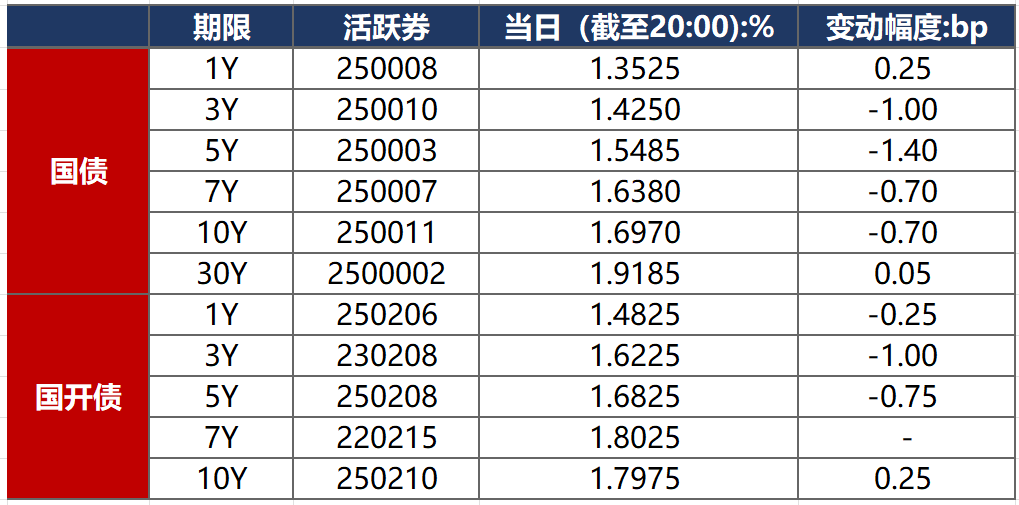
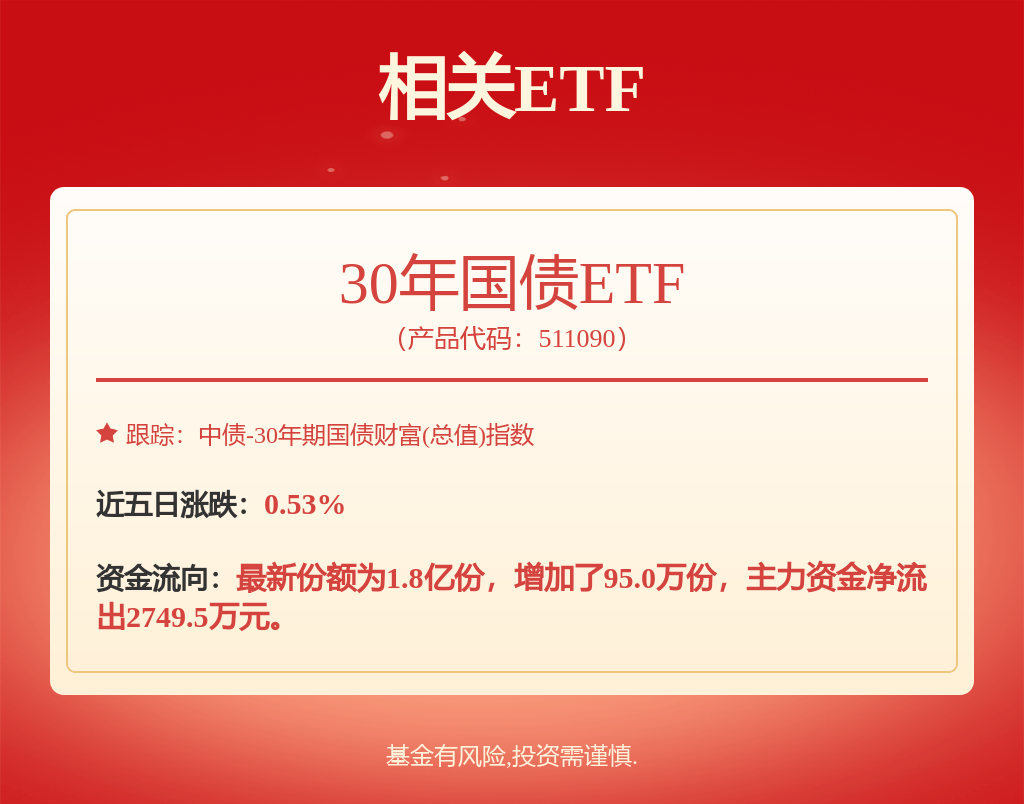
Group 1: Market Overview - The bond market experienced a slight increase on August 7, with the 30-year government bond ETF rising by 0.15% [1] - As of 10:00 AM, the latest price for the 30-year government bond futures contract was 119.54 yuan, up 0.20%, with a trading volume of 17,161 contracts and a total open interest of 100,808 contracts [1] - Other government bond futures also saw minor increases, with the 10-year bond up 0.07%, the 5-year bond up 0.06%, and the 2-year bond up 0.02% [1] Group 2: Monetary Policy and Interest Rates - The central bank conducted a 7-day reverse repurchase operation of 1,607 billion yuan, maintaining the bidding rate at 1.40% [1] - As of 4:30 PM the previous day, the yield on the 10-year government bond active coupon decreased by 0.5 basis points to 1.699%, while the yield on the 10-year policy bank bond increased by 0.1 basis points to 1.796% [1] - The yield on the 30-year government bond active coupon decreased by 0.05 basis points to 1.9175% [1] Group 3: Tax Policy Impact - Starting from August 8, 2025, interest income from newly issued government bonds, local government bonds, and financial bonds will be subject to value-added tax [2] - Existing bonds issued before this date will continue to be exempt from value-added tax until maturity, which may lead to an increase in forward yield expectations for bonds [2] - Despite the short-term impact of the tax policy, it is suggested that there will be opportunities to go long on long-term bonds, maintaining a bullish long-term outlook for the bond market [2] Group 4: Investment Products - The Pengyang 30-year government bond ETF is currently the first ETF tracking the 30-year government bond index, offering T+0 trading attributes [2] - This product allows investors to capitalize on short-term market fluctuations and can serve as a tool for adjusting portfolio duration or hedging equity positions [2] - In a low-interest-rate environment, this ETF is highlighted as a strong investment option for both cash management and portfolio adjustment [2]
美债,惊现“乌龙指”?
财联社· 2025-08-07 02:10
Core Viewpoint - The sudden spike in U.S. Treasury yields during the New York trading session has sparked discussions among industry professionals regarding its causes, with theories ranging from a trading error to preemptive rate-locking operations related to corporate bond issuances [1][3][4]. Group 1: Market Reaction - On the night before, the yield on the 10-year U.S. Treasury bond surged from 4.225% to 4.282% within five minutes, marking a 6 basis point increase in a low-volatility environment [4]. - The spike in yields was attributed to a potential "fat finger" error in the futures market, where a trader may have mistakenly sold 80,000 contracts instead of the intended 8,000, leading to significant market disruption [4][5]. - The erroneous sale of 80,000 contracts is estimated to represent a transaction worth between $8 billion and $10 billion, which is substantial even in the context of the $27 trillion U.S. Treasury market [5]. Group 2: Corporate Bond Issuance Impact - Some analysts suggest that the yield increase may have been influenced by market participants engaging in rate-locking operations ahead of corporate bond issuances, which typically involve selling Treasuries or futures to hedge borrowing costs [6]. - The yield spike coincided with a $42 billion auction of 10-year Treasuries, which ultimately showed weak demand, as evidenced by a bid-to-cover ratio dropping from 2.61 to 2.35, the lowest since August 2024 [6]. - The auction's awarded yield of 4.255% was the highest since December of the previous year, indicating a lack of buyer interest potentially exacerbated by the earlier market volatility [6]. Group 3: Trading Environment - The trading conditions on the day of the yield spike were characterized by typical August market traits, including low trading volumes and heightened sensitivity to sell-offs [7]. - The simultaneous movements in Treasury yields and the probability of Kevin Walsh becoming the next Federal Reserve Chair on prediction platforms suggest a complex interplay of market sentiments, although no direct correlation has been established [10].

机构继续看多,成交额超11亿元,国债ETF5至10年(511020)近5个交易日净流入3166.30万元
Sou Hu Cai Jing· 2025-08-07 01:36
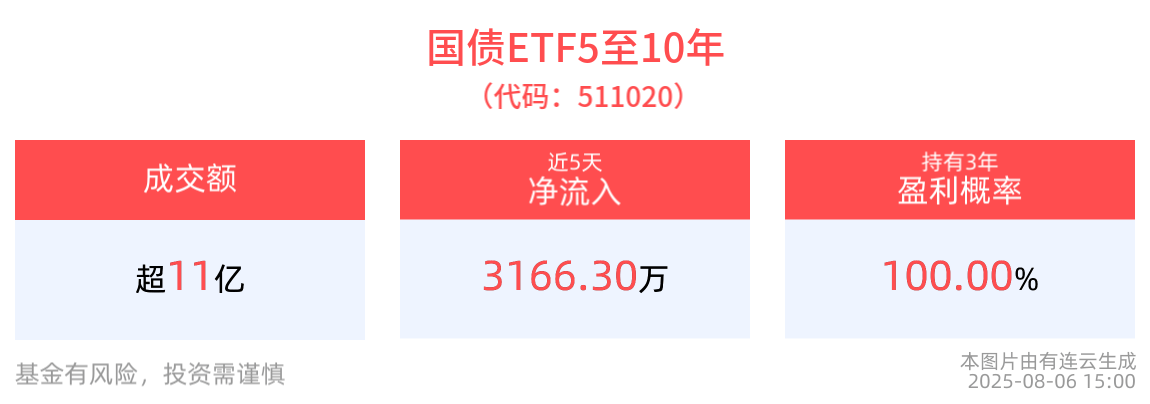
Group 1 - Henan issued 7-year general local bonds with a scale of 14.29449 billion, an issuance rate of 1.7300%, and a marginal multiple of 1.58 times, with an expected multiple of 2.26 [1] - Henan also issued 10-year ordinary special local bonds with a scale of 3.653 billion, an issuance rate of 1.7600%, and a marginal multiple of 1.29 times, with an expected multiple of 2.20 [1] - Agricultural Development Bank issued 392-day bonds with a scale of 15 billion, an issuance rate of 1.3900%, and a bidding multiple of 1.91 times, with a marginal multiple of 2.40 times [1] Group 2 - Shaanxi issued 10-year general local bonds with a scale of 6.50512 billion, an issuance rate of 1.7900%, and a marginal multiple of 2.66 times, with an expected multiple of 1.92 [1] - Shaanxi also issued 15-year ordinary special local bonds with a scale of 5.77238 billion, an issuance rate of 2.0100%, and a marginal multiple of 2.61 times, with an expected multiple of 2.06 [1] - The bond market is experiencing a decoupling from the stock market, with expectations for the 10Y national bond to return to around 1.65% after a rapid adjustment [3] Group 3 - As of August 6, 2025, the 5-10 year national bond active index increased by 0.03%, with the national bond ETF for 5-10 years showing a recent price of 117.31 yuan [3] - The national bond ETF for 5-10 years has seen a near 1-week cumulative increase of 0.25% [3] - The national bond ETF for 5-10 years has a latest scale of 1.488 billion [3] Group 4 - The national bond ETF for 5-10 years has seen a net value increase of 21.13% over the past 5 years [4] - The highest single-month return since inception for the national bond ETF for 5-10 years was 2.58%, with the longest consecutive months of increase being 10 months [4] - The management fee rate for the national bond ETF for 5-10 years is 0.15%, and the custody fee rate is 0.05% [4]
债券策略月报:2025年8月中债市场月度展望及配置策略-20250807
Zhe Shang Guo Ji· 2025-08-07 01:20
Group 1: Market Overview - The economic data for July showed a stable performance, with policy stimulus expectations driving market trends, particularly following the announcement of the Yarlung Tsangpo River hydropower station project, which has an investment scale of over 1 trillion yuan, leading to significant increases in equity and commodity markets [3][4] - The Shanghai Composite Index and Shenzhen Component Index recorded increases of 3.74% and 5.32% respectively, reflecting improved market risk appetite [3][4] - The bond market underperformed due to negative factors such as the "stock-bond seesaw" effect and unexpected tightening of liquidity around tax periods, resulting in rising yields across different maturities [4][11] Group 2: Macroeconomic Environment - The macroeconomic environment remains mixed, with GDP growth around 5.35% year-on-year, but nominal growth lagging at 3.9%, indicating a strong aggregate but weak microeconomic structure [5][34] - Manufacturing PMI for June was recorded at 49.7%, showing a slight recovery but still indicating contraction, while consumer demand showed signs of divergence with retail sales exceeding expectations [5][34] - The monetary policy stance has shifted towards a more hawkish tone, reducing expectations for further rate cuts in the near term [5][34] Group 3: Bond Market Outlook - Looking ahead to Q3, demand remains weak, and short-term policy stimulus expectations are retracting; however, the cooling of commodity and stock markets may provide support for the bond market [6][34] - There is potential for a 10-12 basis point downward adjustment in the yields of 10-year and 30-year government bonds, indicating attractive potential returns [3][6] - The bond issuance pressure is expected to increase in August, with net issuance projected to rise to 1.47 trillion yuan, although it may ease in September [21][34]
科创债新规落地满三个月:一二级市场持续活跃,良性循环促科技金融深度融合
Zheng Quan Ri Bao· 2025-08-07 00:07
Core Insights - The new regulations for technology innovation bonds (科创债) have led to significant growth in the primary market, with a notable increase in issuance scale and a more diverse range of issuers [1][2] - The secondary market has seen improved liquidity and trading activity, contributing to a positive feedback loop that enhances market efficiency and reduces issuance costs [1][4] Group 1: Primary Market Expansion - Since the announcement on May 7, 2023, a total of 683 technology innovation bonds have been issued, amounting to 871.52 billion yuan, representing year-on-year increases of 116.83% in quantity and 180.58% in scale [2] - The issuer structure has diversified, with various financial institutions, including commercial banks and securities companies, actively participating, and more medium-rated enterprises gaining access to financing [2][3] - A total of 30 banks have issued technology innovation bonds, with a combined scale of 230.3 billion yuan, showcasing the market's acceptance of issuers with varying credit ratings [3] Group 2: Secondary Market Activity - From May to July, the transaction volumes for technology innovation bonds were 204.1 billion yuan, 124.6 billion yuan, and 151.9 billion yuan, reflecting year-on-year growth rates of 214.92%, 116.10%, and 94.00% respectively [4] - The introduction of the first batch of 10 technology innovation bond ETFs on July 2 has provided a standardized investment path, enhancing market liquidity and supporting the overall ecosystem [5] - The total scale of these ETFs has reached 110.76 billion yuan, indicating strong market recognition and further improving liquidity in the secondary market [5]
10年期美债拍卖意外疲软
Zheng Quan Shi Bao Wang· 2025-08-06 23:49
Core Insights - The U.S. Treasury auctioned $42 billion in 10-year bonds with a winning yield of 4.255%, lower than the 4.362% from the July auction [1] - The bid-to-cover ratio fell to 2.35, the lowest since August 2024, indicating weak demand [1] - Indirect bids, reflecting foreign demand, dropped to 64.2%, the lowest since January this year, while direct bids from domestic investors fell to 19.6%, the lowest since April [1] - The allocation to primary dealers increased to 16.2%, the highest since August 2024, suggesting that primary dealers are filling the demand gap [1] - The auction results were deemed "unexpectedly poor," confirming market concerns about weak demand [1]
美国短期国债供应洪流来袭 赤字恐慌下市场能否顺利承接成焦点
Xin Jing Bao· 2025-08-06 17:47
美国东部时间8月5日,美国财政部公布,将于8月7日标售总规模1000亿美元的四周期限的国债,创该期 限国债发行的单次规模最高纪录。 这场"美国短期国债供应洪流"的背后,是美国政府上演的一场"借新还旧"的危险债务游戏。美国财政部 希望通过大量发行短期国债,来缓解旧债到期的压力。 当前,美国联邦债务总额达36.21万亿美元,占GDP的123%,远超国际货币基金组织的警戒线。其中公 众持有债务28.91万亿美元,短期国债占比21.29%,中长期债券占比51.22%。 美债市场稳定与否牵动全球市场神经 规模庞大的美国国债市场,吸引了全球投资者的参与。美国国债市场的稳定与否,将直接影响到全球金 融市场的信心。 东方金诚研究发展部高级副总监白雪在接受新京报贝壳财经记者采访时表示,本周美国财政部创纪录发 行千亿美元短期国债,旨在填补TGA账户(一般账户)5000亿美元的资金缺口,但过度依赖短债可能 引发"发债越多——利率波动越大——再融资成本越高"的恶性循环。 另一方面,中日等主要美债持有国持续减持趋势未改。这种"避险买盘"与"战略减持"的并存,使得海外 资金对美债的支撑具有脆弱性。这种供需失衡的状况将在中长期加剧美债的流 ...