券商

Search documents
两融余额超15年?资金都在冲锋的方向在这
Sou Hu Cai Jing· 2025-08-28 18:05
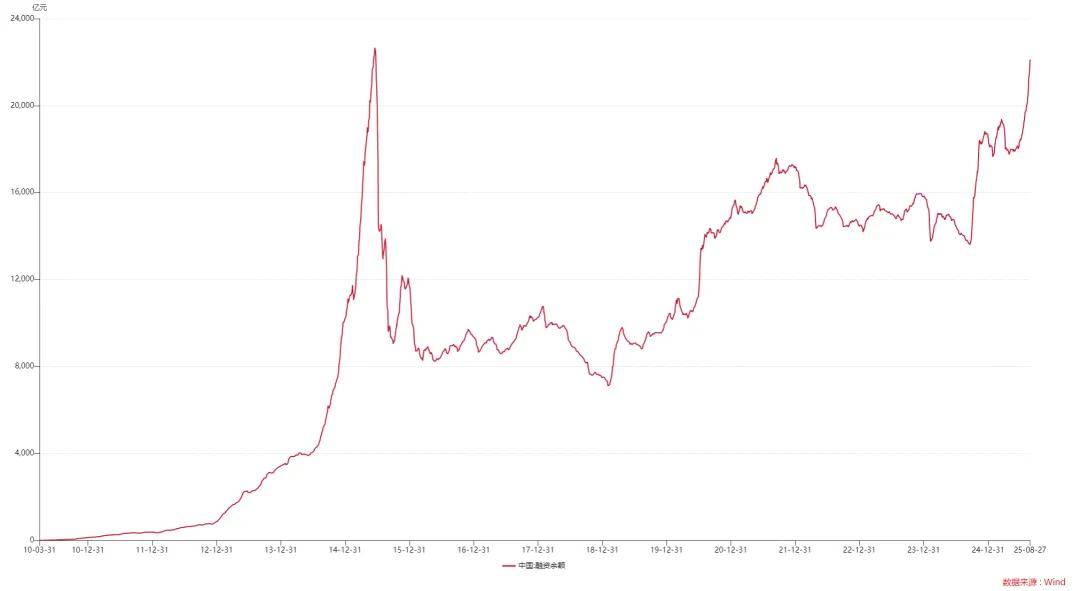
Core Viewpoint - The article discusses the role of margin financing in driving the current bull market, highlighting the industries that have attracted the most margin funds and their performance compared to the Shanghai Composite Index. Group 1: Margin Financing Dynamics - Margin financing has become a core driver of the current bull market, with high-risk speculative funds ignoring valuations and fundamentals, focusing solely on price trends [1][2]. - A cycle is created where industries with increased margin financing see price rises, leading to further investments and continued price increases, particularly in the A-share market without short-selling mechanisms [2][3]. Group 2: Historical Context and Current Trends - In the 2015 bull market, the top five industries by margin financing were: - Securities: 174.4 billion - Banking: 145.5 billion - Real Estate: 107.2 billion - Construction: 77.3 billion - Non-ferrous Metals: 75.7 billion - These five industries accounted for 26% of the total margin financing of 2.2 trillion [2]. - As of now, the margin balance in the Shanghai and Shenzhen markets has reached 2.2123 trillion, nearing the historical peak of 2.2664 trillion from June 2015 [3]. Group 3: Industry Performance Comparison - From June 2013 to June 2015, the Shanghai Composite Index rose by 158%, while the following industries outperformed: - Securities Index: 258% - Banking Index: 109% - Real Estate Index: 246% - Construction Index: 290% - Non-ferrous Metals Index: 187% [5]. - In the current bull market, the top five industries by margin financing are: - Securities: 131.8 billion - Electronic Components: 121.2 billion - Integrated Circuits: 107.8 billion - Application Software: 83.3 billion - Industrial Machinery: 82.9 billion [8][9]. Group 4: Valuation and Future Outlook - The current bull market has shifted focus from traditional sectors like banking and real estate to high-growth sectors such as communication, chips, AI, and robotics, which are now attracting margin financing [7][13]. - Valuations for these sectors are high, with PE ratios indicating that they are expensive: - Communication ETF: 48x - Integrated Circuit ETF: 197x - AI ETF: 230x - Robotics ETF: 81x [14][19][21]. - The article suggests that while these sectors are currently expensive, the strategy should focus on price trends rather than valuations for future investments [23].

资本热话丨板块轮动速度加快,A股投资者盼望“长期牛”
Sou Hu Cai Jing· 2025-08-28 12:28
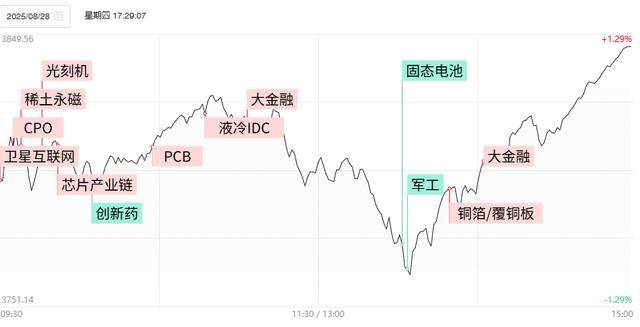
Group 1 - The A-share market experienced significant fluctuations with a notable increase in trading volume, reaching over 30 trillion yuan on two separate days this week, indicating a shift in market dynamics [1][2] - On August 25, the market saw a strong performance with the Shanghai Composite Index rising above 3883 points, driven by a surge in technology stocks, particularly in the semiconductor and rare earth sectors, alongside strong participation from financial stocks [1] - Following a slight decline on August 26, technology stocks rebounded on August 27, but profit-taking led to a rapid decline in indices, particularly affecting the semiconductor sector, which had previously seen significant gains [1] Group 2 - Since May, the Shanghai Composite Index has been on a strong upward trend without any significant corrections until the recent drop, marking the largest single-day decline since April 7 and the first occurrence of a 30 trillion yuan drop in this trend [2] - Analysts suggest that the current market adjustment does not signal the end of the bullish trend, as strong mid-year earnings from leading companies and high industry growth rates are expected to attract further investment [2] - Research from Tianfeng Securities indicates that short-term market corrections may present buying opportunities, while CITIC Securities highlights that the driving forces behind the current market rally are primarily institutional investors, focusing on industry trends and performance rather than retail investors [2]

惊心动魄的一天 | 谈股论金
水皮More· 2025-08-28 10:37
Core Viewpoint - The A-share market showed strong performance today, with major indices collectively rising, indicating a potential recovery phase despite some underlying volatility in individual stocks [2][5]. Market Performance - The Shanghai Composite Index rose by 1.14% to close at 3843.60 points, while the Shenzhen Component Index increased by 2.25% to 12571.37 points. The ChiNext Index surged by 3.82% to 2827.17 points, and the STAR Market 50 Index jumped by 7.23% to 1364.60 points [2]. - The total trading volume in the Shanghai and Shenzhen markets reached 29,708 billion, a decrease of 1,948 billion from the previous day [2]. Sector Analysis - The semiconductor sector, led by companies like Cambrian (寒武纪), saw significant gains, with Cambrian's stock price soaring to 1587 yuan per share, surpassing Kweichow Moutai [3]. - The TMT (Technology, Media, and Telecommunications) sector emerged as the market's focal point, with notable increases in communication and electronic components sectors, rising by 3.69% and 3.39% respectively [3][4]. - Despite the overall index performance, individual stock performance showed significant divergence, with over 4,000 companies experiencing price declines during the day [5]. Financial Sector Dynamics - The financial sector, particularly banks and insurance, played a crucial role in market regulation, with notable selling pressure observed during the trading session [6]. - The selling pressure in the financial sector is attributed to profit-taking from previous gains, the influx of speculative short-term funds, and a mismatch between current index performance and long-term market expectations [6]. External Market Influences - Nvidia's recent quarterly report, which showed disappointing results, led to a decline in its stock price, impacting sentiment in the semiconductor market [6]. - The Hong Kong market experienced a downturn, with the Hang Seng Index falling by 0.81%, influenced by intensified competition in the food delivery sector, affecting major players like Meituan and Alibaba [6]. Investor Sentiment and Strategy - The current market environment necessitates careful direction choices for investors, emphasizing the importance of avoiding impulsive trading behaviors [7]. - The appreciation of the Chinese yuan to 7.1216 is seen as a significant positive factor for assets denominated in yuan, although the timing of its impact on financial and real estate sectors remains uncertain [9].


牛市里,每次回调都是买入机会!
Sou Hu Cai Jing· 2025-08-28 10:28
Group 1 - The recent significant drop in A-shares is viewed as a normal market correction, providing buying opportunities for investors who missed earlier gains [2] - The market's trading volume remains high at approximately 3 trillion, indicating strong trading activity and a bullish market sentiment [3] - The artificial intelligence sector, along with agricultural and military industries, has shown notable performance, driven by favorable policies [3] Group 2 - The rise of brokerage stocks has significantly contributed to the overall market increase, reinforcing the bullish trend [3] - Historical patterns suggest that bull markets often rise amid skepticism, and significant corrections are typically seen as buying opportunities [3] - The current market environment necessitates a shift from a bearish to a bullish investment mindset, encouraging investors to buy on dips [3]

焦点复盘创指、科创50反包长阳再创3年新高,寒武纪股价突破1500元正式登顶“股王”宝座
Sou Hu Cai Jing· 2025-08-28 10:14
智通财经8月28日讯,今日58股涨停,21股炸板,封板率为73%,天普股份5连板,启明信息、德创环保 3连板,国光连锁7天4板,万通发展15天8板,济民健康11天7板,领益智造9天5板,北交所舜宇精工 30cm首板。市场午后V型反弹,科创50指数涨超7%,寒武纪、中芯国际双双创历史新高。沪深两市全 天成交额2.97万亿,较上个交易日缩量1948亿。盘面上,市场热点集中在算力和芯片方向,个股涨多跌 少,全市场超2800只个股上涨。板块方面,CPO、半导体、铜箔、PCB等板块涨幅居前,农业、减肥 药、服装、白酒等板块跌幅居前。截至收盘,沪指涨1.14%,深成指涨2.25%,创业板指涨3.82%。 主线热点 英伟达发布的最新季度财报显示,其单季度营收和净利润均同比增长超50%,均超出市场预期。虽然数 据中心业务略低于市场预期使得英伟达股价盘后承压,但GB300在内的新的Blackwell Ultra已经开始出 货并于Q3进一步增长,英伟达产业链持续得到资金聚焦,光模块方向的"易中天"三巨头,PCB产业链的 胜宏科技,以及液冷服务器方向的英维克等核心品种均继续向上刷新历史高点。此外英伟达再次强调跨 数据中心互联Sca ...
卖科技,买金融?资金用脚投票,投资者该如何应对
Sou Hu Cai Jing· 2025-08-28 08:45
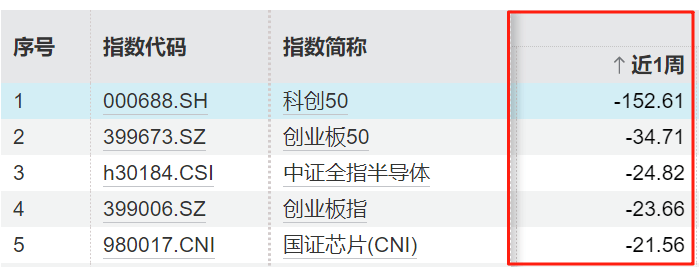
Core Viewpoint - The market is experiencing a debate on whether the technology sector is overvalued, with some investors believing in further upside while others anticipate a short-term pullback, leading to a significant outflow of funds from technology indices [1][2]. Fund Flow Trends - In the past week, major technology indices such as the Sci-Tech 50, ChiNext 50, and the CSI Semiconductor Index saw a total outflow exceeding 20 billion [1][2]. - Funds are shifting towards undervalued sectors like coal, chemicals, consumer goods, and medical devices, with a particular focus on brokerage and financial technology [2]. Financial Sector Performance - The financial sector has shown significant inflows, with financial-related ETFs increasing by 34.642 billion units this month, outperforming other industries [3]. - Leading ETFs in the financial sector, such as the Guotai CSI All-Share Securities Company ETF and the Huabao CSI All-Share Securities Company ETF, have each seen growth exceeding 5 billion units [3][4]. Brokerage Sector Insights - The brokerage sector is viewed as a benchmark for the A-share bull market, with historical data indicating that brokerage indices often lead market rallies, achieving average absolute returns exceeding 80% within six months of a breakout [4]. - The strong inflow into the brokerage sector reflects investor optimism regarding capital market reforms and improved brokerage performance, suggesting a long-term upward trend in the A-share market [4]. ETF Investment Strategies - Three investment strategies for financial ETFs are highlighted: 1. High elasticity route combining financial and technology sectors, focusing on the CSI Financial Technology Theme Index [6]. 2. Traditional route emphasizing performance support from brokerage firms, with significant profit growth reported in Q1 2025 [8]. 3. Value recovery route targeting the Hong Kong brokerage index, which currently has a lower valuation compared to A-shares [11]. Performance Metrics - The CSI All-Share Securities Company Index has seen substantial growth in net profit, with leading firms like Guotai and Haitong reporting a net profit increase of 391.8% [8]. - The Hong Kong brokerage index is valued at 16.96 times earnings, offering better value compared to A-share indices [11]. Market Outlook - The brokerage sector is expected to benefit from liquidity easing and profit growth, with both large and small brokerages likely to maintain strong performance [14].

中加基金固收周报︱科技主线带动牛市前进
Xin Lang Ji Jin· 2025-08-28 07:56
Market Overview - A-shares major indices rose last week, with trading volume remaining high [1] - Among 31 Shenwan first-level industries, communication, electronics, and comprehensive sectors performed relatively well [1] Macroeconomic Data Analysis - In July, national general public budget revenue reached 20,273 billion yuan, a year-on-year increase of 2.6%, with central and local revenues growing by 2.2% and 3.1% respectively, marking the highest monthly growth this year [3] - Government fund revenue in July increased by 8.9% year-on-year, while government fund expenditure growth was 42.4% [3] - The first account revenue showed positive tax revenue growth for four consecutive months, while non-tax revenue declined [3] - Land transfer revenue continued to grow positively, linked to local governments actively selling quality land [3] - Overall, broad fiscal expenditure maintained positive year-on-year growth supported by government debt, with net financing close to 8 trillion yuan in the first half of the year, an increase of 4.3 trillion yuan year-on-year [3] Stock Market Strategy Outlook - The market showed strong fluctuations last week, with liquidity remaining ample and a bullish trend supported by technology leaders [7] - Despite some concerns about economic data and stimulus expectations, favorable factors are outweighing these worries, with a supportive monetary policy environment [7] - The market is expected to maintain upward momentum without significant adjustments in August, with attention shifting to macro catalysts and trading indicators in September [7] Industry Insights - For defensive dividend sectors, it is recommended to reduce allocation or adjust the structure in the short term, favoring cyclical sectors with expected rebounds [9] - Focus on dividend stocks with catalysts, as well as stable and defensive attributes in Hong Kong stocks, financials, utilities, and precious metals [9] - In offensive sectors, technology remains a key focus, with opportunities arising from domestic policy stability and U.S. policy fluctuations [9] - Opportunities in domestic demand, technology, and overseas expansion are highlighted, with a focus on undervalued index-weighted stocks for potential capital inflows [8][9]
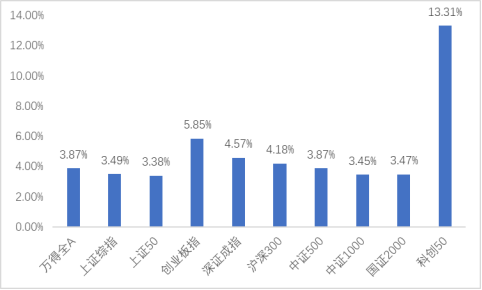
探底回升,金融科技ETF华夏(516100)近8个交易日吸金4.45亿
Xin Lang Cai Jing· 2025-08-28 07:54
Group 1 - The financial technology and brokerage sectors experienced a rebound after a dip, with the financial technology ETF Huaxia (516100) rising by 1.41% after hitting a low of 2.6%, resulting in a fluctuation of over 4% [1] - Key stocks within the financial technology ETF, such as Wealth Trend, Lingzhi Software, Yinzhijie, and Tianyang Technology, showed strong performance, while stocks like Dongxin He Ping, Tuoer Si, and Shenzhou Information saw their declines narrow [1] - The brokerage ETF fund (515010) increased by 0.93%, with all constituent stocks turning positive, particularly notable gains from Xinda Securities, Xiangcai Shares, and Great Wall Securities [1]
中国金融股为何上升?大摩:低风险但有增长,保险业将成领头羊
Hua Er Jie Jian Wen· 2025-08-28 07:51
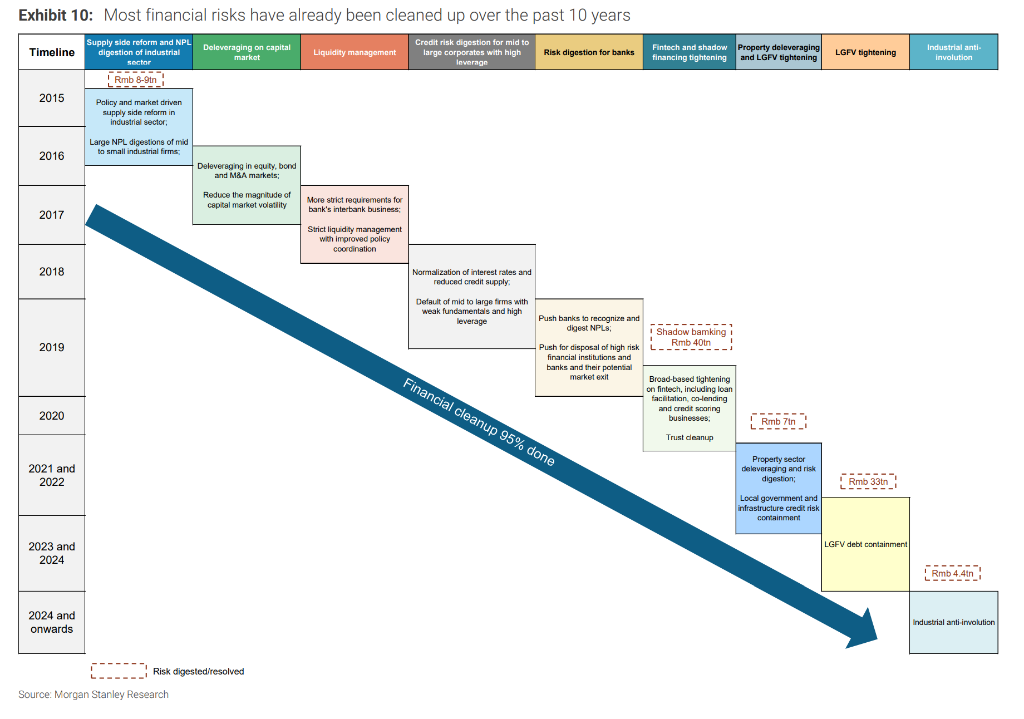
Core Viewpoint - Morgan Stanley believes that China's financial industry is entering a relatively healthy operating cycle, with the insurance sector expected to be the next to return to double-digit price-to-earnings ratios after brokerage firms, leading the financial stocks [1]. Financial Risk Reduction - High-risk financial assets have significantly decreased from 62 trillion RMB (30.2% of total financial assets) in 2017 to 21 trillion RMB (4.9%) in 2025, as a result of ten years of financial cleanup [2]. - It is anticipated that by the end of 2027, high-risk financial assets will further decline to approximately 15 trillion RMB, accounting for about 3% of total financial assets [4]. Profitability and Growth Expectations - The financial industry is expected to experience a rebound in income and profit growth due to stabilized asset yields and reduced risk premiums, with overall profit growth projected to return to a sustainable level of 6-7% [7]. - In an optimistic scenario, financial institutions could see loan and asset yields rise by 50-70 basis points over the next 3-4 years, supporting revenue growth of 7-8% and double-digit profit growth [7]. Insurance Sector Outlook - The insurance industry is particularly favored, with expectations of a return to double-digit price-to-earnings ratios, supported by strong insurance sales and stable balance sheet growth [11]. - If financial asset yields show recovery in the coming years, the valuation rebound for insurance companies may occur faster than currently anticipated [13]. Banking Sector Opportunities - Overall bank income and profit growth may return to 4-6% annually, with some mid-sized banks potentially achieving double-digit profit growth [14]. - The regulatory environment for brokerages has improved, leading to a revaluation back to double-digit price-to-earnings ratios, which is expected to drive the next round of stock price increases [14]. Market Dynamics - The average daily trading volume (ADT) in the A-share market is projected to exceed 2 trillion RMB, driven by changes in the regulatory environment, higher potential ADT, and improved corporate earnings expectations [16].
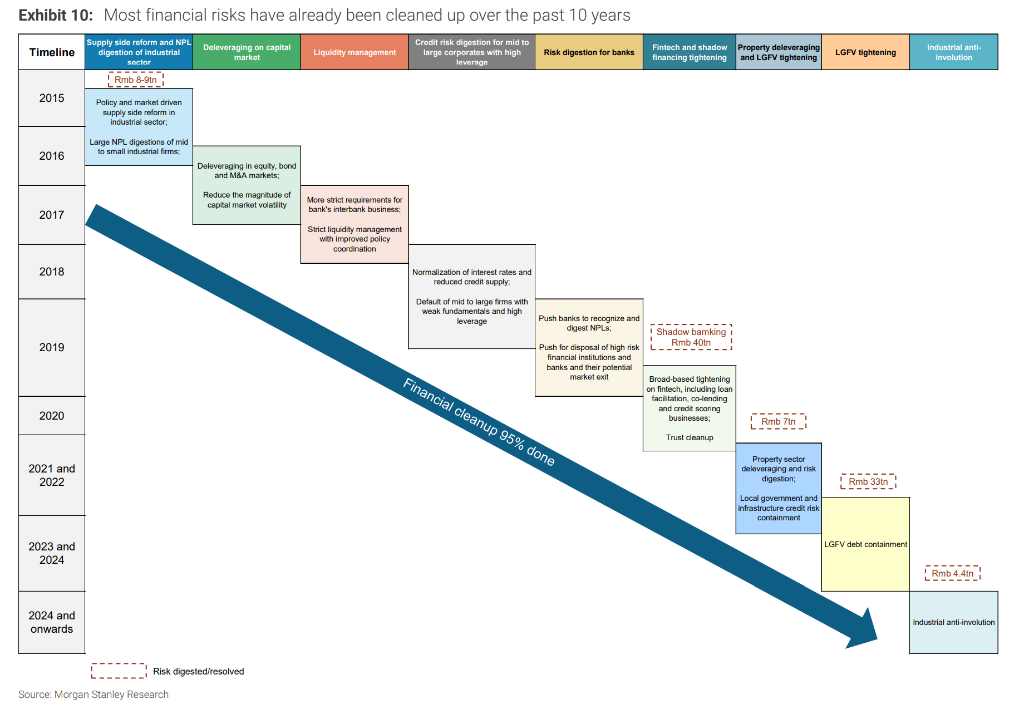
中国金融股估值为何上升?大摩:进入“低风险但有增长”模式,保险业将成领头羊
Hua Er Jie Jian Wen· 2025-08-28 07:28
Core Viewpoint - Morgan Stanley believes that China's financial industry is entering a relatively healthy operating cycle, with the insurance sector expected to be the next to return to double-digit price-to-earnings ratios after brokerage firms, leading the financial stocks [1] Financial Risk Reduction - High-risk financial assets have significantly decreased from 62 trillion RMB (30.2% of total financial assets) in 2017 to 21 trillion RMB (4.9%) by 2025 [2] - It is anticipated that by the end of 2027, high-risk financial assets will further decline to approximately 15 trillion RMB, accounting for about 3% of total financial assets [4] Profitability and Growth Expectations - The financial industry is expected to see a rebound in income and profit growth, with overall profit growth projected to return to a sustainable level of 6-7% [7] - In a bullish scenario, financial asset yields are expected to rise by 50-70 basis points over the next 3-4 years, supporting revenue growth of 7-8% and double-digit profit growth for financial enterprises [8] Insurance Sector Outlook - The insurance industry is particularly favored, with expectations of being the first to achieve valuation recovery, supported by strong insurance sales and stable balance sheet growth [12] - If financial asset yields show improvement in the coming years, the rebound in insurance company valuations may occur faster than currently anticipated [14] Banking Sector Projections - Overall bank revenue and profit growth may return to 4-6% annually, with some mid-sized banks expected to recover to double-digit profit growth [15] - The average daily trading volume (ADT) in the A-share market is projected to exceed 2 trillion RMB, driven by improved regulatory environments and higher corporate earnings expectations [16]