
农产品

Search documents
农产品早报-20251029
Yong An Qi Huo· 2025-10-29 00:48
Report Summary 1. Report Industry Investment Rating No investment rating information is provided in the report. 2. Core Views - **Corn**: New - season corn has been listed, with prices dropping significantly during the National Day. Short - term prices will be weak due to concentrated supply. Mid - to long - term prices depend on the game between farmers and traders. A large price drop may trigger farmers' resistance and price rebound [4]. - **Starch**: After the holiday, raw material prices are weakening, but starch price adjustment is limited by high production costs. Short - term prices are expected to decline, and inventory accumulation may restrict price rebound. Mid - to long - term prices depend on downstream consumption [4]. - **Sugar**: Internationally, Brazilian sugar supply pressure weighs on prices, and future production is uncertain. Domestically, prices follow international trends, and imported sugar arrival and processed sugar price cuts put pressure on the market [5]. - **Cotton**: The market is in a consolidation phase, waiting for demand verification. Without major macro - risks, the April low may be the long - term bottom, and the downside is limited. Attention should be paid to demand changes [7]. - **Eggs**: Supply pressure is partially relieved by orderly chicken culling and reduced new production. Demand increases as the weather cools. The price has rebounded slightly, and future price trends depend on the culling rhythm [13]. - **Apples**: New - season late - maturing Fuji apples are on the market. Yields are expected to decrease in some areas, and quality is affected by rain. The average opening price is above 3.5 yuan/jin, and the short - term price may fluctuate upward [17]. - **Pigs**: Weekend spot prices are stable with a slight increase. The short - term price rebounds due to factors like slow - down in slaughter and downstream demand. However, mid - term supply pressure remains due to insufficient capacity reduction [17]. 3. Summary by Commodity Corn/Starch - **Price Data**: From 2025/10/22 to 2025/10/28, corn prices in some regions decreased (e.g., Changchun down 20, Weifang down 20), and starch prices showed little change. Corn's import profit decreased by 25, and starch's processing profit remained at 112 [3]. - **Analysis**: New - season corn listing leads to short - term price weakness. Starch prices are affected by raw material prices and cost factors [4]. Sugar - **Price Data**: From 2025/10/22 to 2025/10/28, the spot price in Kunming decreased by 5, the basis in Liuzhou decreased by 38, and the number of warehouse receipts decreased by 100 [5]. - **Analysis**: International supply pressure and domestic import factors affect sugar prices [5]. Cotton - **Price Data**: From 2025/10/22 to 2025/10/28, the price of 3128 cotton decreased by 40, and the number of warehouse receipts increased by 96. The 32S spinning profit increased by 42 [7]. - **Analysis**: The market is in a wait - and - see state, and the downside is limited [7]. Eggs - **Price Data**: From 2025/10/22 to 2025/10/28, the basis increased by 65, and the price of live pigs increased by 0.07 [12]. - **Analysis**: Supply and demand factors jointly drive the price rebound, and the future depends on the culling rhythm [13]. Apples - **Price Data**: From 2025/10/22 to 2025/10/28, the spot price in Shandong remained at 7500, and the basis for different contracts changed [16][17]. - **Analysis**: Yield and quality issues affect prices, and the short - term price may rise [17]. Pigs - **Price Data**: From 2025/10/22 to 2025/10/28, prices in various regions increased (e.g., Henan Kaifeng up 0.15, Shandong Linyi up 0.30), and the basis increased by 320 [17]. - **Analysis**: Short - term price rebounds, but mid - term supply pressure remains [17].
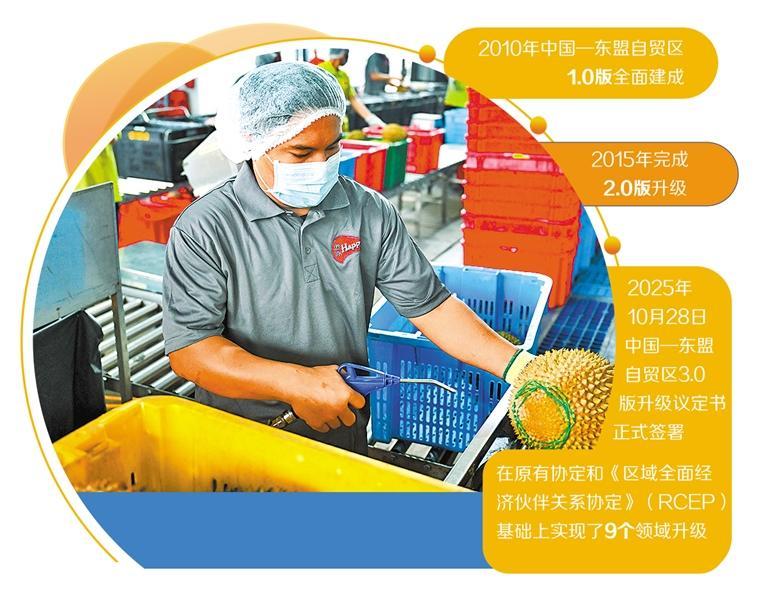
东盟自贸区进入新发展阶段
Jing Ji Ri Bao· 2025-10-28 22:20
Core Points - The signing of the China-ASEAN Free Trade Area 3.0 upgrade protocol during the 47th ASEAN Summit on October 28 aims to enhance economic cooperation and support multilateral free trade amidst global uncertainties [2][3] - The 3.0 version introduces significant upgrades in nine areas, marking a shift from previous agreements and indicating a new development phase for the China-ASEAN Free Trade Area [2][4] Summary by Sections Trade and Economic Cooperation - The original goal of the China-ASEAN Free Trade Area was to eliminate all tariffs and non-tariff barriers on goods trade, achieving over 90% zero tariffs by 2010 [3] - The 2.0 version aimed for a bilateral trade volume of $1 trillion and $150 billion in mutual investment by 2020, focusing on enhancing the liberalization of goods trade [3] Supply Chain Connectivity - The 3.0 version emphasizes supply chain connectivity, addressing issues such as the free flow of key products and services, infrastructure connectivity, and collaborative responses to supply chain disruptions [4][5] - It includes provisions related to digital economy, standards, and trade facilitation, which are crucial for building a secure and efficient regional supply chain [5] Emerging Topics - New areas of cooperation in the 3.0 version include digital economy and green economy, which extend beyond traditional trade topics [6][7] - The digital economy section covers measures for seamless digital trade, data management, and cybersecurity, aiming to enhance participation from small and medium enterprises [6] - The green economy focus includes environmental products and services, promoting sustainable economic growth and energy transition [7] Institutional Development - The 3.0 version introduces separate chapters on standards and regulations, competition, and consumer protection, reflecting the need for higher institutional standards in trade agreements [8] - It aims to unify standards and technical regulations, while also enhancing protections for online and tourism consumers, fostering a fair and transparent market environment [8]

央行恢复国债买卖,国债期货全面上行
Tebon Securities· 2025-10-28 14:49
Market Analysis - The A-share market experienced a volatile session, with the Shanghai Composite Index briefly surpassing 4000 points, reaching a high of 4010.73 points, the highest since August 2015, before closing at 3988.22 points, down 0.22% [3][4][6] - The Shenzhen Component Index closed at 13430.10 points, down 0.44%, while the ChiNext Index showed relative strength, closing at 3229.58 points, down 0.15% [3][6] - The market turnover was approximately 2.16 trillion yuan, an 8.1% decrease from the previous trading day, with 2362 stocks rising and 2904 stocks falling [3] Sector Performance - The technology sector maintained a strong performance, with military and computer sectors leading gains at 1.23% and 0.49% respectively [6] - The cross-strait integration index surged by 7.06%, driven by media coverage on Taiwan's future, leading to a wave of涨停 (limit-up) stocks in Fujian [6] - The non-ferrous metals sector faced a pullback due to a decline in international gold prices, which fell below 4000 USD/ounce [6] Bond Market - The central bank's resumption of government bond trading led to a collective rise in bond futures, with the 30-year contract closing at 115.96 yuan, up 0.55% [8] - The central bank conducted a net injection of 315.8 billion yuan through reverse repos, signaling a continued loose monetary policy [8] - The resumption of government bond trading is expected to boost market confidence, with attention on the specific scale and duration of future operations [8] Commodity Market - The South China commodity index closed at 2539.68 points, down 0.92%, with a clear divergence in performance among sectors [8] - Agricultural products, particularly apples, saw significant price increases due to supply concerns and upcoming consumption peaks, with apple futures closing at 9238 yuan/ton [8] - Precious metals experienced sharp declines, with gold and silver prices dropping by 4.20% and 3.32% respectively, attributed to reduced safe-haven demand and technical corrections [8] Investment Insights - The breakthrough of the Shanghai Composite Index above 4000 points and the introduction of measures to protect small investors are seen as positive signals for market confidence [10] - The upcoming Federal Reserve meeting and APEC conference are anticipated to influence market trends positively if outcomes are favorable [10] - The bond market is expected to remain supported by the central bank's actions, with a focus on liquidity signals from the Federal Reserve [10] Hot Investment Themes - Key sectors to watch include artificial intelligence, nuclear fusion, domestic chip production, quantum technology, and consumer goods, driven by technological advancements and policy support [12]
商品量化CTA周度跟踪-20251028
Guo Tou Qi Huo· 2025-10-28 14:34
Report Summary 1. Industry Investment Rating No industry investment rating is provided in the report. 2. Core Viewpoints - The proportion of long and short positions in commodities changed little this week. The factor strength of the non - ferrous sector rebounded, while that of the precious metals and agricultural products sectors declined. The non - ferrous sector was relatively strong in the cross - section, while the chemical and precious metals sectors were relatively weak [2]. - Different commodities have different trends in strategy net value and fundamental factors. For example, in the methanol market, the comprehensive signal was long this week; in the float glass market, it was neutral; in the iron ore market, it remained neutral; and in the Shanghai lead market, it remained short [4][7][9]. 3. Summary by Commodity Methanol - **Strategy Net Value**: Last week, the supply factor increased by 0.11%, the demand factor increased by 0.13%, the inventory factor increased by 0.02%, and the synthetic factor strengthened by 0.19%. The comprehensive signal this week is long [3][4]. - **Fundamental Factors**: High import volume of methanol signaled a short on the supply side; increased开工负荷 of acetic acid and MTBE plants signaled a long on the demand side; methanol inventory in East China ports signaled a long on the inventory side; the spot price of inland methanol signaled a short, and the East China basis signaled a long, with the spread side being neutral to short [4]. Float Glass - **Strategy Net Value**: Last week, the inventory factor decreased by 0.06%, the spread factor weakened by 0.07%, the profit factor increased by 0.06%, and the synthetic factor decreased by 0.05%. The comprehensive signal this week is neutral [7]. - **Fundamental Factors**: The capacity utilization rate of float glass remained flat, so the supply side remained neutral; the increase in the number of commercial housing transactions in 30 large - and medium - sized cities signaled a long on the demand side; continuous inventory accumulation of domestic float glass enterprises signaled a short on the inventory side; the continuous slight decline in the spot market and the stable recovery of the futures price made the spread side change from a strong short to neutral [7]. Iron Ore - **Strategy Net Value**: Last week, each factor remained flat compared with the previous week, and the comprehensive signal this week remained neutral [9]. - **Fundamental Factors**: Decreased shipments from FMG and Rio Tinto and reduced arrivals at northern ports strengthened the long feedback on the supply side; decreased daily port clearance volume and steel mill consumption of domestic sintered ore powder maintained the short signal on the demand side; inventory accumulation at major national ports slightly strengthened the short feedback on the inventory side; the increase in the spot price center strengthened the long feedback on the spread side, and both the inventory and spread sides maintained a neutral signal [9]. Shanghai Lead - **Strategy Net Value**: Last week, the supply factor decreased by 0.45%, the demand factor weakened by 0.44%, the spread factor decreased by 0.57%, and the synthetic factor weakened by 0.38%. The comprehensive signal this week remained short [9]. - **Fundamental Factors**: Reduced losses of SMM tax - free recycled lead and a lower ratio of waste battery prices to recycled refined lead prices maintained the short signal on the supply side; inventory reduction in LME and SHFE made the inventory side turn to a long feedback, maintaining a neutral signal; the narrowing of the near - far month discount and the expansion of the spot discount weakened the short feedback on the spread side, and the signal turned to neutral [9]. Sector - Specific Momentum and Structure - **Momentum and Structure Data**: The report provides momentum and structure data for different sectors, including the egg - related, non - ferrous, energy - chemical, agricultural products, equity index, and precious metals sectors. For example, the non - ferrous sector had a momentum sequence value of 0.06, a momentum cross - section value of 0.93, a term structure value of - 2.2, and a position - holding volume value of - 0.64 [5].
电商的西北战事
3 6 Ke· 2025-10-28 12:21
Core Insights - The Northwest region of China presents significant challenges for e-commerce due to its vast geography, sparse population, and seasonal agricultural production, leading to a slow online adoption rate [1][3] - Despite the high inbound logistics volume of 40,000 to 50,000 packages daily in cities like Jiuquan, the outbound volume is only 8,000 packages, indicating a supply-side shortfall [3][4] - E-commerce platforms like Pinduoduo and Douyin have been attempting to penetrate this market, but have faced various challenges, including high logistics costs and low supply chain concentration [3][8] E-commerce Market Dynamics - The local market has a strong consumption potential, particularly for platforms seeking growth, but the supply remains insufficient [3][4] - Pinduoduo has the highest share of inbound e-commerce packages, while Douyin shows the fastest growth rate [3] - The local agricultural sector is characterized by strong seasonality, with products like seeds in spring and fruits in autumn, complicating continuous sales efforts [5][8] Logistics and Supply Chain Challenges - High logistics costs are a major barrier to the online retail development in the Northwest, with local producers often preferring wholesale arrangements to mitigate these costs [10][11] - The logistics infrastructure is underdeveloped, leading to inefficiencies and increased costs for e-commerce operations [10][11] - Attempts to improve logistics through initiatives like drone delivery face significant hurdles, including high operational costs and limited range [12][14] Local Entrepreneurial Efforts - Local entrepreneurs, such as Wang Qiang, are adapting by entering the e-commerce space to boost their logistics volumes and mitigate losses from traditional delivery services [4][5] - The competitive landscape is intensifying, with price wars eroding profit margins for local sellers [7][8] - Entrepreneurs are leveraging platforms like Douyin for live-streaming sales, which are more suited to the seasonal nature of their products [5][7] Future Outlook - The Northwest's e-commerce landscape is evolving, but significant structural challenges remain, necessitating patience and strategic adjustments from both local businesses and e-commerce platforms [14][15] - Continued efforts from local authorities and logistics companies to enhance delivery services and infrastructure are crucial for the region's e-commerce growth [11][12]


云南裕超经贸有限公司成立 注册资本100万人民币
Sou Hu Cai Jing· 2025-10-28 11:12
Core Insights - Yunnan Yuchao Economic and Trade Co., Ltd. has been established with a registered capital of 1 million RMB and is represented by Wu Wenwen [1] Company Overview - The company operates in various sectors including the sale of rubber products, high-quality synthetic rubber, and manufacturing of rubber processing equipment [1] - It also engages in rubber product manufacturing, rubber crop planting, and provides technical services such as consulting and technology transfer [1] - Additional activities include general cargo warehousing (excluding hazardous chemicals), domestic container cargo transportation agency, and road cargo transportation station operations [1] Agricultural and Logistics Activities - The company is involved in the sale of agricultural products, including intelligent logistics equipment for agricultural products, and engages in the planting and retailing of fresh fruits [1] - It also participates in wholesale activities for daily necessities and edible agricultural products [1]
玉米和淀粉10月报-20251028
Yin He Qi Huo· 2025-10-28 11:03
1. Report Industry Investment Rating - No information provided about the industry investment rating in the report. 2. Core Views of the Report - Internationally, the new - season supply of global corn is loose. The production of US corn reaches a new high, and it will be in a long - term bottom - oscillating state. Brazilian corn has a good harvest, and its exports are higher than the same period last year [10][11][20]. - Domestically, the production of new - season corn increases, and the planting cost decreases. However, there is significant selling pressure in the Northeast. Feed demand is growing, and corn has a high cost - performance ratio. Deep - processing of corn starts to make profits, and the operating rate rebounds. The inventories of north - south ports are starting to rise, but the corn inventory in the north port is still low. Corn and starch will mainly fluctuate within a certain range in the future [27][32][55][73][78]. 3. Summary According to Relevant Catalogs 3.1 First Part: Preface Summary 3.1.1 Market Review - In October, the USDA report was not released. The yield per unit of US corn might continue to be lowered, but its production reached a new high, and it oscillated narrowly around 420 cents per bushel. In October, corn in Northeast and North China was concentrated on the market, and the spot price of corn dropped significantly. The purchase price at the north port fell to 2,070 yuan per ton and then rebounded to 2,120 yuan per ton in late October. The downstream demand for corn starch was still weak, and the starch inventory was at a historical high. However, due to the large drop in corn prices, the profit of starch enterprises was good, and the operating rate increased. The 01 - contract corn oscillated downward, and the price difference between corn and starch widened [4]. 3.1.2 Market Outlook - Internationally, the yield per unit of US corn might continue to be lowered later, and the 12 - contract of US corn had strong support at 400 cents per bushel. However, its production was at a high level, and the expected rebound height was limited. It would be in a long - term bottom - oscillating state. Domestically, a large amount of corn in Jilin would be on the market in November, and there was still room for the spot price of corn to fall. Considering the low inventories of traders and downstream enterprises and the possible reluctance of farmers to sell, the purchase price at the north port might have support at 2,050 yuan per ton. The 01 - contract corn might have strong support around 2,090 yuan. For starch, due to the stable price of by - products, deep - processing would still make profits after a large amount of new - season corn was on the market. However, considering the weak downstream demand and high inventory, the profit of starch enterprises was expected to shrink, and the 01 - contract starch was expected to oscillate narrowly. The price difference between corn and starch on the futures market might shrink [5]. 3.1.3 Strategy Recommendation - Unilateral trading: Go long on US corn with a light position around 400 cents per bushel. For the 01 - contract corn, conduct short - term long operations between 2,090 - 2,150 yuan, and for the 05 - contract, conduct short - term long operations between 2,190 - 2,250 yuan. - Arbitrage: Narrow the price difference between the 01 - contract corn and starch when it is between 270 - 320 yuan. - Options: Sell corn put options (c2601 - P - 2100) when the futures price falls to a low point [6]. 3.2 Second Part: International Corn Fundamental Situation 3.2.1 Global Corn New - Season Supply is Loose - The USDA monthly data was not released in October, so the September report was used as a benchmark. The September USDA report showed a loose supply. In September 2025, the global corn production decreased month - on - month but increased significantly year - on - year, and consumption increased. The expected global corn production in the 25/26 season was 1.287 billion tons, slightly lower than the previous month's 1.288 billion tons but higher than the previous year's 1.223 billion tons, with a year - on - year increase of 57.67 million tons. The total domestic consumption was 1.281 billion tons, higher than the previous year's 1.249 billion tons. The expected ending inventory was 281 million tons, lower than the previous year's 284 million tons, and the stock - to - use ratio was 21.97% [10]. 3.2.2 US Corn Production Reaches a New High, Domestic Ethanol Production Will Still Increase, and US Corn Oscillates at the Bottom - In the September report, the new - season area of US corn was revised up month - on - month, and the yield per unit was lowered. The area of US corn in the 25/26 season was about 98.7 million acres, higher than 97.3 million acres in August and much higher than 90.6 million acres last year. The yield per unit of US corn might continue to be lowered later, and the 12 - contract of US corn would oscillate at the bottom. The current ethanol production of US corn was at a high level, and the fuel ethanol inventory continued to decline. The net short position of US corn was also decreasing. As of September 23, the net short position of US corn was - 51,000 lots, and the 12 - contract of US corn was expected to have strong support around 400 cents per bushel [11][13]. 3.2.3 Brazilian Corn Has a Good Harvest, and Exports are Higher than the Same Period Last Year - The exports of Brazil's second - crop corn started to be higher than last year. In September, the exports were 6.98 million tons, and from January to September 2025, the cumulative exports of Brazil were 23.95 million tons, higher than 23.62 million tons in the same period last year. As of October 24, the import cost in December was 2,152 yuan per ton, and the import profit was 158 yuan per ton [20][22]. 3.3 Third Part: Domestic Corn Fundamental Analysis 3.3.1 New - Season Production Increases and Planting Cost Decreases, with Significant Selling Pressure in the Northeast - Currently, there is significant selling pressure on corn in the Northeast, and the spot price of corn oscillates at the bottom. In October, the main selling pressure came from the concentrated listing of farm - produced corn in Heilongjiang, corn in Liaoning, and corn in North China. The purchase price at the north port fell to a low of 2,070 yuan per ton. From mid - October to the end of October, due to the fact that a large amount of corn in Jilin was not on the market, the spot price of corn rebounded. However, from the end of October to early November, with the concentrated listing of corn in Jilin and North China, the spot price of corn is expected to fall again, and the purchase price may reach a low of around 2,050 yuan per ton in the short term. Since the inventories of traders, downstream feed enterprises, and deep - processing enterprises are low, there is an intention to build inventories. It is expected that the decline of corn in Jilin is limited, and the purchase price at the north port has support at 2,050 yuan per ton in the short term. In the 25/26 season, the land rent decreased, and the yield per unit increased, resulting in a significant increase in the national production. It is expected that the national corn production will increase by 11 - 12 million tons [26][27]. 3.3.2 Feed Demand Increases, and Corn Has a High Cost - Performance Ratio - Feed demand continues to grow. According to data from the Feed Industry Association, the feed production in September was 30.36 million tons, and the cumulative production from January to September was 246.53 million tons, a year - on - year increase of 6.6%. Data from the National Bureau of Statistics showed that the feed production in September was 31.29 million tons, and the cumulative production from January to September was 250.7 million tons, a year - on - year increase of 6.4%. The profit of pig farming continues to decline, but the pig inventory is higher than the same period last year. As of October 23, the self - breeding and self - raising profit per pig was - 149 yuan, and the profit from purchasing piglets was - 279 yuan. The inventory of commercial pigs in 123 large - scale farms in September was 36.85 million heads, a month - on - month increase of 1.44% and a year - on - year increase of 5.29%. The profit of white - feather broilers is still in the red, but the inventory of laying hens is still high. It is expected that feed demand will continue to increase in November [32]. 3.3.3 Deep - Processing of Corn Starts to Make Profits, and the Operating Rate Rebounds - In October 2025, the spot price of corn dropped significantly, and the price of by - products was relatively stable. Starch enterprises have started to make profits, and the operating rate has increased. However, the downstream demand is still weak, and the starch inventory is still at a historical high. As of October 22, the corn inventory of 96 deep - processing enterprises was 2.622 million tons, higher than 2.12 million tons in the same period last month but lower than 3.03 million tons in the same period last year. The operating rate of starch enterprises continued to rebound, reaching 55.62% as of October 22. The starch inventory is higher than last year, and the profit of starch enterprises has increased. It is expected that in November, with the continuous loose supply of new - season corn, the spot price of corn still has room to fall, and the profit of the starch industry will remain high. The downstream demand for starch is still weak, and the increase in the import volume of cassava starch will suppress the demand for corn starch [55][56]. 3.3.4 North - South Port Inventories Start to Rise, and the Corn Inventory in the North Port is Low - In October, the corn inventory in the north port started to rise, and the grain inventory in the south port also increased, but the corn inventory in the north port was still at a low level. As of October 17, the total corn inventory of the four northern ports was 959,000 tons, a decrease of 513,000 tons compared with the same period last year. It is expected that in November, due to the significant increase in the shipping volume, the inventory accumulation in the north port may be relatively slow. The domestic and foreign trade inventories of Guangdong Port and the inventories of imported sorghum and barley have increased, and the grain inventory is higher than the same period last year. With the successive listing of new - season corn, the inventories of north - south ports will continue to accumulate in November [73]. 3.3.5 Trading Logic of Corn and Starch - In October 2025, with the concentrated listing of corn, the spot price of corn dropped significantly. From the end of October to early November, there will still be selling pressure on corn, and the spot price is expected to fall, but there may be a rebound in mid - November. For starch, it is expected that starch enterprises will still make profits in November, but the profit margin will be lower than last year. The 01 - contract corn is likely to fluctuate between 2,090 - 2,150 yuan, and the 05 - contract is expected to fluctuate narrowly between 2,200 - 2,250 yuan. The price difference between corn and starch may fluctuate between 270 - 320 yuan [78]. 3.4 Fourth Part: Future Outlook and Strategy Recommendation 3.4.1 Corn - In October, Sino - US relations eased. The yield per unit of US corn may be lowered, and its price is far lower than the planting cost. It is expected that the 12 - contract of US corn has support at 400 cents per bushel, but considering that its production is still at a new high, it is expected to oscillate at the bottom in the 25/26 season. For domestic corn, due to the influence of rainfall in North China, the mildew rate of corn is high, and the selling pressure in North China is still significant in early November. From the end of October to early November, with the concentrated listing of corn in Jilin, the spot price of corn will still fall, but it is expected that the purchase price of 2,050 yuan per ton has strong support. In mid - November, the selling pressure in Jilin will ease, and corn prices will rebound slightly. It is expected that the purchase price at the north port will fluctuate between 2,050 - 2,130 yuan in November, the 01 - contract futures will fluctuate between 2,080 - 2,150 yuan, and the 05 - contract corn will fluctuate between 2,190 - 2,260 yuan [84][85]. 3.4.2 Starch - Due to the significant drop in the spot price of corn and the stable price of by - products, the profit of starch enterprises is good. However, the demand for corn starch is still weak, the inventory is at a high level in the past few years, and the import volume of cassava is high. After a large amount of new - season corn is on the market, the operating rate of deep - processing will increase, and it is difficult to reduce the starch inventory. The supply of deep - processing corn in North China will be sufficient, the operating rate will remain high, and the corn price will be relatively low. The profit of starch enterprises will remain high in November. It is expected that the bottom price of starch in North China is around 2,650 yuan per ton, and in the Northeast, it is around 2,400 yuan per ton. The 01 - contract starch will continue to oscillate at the bottom, and the price difference between the 01 - contract corn and starch is expected to fluctuate between 270 - 320 yuan [85]. 3.4.3 Trading Strategy - Unilateral trading: Go long on US corn with a light position around 400 cents per bushel. For the 01 - contract corn, conduct short - term long operations between 2,090 - 2,150 yuan. For the 05 - contract corn, conduct short - term long operations between 2,190 - 2,250 yuan. - Arbitrage: Operate the price difference between the 01 - contract corn and starch when it is between 270 - 320 yuan. - Options: Sell c2601 - P - 2100 options after the futures price falls [86].
全球大豆贸易格局生变 中国握紧定价权
Jin Tou Wang· 2025-10-28 10:50
Group 1 - The trade issues between the US and China have led to a significant reduction in US soybean exports to China, with Brazil filling the gap by increasing its soybean exports to China [1] - In the first eight months of this year, Brazil exported 77 million tons of soybeans to China, which accounted for a large portion of Brazil's first-season soybean production, while US exports to China were only 17 million tons [1] - The Brazilian government anticipates a 3.6% increase in soybean production for the next season, reaching nearly 178 million tons, as demand from China remains strong [1] Group 2 - Chinese buyers are currently delaying the confirmation of soybean purchases from Brazil due to high prices, with many companies suspending orders for December and January, affecting 8 million tons of soybean orders [2] - The high export prices and logistical challenges are prompting Chinese buyers to adopt a more flexible procurement strategy, indicating their strong bargaining power in the soybean market [2] - The situation reflects a shift in market dynamics, where Brazil's suppliers are reassessing their pricing strategies in response to China's purchasing behavior [2]
瑞丽市诚圣珠宝有限公司成立 注册资本100万人民币
Sou Hu Cai Jing· 2025-10-28 10:49
Core Viewpoint - Recently, a new company named Ruili Chengsheng Jewelry Co., Ltd. was established, indicating potential growth in the jewelry industry in Ruili City [1] Company Summary - The legal representative of Ruili Chengsheng Jewelry Co., Ltd. is Nie Yuanyuan [1] - The registered capital of the company is 1 million RMB [1] - The company’s business scope includes wholesale and retail of jewelry, arts and crafts, and various technical services [1] Industry Summary - The company is involved in multiple sectors including jewelry manufacturing, recycling, and repair services [1] - It also engages in agricultural product sales and internet technology services, reflecting a diversified business model [1] - The establishment of this company may signal an increase in competition and innovation within the local jewelry market [1]
瑞达期货红枣产业日报-20251028
Rui Da Qi Huo· 2025-10-28 10:18
Report Summary 1. Relevant Data - **Futures Market**: The closing price of the main futures contract for red dates was 10,445 yuan/ton, up 55 yuan; the main contract's open interest was 185,560 lots, up 440 lots; the net long position of the top 20 futures holders was -9,476 lots, down 4,648 lots; the number of warehouse receipts was 0; the effective warehouse receipt forecast was 0 [2]. - **Spot Market**: The unified - price of red dates in Kashgar was 7.5 yuan/kg (unchanged), in Alar was 7.15 yuan/kg (unchanged), and in Aksu was 6.75 yuan/kg (unchanged). The wholesale price of first - class grey dates in Hebei was 4.8 yuan/jin (unchanged), and in Henan was 4.75 yuan/jin (unchanged). The price of top - grade red dates in Henan was 10.5 yuan/kg (unchanged), in Hebei was 10.55 yuan/kg (down 0.09 yuan), and in Guangdong was 11.6 yuan/kg (unchanged). The price of first - class red dates in Guangdong was 10.6 yuan/kg (unchanged) [2]. - **Upstream Market**: The annual output of red dates was 606.9 million tons, up 318.7 million tons; the planting area was 1.993 million hectares, down 41,000 hectares [2]. - **Industry Situation**: The national red date inventory was 9,103 tons (weekly), up 94 tons; the monthly export volume was 2,283,671 kg, down 81,222 kg; the cumulative monthly export volume was 23,548,402 kg, up 2,283,671 kg [2]. - **Downstream Situation**: The cumulative quarterly sales volume of red dates of Hao Xiang Ni was - 2,981.06 tons, and the cumulative quarterly output increased by 36,480.43 tons year - on - year, with a growth rate of 1.47%, and the sales volume decreased by 34.59% year - on - year [2]. 2. Core View - New - season red dates have not been concentrated for harvest, but inland jujube merchants have gone to production areas to purchase. Some merchants are actively ordering new - season raw materials, while others are buying old stock. The acquisition progress in Hotan and Qiemo areas is relatively fast. The market's acceptance of new goods is worthy of attention. In the future, supply - side pressure will gradually emerge, and the probability of a continued decline in jujube prices increases. It is necessary to pay attention to the mainstream purchase price and quality of new jujubes [2]. 3. Industry News - The mainstream price of general - grade red dates in Aksu is 6.50 - 7.00 yuan/kg, in Alar is 6.80 - 7.50 yuan/kg, in some parts of Kashgar the floor price is 7.50 yuan/kg, in Hotan is 8.00 - 8.50 yuan/kg, in Qiemo is 7.50 - 8.00 yuan/kg, and in Ruoqiang is 8.00 - 8.50 yuan/kg, with high - quality products commanding higher prices. Affected by the solar terms, the harvest time of grey dates is earlier than last year, and the market focus is on the supply of goods available for making warehouse receipts [2].