
基建

Search documents
2026年一季度中国经济观察报告-毕马威
Sou Hu Cai Jing· 2026-02-12 06:22
Economic Overview - In 2025, China's economy reached a total of 140 trillion yuan, with a real GDP growth of 5.0%, achieving the target set at the beginning of the year. The GDP growth rate for the fourth quarter was 4.5%, down 0.3 percentage points from the third quarter, with external demand being the main support while consumption and investment remained weak [1][15][30] - The economic landscape showed four distinct divergences: supply-demand, internal-external demand, new-old momentum, and macro data versus micro perception. Traditional industries faced demand losses and slow capacity clearance, leading to supply-demand mismatches that affected prices and corporate profits [1][31] Investment Trends - Fixed asset investment in 2025 saw a historic decline of 3.8%, marking the first annual negative growth since records began. In the fourth quarter, investment dropped by 12.8%, significantly worse than the 6.2% decline in the third quarter. Real estate, infrastructure, and manufacturing investments all saw substantial declines [19][50] - The government is expected to implement policies to stabilize and support investment, with a focus on "investing in people" and encouraging private investment. The manufacturing sector is anticipated to see marginal improvements due to the "14th Five-Year Plan" emphasizing technological innovation and industrial upgrades [2][51][60] Consumption Insights - The total retail sales of consumer goods in 2025 grew by 3.7%, with a notable decline of 1.8% in the fourth quarter, marking the first quarterly negative growth since 2023. However, service consumption and self-indulgent consumption showed resilience, with service consumption growth reaching 5.5% [18][37] - The consumption market is expected to continue its shift towards new and quality-driven consumption, with policies aimed at promoting green, intelligent, and elderly-friendly consumption [2][18] Export Performance - Exports in 2025 increased by 5.5%, with a trade surplus of nearly 1.2 trillion USD, a historical high. High-end manufacturing emerged as the core driver of exports, supported by strong demand from ASEAN, Africa, India, and other regions [21][30] - The government aims to address trade imbalances and enhance the quality of exports while navigating the challenges posed by global trade protectionism [21][30] Fiscal Policy - Public fiscal revenue in 2025 decreased by 1.7%, falling short of the initial budget growth target of 0.1%. Public expenditure growth was only 1.0%, the lowest completion rate on record at 96.8% of the budget [22][65] - The government plans to increase fiscal support for infrastructure and social welfare, with a focus on stabilizing investment and consumption in 2026 [22][65] Monetary Policy - In 2025, monetary policy was characterized by moderate easing, with a total of 50 basis points in reserve requirement ratio cuts and 10 basis points in interest rate cuts. The focus for 2026 will be on stabilizing expectations and promoting transformation [23][60] - The central bank is expected to maintain a flexible and effective monetary policy, with potential further cuts in interest rates and reserve requirements to support economic recovery [23][60]


沈阳公用发展股份股价波动上行 区域政策或成潜在利好
Jing Ji Guan Cha Wang· 2026-02-12 06:20
Core Viewpoint - Shenyang Public Utilities Development Co., Ltd. (00747.HK) has shown a fluctuating upward trend in its stock price over the past week, with a recent price of HKD 0.11, reflecting a 10.00% increase over five days, outperforming the Hang Seng Index [1] Group 1: Stock Performance - The stock price increased by 15.00% on February 9, followed by a 4.35% pullback on February 10, and closed flat at HKD 0.11 on February 11 [1] - The average daily trading volume remains low, below HKD 150,000, with a turnover rate between 0.01% and 0.20%, indicating limited market participation [1] - The current stock price is near the upper Bollinger Band (HKD 0.116), with the KDJ indicator showing a J line at 48.37, indicating a neutral zone, while the MACD histogram has turned positive, suggesting strong short-term momentum [1] Group 2: Recent Events - From February 4 to 7, 2026, Liaoning Province held a series of conferences focusing on policy support and financing for key industries such as automotive, machinery, and power equipment [2] - As a local infrastructure company, Shenyang Public Utilities Development may indirectly benefit from regional policy expectations, although the company has not released any direct announcements related to these events [2]
历史的“春节后”
Guotou Securities· 2026-02-11 10:42
Group 1 - The report highlights a high probability of style switching in A-shares around the Spring Festival, with a historical tendency for value and large-cap stocks to dominate before the festival, while growth and small-cap stocks tend to perform better afterward [1][8][23] - From 2010 to 2025, there were only two years (2020 and 2022) without a clear switch between growth and value styles, indicating a strong historical pattern of style rotation [8][18] - The report identifies that in 62.5% of the years analyzed, there was a significant switch from large-cap to small-cap stocks after the Spring Festival, suggesting a high likelihood of this trend continuing [1][8] Group 2 - Historical analysis shows that the sectors leading in performance before the Spring Festival often do not repeat their success in the following month, indicating a high probability of sector rotation [2][8] - The report notes that in years where value stocks led after the Spring Festival (2011, 2016, 2021), there were common factors such as liquidity tightening or unexpected risk events that suppressed growth stocks [2][23] - The macro environment in 2015 and 2019, characterized by ample liquidity and weak fundamentals, is compared to the upcoming 2026 Spring Festival, suggesting potential for similar market dynamics [2][3] Group 3 - The report assesses that the current market style is shifting towards value before the 2026 Spring Festival, with technology and growth stocks receding [3][4] - It suggests that if the value style continues post-festival, it will be driven by expectations of domestic economic recovery and policy support, although there are concerns regarding inflation metrics [3][4] - The analysis indicates that the performance of small-cap stocks is expected to rebound significantly after the Spring Festival, driven by liquidity recovery and risk appetite [18][19]
中国中铁:中国中铁始终将自身发展深度融入国家战略部署要求
Zheng Quan Ri Bao· 2026-02-10 12:13
Group 1 - The core viewpoint of the article highlights that China Railway, as a leading enterprise in the infrastructure industry, integrates its development deeply into national strategic deployments and policies aimed at expanding domestic demand [1] - China Railway emphasizes its commitment to leveraging its resource advantages to actively contribute to national policy directions [1]

宏观经济信用观察(二零二五年年报):增长目标顺利实现 结构转型持续深化
联合资信评估· 2026-02-10 10:25
Economic Performance - In 2025, China's GDP reached 140.19 trillion yuan, growing by 5.0% year-on-year, achieving the annual growth target[10] - The quarterly GDP growth rate showed a decline from 5.4% in Q4 2024 to 4.5% in Q4 2025, primarily due to high base effects and policy timing[10] - Consumption contributed 2.6 percentage points to GDP growth, with a contribution rate of 52%, up from 47% in 2024[11] Investment Trends - Total fixed asset investment was 48.52 trillion yuan, down 3.8% year-on-year, with infrastructure and real estate investments declining significantly[20] - Manufacturing investment grew by only 0.6%, indicating a slowdown in growth momentum[20] - Infrastructure investment (excluding electricity) decreased by 2.2%, reflecting deeper local government debt issues[21] Export and Import Dynamics - Total goods trade reached 6.35 trillion USD, a 3.2% increase, with exports at 3.77 trillion USD, growing by 5.5%[27] - High-tech product exports rose by 13.2%, contributing 2.4 percentage points to overall export growth[27] - The diversification of export markets has strengthened, with ASEAN becoming the largest export market for three consecutive years[27] Price and Employment - CPI remained flat year-on-year, while PPI decreased by 2.6%, indicating low inflation and ongoing deflationary pressures[30][31] - The average urban unemployment rate was 5.2%, slightly below the target of 5.5%, with seasonal fluctuations observed throughout the year[42] Credit and Financing - Social financing increased by 35.6 trillion yuan, with a year-on-year growth of 8.3%[45] - Government bond financing rose by 2.5 trillion yuan, while household loans decreased by 2.3 trillion yuan, indicating a shift in financing dynamics[45]
中国财政资金支出结构悄然生变:更多资金投资于人,基建支出下滑明显
第一财经· 2026-02-10 04:58
Core Viewpoint - The article discusses the significant changes in China's fiscal spending structure, highlighting a decline in infrastructure investment and a shift towards human capital investment amid increasing fiscal revenue-expenditure contradictions [3]. Fiscal Spending Trends - In 2025, key infrastructure-related expenditures such as agricultural, forestry, water, and transportation saw declines of 13.2%, 5%, and 0.7% respectively, leading to an overall decrease of approximately 7.8% compared to 2024 [4]. - The total fixed asset investment in China for 2025 was about 48.5 trillion yuan, a decrease of 3.8% year-on-year, with infrastructure investment (excluding certain utilities) down by 2.2% [4][5]. Debt and Investment Dynamics - The new special bond limit for 2025 is set at 4.4 trillion yuan, with only 2.5 trillion yuan allocated for infrastructure projects, a reduction of over 400 billion yuan from 2024 [4]. - The focus of government debt funding is shifting towards resolving existing hidden debts, resulting in reduced incremental funding for infrastructure [4]. Future Outlook for Infrastructure Investment - The 2026 economic work plan aims to stabilize investment, with expectations for infrastructure investment growth to rebound to 8% due to low base effects and the implementation of new policy financial tools [9][10]. - Analysts predict a potential recovery in infrastructure investment growth rates to a range of 3% to 4.5% as the sector undergoes a "bottoming out and structural reshaping" process [11].
中国财政资金支出结构悄然生变:更多资金投资于人,基建支出下滑明显
Di Yi Cai Jing Zi Xun· 2026-02-10 03:29
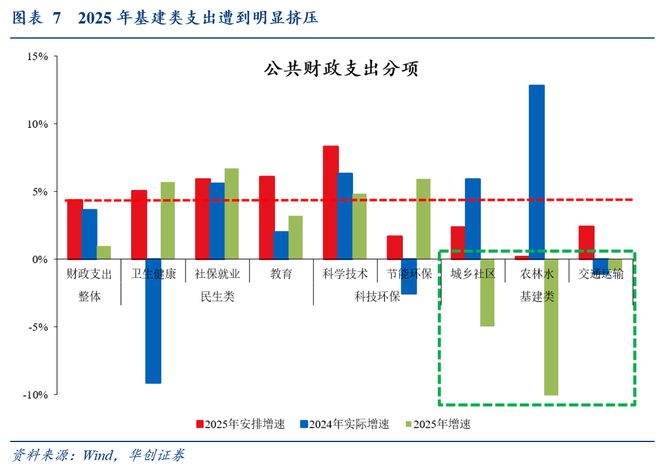
在财政收支矛盾加大背景下,中国财政资金支出结构正发生明显变化,更多的财政资金投资于人,去年 全国财政资金中投向基础设施建设方面的资金出现明显下滑。 目前政府财政资金投向基建领域,一个是观察全国一般公共预算支出中的基建类相关支出;另一个则是 观察全国政府性基金支出中的,用于项目建设的地方政府专项债券资金支出。 根据财政部最新数据,在2025年全国一般公共预算支出主要支出科目中,与基建密切相关的农林水支 出、城乡社区支出、交通运输支出分别同比下降13.2%、5%和0.7%。这三项基建类支出合计规模较2024 年下降约7.8%,明显低于2025年全国一般公共预算支出平均增速(1%)。 数据来源:华创证券研报(下同) 根据中诚信国际研究院数据,从预算安排来看,2025年新增专项债限额4.4万亿元,其中0.8万亿元为用 于化债的额度,据估算用于清欠政府拖欠企业账款的专项债额度约0.5万亿元、土储专项债额度约0.6万 亿元左右,由此估算的用于基础设施建设项目的专项债额度仅2.5万亿元,较2024年(3.12万亿)减少 4000多亿元。 中诚信国际研究院院长袁海霞告诉第一财经,2025年政府债务资金侧重于化解存量隐性债务, ...
投资于物和投资于人紧密结合,促进有效投资
2 1 Shi Ji Jing Ji Bao Dao· 2026-02-09 22:57
Group 1 - The State Council's recent meeting emphasizes the need to innovate and improve policy measures to promote effective investment, focusing on utilizing central budget investments, ultra-long-term special bonds, local government special bonds, and new policy financial tools [1][2] - The National Bureau of Statistics indicates a projected 3.8% year-on-year decline in national fixed asset investment by 2025, with traditional sectors like infrastructure and real estate seeing reduced investment, while high-tech manufacturing and services are experiencing growth [1][2] - The meeting's deployment aims to stabilize investment and enhance quality and efficiency in the long term, utilizing a combination of policy tools to create a new rhythm for investment stability [1][5] Group 2 - Effective investment requires ensuring ample funding, with a focus on a collaborative investment funding guarantee system involving national guidance, market participation, and cooperation between central and local governments [2][4] - The meeting identifies five key areas for investment: infrastructure, urban renewal, public services, emerging industries, and future industries, promoting a balance between strengthening existing capabilities and addressing shortcomings [3][4] - Various market entities must work together, with central enterprises expected to lead in strategic emerging industries, while policies are in place to support private investment, thereby lowering financing barriers and costs [4][5] Group 3 - The meeting highlights the importance of timely macroeconomic policies and the need for early arrangement of fiscal funds to ensure effective project implementation [4][5] - The comprehensive deployment from the meeting aligns with the central economic work conference's directive to combine investments in physical and human capital, aiming for a more efficient accumulation of material capital and systematic cultivation of human capital [5]
建筑材料行业2026年投资策略:重点关注电子布板块,重视第二增长曲线
Southwest Securities· 2026-02-08 06:31
Core Viewpoints - The traditional building materials sector is expected to bottom out and recover due to a combination of factors such as the slowdown in new real estate demand and the gradual release of stock renovation demand, with consumer building materials benefiting significantly [4] - The special fiberglass electronic cloth sector is experiencing high demand due to the explosion of computing power needs, and companies with outstanding technical advantages and production capacity reserves are favored [4] - Infrastructure investment opportunities are promising, particularly in sectors related to urban renewal and underground pipeline construction [4] Cement Sector - Cement demand is expected to stabilize as confidence in the housing market strengthens, with a potential bottoming out of demand [26][29] - The production of cement is declining due to weak demand from the real estate sector, with a forecasted production volume of 1.693 billion tons in 2025, down 6.9% year-on-year [29] - The average price of cement is recovering due to industry self-discipline and effective supply control, with policies aimed at eliminating backward production capacity expected to accelerate this trend [33] Fiberglass Sector - The fiberglass sector is expanding its application fields, with strong demand for electronic fiberglass cloth driven by the growth of computing power needs [36][41] - The apparent consumption of fiberglass in China has increased from 187,000 tons in 2012 to 624,000 tons in 2023, with a compound annual growth rate of 11.56% [40] - The demand for high-performance computing and AI applications is significantly increasing, leading to a structural change in demand for fiberglass materials [44] Glass Sector - The demand for flat glass is under pressure due to a decline in housing completion areas, with consumption levels expected to continue decreasing [51] - The glass industry is facing high inventory levels, with total inventory reaching 58.227 million weight boxes as of December 11, 2025, indicating a need for supply-side adjustments [51] - The photovoltaic glass sector is experiencing growth, but overall glass prices are under pressure due to capacity expansion and declining demand [51] Consumer Building Materials - The consumer building materials sector is seeing a release of stock demand, with policies aimed at stabilizing the housing market expected to support sales and completion rates [62] - The renovation demand is anticipated to recover as macroeconomic policies stimulate consumption, with a significant portion of demand coming from homes built 10-15 years ago [66] - The urban renewal initiatives and the establishment of a housing pension system are expected to further boost demand for consumer building materials [66] Recommended Investment Targets - Companies such as Rabbit Baby (兔宝宝, 002043) and Beixin Building Materials (北新建材, 000786) are highlighted for their strong market positions and competitive advantages in the consumer building materials sector [4][103] - International Composites (国际复材, 301526) is recommended for its strong performance in the special fiberglass cloth sector [4] - Companies like Jinjing Technology (金晶科技, 600586) and Puhua Co., Ltd. (濮耐股份, 002225) are noted for their promising second growth curves in TCO glass and high-activity magnesium oxide businesses, respectively [4]





1月资金行为跟踪:资金再平衡:公募和融资的预期差
ZHESHANG SECURITIES· 2026-02-05 07:28
- The report does not include any specific quantitative models or factors for analysis, construction, or testing results. It primarily focuses on market dynamics, fund flows, and sectoral trends without detailing quantitative methodologies or factor-based approaches[1][2][3]