
有色金属业

Search documents
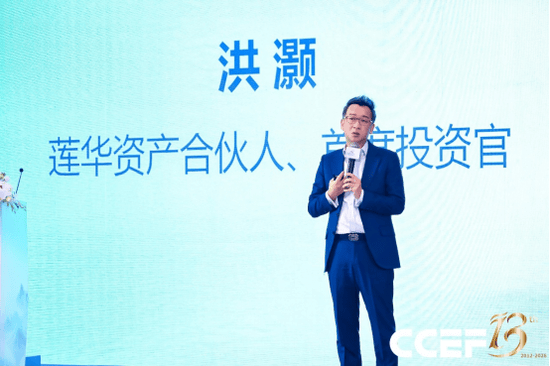
洪灏:当前全球主要央行均进入扩表周期,流动性充沛叠加周期顶峰效应,大概率将催生一轮“伟大的泡沫”
Sou Hu Cai Jing· 2026-01-11 13:09
Core Viewpoint - The presentation discusses the outlook for 2026, emphasizing the implications of the Federal Reserve's monetary policy and its effects on the U.S. economy and global markets [3]. Group 1: Federal Reserve and Economic Impact - The Federal Reserve's balance sheet has decreased from a peak of $9.1 trillion in 2022 to just over $6 trillion, resulting in a $3 trillion reduction [3]. - As the Fed's balance sheet shrinks, new job growth in the U.S. continues to decline, significantly impacting low-income groups [3]. - The tightening of short-term liquidity has led to a significant rise in repo rates, affecting various financial market operations, including hedge fund arbitrage costs [3]. Group 2: U.S.-China Relations and Inflation - China's current account surplus continues to reach new highs, with strong export performance that constrains the downward potential of U.S. long-term inflation expectations [4]. - The U.S. yield curve is expected to steepen, with long-term rates remaining high due to persistent inflation expectations, while short-term rates decline as the Fed cuts rates [4]. - If U.S. long-term inflation expectations remain uncontrolled, further Fed rate cuts could weaken the dollar's credibility and drive up precious metal prices [4]. Group 3: Precious Metals Outlook - Gold is projected to have a fair value between $4,300 and $4,500, based on a "cup and handle" technical pattern, indicating a high probability of price increase [5]. - Silver has formed a textbook "cup and handle" pattern over 60 years, suggesting significant upside potential, with prices expected to rise alongside gold [6]. - Global liquidity is on the rise, aligning with the Fed's easing policies, which supports the bullish outlook for both gold and silver [7]. Group 4: Investment Strategies and Market Cycles - The historical relationship between gold and the S&P 500 indicates that gold often serves as a safe-haven asset, with both assets sometimes moving in tandem [8]. - The S&P 500 is currently at a cyclical peak, with historical patterns suggesting that this phase may lead to asset bubbles, particularly in neglected assets and new asset classes like cryptocurrencies [9]. - The current global liquidity environment, combined with the peak of the market cycle, is likely to create a "great bubble," presenting significant investment opportunities [9].

百利好丨2026年全球经济展望
Sou Hu Cai Jing· 2026-01-09 08:24
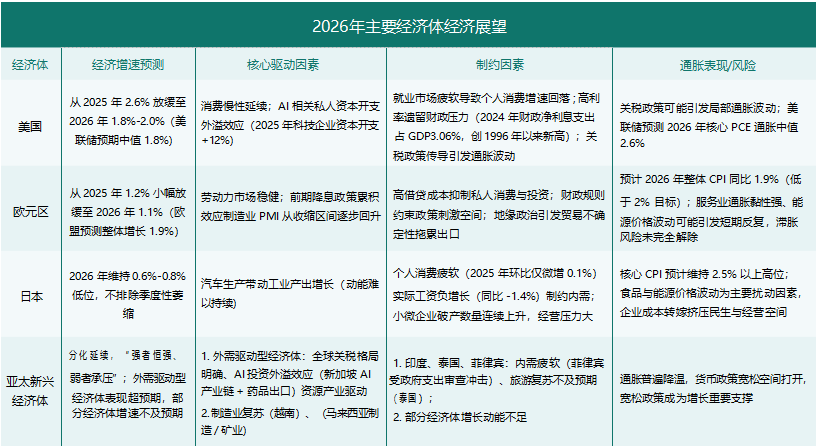
Global Economic Outlook - In 2026, the global economy is expected to continue developing under a moderate slowdown, with emerging markets gradually replacing developed economies as the key growth drivers [1] - The monetary policy will shift from accommodative to a wait-and-see approach, focusing on structural differentiation, policy window management, and tail risk control as the main strategies for 2026 [1] Economic Projections for Major Economies - The US economy is projected to slow down from 2.6% in 2025 to a range of 1.8%-2.0% in 2026, driven by chronic consumption issues and AI-related private capital expenditure [2] - The Eurozone is expected to grow at 1.1% in 2026, with manufacturing PMI gradually recovering but facing challenges from geopolitical tensions and weak personal consumption [2] - Japan's growth is anticipated to remain low, with potential quarterly fluctuations, as real wages decline and small businesses face increasing operational pressures [2] - Emerging economies in the Asia-Pacific region are showing mixed performance, with some exceeding expectations while others struggle with weak domestic demand and external pressures [2] Global Central Bank Monetary Policy Outlook - The Federal Reserve is likely to implement three rate cuts of 25 basis points each, bringing the benchmark rate down to 3.00%-3.25% [3] - The European Central Bank is expected to maintain a stable interest rate policy, with no clear plans for rate adjustments, while monitoring inflation close to the 2% target [3] - The Bank of Japan is likely to keep the benchmark rate at a low level of 0.5%, facing challenges in balancing inflation control and economic growth [3] - Emerging market central banks will continue a high-accommodation cycle, with varying policy rhythms based on local economic conditions [3] Investment Bank Perspectives - The IMF reports that global economic growth will continue to slow down moderately in 2026, with structural differentiation intensifying due to weakened growth momentum in developed economies [4] - OECD forecasts a decline in global economic growth from 3.2% in 2025 to 2.9% in 2026, with the US economy expected to slow to 1.7% [5] - The Eurozone is projected to grow only 1%, indicating a relatively weak performance compared to other regions [5] Core Risk Overview - Geopolitical and trade risks include uncertainties from global tariff restructuring and regional conflicts that could disrupt supply chains and commodity prices [6] - Financial vulnerabilities are high in the Eurozone, with rising debt levels in emerging markets potentially leading to localized financial risks during interest rate adjustments [6] - Commodity price volatility, particularly in energy and food sectors, may disrupt central bank policy rhythms due to external factors like geopolitical conflicts and extreme weather [6] Summary - Globalization is significantly impacted by tariff conflicts, leading to disruptions in global trade chains and a high probability of economic slowdown [7] - The Federal Reserve is expected to maintain a loose monetary policy, but the interplay between the Fed and the US government may heighten global financial risks [7] - Precious metals, particularly gold, are likely to benefit, with potential prices reaching between $5000-$5200, while the dollar index may decline below 90 [7] - Commodity markets show mixed signals, with energy prices struggling but potential rebounds in the second half of the year, while non-ferrous metals may rise due to increased global electricity demand and AI development [7]
首席点评:上证指数创史上最长连阳纪录
Shen Yin Wan Guo Qi Huo· 2026-01-07 09:03
报告日期:2026 年 1 月 7 日 申银万国期货研究所 首席点评: 上证指数创史上最长连阳纪录 中国人民银行部署 2026 年重点工作,要求灵活高效运用降准降息等多种货币政 策工具,保持流动性充裕。据央视财经,我国情绪消费市场规模快速攀升,从 2022 年 1.63 万亿元升至 2024 年 2.31 万亿元,2025 年将达 2.72 万亿元,2029 年将突破 4.5 万亿元。昨日上证指数收涨 1.5%报 4083.67 点,创史上最长连阳 纪录。开源航班追踪数据和地面观察员的观测显示,近日有大批美军飞机突然飞 往欧洲,其中 1 月 3 日至少有 10 架 C-17 运输机从美国飞往欧洲,一名美国高级 官员表示,特朗普总统及其团队正在讨论多种获取格陵兰岛的方案。隔夜美债收 益率上行,美股再创新高,夜盘大宗商品价格普遍走强。 重点品种:股指、铝、焦煤 股指:美国三大指数上涨,上一交易日股指继续大幅上涨,有色金属板块领涨, 通信板块下跌,市场成交额 2.83 万亿元。资金方面,1 月 5 日融资余额增加 192.66 亿元至 25434.22 亿元。我们预计 2026 年供给侧改革持续并将推升大宗商品的价 ...
我国关税调整方案明日起实施 商品影响几何?
Qi Huo Ri Bao· 2025-12-31 00:18
Group 1: Import Tariff Adjustments - The State Council Tariff Commission announced adjustments to import tariffs for steel, coal, non-ferrous metals, cotton, and urea effective January 1, 2026 [1] - The total import quota for cotton in 2026 is set at 894,000 tons, with a low tariff rate of 1% for quota imports [3][4] - The sliding tax mechanism for cotton imports will help stabilize domestic market prices by adjusting costs based on import prices [4] Group 2: Impact on Cotton Industry - The adjustment in cotton planting area in major production regions like Xinjiang is expected to draw significant market attention [4] - The new quota application process allows companies to apply for quotas throughout the year, enhancing flexibility [4] - The focus on stabilizing cotton prices and protecting domestic farmers' interests is emphasized through the sliding tax mechanism [4] Group 3: Steel and Coal Industry - The tariff adjustments for steel and coal products remain largely unchanged from 2025, with zero import tax on recycled steel materials [5][6] - China's crude steel production reached 892 million tons in the first eleven months of the year, accounting for 54% of global output [6] - Steel exports hit a record high of nearly 11 million tons, while imports decreased significantly [6][7] Group 4: Urea and Fertilizer Industry - The import tax rate for urea and other fertilizers remains at 1%, supporting food security and stabilizing agricultural production costs [9][10] - The domestic urea production capacity exceeds 70 million tons, indicating self-sufficiency and minimal reliance on imports [11] - The low tax rate is expected to enhance supply flexibility and stabilize market prices, ensuring agricultural production stability [12] Group 5: Non-Ferrous Metals - The import tariffs for copper and aluminum products remain unchanged, reflecting a strategy to ensure stable raw material supply for domestic industries [14] - The focus is on maintaining supply chain security and supporting high-quality domestic industrial development [14] - The cancellation of temporary tax rates on certain products indicates a shift towards more stable tariff policies [15]
金银铜齐齐新高-周期怎么看
2025-12-29 01:04
Summary of Key Points from Conference Call Records Industry Overview Commodities - Recent strong performance in commodity prices, with gold surpassing 4,600 yuan, silver increasing by 11% to 80 USD, and LME copper stabilizing above 12,000 USD. Early year copper prices were below 75,000 yuan [2][7] - Short-term price fluctuations due to factors like silver delivery month squeeze, not driven by supply-demand improvements. Long-term outlook remains positive due to a weaker dollar and anticipated Fed rate cuts [2][7] - The current commodity cycle is influenced by international competition, differing from previous cycles driven by real estate and infrastructure [3][8] Aviation Sector - Positive outlook for the aviation sector in 2026, with New Year ticket prices up by 6-7% and passenger load factors increasing by 1-2%. Recovery in China-Japan-Korea routes noted [4] - Anticipated recovery in airline profitability to exceed 2019 levels due to extended holiday periods and improved travel demand [4] Express Delivery Industry - Jitu's stable growth in Southeast Asia, recommended as a stock with potential for doubling in three years. SF Express exited the Douyin return segment to protect profits, with a 30% increase in package volume but unfulfilled profit expectations [5][6] - Focus on bottoming SF Express stock, while waiting for data from other express companies for validation of growth potential [6] Non-Ferrous Metals - Positive outlook for the non-ferrous metals sector in 2026, though growth may not match 2025 levels. Current valuations are lower than in 2025, with high certainty of EPS recovery [10] - Energy metals remain undervalued, presenting investment opportunities [10] Coal Industry - Recent decline in coal prices, with the coal index down by 0.89%. However, coking coal fundamentals remain strong, with prices up 170 yuan per ton year-on-year [11][12] - High inventory levels suppress price rebounds, but potential stabilization due to weather factors is noted. Recommendations include investing in high-dividend coal companies [12] Core Insights and Arguments - The commodity price center is expected to rise long-term, supported by macroeconomic factors such as a weaker dollar and Fed rate cuts [2][7] - The aviation sector is projected to recover significantly, driven by increased travel demand and favorable pricing trends [4] - The express delivery market shows resilience, with specific companies like Jitu and SF Express highlighted for their growth potential [5][6] - Non-ferrous metals are positioned for a strong performance, with a focus on energy metals as attractive investment options [10] - The coal industry faces challenges with price declines but offers opportunities in high-dividend stocks amidst stable fundamentals [12] Additional Important Points - The equity market is not overheated, with P/E and P/B ratios at historical lows, indicating a favorable environment for investment [9] - The end of the current commodity cycle will depend on factors such as the restoration of dollar credit, supply chain restructuring, and domestic policies [8]
资讯早班车-2025-12-25-20251225
Bao Cheng Qi Huo· 2025-12-25 01:48
投资咨询业务资格:证监许可【2011】1778 号 期货研究报告 资讯早班车-2025-12-25 一、 宏观数据速览 | 发布日期 | 指标日期 | 指标名称 | 单位 | 当期值 | 上期值 | 去年同期值 | | --- | --- | --- | --- | --- | --- | --- | | 20251020 | 2025/09 | GDP:不变价:当季同比 | % | 4.80 | 5.20 | 4.60 | | 20251130 | 2025/11 | 制造业 PMI | % | 49.20 | 49.00 | 50.30 | | 20251130 | 2025/11 | 非制造业 PMI:商务活 动 | % | 49.50 | 50.10 | 50.00 | | 20251212 | 2025/11 | 社会融资规模增量:当 | 亿元 | | 24885.00 8161.00 | 23288.00 | | | | 月值 | | | | | | 20251212 | 2025/11 | M0(流通中的现金):同 比 | % | 10.60 | 10.60 | 12.70 | | 202512 ...
资讯早班车-2025-12-22-20251222
Bao Cheng Qi Huo· 2025-12-22 03:05
1. Report Industry Investment Rating No relevant content provided. 2. Core Views of the Report - The overall operation of China's commodity market in 2025 was stable, with obvious characteristics of new and old kinetic energy conversion. The average value of the China Commodity Price Index was expected to be 112.1 points, a decrease of 0.1% compared to the previous year [4]. - The Chinese bond market showed a positive trend, with the yields of interest - rate bonds declining. The year - end bond market might continue to fluctuate, and the market was cautious about the overall space of the bond market next year [26]. - A - share market entered a critical window for cross - year layout, and structural opportunities would focus on the tracks where policy orientation and industrial prosperity resonated, with the subsequent spring market worth looking forward to [36]. 3. Summary by Directory 3.1 Macro Data Overview - GDP growth in Q3 2025 was 4.8% year - on - year, slightly lower than the previous quarter's 5.2% but higher than the same period last year's 4.6% [1]. - In November 2025, the manufacturing PMI was 49.2%, and the non - manufacturing PMI for business activities was 49.5%, both showing a certain decline [1]. - Social financing scale in November 2025 increased compared to the same period last year, and M0, M1, and M2 growth rates showed different trends [1]. 3.2 Commodity Investment Reference 3.2.1 Comprehensive - Guangzhou Futures Exchange restricted the daily opening volume of lithium carbonate futures contracts [2]. - Dalian Commodity Exchange adjusted the premium and discount of designated delivery warehouses for coking coal futures [2]. - Shanghai International Energy Trading Center planned to revise the standard contract of the Container Shipping Index (European Line) futures [3]. - The Ministry of Commerce launched a final review investigation on anti - dumping measures for imported ethylene - propylene - diene monomer rubber from the US, South Korea, and the EU [3]. 3.2.2 Metals - Platinum prices soared in 2025, with a year - to - date increase of over 110%, far exceeding that of gold [6]. - Gold and silver prices rose under the new round of interest - rate cuts, with silver prices increasing by over 130% this year [6]. - There was an obvious surplus of refined copper in the first ten months of 2025 [6]. 3.2.3 Coal, Coke, Steel, and Minerals - Dalian Commodity Exchange adjusted the premium and discount of designated delivery warehouses for coking coal futures [2][9]. - China's steel consumption in 2025 was expected to be 8.08 billion tons, a year - on - year decrease of 5.4%, and the global steel consumption was expected to be 17.19 billion tons, a year - on - year decrease of 1.8% [9]. - Indonesia proposed to significantly reduce nickel ore production in 2026 [11]. 3.2.4 Energy and Chemicals - Bohai Oilfield's cumulative production of oil and gas equivalent in 2025 exceeded 40 million tons, reaching a record high [12]. - China's energy key projects in 2025 were expected to complete an investment of 3.54 trillion yuan, a year - on - year increase of 11% [12]. - The price of polysilicon increased, but there was a situation of "high price but no market" [13]. 3.2.5 Agricultural Products - Manzhouli Port achieved a "zero breakthrough" in importing Russian agricultural products [15]. - The Philippines extended the import ban on sugar until December 2026 [15]. 3.3 Financial News Compilation 3.3.1 Open Market - This week, 4575 billion yuan of reverse repurchases in the central bank's open market were due, along with 1200 billion yuan of treasury cash fixed - term deposits and 3000 billion yuan of MLF [16]. - On December 19, the central bank conducted 562 billion yuan of 7 - day reverse repurchases and 1000 billion yuan of 14 - day reverse repurchases, with a net investment of 357 billion yuan on that day [16][17]. 3.3.2 Important News and Information - The market generally expected that the LPR in December would remain stable [18]. - The State Council Executive Meeting arranged the implementation of the decisions and deployments of the Central Economic Work Conference [18]. - The General Administration of Market Regulation revised the "Regulations on Prohibiting Monopoly Agreements" [18]. 3.3.3 Bond Market Summary - The yields of interest - rate bonds in the Chinese bond market declined, and the 30 - year active bond "25 Super Long Special Treasury Bond 06" performed prominently [26]. - Most of Vanke's bonds rose in the exchange bond market [26]. 3.3.4 Foreign Exchange Market Express - The on - shore RMB against the US dollar closed at 7.041 on December 22, up 9 basis points from the previous trading day [30]. - The US dollar index rose 0.28% in late New York trading, and most non - US currencies fell [30]. 3.3.5 Research Report Highlights - CITIC Securities believed that the factors driving the RMB appreciation were increasing, and investors should adapt to asset allocation in a RMB - appreciating environment [32]. - CITIC Securities thought that Japan's benign inflation cycle was stable, and the Bank of Japan was about to raise interest rates again [32]. - CITIC Construction Investment considered that the concentrated release of pessimistic sentiment at the end of the year brought potential space for financial bonds [32]. 3.4 Stock Market Important News - A - share market was in a high - level oscillation state near the end of the year, and the Shanghai Composite Index turned positive last week [36]. - As of December 19, the net inflow of subscription and redemption funds of CSI A500 exceeded that of CSI 300 in December, with the net inflow scale exceeding 46 billion yuan [36]. - By December 18, more than 454 listed companies had received institutional research in December, and the hard - tech track became the main focus [37].
宝城期货资讯早班车-20251217
Bao Cheng Qi Huo· 2025-12-17 01:40
Report Industry Investment Rating No relevant information provided. Core Viewpoints of the Report The overall economic situation shows a mixed picture. The external demand has improved, and prices have generally increased, but domestic demand is still bottom - seeking. Policies are expected to be more active in 2026 to support economic recovery, and the bond market is expected to have opportunities. Multiple institutions are optimistic about the continued rebound of Chinese assets in 2026 [24][25][30]. Summary by Directory 1. Macro Data - GDP in Q3 2025 grew at a 4.8% year - on - year rate, lower than the previous quarter's 5.2% but higher than the 4.6% of the same period last year [1]. - In November 2025, the manufacturing PMI was 49.2%, the non - manufacturing PMI for business activities was 49.5%, both showing certain trends compared to previous periods [1]. - Social financing scale in November 2025 was not provided, with previous values of 24,885 billion yuan and 8,161 billion yuan, and the same - period value last year of 23,288 billion yuan [1]. - CPI in November 2025 increased by 0.7% year - on - year, and PPI decreased by 2.2% year - on - year [1]. - Fixed - asset investment (excluding rural households) from January to November 2025 had a cumulative year - on - year decline of 2.6%, and the social consumer goods retail total had a cumulative year - on - year increase of 4.0% [1]. - Exports in November 2025 increased by 5.9% year - on - year, and imports increased by 1.9% year - on - year [1]. 2. Commodity Investment Reference Comprehensive - In 2026, expanding domestic demand is the top priority, and efforts will be made to boost consumption from both supply and demand sides. The real estate market will be stabilized from both supply and demand ends [2]. - Anti - dumping duties of 4.9% - 19.8% will be imposed on imported pork and pork by - products from the EU starting from December 17, 2025, for a period of 5 years [2]. - On December 16, 2025, 42 domestic commodity varieties had positive basis, and 25 had negative basis [2]. Metals - Copper prices soared to a record high, partly due to the large - scale copper hoarding by the US. The LME's three - month copper price reached a high of $11,952 per ton last Friday, currently around $11,626 per ton, up about 33% this year [4]. - On December 15, 2025, zinc, lead, tin, and copper inventories reached new highs, while nickel and aluminum inventories decreased [5]. - Morgan Stanley expects nickel prices to rebound to around $15,500 per ton in 2026 [5]. - Goldman Sachs raised its forecast for the average copper price in 2026 from $10,650 to $11,400 per ton, and there is a 55% probability that the Trump administration will announce a 15% copper import tariff in the first half of 2026, which may take effect in 2027 and increase to 30% in 2028 [6]. Coal, Coke, Steel, and Minerals - A series of measures to rectify the "involution - style" competition in the steel industry are being implemented, and the upstream coke and iron ore prices have declined [7]. - Yichun plans to cancel 27 mining licenses, including Jiangte Motor's Yifeng County Shiziling Lithium - bearing Porcelain Stone Mine [7]. - Rio Tinto will launch the first phase of a project in Western Australia, with an estimated iron ore production of 50 million tons per year by 2030 [8]. - Japan will cooperate with Malaysia in the exploration and development of rare earth and other mineral resources [8]. - In November 2025, Brazilian steel sales decreased by 3.5% year - on - year to 1.748 million tons. It is expected that in 2026, exports will decrease by 0.6% to 10.18 million tons, and imports will increase by 3.9% to 6.65 million tons [8]. - As of early December 2025, the prices of coke and coking coal in the circulation field declined [8]. Energy and Chemicals - The National Energy Administration will strengthen energy supervision and ensure the safety of the energy and power system in 2026 [9]. - Hungary signed a 5 - year LNG procurement agreement with Chevron for a total of 2 billion cubic meters [9]. - Last week, US API crude oil inventories decreased by 9.322 million barrels, exceeding expectations [9]. - The price discount of Venezuelan Merey crude oil widened to a $21 - per - barrel discount compared to Brent crude oil [9]. - JP Morgan will seek about $14 billion in funds for Argentina's LNG export project [9]. Agricultural Products - The Indian market regulatory body will propose to relax commodity derivatives rules, cancel the ban on agricultural product derivatives trading, and reduce margin requirements [10]. - As of December 14, 2025, EU's 2025/26 soft wheat exports were 10.5 million tons, barley exports were 5 million tons, corn imports were 7.5 million tons, and soybean meal imports were 8.3 million tons [10]. 3. Financial News Compilation Open Market - On December 16, 2025, the central bank conducted 135.3 billion yuan of 7 - day reverse repurchase operations, with a net investment of 18 billion yuan [11]. Key News - In 2026, expanding domestic demand is the top priority, and efforts will be made to boost consumption from both supply and demand sides. The real estate market will be stabilized from both supply and demand ends [12]. - The National Development and Reform Commission will take measures to stabilize bulk consumption, improve the social security system, and promote a fair market order [12]. - Shenzhen will prevent and resolve financial risks, support the reform of the GEM, and enhance the competitiveness of the capital market [13]. - In 2026, the central bank will continue to implement a moderately loose monetary policy and maintain financial market stability [13]. - The market expects the fiscal deficit rate in 2026 to be no less than 4% [14]. - BofA Securities expects the downward trend of the mainland real estate market to bottom out in 2026 [14]. - Vanke will hold a bondholder meeting to discuss the adjusted extension plan for "22 Vanke MTN004" [14]. - On December 16, 2025, the on - shore and off - shore RMB exchange rates against the US dollar reached new highs in 14 months, and the RMB is expected to appreciate moderately in 2026 [15]. - As of December 16, 2025, commercial banks issued 58 green financial bonds, with a total issuance scale of 458.2 billion yuan, a year - on - year increase of over 202% [15]. - The EU plans to issue about 90 billion euros in bonds in the first half of 2026 [15]. - The US Treasury Secretary is optimistic about the US economic outlook, expecting a 3.5% GDP growth in 2025 [16]. - In November 2025, the US added 64,000 non - farm jobs, but the unemployment rate rose to 4.6% [16]. Bond Market Review - Bond market sentiment improved slightly. Yields of major inter - bank interest - bearing bonds mostly declined slightly, and Treasury bond futures showed a differentiated trend [19]. - In the exchange - traded bond market, Vanke bonds generally rose, and the Wande Real Estate Bond 30 Index rose 0.58%, while the Wande High - Yield Urban Investment Bond Index fell 0.06% [19]. - The CSI Convertible Bond Index fell 0.72% to 478.64 points, with a trading volume of 55.556 billion yuan [20]. - On December 16, 2025, most money market interest rates rose, and Shibor short - term varieties showed a differentiated performance [20][21]. - Inter - bank repurchase fixed - rate bonds generally declined, and silver - silver inter - bank repurchase fixed - rate bonds showed a differentiated performance [21]. - The winning yields of Agricultural Development Bank's 2 - year financial bonds were 1.5899% and 1.6039% respectively [22]. - Most European and US bond yields declined [22]. Foreign Exchange Market - On December 16, 2025, the on - shore RMB exchange rate against the US dollar rose 80 points, and the RMB central parity rate against the US dollar rose 54 points [23]. - In New York, the US dollar index fell 0.06%, and most non - US currencies showed mixed performance [23]. Research Report Highlights - Huatai Fixed Income believes that in November 2025, external demand improved, prices rose, but domestic demand continued to bottom - seek. It is recommended to wait for opportunities in the bond market [24]. - Guosheng Fixed Income believes that in November 2025, the economy was weak in both production and demand. The bond market is expected to stabilize and start a trend - like market in the second half of the first quarter of 2026 [25]. - CICC Fixed Income believes that the November 2025 economic data was below expectations, and the bond market is expected to perform well in 2026. It is recommended to pay attention to the allocation opportunities from the end of this year to the first quarter of next year [25]. - CITIC Securities believes that the November 2025 economic data declined in both supply and demand. Policies in 2026 will be more coordinated and focused on implementation effects [26]. - Changjiang Fixed Income believes that the net investment of repurchase in December 2025 decreased. The money market may face some fluctuations due to tax payments [26]. - Xingzheng Fixed Income believes that credit bond ETFs should focus on product returns and consider individual bond attributes in portfolio selection [27]. 4. Stock Market Key News - On the day, the A - share market declined unilaterally, with nearly 4,300 stocks falling. The Shanghai Composite Index fell 1.11% to 3,824.81 points, and the market turnover was 1.75 trillion yuan [29]. - The Hong Kong Hang Seng Index fell 1.54% to 25,235.41 points, and the trading volume decreased slightly [29]. - Multiple institutions believe that Chinese assets have the basis for a continuous rebound in 2026, and overseas long - term funds have been flowing into the Chinese stock market since 2025 [30].
美联储2026年或放缓降息步伐
Qi Huo Ri Bao Wang· 2025-12-16 02:09
Core Viewpoint - The Federal Reserve's recent decision to lower the benchmark interest rate by 25 basis points aligns with market expectations, indicating a potential slowdown in future rate cuts compared to this year [1][2][5] Group 1: Federal Reserve's Actions - The Federal Reserve has cut the benchmark interest rate to a range of 3.50% to 3.75%, marking a total reduction of 75 basis points this year [2] - The decision faced internal dissent, with three officials voting against the rate cut, indicating a higher level of disagreement within the Fed than previously anticipated [2][3] - The Fed has also announced the end of its balance sheet reduction and the initiation of asset purchases to maintain adequate reserves, reflecting liquidity pressures in the banking system [5][6] Group 2: Economic Indicators - The Fed's economic outlook has been adjusted, with GDP growth forecasts for 2025 and 2026 raised to 1.7% and 2.3% respectively, while inflation expectations have been slightly lowered [6] - The unemployment rate has risen to 4.4%, the highest in four years, indicating a cooling labor market, which may increase the necessity for further rate cuts [8][10] - Core service inflation has decreased from 4.3% to 3.5%, suggesting that overall inflation levels may remain subdued [9] Group 3: Market Implications - The market is currently pricing in a cautious approach from the Fed, with expectations of potential rate cuts in early 2026, but also a possibility of pausing cuts depending on economic data [7][10] - The global monetary policy landscape is diverging, with the Fed in a rate-cutting cycle while other major central banks are on hold, reflecting varying economic conditions [12] - Risk assets, particularly equities, are expected to perform well due to improved market sentiment and liquidity conditions, despite concerns over potential bubbles in sectors like AI [14][15]

中加基金权益周报|债市情绪偏弱,长债对利空敏感性提高
Xin Lang Cai Jing· 2025-12-12 08:02
Market Overview and Analysis - The issuance scale of government bonds, local government bonds, and policy financial bonds in the primary market last week was 223 billion, 108.7 billion, and 99 billion respectively, with net financing amounts of -33.8 billion, 60.5 billion, and -106.5 billion [1] - Financial bonds (excluding policy financial bonds) totaled an issuance scale of 134.6 billion, with a net financing amount of 71.4 billion. Non-financial credit bonds had an issuance scale of 220.7 billion, with a net financing amount of 61 billion [1] - Two new convertible bonds were issued, with an expected financing scale of 270 million [1] Secondary Market Review - Long-term bonds continue to face pressure, leading to another adjustment in the bond market. Key influencing factors include the central bank's November government bond trading volume, the Vanke incident, and the political bureau meeting [2] Liquidity Tracking - At the beginning of December, the funding environment is seasonally loose. The final R001 and R007 rates decreased by 5.3 basis points and 2.6 basis points respectively compared to the previous week [3] Policy and Fundamentals - He Lifeng held a video call with the U.S. Treasury Secretary and Trade Representative to promote stable and positive Sino-U.S. economic and trade relations. High-frequency data shows a mixed performance on the production side, weak demand in real estate exports, and a mixed price trend with most production material prices rebounding [4] Overseas Market - U.S. employment data showed mixed results, while expectations for interest rate hikes in Japan increased, leading to a decline in U.S. long-term bonds. The 10-year U.S. Treasury bond closed at 4.14%, up 12 basis points from the previous week [5] Equity Market - Last week, A-shares were positively influenced by the dovish stance of the Federal Reserve, with prices of silver, copper, and aluminum rising, resulting in a notable performance in the non-ferrous sector with a weekly increase of 5.35%. The average daily trading volume decreased to 1.70 trillion, down 40.745 billion from the previous week. As of December 4, 2025, the total financing balance across A-shares was 24,664.78 billion, an increase of 11.493 billion from November 27 [6] Bond Market Strategy Outlook - The bond market's oscillating pattern remains unbroken, but short-term pressure on long-term bonds continues. On one hand, the basic economic outlook for 2026 suggests marginal stabilization, but the upward slope is not steep. Before a clear recovery in fundamentals, the central bank's monetary policy is expected to remain accommodative, with a necessity for further cuts in reserve requirements and interest rates. The market's short-term expectations for monetary policy are relatively pessimistic [7] - On the other hand, the trend of deposit liquidity has increased the instability of banks' liabilities but has also effectively reduced their costs. After the disturbances from deposit disintermediation dissipate, the cost-effectiveness of banks in bond allocation is expected to rise again. Additionally, the central bank's resumption of government bond trading serves dual purposes of fiscal and monetary coordination and yield curve adjustment, indicating that bond yields still have an upper limit [7] - The traditional bond market configuration in mid to late December is still anticipated. The convertible bond index is experiencing high-level fluctuations, with recent movements in convertible bond funding being a major focus. The long-term logic of convertible bonds remains intact, with no reversal in supply-demand relationships and policy support for economic stability not fully dissipated [7]