
计算机通信和其他电子设备制造

Search documents
中国南方五省区10月用电量实现两位数增长
Zhong Guo Xin Wen Wang· 2025-11-24 13:12
Group 1 - In October, the total electricity consumption in five provinces of Southern China (Guangdong, Guangxi, Yunnan, Guizhou, Hainan) reached 160.3 billion kWh, marking a year-on-year increase of 10%, the first double-digit growth since February of this year, indicating steady economic progress in the region [1] - By industry, the first, second, and third sectors, along with urban and rural residential electricity consumption, saw year-on-year increases of 6.6%, 6.5%, 12%, and 21.7% respectively [1] - Over 70% of industries in the region experienced positive growth in electricity consumption, with nearly 40% of industries showing growth rates exceeding 10% [1] Group 2 - The electricity consumption in the high-tech and equipment manufacturing sectors, as well as the digital economy, showed significant performance, with high-tech and equipment manufacturing electricity consumption increasing by 6.7% year-on-year [1] - In October, the electricity consumption for the automotive manufacturing industry and new energy vehicle manufacturing in the Southern provinces grew by 2.8% and 30.2% year-on-year, respectively [2] - In Guangdong, a major automotive manufacturing province, the electricity consumption for these two sectors increased by 12.2% and 33% year-on-year [2]
代立业集团支付员工离职补偿金,华林证券收到监管警示函
Nan Fang Du Shi Bao· 2025-10-26 04:11
Core Viewpoint - The Tibet Securities Regulatory Bureau has issued administrative regulatory measures against Hualin Securities due to multiple compliance issues, including inadequate execution of personnel recruitment and compensation management, improper payment of severance to certain employees of Shenzhen Liyue Group, and involvement of Liyue Group staff in company operations [2] Group 1: Regulatory Issues - Hualin Securities has been found to violate several regulations, including the "Internal Control Guidelines for Securities Companies," "Corporate Governance Standards for Listed Companies," and "Compliance Management Measures for Securities Companies and Securities Investment Fund Management Companies" [2] - The Tibet Securities Regulatory Bureau has decided to issue a warning letter to Hualin Securities, which will be recorded in the integrity file of the securities and futures market [2] Group 2: Shareholding Structure - Liyue Group is the largest shareholder of Hualin Securities, holding a 64.46% stake [4] - The actual controller of Liyue Group is Lin Li, who holds a 99.9% share [5] Group 3: Previous Regulatory Actions - Hualin Securities has been previously named in regulatory actions, including a warning from the Shanghai Securities Regulatory Bureau in September for non-compliance in employee conduct, specifically regarding unauthorized client solicitation activities [7]


制造业符合条件的仪器、设备加速折旧政策,固定资产或购入软件加速折旧或摊销政策
蓝色柳林财税室· 2025-10-25 06:55
Core Viewpoint - The article discusses the tax and fee incentives provided by the Chinese government to support the development of the manufacturing industry, highlighting policies related to accelerated depreciation for fixed assets in various sectors [2][12]. Summary by Sections Enjoyment Subjects - Enterprises in all manufacturing sectors, as well as those in information transmission, software, and information technology services, are eligible for the accelerated depreciation policy [2][3]. Enjoyment Content - Six specific industries, including biopharmaceuticals and aerospace, can shorten depreciation periods or adopt accelerated depreciation methods for fixed assets purchased after January 1, 2014 [3]. - Key industries such as light industry, textiles, machinery, and automobiles can also choose to shorten depreciation periods or use accelerated depreciation for fixed assets purchased after January 1, 2015 [3]. - As of January 1, 2019, the scope of industries eligible for accelerated depreciation has been expanded to include all manufacturing sectors [3]. Enjoyment Conditions - The minimum depreciation period for shortened depreciation cannot be less than 60% of the standard depreciation period as per the Corporate Income Tax Law [4][6]. - Enterprises can choose between the double declining balance method or the sum-of-the-years-digits method for accelerated depreciation [4][6]. Enjoyment Time - The incentives have been in effect since January 1, 2014, and will continue to be available [5]. Application Timing - Enterprises must submit monthly, quarterly, and annual corporate income tax prepayment and settlement declarations to enjoy the benefits [7][17]. Required Documentation - Enterprises must retain documentation proving their eligibility, including invoices for fixed asset purchases and records of tax and accounting differences [8][17]. Enjoyment Methods - The application for benefits can be processed through online platforms such as the electronic tax bureau or in-person at tax service halls [9][18]. Policy Basis - The policies are based on several official notifications and regulations issued by the Ministry of Finance and the State Administration of Taxation, including notices from 2014, 2015, and 2019 [12][19].

GDP同比增长5.5%!上海前三季度成绩单出炉
Di Yi Cai Jing Zi Xun· 2025-10-22 01:41
Economic Overview - Shanghai's GDP for the first three quarters reached 40,721.17 billion yuan, with a year-on-year growth of 5.5% at constant prices [1] Industrial Production - Industrial added value in Shanghai grew by 5.2% year-on-year, with total industrial output value increasing by 5.7% [2] - Key manufacturing sectors showed significant growth: railway, shipbuilding, aerospace, and other transport equipment increased by 15.9%, electrical machinery and equipment by 14.3%, and computer and communication equipment by 12.1% [2] - The three leading manufacturing sectors (AI, integrated circuits, and biomedicine) saw production value growth of 12.8%, 11.3%, and 3.6% respectively [2] - Strategic emerging industries in manufacturing grew by 7.3%, with new energy industries up by 19.6% [2] Tertiary Sector Growth - The tertiary sector's added value increased by 5.9%, with information transmission, software, and IT services growing by 15.5% [3] - The financial sector's added value reached 6,965.27 billion yuan, marking a 9.8% increase [3] Fixed Asset Investment - Fixed asset investment in Shanghai rose by 6.0%, with industrial investment surging by 20.3% [4] - Urban infrastructure investment grew by 11.7%, while real estate development investment saw a modest increase of 2.2% [4] Consumer Market - Retail sales of consumer goods totaled 12,302.77 billion yuan, reflecting a year-on-year growth of 4.3% [5] - Categories such as sports and entertainment goods, furniture, and home appliances experienced significant retail growth, with increases of 27.7%, 22.1%, and 28.2% respectively [5] Financial Market Activity - Major financial markets in Shanghai saw a transaction volume increase of 12.7%, with the Shanghai Stock Exchange's securities transaction volume up by 38.4% [6] - By the end of September, the balance of deposits in financial institutions reached 23.84 trillion yuan, a year-on-year increase of 8.4% [6] Price Stability and Income Growth - Consumer prices remained stable, with the CPI unchanged year-on-year [7] - The average disposable income for residents reached 69,220 yuan, reflecting a growth of 4.3% [7]
肇庆1-8月经济运行稳中有进 工业生产等向好
Nan Fang Du Shi Bao· 2025-10-16 13:01
Economic Overview - The total retail sales of consumer goods in Zhaoqing reached 81.677 billion yuan from January to August 2025, showing a year-on-year growth of 2.5% [2] - Online retail sales from above-designated size enterprises increased by 8.1%, contributing 1.4 percentage points to overall consumption [2] - The retail sales of home appliances and cultural office supplies grew significantly by 89.4% and 71.0% respectively [2] - Rural consumption growth (3.0%) slightly outpaced urban growth (2.4%) [2] Industrial Production - The industrial production maintained a positive trend, with the added value of above-scale industries increasing by 4.7% year-on-year, an improvement of 0.6 percentage points compared to January-July [2] - The manufacturing sector, along with electricity, heat, gas, and water production and supply, saw growth rates of 5.0% and 2.1% respectively, while the mining industry experienced a decline of 8.0% [2] - Key industries such as computer communication and other electronic equipment manufacturing, automotive manufacturing, electrical machinery and equipment manufacturing, and chemical raw materials and products manufacturing contributed significantly to industrial growth, with respective growth rates of 13.4%, 26.2%, 16.8%, and 7.5% [2] - Newly registered above-scale industrial enterprises in the previous year saw an impressive added value growth of 86.1% from January to August, contributing 1.7 percentage points to the overall industrial growth [2] Investment and Real Estate - Fixed asset investment in the city decreased by 24.2% year-on-year from January to August [3] - Investment in the primary industry grew by 3.7%, while the secondary and tertiary industries saw declines of 30.2% and 17.2% respectively [3] - Infrastructure investment showed a slight increase of 0.2%, while construction and installation engineering investment fell by 18.4% [3] - Real estate development investment dropped significantly by 42.2%, with the sales area of commercial housing at 1.265 million square meters, down 30.0% year-on-year, although the decline rate narrowed by 5.5 percentage points compared to January-July [3] Financial Stability and Price Trends - The financial sector remained stable, with the balance of deposits and loans reaching 407.354 billion yuan and 361.993 billion yuan respectively by the end of August, both maintaining a growth rate of over 7.4% [3] - The Consumer Price Index (CPI) saw a year-on-year decrease of 0.4%, driven by a significant drop in food prices (-3.6%), while service prices experienced a slight increase of 0.2% [3]

突破万亿再+1!透视8月用电量重磅数据 多维度感知经济向“新”活力
Yang Shi Wang· 2025-09-24 02:19
Core Insights - In August, China's total electricity consumption exceeded 1 trillion kilowatt-hours for the second consecutive month, showing a stable growth trend with a year-on-year increase of 5.0% [1][3] - The growth in electricity consumption is attributed to high summer temperatures and various government policies aimed at boosting consumption, leading to a continuous release of production capacity across industries [3] Industry Performance - The electricity consumption in the manufacturing sector reached a year-to-date monthly high in August, with a year-on-year growth rate of 5.5% [6][8] - The first and second industries saw significant growth in electricity consumption, with the first industry increasing by 9.7% and the second industry by 5.0% year-on-year [7] - The third industry and residential electricity consumption experienced a decline, with growth rates of 7.2% and 2.4% respectively [7] Sector-Specific Insights - High-tech and equipment manufacturing industries showed robust growth, with electricity consumption increasing by 9.1%, surpassing the average growth rate of the manufacturing sector by approximately 4.6 percentage points [8] - In Anhui, the automotive manufacturing sector's electricity consumption surged by 23.2%, indicating a return to over 20% growth, contributing 53% to the overall manufacturing electricity consumption increase in the province [8][10] - In Jiangsu, the smart manufacturing sector maintained rapid growth, with the electricity consumption of vehicle-mounted smart devices increasing by over 87% in the first eight months [12] - In Guangdong, the electricity consumption in the computer, communication, and other electronic equipment manufacturing sectors grew by 8.3%, reflecting a solid foundation for advanced manufacturing [12] - The raw materials industries, including steel and building materials, showed a recovery trend with a combined year-on-year electricity consumption growth of 4.2%, an increase of 3.7 percentage points from July [12]
中金:工企利润修复路径探究
Hua Er Jie Jian Wen· 2025-09-23 13:09
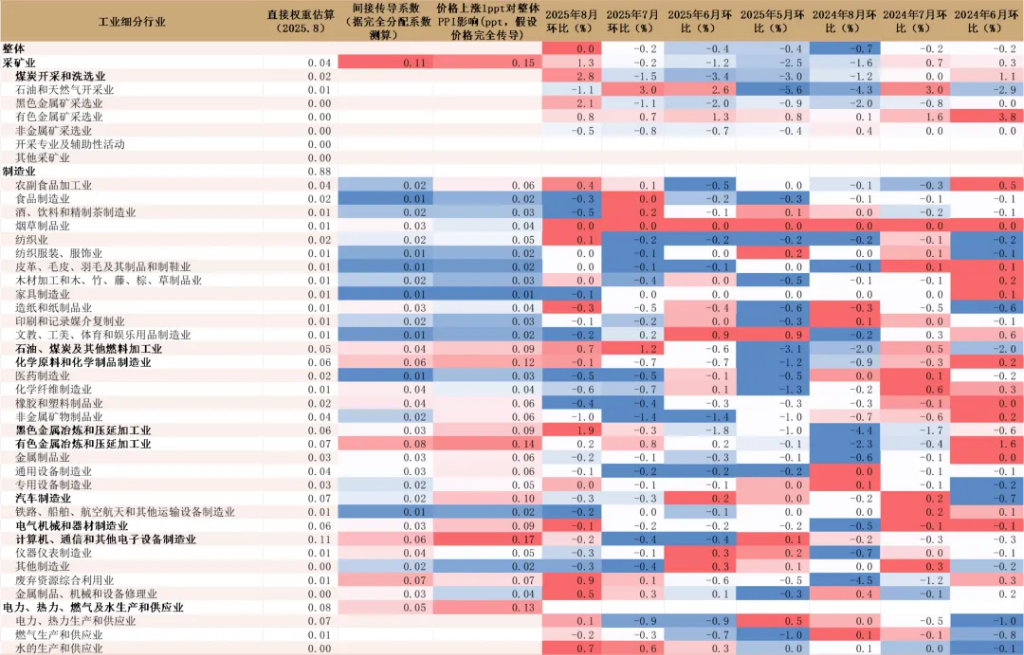
Core Viewpoint - The government has initiated comprehensive rectification of excessive competition across multiple industries since the second half of last year, aiming to promote the recovery of industrial product prices, restore industry profitability, and optimize industrial structure. In August, the PPI (Producer Price Index) showed signs of stabilization, but investment and commodity consumption have significantly slowed, indicating weak growth momentum in terminal demand [1][2]. Group 1: Supply-Side Dynamics - The current capacity governance emphasizes legal compliance and is characterized by a steady pace of capacity reduction, with a focus on exiting excess low-end outdated capacities in industries such as coal, steel, and photovoltaics. Policies are dense in these sectors, which directly influence the sustainability of price recovery [4][5]. - Approximately 60% of industries are currently at historical profit margins below the 40th percentile, indicating a need for improvement in asset turnover and overall revenue growth to enhance asset return rates [4][6]. - The PPI's fluctuation is significantly influenced by industries such as mining, non-ferrous and ferrous metal smelting, and chemical manufacturing, with notable price increases in coal and water supply sectors [3][4]. Group 2: Demand-Side Challenges - Economic momentum weakened in August, and the effectiveness of stimulus policies on consumer goods is uncertain, particularly as the replacement cycle for durable goods is long, which may diminish the impact of such policies [5][6]. - Real estate and infrastructure investments remain crucial for growth, but both sectors have shown negative year-on-year changes, with real estate down by 12.9% and infrastructure up by only 5.4% in the first eight months of the year [6][8]. - The recovery in the real estate market is expected to take time, and the effectiveness of existing PPP projects and new financial tools will be critical for stabilizing infrastructure investment in the fourth quarter [6][8]. Group 3: Price Transmission and Industry Specifics - The price transmission from upstream to downstream industries is contingent on terminal demand conditions, with structural demand in specific sectors like steel and photovoltaics showing potential for marginal recovery [5][9]. - The analysis of price transmission in the black building materials chain indicates significant price declines in raw materials, while the photovoltaic sector has experienced varied price movements, reflecting the complexities of market dynamics [9][10].
多项指标表现抢眼 广东上市公司业绩稳步增长
Zhong Guo Zheng Quan Bao· 2025-09-10 23:14
Core Insights - Guangdong's 883 A-share listed companies reported steady growth in operating performance for the first half of 2025, outperforming the national average in key indicators [1] Revenue and Profit Growth - In the first half of 2025, Guangdong's listed companies achieved a total revenue of 5.14 trillion yuan, a year-on-year increase of 6.3%, surpassing the national average growth of 0.09% [2] - The net profit attributable to shareholders reached 400.12 billion yuan, with a year-on-year growth of 2.63%, slightly above the national average of 2.59% [2] - Among 871 non-financial listed companies, total revenue was 4.33 trillion yuan, and net profit was 197.63 billion yuan, reflecting year-on-year growth of 7.5% and 4.1% respectively [2] - 659 companies reported profits, accounting for 74.6% of the total [2] Manufacturing Sector Performance - Guangdong's manufacturing sector, a key economic pillar, showed overall growth, with 634 manufacturing companies generating 2.94 trillion yuan in revenue and 172.19 billion yuan in net profit, marking year-on-year increases of 13% and 6.3% respectively [2] - In the computer communication and electronic equipment manufacturing sector, 225 companies reported revenues of 1.1 trillion yuan and net profits of 49.18 billion yuan, with year-on-year growth of 19.6% and 15.5% [3] - The automotive manufacturing sector saw 15 companies achieve revenues of 453.87 billion yuan, a year-on-year increase of 18.1%, while net profit decreased by 12.1% to 15.09 billion yuan [3] Key Performance Indicators - Guangdong's listed companies reported significant overseas market revenue, with 477 manufacturing companies generating 832.75 billion yuan, a year-on-year increase of 16.2%, exceeding the national average of 10.5% [4] - Research and development (R&D) expenditures totaled 158.9 billion yuan, reflecting a year-on-year growth of 11.6%, which is higher than the national growth rate of 3.2% [4] - Capital expenditures reached 316.3 billion yuan, up 2.8% year-on-year, indicating a recovery in investment sentiment among companies in key sectors [5] Dividend and Share Buyback Trends - Several listed companies in Guangdong have initiated mid-term dividends, with companies like Midea Group and Haidilao distributing over 1 billion yuan each [6] - The implementation of the "Merger and Acquisition Six Guidelines" has led to over 250 companies disclosing or completing mergers and acquisitions exceeding 150 billion yuan [7]
8月份CPI同比下降0.4%
Mei Ri Jing Ji Xin Wen· 2025-09-10 14:04
Group 1 - The Consumer Price Index (CPI) for August showed a year-on-year decrease of 0.4%, primarily due to lower food prices and a high base from the previous year [1][2] - Core CPI, excluding food and energy, increased by 0.9% year-on-year, marking the fourth consecutive month of growth [1][3] - The Producer Price Index (PPI) ended an eight-month decline, remaining flat month-on-month, with a year-on-year decrease of 2.9%, but the decline was narrower than the previous month [4][5] Group 2 - Food prices saw a seasonal month-on-month increase of 0.5%, but the year-on-year decline in food prices expanded to 4.3%, significantly impacting the overall CPI [3][4] - The prices of vegetables, pork, and fruits remained stable, contributing to the CPI's downward trend [2][3] - The PPI's month-on-month stability was attributed to improved supply-demand relationships in certain sectors and the impact of anti-involution policies on price expectations [4][5] Group 3 - The core CPI's growth is supported by consumption promotion policies, particularly benefiting prices of automobiles and home appliances [3] - Future expectations suggest that the CPI may recover to positive growth in September, with a projected increase to around 0.1% year-on-year [3] - The PPI may enter a recovery phase due to ongoing anti-involution policies and improvements in export structures, which could support prices of raw materials and finished products [5]
1—7月杭州经济稳中向好
Sou Hu Cai Jing· 2025-08-24 03:17
Group 1: Economic Performance - Hangzhou's economy shows strong recovery with a total retail sales of consumer goods reaching 527.1 billion yuan, a year-on-year increase of 5.1% from January to July [1] - Upgrading consumption trends are evident, with retail sales of home appliances and audio-visual equipment increasing by 86.3%, and communication equipment by 34.5% [1] - The retail sales of new energy vehicles grew by 23.7%, indicating a shift towards green and smart consumption [1] Group 2: Foreign Trade - The total import and export volume reached 515.4 billion yuan, with exports at 368 billion yuan, marking a growth of 12.3%, surpassing the national average [2] - Exports of mechanical and electrical products amounted to 174 billion yuan, growing by 11.5%, while high-tech product exports reached 55.8 billion yuan, increasing by 10.9% [2] - Private enterprises played a significant role, with exports totaling 282 billion yuan, accounting for 76.6% of the city's total exports [2] Group 3: Industrial Growth - The industrial added value for large-scale enterprises reached 261.3 billion yuan, with a year-on-year growth of 6.9% [3] - Key industries such as computer communication and electronic equipment manufacturing saw substantial growth, with increases of 17.0% and 30.1% respectively [3] - New momentum in high-tech and strategic emerging industries showed added value growth rates of 8.3% and 9.7%, indicating a robust industrial transformation [3] Group 4: Service Sector Development - The revenue of large-scale service industries reached 1,094.4 billion yuan, with an 8.6% year-on-year increase [3] - The information transmission, software, and IT services sector grew by 12.7%, while scientific research and technical services increased by 6.2% [3] - The digital economy's core industries and high-tech services saw revenue growth of 12.6% and 11.8%, respectively, highlighting the sector's importance in economic growth [3] Group 5: Future Outlook - Hangzhou's economy is maintaining a stable operation, with a focus on high-quality development [4] - The city aims to enhance innovation, reform, and openness to ensure effective qualitative improvements and reasonable quantitative growth [4]