
证券业

Search documents
东海证券晨会纪要-20260323
Donghai Securities· 2026-03-23 02:26
Group 1: Key Recommendations - The report provides a comprehensive analysis of the "Wash Path" in the context of the U.S. reserve framework, highlighting the transition from a scarce reserve framework to an ample reserve framework post-2008 financial crisis [5][6][7] - The "Wash Path" aims to return to a scarce reserve framework, allowing the Federal Reserve to control reserve supply through open market operations, thus flexibly managing the federal funds rate [7][8] - The report outlines a three-step process under the "Wash Path": interest rate cuts, easing bank regulations, and balance sheet reduction, with a focus on promoting technological advancements and increasing bank lending [8][10] Group 2: Market Overview - Global equity markets experienced a general decline, while Hong Kong stocks rose; major commodity futures such as gold, oil, aluminum, and copper saw price drops [11] - The report notes a significant supply gap in the oil market, potentially exceeding 10 million barrels per day, due to ongoing tensions in the Middle East, which could impact downstream demand for other commodities [12] - The domestic equity market showed mixed performance, with financial and consumer sectors leading, while the industrial sector faced declines; the average daily trading volume was 21,972 billion yuan [12][19] Group 3: Economic Indicators - The latest Loan Prime Rate (LPR) remained unchanged for ten consecutive months, with the one-year LPR at 3.00% and the five-year LPR at 3.50% [15] - The report highlights the People's Bank of China's commitment to maintaining a moderately loose monetary policy to ensure liquidity and balance between short-term and long-term economic health [16] - The report indicates that the U.S. Treasury yields have shown upward trends, with the 2-year yield rising to 3.88% and the 10-year yield to 4.39% [24]
陆家嘴财经早餐2026年3月23日星期一
Wind万得· 2026-03-22 22:54
Group 1 - Premier Li Qiang emphasized that China's competitive advantages come from deepening reforms and innovation, not subsidies or protectionism, and highlighted the importance of fair competition in the market economy [4] - Central Bank Governor Pan Gongsheng stated that the People's Bank of China will maintain a supportive monetary policy stance to create a favorable environment for stable economic growth and high-quality development [4] - The National Internet Emergency Center and the China Cybersecurity Association released security guidelines for the use of OpenClaw, providing recommendations for ordinary users and cloud service providers [5] Group 2 - The China Development Forum 2026 released multiple policy signals, indicating a focus on high-quality development and global economic stability [6] - The Chinese automotive industry achieved a significant milestone by surpassing Japan in global annual sales for the first time, with nearly 27 million vehicles sold [17] - The Ministry of Finance plans to increase public service spending and implement consumer-friendly policies to stimulate domestic demand, including a special fund of 100 billion yuan to promote consumption [9][10] Group 3 - The latest findings from the Ministry of Natural Resources revealed a significant increase in rare earth resources in Sichuan, with verified reserves totaling 9.67 million tons, marking an over 200% increase compared to previous estimates [18] - The launch of the "TERAFAB" chip manufacturing project by Tesla aims to achieve an annual production capacity of over 1 terawatt, with an estimated total investment of $20 billion [21] - Apple CEO Tim Cook announced continued support for innovation and education in China, pledging additional donations to a national vocational education pilot project [22]






存单收益率继续下行支撑中短债,曲线陡峭趋势仍在持续:国内经济起步有力,全球滞涨交易影响货币预期
Zhong Tai Qi Huo· 2026-03-22 13:09
1. Report Industry Investment Rating No relevant content provided. 2. Core Viewpoints of the Report - The core of current bond market trading lies in the contrast between loose liquidity and a significant rise in inflation expectations. The bond market shows little volatility, but the curve steepening trend continues. Due to the decline in inter - bank certificate of deposit rates, the yields of medium - and short - term bonds within 10 years may still decline, while the yields of ultra - long - term bonds are more significantly affected by fundamentals and show a weak trend [8]. - Overseas stagflation trading is the current macro - mainline but will not affect domestic monetary policy, as the core lies in the different supply - demand contradictions between domestic and overseas markets. High - frequency real - estate data is not sufficient to change the medium - term data conclusion, and it is too early to change the cyclical conclusion. Looking forward, the probability of a steeper bond market yield curve is still high, and there is insufficient evidence of a bond market bear market [8]. 3. Summary According to the Table of Contents 3.1 Logic and Strategy - The decline in certificate of deposit yields continues to support medium - and short - term bonds, and the curve steepening trend persists [6]. - Regarding the money and policy front, after the tax period, the money price is stable with a slight decline, and the LPR quote remains unchanged, meeting market expectations. The certificate of deposit rate continues to decline. The MLF due next Wednesday is 450 billion yuan, and if the central bank maintains a 50 - billion - yuan bond - buying scale and a 1 - trillion - yuan monthly medium - and long - term liquidity injection, the MLF needs to be renewed by 1.7 trillion yuan. There is a large gap, and the central bank may use other tools such as future reserve requirement ratio cuts. The central bank's research on canceling the 5% lower limit of the deposit reserve ratio lacks market - recognized authenticity, but the market logic has some merit. Currently, the certificate of deposit rate is likely to continue approaching 1.5%. The central bank may cut the reserve requirement ratio in the second quarter, and the pace of interest rate cuts may be postponed [8][32]. - On the fundamental front, domestic economic indicators in January - February showed a significant recovery, except for the real - estate sector. The industrial sector played a key role in production, and new - quality productivity accelerated. The three - horse - carriage of demand worked together, and both domestic and external demand improved. The CPI rose by 0.8% year - on - year, and the core CPI rose by 1.3%, indicating a mild recovery in demand and a further alleviation of deflationary pressure. However, the macro - data from January - February was significantly affected by the Spring Festival, and the data in March may be negatively affected. Overseas, during the "super week" of global central banks from March 16 - 22, 2026, major central banks' policy stances turned hawkish or cautious, and the previously expected easing cycle was postponed or reversed. The market's expectation of interest rate cuts in major developed economies has basically disappeared, replaced by concerns about possible interest rate hikes [8][18]. 3.2 Macro Main Asset Fund Flow Changes - Affected by inflation, the yields of Chinese and US bonds have both increased, the US dollar has rebounded with fluctuations, and the US and Chinese stock markets have significantly declined. The stagflation expectation continues to prevail. The China Securities Commodity Index has weakened with severe differentiation, precious metals and non - ferrous metals have weakened significantly, and crude - oil - related commodities have continued to rise sharply [12]. 3.3 Recent Macro Data Analysis and Review - Domestic data from January - February showed a comprehensive recovery in most economic indicators except for real - estate. However, the data was affected by the Spring Festival, and the data in March may be under pressure. Overseas, major central banks' policy stances turned hawkish or cautious during the "super week" due to the energy price shock caused by the escalation of the Middle - East geopolitical conflict [8][18]. - In February, domestic inflation showed that the CPI increase expanded, and the PPI decline narrowed, both exceeding expectations. Foreign trade exports increased significantly, mainly driven by the global AI investment boom in the semiconductor industry chain. Financial data showed that the growth rate of social financing was flat, and government bonds were the key support for social financing growth. Overseas, in February, the US CPI and core CPI met expectations and were the same as the previous values, with structural differences in the sub - categories of the CPI [24]. - In February, the domestic manufacturing PMI declined unexpectedly, mainly due to the impact of the extended Spring Festival holiday. Overseas, the unexpectedly weak February non - farm payrolls report in the US and the tense Middle - East situation have created a stagflation combination, putting the Fed in a difficult policy dilemma. The market's expectation of the Fed's interest rate cut rhythm has changed [25]. 3.4 Fundamentals Analysis and Bond Futures and Spot Indicator Monitoring - The money price is stable with a slight decline after the tax period, the LPR quote remains unchanged, and the certificate of deposit rate continues to decline. The MLF due next Wednesday is 450 billion yuan, and there is a large gap in the renewal amount. The central bank may use other tools such as reserve requirement ratio cuts. The central bank's meeting in March emphasized maintaining liquidity and the stability of financial markets, and the necessity of interest rate cuts has decreased. The central bank may cut the reserve requirement ratio in the second quarter, and the interest rate cut rhythm may be postponed [8][32]. - The yields of Chinese and US bonds, the US dollar index, and the RMB exchange rate have shown certain trends. The bond market curve shows a steepening trend, and the yields of medium - and short - term bonds within 10 years may decline [12][36]. 3.5 Equity Broad - Based Index Fundamentals, Liquidity, and Futures - Spot Indicator Monitoring - The ROE of listed companies and macro - economic data show certain relationships. The EPS and PE of major broad - based indexes have different trends, reflecting the performance and valuation of the equity market [90][91]. - The trading volume, turnover rate, and margin trading balance of the equity market show the market's liquidity and activity. The style of the equity index and the basis rate of stock index futures also reflect the market's characteristics [110][129]. 3.6 Medium - Term Fundamental Tracking and Monitoring of the Macroeconomy - The net financing amounts of government bonds, local bonds, and policy - bank bonds, as well as the fiscal revenue and expenditure, show the government's financing and fiscal situation. The relationship between social financing, M2, and M1 reflects the money supply and demand in the market [137][156]. - The real - estate market data, including land transactions, housing sales, and prices, show the current situation and trends of the real - estate market. The inflation data, including the CPI, PPI, and price indexes of various commodities, reflect the inflation situation [164][186]. - The industrial production and inventory data, including production capacity utilization, output, and inventory levels, show the operation of the industrial sector. The import and export data, BCI index, and power generation data reflect the economic situation and business confidence [207][240]. 3.7 Long - Wave Fundamental Tracking and Monitoring of the Macroeconomy No relevant content provided. 3.8 Appendix - The comparison of central meetings shows the economic goals, policy tones, and key points of different periods, reflecting the government's economic decision - making and policy orientation [326][327][328]. - The comparison of public - offering fund sales regulations shows the changes in fees such as subscription fees, redemption fees, and sales service fees for different types of funds, which will affect the investment cost and return of investors [332]. - The event of the US tariff policy change shows the development process, impact, and future prospects of the US - China trade war, which will have an impact on the global economic and trade situation [333][334][335]. - The comparison of government work report indicators shows the economic goals, fiscal and monetary policies, and development priorities of different years, reflecting the government's economic development strategy [340].
——转债周度跟踪20260320:重回起点,平衡转债开始出现机会-20260322
Shenwan Hongyuan Securities· 2026-03-22 05:35
1. Report Industry Investment Rating No information provided in the content. 2. Core View of the Report - This week, against the backdrop of the escalating conflict between the US and Iran, the equity market declined significantly, with small and micro - cap stocks experiencing large drops. Although the equal - weighted and weighted declines of convertible bonds were smaller than those of their underlying stocks, their anti - decline performance compared to the underlying stocks was not prominent compared to the fourth quarter of last year. This is because the valuation of convertible bonds continued to compress significantly, mainly in the balanced and bond - biased areas. There were many individual bonds in the balanced area experiencing a "double - kill" of parity and valuation, and the valuation of new bonds, near - maturity bonds, and bonds that did not undergo downward revisions in the bond - biased area also compressed significantly. Currently, the valuation of the convertible bond market has basically returned to the level at the end of last year, and the valuation has dropped to a short - term neutral range. If there is a substantial negative impact, the phased low of convertible bond valuation is expected to be around the 250 - day moving average (corresponding to a par premium rate of around 28%), and investors can seize the rebound opportunity. Structurally, considering the uncertainty of the equity market trend, there are still potential risk points such as near - maturity, downward revisions, and high valuations in the bond - biased and stock - biased areas. Recently, medium - term balanced convertible bonds with a large decline in valuation have relatively more advantages in both offense and defense [4][7]. 3. Summary by Relevant Catalogs 3.1 Week's View and Outlook - Different from the previous pattern where convertible bonds actively compressed valuation while the underlying stocks were relatively stable, this week, due to the escalating US - Iran conflict, the equity market declined significantly, and small and micro - cap stocks had large drops. The anti - decline performance of convertible bonds compared to the underlying stocks was not prominent, mainly because the valuation compression was concentrated in the balanced and bond - biased areas. The convertible bond market valuation has returned to the end - of - last - year level, and if there is a substantial negative impact, the phased low of valuation is expected to be around the 250 - day moving average. Medium - term balanced convertible bonds are relatively more advantageous [4][7]. 3.2 Convertible Bond Valuation - The escalating US - Iran conflict led to a continued increase in crude oil prices, a significant cooling of domestic risk appetite, and a large - scale compression of convertible bond valuation. The par premium rate dropped 1.7% to 30.1%, breaking through the key point. The valuation compression was mainly concentrated in the balanced and bond - biased areas, and the valuation of new bonds that had not entered the conversion period compressed by more than 5%. The compression range shifted from high - parity to medium - and low - parity intervals. In the 70 - 130 yuan parity interval, the valuation compression was about 2% - 3%, and the compression in the extremely low - parity area below 70 yuan was relatively large. In terms of individual bonds, in the high - parity interval above 140 yuan, some individual bonds such as Yitian, Dazhong, and Huachen had strong valuation performance, with an increase of more than 10%. In the 100 - 140 yuan parity interval, there were many "double - kill" individual bonds. In the bond - biased area below 100 yuan, new bonds, near - maturity bonds, and bonds that did not undergo downward revisions had the largest valuation compression. As of now, the valuation of convertible bonds in the 80 - 100 yuan parity interval and in the 1 - 2 - year and 4 - 5 - year term intervals is still slightly higher than the end - of - last - year level [6][8][10]. 3.3 Clause Tracking 3.3.1 Redemption - This week, 2 convertible bonds including Yuanxin and Huicheng announced redemptions, and 6 announced non - redemptions, with a forced redemption rate of 25%. Currently, there are 30 convertible bonds that have issued forced redemption or maturity redemption announcements and have not been delisted, and the potential conversion or maturity balance of forced - redeemed and matured convertible bonds among the non - delisted bonds is 9.9 billion yuan [6][27]. 3.3.2 Downward Revision - This week, Ruike proposed a downward revision, and 4 convertible bonds including Qiaoyin, Lanfan, and Baolai announced downward - revision results. Only Baolai did not revise to the bottom, and the others all revised to the bottom. As of now, 81 convertible bonds are in the temporary non - downward - revision range, 19 cannot be downward - revised due to net - asset constraints, 1 has triggered the downward - revision condition but has not issued an announcement, 22 are accumulating downward - revision days, and 3 have issued downward - revision board plans but have not gone to the general meeting of shareholders [6][35]. 3.3.3 Put Option - This week, Tiannai Convertible Bond issued a conditional put - option announcement. As of now, 1 convertible bond has issued a conditional put - option announcement, 11 are accumulating put - option trigger days, among which 10 are accumulating downward - revision days, and 1 proposed a downward revision [6][38]. 3.4 Primary Issuance - As of now, there are 4 convertible bonds in the approval - registration process, with a to - be - issued scale of 6.4 billion yuan; there are 12 convertible bonds in the listing - committee approval process, with a to - be - issued scale of 11.9 billion yuan [40].
601899,拟分红超100亿元!多家A股公司也发预案
证券时报· 2026-03-21 14:04
Core Viewpoint - Multiple A-share companies have announced cash dividend plans, indicating a trend of returning profits to shareholders while showcasing their financial performance for 2025 [1][2][3][4]. Group 1: Company Announcements - Zijin Mining (601899) plans to distribute a cash dividend of 3.8 yuan per 10 shares, totaling approximately 101.04 billion yuan, with a revenue of 349.08 billion yuan and a net profit of 51.78 billion yuan for 2025, reflecting a 14.96% and 61.55% year-on-year growth respectively [1]. - Longjing Environmental Protection (600388) aims to distribute a cash dividend of 3.8 yuan per 10 shares, reporting a revenue of 11.87 billion yuan and a net profit of 1.11 billion yuan, with year-on-year growth of 18.49% and 33.95% respectively [2]. - Jinpan Technology (688676) proposes a cash dividend of 6.8 yuan per 10 shares, with a revenue of 7.30 billion yuan and a net profit of 660 million yuan, showing a 5.71% and 14.82% increase year-on-year [2]. - Chifeng Gold (600988) plans to distribute a cash dividend of 0.32 yuan per share, achieving a revenue of 12.64 billion yuan and a net profit of 3.08 billion yuan, with year-on-year growth of 40.03% and 74.7% respectively [3]. - Lexin Technology (688018) intends to distribute a cash dividend of 5 yuan per 10 shares, reporting a revenue of 2.57 billion yuan and a net profit of 498 million yuan, with year-on-year growth of 27.82% and 46.72% respectively [3]. - Shede Spirits (600702) proposes a cash dividend of 3.1 yuan per 10 shares, with a revenue of 4.42 billion yuan and a net profit of 223 million yuan, reflecting a year-on-year decline of 17.51% and 35.51% respectively [3]. - China Resources Sanjiu (000999) plans to distribute a cash dividend of 5.9 yuan per 10 shares, achieving a revenue of 31.60 billion yuan and a net profit of 3.42 billion yuan, with year-on-year growth of 14.43% and 1.58% respectively [4]. Group 2: Financial Performance Highlights - Zijin Mining's basic earnings per share (EPS) is 1.95 yuan, with significant increases in mineral production, including 90 tons of gold and 109,000 tons of copper [1]. - Longjing Environmental Protection's EPS is 0.88 yuan, indicating strong profitability growth [2]. - Jinpan Technology's EPS is 1.44 yuan, reflecting solid financial health [2]. - Chifeng Gold's EPS is 1.69 yuan, with a notable increase in cash flow from operating activities by 69.97% [3]. - Lexin Technology's EPS is 1.44 yuan, showcasing robust growth in both revenue and profit [3]. - Shede Spirits' EPS is 0.6803 yuan, despite a decline in revenue and profit [3]. - China Resources Sanjiu's EPS is 2.06 yuan, with significant investment in R&D amounting to 1.73 billion yuan [4].


今年1-2月财政收入同比增长0.7%,资金面平稳宽松,债市走势分化
Dong Fang Jin Cheng· 2026-03-20 12:26
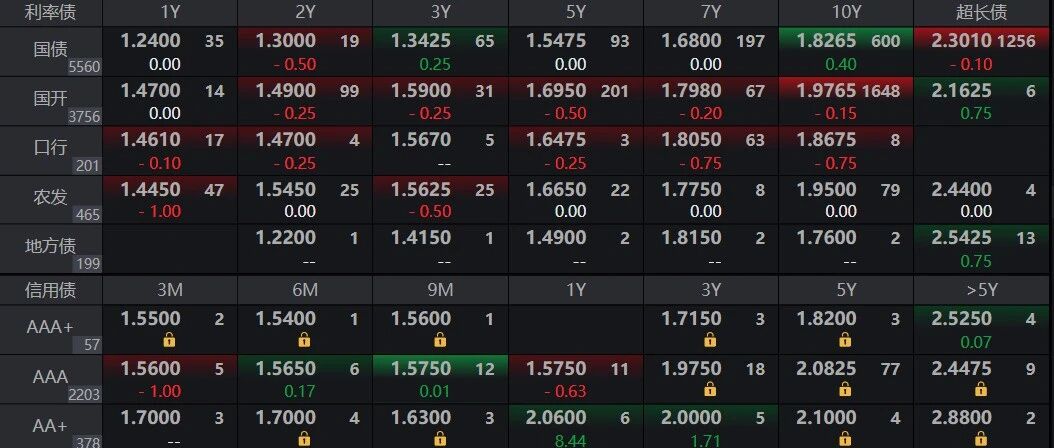
1. Report Industry Investment Rating - No relevant content provided 2. Core Viewpoints of the Report - On March 19, the capital market showed a mixed performance. The capital market was stable and loose, the bond market had a differentiated trend with short - term bonds remaining strong and long - term bonds weakening. The convertible bond market followed the decline of the equity market, and most convertible bond individual securities fell. The yields of U.S. Treasury bonds of different maturities were also differentiated, and the 10 - year Treasury bond yields of major European economies generally increased [1]. 3. Summary by Directory 3.1 Bond Market News 3.1.1 Domestic News - From January to February this year, the national general public budget revenue was 4.4154 trillion yuan, a year - on - year increase of 0.7%. Among them, national tax revenue was 3.6393 trillion yuan, a year - on - year increase of 0.1%, and non - tax revenue was 776.1 billion yuan, a year - on - year increase of 3.4%. Central general public budget revenue decreased by 1.7% year - on - year, while local general public budget revenue increased by 2.6% year - on - year [3]. - The central bank will continue to implement a moderately loose monetary policy, firmly maintain the stable operation of financial markets such as stocks, bonds, and foreign exchange, and study the establishment of a liquidity support mechanism for non - bank financial institutions in specific scenarios [4]. - The CSRC held a symposium on the "15th Five - Year Plan" of the capital market with investment institutions, and participants put forward suggestions on deepening investment - side reform and enhancing the internal stability of the capital market [5]. - The State Administration of Foreign Exchange will further improve the expectation management mechanism, maintain the stable operation of the foreign exchange market, deepen foreign exchange reform and innovation, and promote high - level opening - up in the foreign exchange field [6]. - The Ministry of Commerce stated that China and the U.S. will continue to play the role of the Sino - U.S. economic and trade consultation mechanism, strengthen dialogue and communication, and promote the stable and positive development of bilateral economic and trade relations [7]. 3.1.2 International News - On March 19, the European Central Bank kept the deposit rate unchanged at 2% for the sixth consecutive time. It warned that the Middle East conflict has significantly increased the uncertainty of the euro - zone economic outlook, with upward inflation risks and downward economic growth pressure [8]. 3.1.3 Commodities - On March 19, WTI April crude oil futures fell 0.18% to $96.14 per barrel, Brent May crude oil futures rose 1.18% to $108.65 per barrel, spot gold fell 3.42% to $4,653.01 per ounce, and NYMEX April natural gas futures fell 2.31% to $3.128 per million British thermal units [9]. 3.2 Capital Market 3.2.1 Open Market Operations - On March 19, the central bank conducted 13 billion yuan of 7 - day reverse repurchase operations at a fixed - rate and quantity - tender basis, with an operating rate of 1.40%. The net withdrawal of funds on the day was 1.15 billion yuan due to the maturity of 24.5 billion yuan of reverse repurchases [10]. 3.2.2 Capital Interest Rates - On March 19, the capital market was stable and loose. DR001 rose 0.03bp to 1.320%, and DR007 fell 0.61bp to 1.427%. Other capital interest rates also showed different changes [11][12]. 3.3 Bond Market Dynamics 3.3.1 Interest - Bearing Bonds - **Spot Bond Yield Trends**: On March 19, the yields of major inter - bank interest - bearing bonds showed a differentiated trend. Short - term bonds were strong due to the loose capital market, while long - term bonds weakened due to profit - taking. For example, the yield of the 10 - year Treasury bond active bond 250022 rose 0.80bp to 1.8360%, and the yield of the 10 - year CDB bond active bond 250220 rose 0.65bp to 1.9780% [14]. - **Bond Tendering Situations**: Multiple bonds were tendered on March 19, with different issuance scales, winning yields, full - field multiples, and marginal multiples [16]. 3.3.2 Credit Bonds - **Secondary Market Transaction Abnormalities**: On March 19, the transaction prices of two industrial bonds deviated by more than 10%. "H2 Vanke 02" fell by more than 10%, and "H1 Vanke 06" rose by more than 11% [17]. - **Credit Bond Events**: Multiple companies announced events such as loan defaults, bill payment defaults, redemption option decisions, and bond issuance cancellations [20]. 3.3.3 Convertible Bonds - **Equity and Convertible Bond Indexes**: On March 19, the three major A - share indexes fell, and the convertible bond market also weakened. The CSI Convertible Bond Index, Shanghai Stock Exchange Convertible Bond Index, and Shenzhen Stock Exchange Convertible Bond Index fell 1.64%, 1.53%, and 1.84% respectively. Most convertible bond individual securities fell [19]. - **Convertible Bond Tracking**: On March 20, Tonglian Convertible Bond was listed. On March 19, Huaxiang Co., Ltd.'s convertible bond issuance was approved by the exchange, and Hongtu Convertible Bond announced a downward revision of the conversion price [26]. 3.3.4 Overseas Bond Markets - **U.S. Bond Market**: On March 19, the yields of U.S. Treasury bonds of different maturities showed a differentiated trend. The 2 - year U.S. Treasury bond yield rose 3bp to 3.79%, and the 10 - year U.S. Treasury bond yield fell 1bp to 4.25%. The yield spreads of 2/10 - year and 5/30 - year U.S. Treasury bonds narrowed [23][24]. - **European Bond Market**: On March 19, the 10 - year Treasury bond yield of Spain remained unchanged, while the 10 - year Treasury bond yields of other major European economies generally increased [27]. - **Daily Price Changes of Chinese - funded U.S. Dollar Bonds**: As of the close on March 19, the prices of Chinese - funded U.S. dollar bonds showed different changes, with some rising and some falling [29].
【笔记20260320— 加油吧,赶在下周一前】
债券笔记· 2026-03-20 10:49
Core Viewpoint - The article discusses the current financial market conditions, highlighting the mixed performance of the stock market and the impact of central bank policies on interest rates and liquidity [3][5]. Group 1: Market Conditions - The stock market experienced a significant decline, with major indices dropping below 4000 points, erasing all gains made in the year [6]. - The central bank is reportedly conducting research to cancel the lower limit on the reserve requirement ratio, which has implications for liquidity in the market [5][6]. - The bond market showed volatility, with the 10-year government bond yield fluctuating around 1.8365% [5][8]. Group 2: Interest Rates and Liquidity - The central bank conducted a 205 billion yuan reverse repurchase operation, with a net withdrawal of 170 billion yuan due to 375 billion yuan of reverse repos maturing [3]. - The funding rates remained stable, with DR001 around 1.32% and DR007 at approximately 1.42% [3]. - The weighted rates for various funding instruments showed slight changes, with R001 at 1.40% and R007 at 1.48%, indicating a mixed trend in the interbank funding market [4].
十五五规划纲要出炉 | 金融企业如何跨越“数据+AI”的转型鸿沟?
AI前线· 2026-03-19 05:44
Core Viewpoint - The article emphasizes the importance of digital and intelligent transformation in the financial industry as outlined in the 14th Five-Year Plan, highlighting the shift towards an era where artificial intelligence (AI) becomes the core system driving key financial processes such as risk control, investment research, and marketing [1]. Group 1: AI-Driven Scientific and Technological Development - Accelerate the exploration of AI-driven new research paradigms and technology development models, promoting the application of large scientific models and building intelligent research platforms [3]. - Strengthen the collaboration between AI and fields such as quantum technology, life sciences, new materials, new energy, and 6G [3]. Group 2: AI in Industry Development - Promote the application of AI across all stages of industrial design, production, and operations, particularly in energy systems and logistics [3]. - Encourage the widespread use of intelligent terminals and agents in service sectors like biological breeding and logistics [3]. Group 3: AI for Consumer Quality Improvement - Develop efficiency-enhancing and companion-type intelligent applications, including new generations of AI smartphones and computers [3]. - Explore new forms of intelligent products and expand intelligent service consumption scenarios [3]. Group 4: AI for Public Welfare - Innovate teaching models with intelligent companions and teachers, enhancing personalized learning and smart tutoring applications [3]. - Promote high-level health assistants and expand the application of intelligent diagnostic aids in grassroots medical institutions [3]. Group 5: AI in Governance - Enhance the application of AI in comprehensive market regulation, safety production supervision, disaster prevention, and ecological protection [4]. - Explore the construction of a collaborative safety governance system involving natural persons, digital entities, and intelligent robots [4]. Group 6: Global Cooperation in AI - Promote the establishment of a global AI cooperation organization and a multilateral cooperation platform for AI along the Belt and Road [4]. - Accelerate the development of a globally open open-source technology system and community ecology [4]. Group 7: Infrastructure for AI Development - The plan emphasizes the need for a robust foundation for financial digitalization, focusing on the efficient supply of computing power, algorithms, and data [5]. - Propose the construction of a market-oriented operation for computing power facilities to meet demand through various innovative methods [5]. Group 8: Talent and Skills Gap - The financial sector faces challenges in transforming due to gaps in understanding and skills among management regarding new concepts like intelligent economy and trustworthy data spaces [15]. - The lack of composite talents who understand both financial business logic and AI engineering is a significant bottleneck for transformation [15]. Group 9: Challenges in Scene Implementation - Despite encouragement for new intelligent models, the practical application of AI in complex tasks remains challenging, requiring organizational process reengineering [16]. - Many institutions struggle to utilize advanced computing power and services due to a lack of skilled personnel, leading to underutilization of technology [16]. Group 10: Strategic Mission for Financial Sector - The financial industry is tasked with a new strategic mission to develop technology finance, green finance, inclusive finance, and digital finance, aligning with technological innovation [14]. - The plan emphasizes the need for a financial system that adapts to technological innovation [14].

2026年债市投资策略:或胜于预期
Hua Yuan Zheng Quan· 2026-03-19 02:14
Economic Review and 2026 Outlook - In 2025, the actual GDP growth rates for Q1 to Q4 were 5.4%, 5.2%, 4.8%, and 4.5%, while nominal GDP growth rates were 4.6%, 3.9%, 3.7%, and 3.9% respectively, indicating a downward trend in actual GDP growth throughout the year [4][10] - Fixed asset investment (excluding rural households) decreased by 3.8%, the lowest since 2010, while retail sales of consumer goods grew by 3.7%, and export growth (in RMB terms) was 6.1% [4][19] - The economic state in 2025 was characterized by strong supply but weak demand, with resilient production and exports, but persistent weakness in domestic demand [4][19] 2026 Policy and Institutional Behavior Outlook - A moderately loose monetary policy is expected, with a forecasted policy interest rate cut of 10-20 basis points, and a potential reserve requirement ratio (RRR) cut of 50-100 basis points [4][62][66] - The net financing scale of government bonds in 2026 is projected to be around 13.8 trillion yuan, remaining stable compared to the previous year [4][76] - The influence of trading desks on the bond market is anticipated to weaken, while the pricing power of banks and insurance funds is expected to increase due to lower funding costs [4][62][79] Investment Recommendations - The bond market in 2026 is expected to perform better than anticipated, with a projected net issuance of around 20 trillion yuan and significant demand from banks and insurance funds [4][58] - The 10-year government bond yield is expected to fluctuate between 1.6% and 1.9%, while the 30-year government bond yield is projected to be between 1.9% and 2.4% [4][58] - Investors are advised to focus on opportunities in long-term bonds and to monitor oil price fluctuations and changes in risk appetite [4][58]
2月信贷、社融数据延续平稳走势,资金面整体偏松,债市走势分化
Dong Fang Jin Cheng· 2026-03-18 00:15
Report Industry Investment Rating - Not provided in the content Core Viewpoints - On March 13, the overall liquidity was loose, the bond market showed a divergent trend with short - term bonds performing well and medium - and long - term bonds being weak, the convertible bond market's major indices declined collectively, and most convertible bond issues fell. The yields of U.S. Treasury bonds of various maturities showed a divergent trend, and the yields of 10 - year government bonds of major European economies generally increased [1] Summary by Relevant Catalogs I. Bond Market News (1) Domestic News - The article "Promote High - quality Development of the Marine Economy" by General Secretary Xi Jinping emphasizes the importance of high - efficiency development and utilization of the ocean, and puts forward five major ideas for promoting high - quality development of the marine economy [3] - In February 2026, new RMB loans were 900 billion yuan, a year - on - year decrease of 110 billion yuan; new social financing scale was 2.38 trillion yuan, a year - on - year increase of 146.9 billion yuan. At the end of February, M2 increased by 9.0% year - on - year, and M1 increased by 5.9% year - on - year, 1.0 percentage point faster than at the end of last month [4] - The Financial Regulatory Administration and the Central Bank jointly issued regulations requiring lenders to show borrowers a comprehensive financing cost statement for personal loans, aiming to make loan fees more transparent and protect consumers' rights [4][5] - The new regulations on information disclosure of public offering fund regular reports will be implemented on May 1, which guide the industry to focus on the concepts of "long - term investment" and "value investment" [6] - The China Securities Regulatory Commission will strengthen the monitoring of the linkage between domestic and foreign, futures and spot markets, and promote the implementation of policies to serve new productive forces [7] (2) International News - In January, the U.S. core PCE price index increased by 3.1% year - on - year, reaching a two - year high; the overall PCE price index increased by 2.8% year - on - year. The service price was the core driving force of inflation, and the actual consumer spending growth was weak [8] - In January, the initial value of the month - on - month change in U.S. durable goods orders was 0%, lower than the market expectation of 1.1%. The growth momentum of the manufacturing industry weakened [9] (3) Commodities - On March 13, international crude oil futures prices continued to rise, while NYMEX natural gas futures prices fell. WTI April crude oil futures rose 3.11% to $98.71 per barrel, and Brent May crude oil futures rose 2.67% to $103.14 per barrel. COMEX April gold spot prices fell 1.13% to $5022.17 per ounce, and NYMEX April natural gas futures prices fell 3.57% to $3.132 per million British thermal units [10] II. Liquidity (1) Open Market Operations - On March 13, the central bank carried out 37.5 billion yuan of 7 - day reverse repurchase operations at a fixed interest rate, with an operating interest rate of 1.40%. The net withdrawal of funds on that day was 7.3 billion yuan [12] (2) Funding Rates - On March 13, the overall liquidity was loose. DR001 decreased by 0.58bp to 1.322%, and DR007 decreased by 0.88bp to 1.462%. Various funding rates generally declined [13][14] III. Bond Market Dynamics (1) Interest - rate Bonds - On March 13, the performance of major interest - rate bonds was divergent. Short - term bonds performed well, while medium - and long - term bonds were weak. The yield of the 10 - year Treasury bond active bond 250022 increased by 1.15bp to 1.8225%, and the yield of the 10 - year CDB bond active bond 250220 increased by 0.90bp to 1.9780% [16] - The 26 Attached - interest Treasury Bond 01 (Continued 2) with a term of 1 year had an issue scale of 175 billion yuan, a winning bid yield of 1.1905%, a full - field multiple of 2.65, and a marginal multiple of 10.06; the 26 Attached - interest Treasury Bond 06 with a term of 2 years had an issue scale of 155 billion yuan and a full - field multiple of 3.14, and a marginal multiple of 5.08 [17] (2) Credit Bonds - On March 13, the trading price of one industrial bond, "H3 Vanke 01", deviated by more than 10%, rising more than 13% [17] - There were multiple credit bond events, including the cancellation of a bondholder meeting by Fujian Jiuxian Industrial Investment, the negative watch on the long - term issuer rating of United Energy Group by Fitch, the revocation of the insurance financial strength rating of Guoyuan Insurance by Moody's, the investigation of Shuangliang Group by the CSRC, the debt guarantee by Zhongyou Jinhong, and the planned asset transfer by Jingtou Development [20] (3) Convertible Bonds - On March 13, the three major A - share stock indices fell. The Shanghai Composite Index, Shenzhen Component Index, and ChiNext Index fell 0.82%, 0.65%, and 0.22% respectively, with a full - day trading volume of 2.42 trillion yuan. Most Shenwan primary industries fell [19] - The major convertible bond market indices fell collectively. The CSI Convertible Bond Index, Shanghai Convertible Bond Index, and Shenzhen Convertible Bond Index fell 1.04%, 1.10%, and 0.94% respectively. The trading volume of the convertible bond market was 73.553 billion yuan, an increase of 10.12 billion yuan from the previous trading day. Most convertible bond issues fell [21] - There were multiple convertible bond events, including the approval of Diwell's convertible bond issuance by the exchange, the impending triggering of the conversion price downward - revision clause for Jin 23 Convertible Bond, and the announcements of early redemption or non - early redemption for multiple convertible bonds [25] (4) Overseas Bond Markets - On March 13, the yields of U.S. Treasury bonds of various maturities showed a divergent trend. The yield of the 2 - year U.S. Treasury bond decreased by 3bp to 3.73%, and the yield of the 10 - year U.S. Treasury bond increased by 1bp to 4.28%. The yield spreads of 2/10 - year and 5/30 - year U.S. Treasury bonds widened. The break - even inflation rate of the 10 - year U.S. inflation - protected Treasury bond (TIPS) decreased by 2bp to 2.36% [24][26][27] - On March 13, the yields of 10 - year government bonds of major European economies generally increased. The yield of the 10 - year German government bond increased by 4bp to 2.98%, and the yields of 10 - year government bonds of France, Italy, Spain, and the UK increased by 5bp, 6bp, 4bp, and 5bp respectively [28] - The daily price changes of Chinese - funded U.S. dollar bonds showed that some bonds had price increases, while others had price decreases. For example, the bonds of Ideal Auto, CNOOC North America Unlimited Liability, etc. rose, while the bonds of China National Agrochemical (Hong Kong) Fengqiao Co., Ltd., Bilibili, etc. fell [30]