
食品饮料业

Search documents
日本商品展览会延期后在大连举办
日经中文网· 2025-10-27 03:38
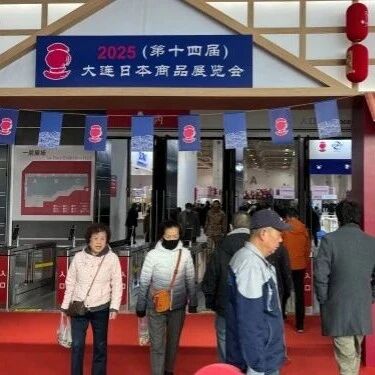
Core Viewpoint - The successful opening of the Dalian Japan Goods Exhibition is significant as it may improve Chinese sentiments towards Japan through exposure to Japanese products and services, despite the historical and political tensions between the two countries [2][7]. Group 1: Event Overview - The Dalian Japan Goods Exhibition, which started in 2008, is now in its 14th year and is organized by the Dalian municipal government, which actively seeks Japanese investment [4]. - The exhibition features participation from 27 prefectures and 4 cities in Japan, showcasing approximately 4,000 products across various categories, including food, beverages, and health products for the elderly [4][6]. Group 2: Political Context - The exhibition has been affected by political relations, with cancellations in 2012 due to deteriorating Sino-Japanese relations and in 2023 amid concerns over the Fukushima nuclear water discharge [6]. - The event was initially scheduled for September but was postponed to October due to uncertainties surrounding its feasibility [6]. Group 3: Public Sentiment - The successful opening of the exhibition is seen as a potential turning point for improving public sentiment towards Japan, as evidenced by attendees like a 70-year-old visitor who expressed interest in Japanese cosmetics [7].

【跨国公司在中国】“稳外资”政策加持 跨国企业在中国“投资未来”
Jing Ji Guan Cha Bao· 2025-10-24 06:30
Group 1: China's Economic Policy and Foreign Investment - The Fourth Plenary Session of the 20th Central Committee of the Communist Party of China emphasized expanding high-level opening-up and creating a win-win cooperation environment, with a focus on maintaining a multilateral trade system and promoting international circulation [1] - By mid-2023, China had attracted a cumulative actual use of foreign capital amounting to $708.73 billion during the 14th Five-Year Plan period, with a year-on-year increase of 11.7% in newly established foreign-invested enterprises in the first half of 2025 [1][2] - The Ministry of Commerce reported that by the end of 2024, over 1.239 million foreign-invested enterprises had been established in China, with a cumulative actual use of foreign capital reaching 20.6 trillion yuan [2][6] Group 2: Multinational Corporations' Investments - Airbus inaugurated a second A320 series aircraft assembly line in Tianjin, which is expected to be fully operational by early 2026, reflecting the growing demand in the Chinese aviation market, projected to require 9,500 aircraft over the next 20 years [2][7] - Coca-Cola's recent financial report indicated a 14% increase in global sales of its sugar-free products, with the Asia-Pacific market being a significant growth driver [3] - Hilton Group opened the Waldorf Astoria Hotel in Shanghai, marking a milestone of over 888 hotels in China, and plans to double its hotel count in the country [5] Group 3: Industry Trends and Innovations - The report from the Ministry of Commerce indicated that high-tech sectors accounted for 43.7% of foreign investment in manufacturing by 2024, with foreign enterprises contributing nearly 50% to China's high-tech product exports [6][7] - The newly established Coca-Cola factory in Zhengzhou features advanced automation technologies, including a "smart robot picking" system, enhancing operational efficiency [6] - Boston Scientific launched its first manufacturing base in China, aiming to provide innovative medical products and strengthen local supply chains [8]


股指周报(IF&IH&IC&IM):关税摩擦扰动市场,股指下跌-20251020
Guo Mao Qi Huo· 2025-10-20 05:19
Report Industry Investment Rating No relevant content provided. Core Viewpoints of the Report - Exports have performed better than expected. From January to September 2025, China's exports in RMB terms increased by 7.1% year-on-year, with a year-on-year growth rate of 8.4% in September, driven by the base effect and the strong performance of mechanical and electrical products [3]. - In September, the year-on-year declines in CPI and PPI both narrowed. The CPI decreased by 0.3% year-on-year, slightly up from -0.4% last month but still lower than the market expectation of -0.1%. The PPI was -2.3%, narrowing by 0.6 percentage points from last month [3]. - The growth rate of social financing has declined, but household deposits have become more active. At the end of September 2025, the stock of social financing scale was 437.08 trillion yuan, a year-on-year increase of 8.7%, 0.1 percentage point lower than the previous value. The acceleration of government bond issuance is the main factor supporting the high growth rate of social financing stock [3]. - Short - term policy expectations remain. From October 20 - 23, the Fourth Plenary Session of the 20th Central Committee of the Communist Party of China will be held to study suggestions on formulating the 15th Five - Year Plan for National Economic and Social Development, analyze and study the current economic situation, and deploy economic work for the second half of the year [3]. - Sino - US tariff policies have escalated, and the Sino - US equity markets have been severely hit. Since early October, the US has introduced a series of restrictive measures against China, and China has taken counter - measures [3]. - The market trading volume shrank last week. The daily trading volumes of A - shares last week were 21038 billion yuan, 23147 billion yuan, 18835 billion yuan, 17526 billion yuan, and 17598 billion yuan respectively, with the average daily trading volume decreasing by 1132.1 billion yuan compared to the previous week [3]. - In the short term, due to the uncertainty of Sino - US economic and trade policies, market risk appetite may fluctuate. As the adverse factors of trade frictions gradually ease, the stock index is expected to return to the upward channel. It is advisable to focus on risk avoidance in the short term, and the large - cap style may be more resilient. Stock index futures long investors can consider using options tools for risk hedging [3]. Summary by Sections 1. Stock Index Market Review - Last week, the CSI 300 fell 2.22% to 4514.2; the SSE 50 fell 0.24% to 2967.8; the CSI 500 fell 5.17% to 7016.1; the CSI 1000 fell 4.62% to 7185.5 [5]. - Among the Shenwan primary industry indices, only the banking (4.9%), food and beverage (0.9%), and transportation (0.4%) sectors rose last week, while the electronics (-7.1%), media (-6.3%), and other sectors led the decline [7]. - As of October 17, the monthly contracts expired. The annualized discounts of the next - month contracts IF2511, IH2511, IC2511, and IM2511 were 5.32%, 1.57%, 17.4%, and 15.51% respectively [11]. - The spread between the CSI 300 and the SSE 50 was at the 94.1% historical quantile level; the spread between the CSI 1000 and the CSI 500 was at the 34.7% historical quantile level [15]. 2. Stock Index Influencing Factors - Liquidity - This week, the central bank conducted 6331 billion yuan of reverse repurchase operations and 6000 billion yuan of 182 - day outright reverse repurchase operations in the open market. After deducting the maturity amount, a net回笼 (including treasury cash) of 6979 billion yuan was achieved this week. Next week, 7891 billion yuan of reverse repurchases will expire [20]. - As of October 16, the margin trading balance of A - shares was 24496.3 billion yuan, an increase of 153.3 billion yuan from the previous week. The proportion of margin - buying amount to the total market trading volume was 12.3%, at the 98.1% quantile level in the past decade [26]. 3. Stock Index Influencing Factors - Economic Fundamentals and Corporate Earnings - In September 2025, the manufacturing PMI was 49.8, up 0.4 from August; the new order index was 49.7, up 0.2; the new export order index was 47.8, up 0.6 [36]. - The year - on - year growth rates of the net profit attributable to the parent company of the CSI 300 in Q2 2025, Q1 2025, and Q4 2024 were 2.49%, 3.32%, and 2.78% respectively; the ROE (TTM) was 9.71%, 9.75%, and 10.09% respectively [40]. 4. Stock Index Influencing Factors - Policy Driven - In September, the Ministry of Commerce stated that relevant departments had introduced more than 30 policies to establish a "1 + N" policy system for service consumption and would introduce a series of targeted documents [45]. - From September 1, 2025, to August 31, 2026, residents using personal consumption loans for consumption can enjoy an interest - subsidy policy, with a subsidy ratio of 1 percentage point [47]. 5. Stock Index Influencing Factors - Overseas Factors - In September 2025, the US manufacturing PMI was 49.1%, up 0.4 percentage points from the previous value; the non - manufacturing PMI was 50%, down 2 percentage points from the previous value [55]. - In August 2025, the US PCE increased by 2.74% year - on - year, and the core PCE increased by 2.91% year - on - year; the CPI increased by 2.9% year - on - year, and the core CPI increased by 3.1% year - on - year [61]. - Trump has proposed a series of tariff increase measures against China, and China has taken corresponding counter - measures [63][65].
金价暴涨!
中国能源报· 2025-10-17 01:35
Group 1: Market Overview - On October 16, international gold prices closed above $4,300 per ounce, reaching a record high due to increased investor interest in gold as a risk hedge amid economic uncertainties [2] - The U.S. stock market experienced a decline after initial gains, with the Dow Jones down 0.65%, S&P 500 down 0.63%, and Nasdaq down 0.47% due to concerns over bank loan issues and fraud allegations [1] Group 2: Corporate Developments - Nestlé announced plans to cut approximately 16,000 jobs, equivalent to 6% of its total workforce, and aims to save about 3 billion Swiss francs (approximately 26.8 billion RMB) by the end of 2027, leading to a significant increase in its stock price by over 9% [3] Group 3: Economic Indicators - The UK GDP showed a minimal growth of 0.1% in August, with July's data revised to a contraction of 0.1%, indicating ongoing stagnation in the service sector and presenting challenges for the Chancellor [4] - U.S. crude oil inventories rose by 3.5 million barrels, significantly exceeding expectations, which contributed to a drop in international oil prices to a five-month low, with WTI crude at $57.46 per barrel and Brent crude at $61.06 per barrel [5]

2025可持续全球领导者大会开幕:凯文·凯利现身,数十位企业家共议绿色发展
新浪财经· 2025-10-16 23:39
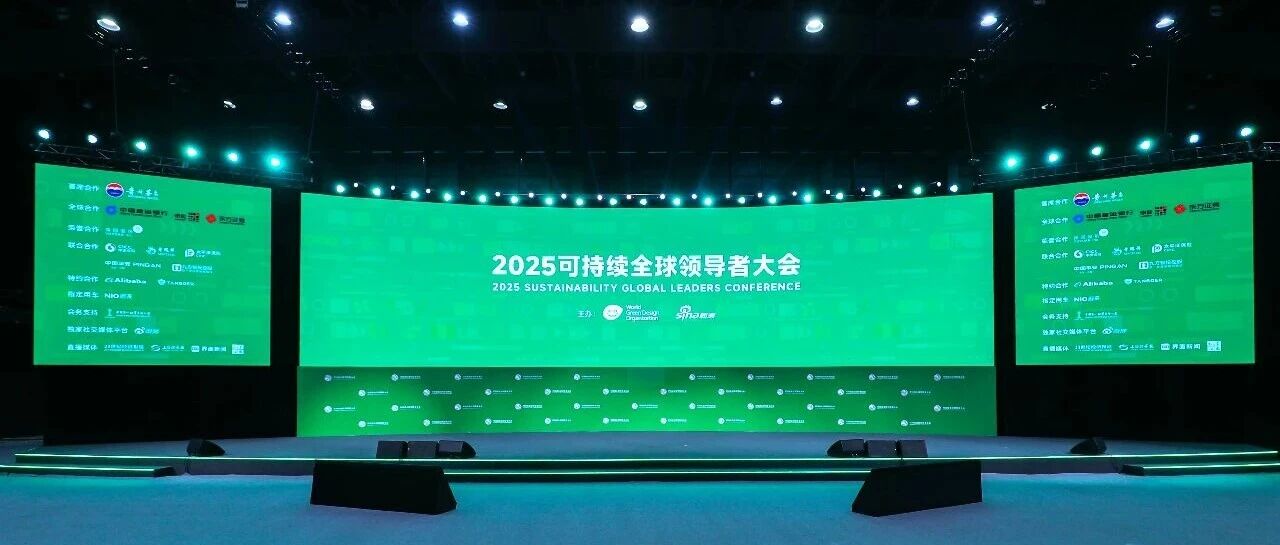
Core Viewpoint - The 2025 Sustainable Global Leaders Conference, held from October 16 to 18 in Shanghai, focuses on "Facing Challenges Together: Global Action, Innovation, and Sustainable Growth," aiming to explore new paths for sustainable development and inject "Chinese momentum" into global governance [2]. Group 1: Conference Overview - The conference is co-hosted by the World Green Design Organization (WGDO) and Sina Group, with support from the International Financial Reporting Standards Foundation (IFRS Foundation) [3]. - Keynote speakers include prominent figures from various sectors, including finance, academia, and business, discussing sustainable development [2]. Group 2: Sustainable Development Goals - WGDO's mission is to establish green design systems and promote global green transformation to achieve sustainable development [5]. - The conference highlights China's role as a leader in sustainable development, emphasizing the importance of innovation and collaboration [7]. Group 3: Financial Institutions' Role - Financial institutions like China Bank and Bank of Communications are actively participating in carbon market construction and promoting green finance [20][22]. - Shanghai's ESG development is characterized by a high rate of ESG report publication among listed companies, with state-owned enterprises leading the way [24]. Group 4: ESG and Sustainable Finance - The conference emphasizes the integration of ESG principles into corporate governance and financial practices, with various banks and financial institutions committing to enhance their ESG strategies [42][44]. - The need for innovative financial tools to support carbon reduction and sustainable development is highlighted, with a focus on leveraging technology [30][36]. Group 5: Industry Perspectives - Various industry leaders express their commitment to sustainable practices, emphasizing the importance of integrating environmental responsibility into business strategies [65][67]. - The conference showcases how companies across different sectors are adopting sustainable practices as a core part of their operations, reflecting a broader trend towards sustainability in the business landscape [70][72].
每日投行/机构观点梳理(2025-10-14)
Jin Shi Shu Ju· 2025-10-14 10:36
Group 1: Gold and Silver Price Forecasts - Bank of America raised its gold price forecast for next year to $5,000 per ounce, with an average of $4,400 per ounce, and silver to $65 per ounce, with an average of $56 per ounce [1] - The extreme imbalance in the physical silver market may normalize at some point, potentially increasing volatility [1] Group 2: Currency and Interest Rate Predictions - HSBC believes the US dollar is likely to weaken further and may hit a bottom early next year, especially if the Federal Reserve resumes a loosening cycle while avoiding recession [2] - Standard Chartered analysts suggest that if the US economic momentum remains strong, the likelihood of further rate cuts in 2026 may decrease, which could push up the dollar and US bond yields [3] - Dutch International Group anticipates that the UK government may limit inflationary policies in its November budget, paving the way for further rate cuts by the Bank of England [4] Group 3: UK Economic Outlook - Dutch International Group analysts indicate that the UK economy's actual performance is not as weak as reported, but the combination of tightening fiscal policy and loosening monetary policy may pressure the British pound [5] - The UK Chancellor will need to implement tax increases or spending cuts to reduce the fiscal deficit, which may lead to a higher risk for the pound compared to the euro [5] Group 4: Australian Monetary Policy - Nomura Securities suggests that the Australian currency market has overestimated the likelihood of further rate cuts by the Reserve Bank of Australia, as recent policy meeting minutes indicate a lack of clarity on economic capacity and neutral cash rate levels [6] Group 5: AI Industry Developments - CITIC Securities reports that OpenAI's collaboration model of "procurement contracts + equity" with industry chain companies is beneficial for the entire AI ecosystem, aiding in stable computing resources and model capability [7] - The upcoming release of AI products in late 2025 is expected to accelerate commercialization, with significant events including OpenAI's Sora 2 launch and Meta's AI glasses [8] Group 6: Shipping and Trade Dynamics - Huatai Securities analyzes the impact of mutual port fees between China and the US on shipping, suggesting that it may lead to a reallocation of global shipping resources and increase freight rates [9] - The report indicates that if port fees continue, it will systematically raise global oil and bulk shipping rates, benefiting Chinese shipping companies while negatively impacting container shipping [9] Group 7: Export Growth and Economic Indicators - Huatai Securities notes that China's export growth remains strong, with a year-on-year increase of 8.3% in September, driven by AI industry demand and the Belt and Road Initiative [10] - Despite a potential slight decline in export growth rates in Q4 due to high base effects, the overall economic outlook remains positive [10] Group 8: Market Trends and Investment Focus - Huatai Securities highlights that post-holiday market trends are volatile, with a focus on cyclical sectors and defensive stocks as investors shift their attention [11] - The report emphasizes the importance of monitoring third-quarter earnings reports in the food and beverage sector, with a focus on companies with stable demand and improved competitive dynamics [12]
公告精选︱佛塑科技:拟设立项目公司投资建设聚酰胺-尼龙薄膜项目;养元饮品:泉泓投资持有长江存储控股0.98%股份,持股比例较低
Ge Long Hui· 2025-09-27 01:09
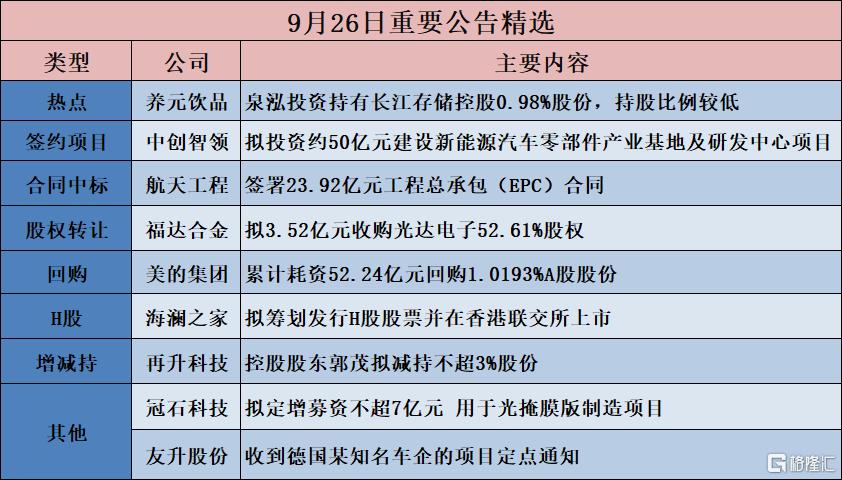
Key Points - The article highlights significant corporate announcements and developments in various companies, including investments, contracts, and stock activities [1][2][3] Investment Projects - Zhongchuang Zhiling plans to invest approximately 5 billion yuan to establish a new energy vehicle parts industrial base and R&D center [1] - Fospower Technology intends to set up a project company to invest in the construction of a polyamide-nylon film project [1] - Hongfuhang plans to establish an overseas company and build a photovoltaic energy storage power station project [1] - Nanfang Glass aims to invest in a new photovoltaic glass production line project in Egypt [1] Contracts and Acquisitions - Aerospace Engineering signed a total engineering contract (EPC) worth 2.392 billion yuan [1] - Fuda Alloy plans to acquire 52.61% of Guangda Electronics for 352 million yuan [1] - Yachuang Electronics intends to purchase 40% of Ouchuangxin and 45% of Yihainengda [1] - Century Hengtong plans to acquire 13% of Qiantong Zhili [1] Stock Buybacks and Issuances - Midea Group has spent a total of 5.224 billion yuan to repurchase 1.0193% of its A-shares [1] - Star Technology submitted an application for H-share issuance and listing on the Hong Kong Stock Exchange [2] - Wufangzhai and Jiadu Technology also submitted applications for H-share issuance and listing [3] - Hailan Home plans to issue H-shares and list on the Hong Kong Stock Exchange [3] Shareholding Changes - Several shareholders of Changxin Bochuang plan to collectively reduce their holdings by no more than 2.99% [3] - Xin Haoying of Fengyuzhu plans to reduce his holdings by no more than 3% [3] - Guo Mao, the controlling shareholder of Zaiseng Technology, intends to reduce his holdings by no more than 3% [3] Other Developments - Guanshi Technology plans to raise no more than 700 million yuan for a photomask manufacturing project [1] - Yousheng Co. received project confirmation from a well-known German automotive company [1] - Xianhe Co. plans to raise no more than 3 billion yuan for the second phase of a high-performance paper-based new material project in Sanjiangkou New Area, Guangxi [1]


螺丝钉指数地图来啦:指数到底如何分类|2025年9月
银行螺丝钉· 2025-09-16 04:01
Core Viewpoint - The article introduces a comprehensive index map that includes various commonly used stock indices, their codes, selection rules, industry distribution, average and median market capitalization of constituent stocks, and the number of constituent stocks, which will be regularly updated for easy reference [1][2]. Group 1: Types of Indices - The index map includes several categories of stock indices: broad-based indices, strategy indices, industry indices, thematic indices, and overseas indices [4][8]. Group 2: Broad-based Indices - Examples of broad-based indices include: - CSI 300 (000300.SH) with an average market cap of 206.67 billion and 300 constituent stocks [5]. - CSI 500 (000905.SH) with an average market cap of 32.77 billion and 500 constituent stocks [5]. - CSI 800 (000906.SH) with an average market cap of 97.98 billion and 800 constituent stocks [5]. - CSI 1000 (000852.SH) with an average market cap of 14.42 billion and 1000 constituent stocks [5]. - CSI 2000 (932000.CSI) with an average market cap of 5.93 billion and 2000 constituent stocks [5]. Group 3: Strategy Indices - Strategy indices include: - CSI Dividend (000922.CSI) reflecting high dividend yield companies with an average market cap of 193.25 billion and 100 constituent stocks [6]. - Shanghai Dividend (000015.SH) with an average market cap of 275.17 billion and 50 constituent stocks [6]. - Shenzhen Dividend (399324.SZ) with an average market cap of 105.30 billion and 40 constituent stocks [6]. Group 4: Industry Indices - Industry indices are designed to reflect specific sectors, such as: - CSI Consumer (000932.SH) focusing on major consumer industry stocks with an average market cap of 125.14 billion and 40 constituent stocks [7]. - CSI Medical (000933.SH) which includes companies related to the pharmaceutical industry [7]. Group 5: Thematic Indices - Thematic indices are tailored to specific investment themes, such as: - CSI Innovation (399989.SZ) which selects companies involved in innovative drug development [7]. - CSI Green Energy focusing on companies in the renewable energy sector [7].

财联社8月4日早间新闻精选
Xin Lang Cai Jing· 2025-08-04 00:28
Group 1 - The People's Bank of China (PBOC) emphasizes the continuation of a moderately loose monetary policy, including lowering the reserve requirement ratio and maintaining ample liquidity [1][2][3] - The Shanghai Securities Association reports that the average commission rate for A-shares in Shanghai reached a new low of 0.201‰ in the first half of 2025, continuing a downward trend [3] - The Ministry of Finance and the State Taxation Administration announced the resumption of value-added tax on interest income from newly issued government bonds, local government bonds, and financial bonds starting August 8, 2025 [4] Group 2 - The National Development and Reform Commission (NDRC) has established a regular communication mechanism with private enterprises to address concerns about "involution" competition, implementing measures such as revising laws and enhancing industry self-discipline [5] - The National Certification and Accreditation Administration has developed new implementation rules for mandatory product certification for mobile power sources and lithium-ion batteries, effective from August 15, 2025 [6] - Eight departments have issued a digital transformation implementation plan for the machinery industry, aiming to establish at least 200 excellent smart factories by 2027 and 500 by 2030 [7] Group 3 - The State Administration for Market Regulation released guidelines for compliance regarding the charging behavior of online trading platforms, prohibiting multiple charges to platform operators and ensuring service provision [8] - Hikvision reported a year-on-year net profit increase of 11.71% for the first half of the year [11] - Ninebot reported a net profit of 1.242 billion yuan for the first half of the year, a year-on-year increase of 108% [11] Group 4 - Baotai announced that its innovative drug BAT5906 has received approval for clinical trials [12] - China Shenhua is planning to issue shares and pay cash for asset acquisitions, with stock trading suspended from August 4 [13] - Boeing is facing a strike action from approximately 3,200 workers starting midnight on August 4, according to union resolutions [20]
永赢基金王乾:下半年重点关注“反内卷”政策效应、内需复苏、新质生产力等投资线索与方向
Zhong Guo Jing Ji Wang· 2025-07-24 01:41
Group 1 - The A-share market has shown good performance in 2023, with the Shanghai Composite Index rising by 6.88%, the ChiNext Index by 7.89%, and the CSI 300 by 4.7% from the beginning of the year to July 23 [1] - The market experienced significant fluctuations due to factors such as "reciprocal tariffs" and has gradually moved upward since mid-April, supported by proactive domestic policies and a temporary easing of Sino-U.S. trade tensions [1] - There is a clear divergence in sector performance, with non-ferrous metals, non-bank financials, and banks leading in gains, while coal, food and beverage, and real estate sectors remain in negative returns [1] Group 2 - The "anti-involution" policy aims to shift industry competition from low-level price wars to high-quality competition, which could improve the profitability of listed companies and enhance the long-term capacity for technological advancement [2] - Midstream manufacturing and upstream raw materials sectors, which are currently facing supply-demand imbalances, are expected to benefit significantly from the gradual implementation of the "anti-involution" policy [2] Group 3 - Domestic demand has shown resilience in the first half of the year, supported by policies such as "trade-in" for durable goods and equipment upgrades, which bolster manufacturing investment [3] - The stabilization of the real estate market is seen as a crucial factor for the recovery of domestic demand, with ongoing supportive policies expected to contribute to this trend [3] - New productive forces, particularly in artificial intelligence and innovative pharmaceuticals, are anticipated to represent significant investment opportunities in the future [3]