
医疗保健

Search documents
调整后的港股机会还远吗?最新解读来了
中国基金报· 2025-12-11 06:20
Core Viewpoint - The recent pullback in the Hong Kong stock market is primarily driven by short-term factors, while the fundamental outlook remains stable, presenting better value for investment in technology and dividend sectors, with a focus on core assets for medium to long-term allocation [2][4][7]. Group 1: Market Dynamics - The Hong Kong stock market has seen a decline of nearly 5% in the Hang Seng Index and close to 15% in the Hang Seng Tech Index since October [2]. - Factors contributing to the market pullback include fluctuations in Federal Reserve interest rate expectations, concerns over valuation bubbles in the AI sector, and seasonal liquidity pressures as year-end approaches [4][5]. - Despite the market's volatility, there has been a continuous inflow of capital from mainland investors, indicating a strong long-term allocation interest in Hong Kong stocks [5] . Group 2: Investment Opportunities - The current market adjustment has made Hong Kong stocks more attractive in terms of valuation, with a favorable window for investment emerging [6][7]. - Key sectors identified for investment include healthcare, technology, cyclical stocks benefiting from supply-demand changes, and dividend-paying stocks that align with insurance capital investment strategies [10][11]. - The healthcare sector is expected to benefit from policy support for innovative drugs, while the technology sector is poised for growth driven by AI applications and favorable monetary policy [10][11]. Group 3: Future Outlook - Looking ahead to 2026, the Hong Kong stock market is anticipated to experience a dual boost from improved fundamentals and valuations, supported by domestic policies and external monetary easing from major economies [7]. - The AI trend is expected to continue driving growth in the technology sector, with significant upside potential for quality blue-chip stocks in the internet and healthcare domains [10][11].


调整后的港股机会还远吗?最新解读来了
Zhong Guo Ji Jin Bao· 2025-12-11 06:20
Core Viewpoint - The recent pullback in the Hong Kong stock market is primarily driven by short-term factors, while the fundamental outlook remains stable, presenting better value for investment in technology and dividend sectors, with a focus on core assets for long-term allocation [1][4]. Group 1: Market Dynamics - The Hong Kong stock market has experienced a decline of nearly 5% in the Hang Seng Index and close to 15% in the Hang Seng Tech Index since early October [1]. - Factors contributing to the market pullback include fluctuations in Federal Reserve interest rate expectations, concerns over AI valuation bubbles, and seasonal liquidity pressures as the year-end approaches [2]. - The market is sensitive to global liquidity, with the recent Fed rate cut and uncertainties in U.S. economic data impacting investor sentiment [2][3]. Group 2: Investment Opportunities - The current market adjustment has made Hong Kong stocks more attractive, with valuations still appealing compared to other major indices, indicating a good time for investment in sectors with long-term growth potential [4]. - Structural opportunities are evident in the market, with expectations of a moderate upward trend driven by continued inflows from mainland investors and supportive domestic liquidity conditions [3][4]. Group 3: Sector Focus - Investment firms highlight several key sectors for potential growth: - Healthcare, benefiting from policy support for innovative drugs [6]. - Technology, particularly in AI applications, which are expected to gain traction [6]. - Cyclical stocks that may benefit from changing supply-demand dynamics [6]. - Dividend stocks, which align well with insurance capital's investment strategies due to their low volatility and high dividend yield [6]. - The long-term investment value of the internet sector remains strong, with increasing AI penetration expected to enhance growth prospects [6][7].
20cm速递|关注科创板100ETF(588120)投资机会,保险资金配置比例存提升空间
Mei Ri Jing Ji Xin Wen· 2025-12-10 12:08
Group 1 - The core viewpoint is that the proportion of stocks held by insurance companies in the Sci-Tech Innovation Board is on a long-term upward trend, supported by policy encouragement for insurance holdings in Sci-Tech stocks [1] - The risk factor for holdings exceeding two years has been adjusted from 0.4 to 0.36, which facilitates a normalized high proportion of equity allocation while maintaining tactical maneuvering space [1] - The increase in equity allocation by insurance funds is a major source of incremental growth, with potential additional investment space reaching trillions if the stock and fund investment ratio is raised to a 30% cap [1] Group 2 - The Sci-Tech 100 ETF (588120) tracks the Sci-Tech 100 Index (000698), which has a daily fluctuation limit of 20%, reflecting the overall performance of 100 larger and more liquid securities selected from the Sci-Tech Innovation Board [1] - The index components cover multiple high-tech industries, including information technology and healthcare, showcasing strong innovation and growth potential [1]
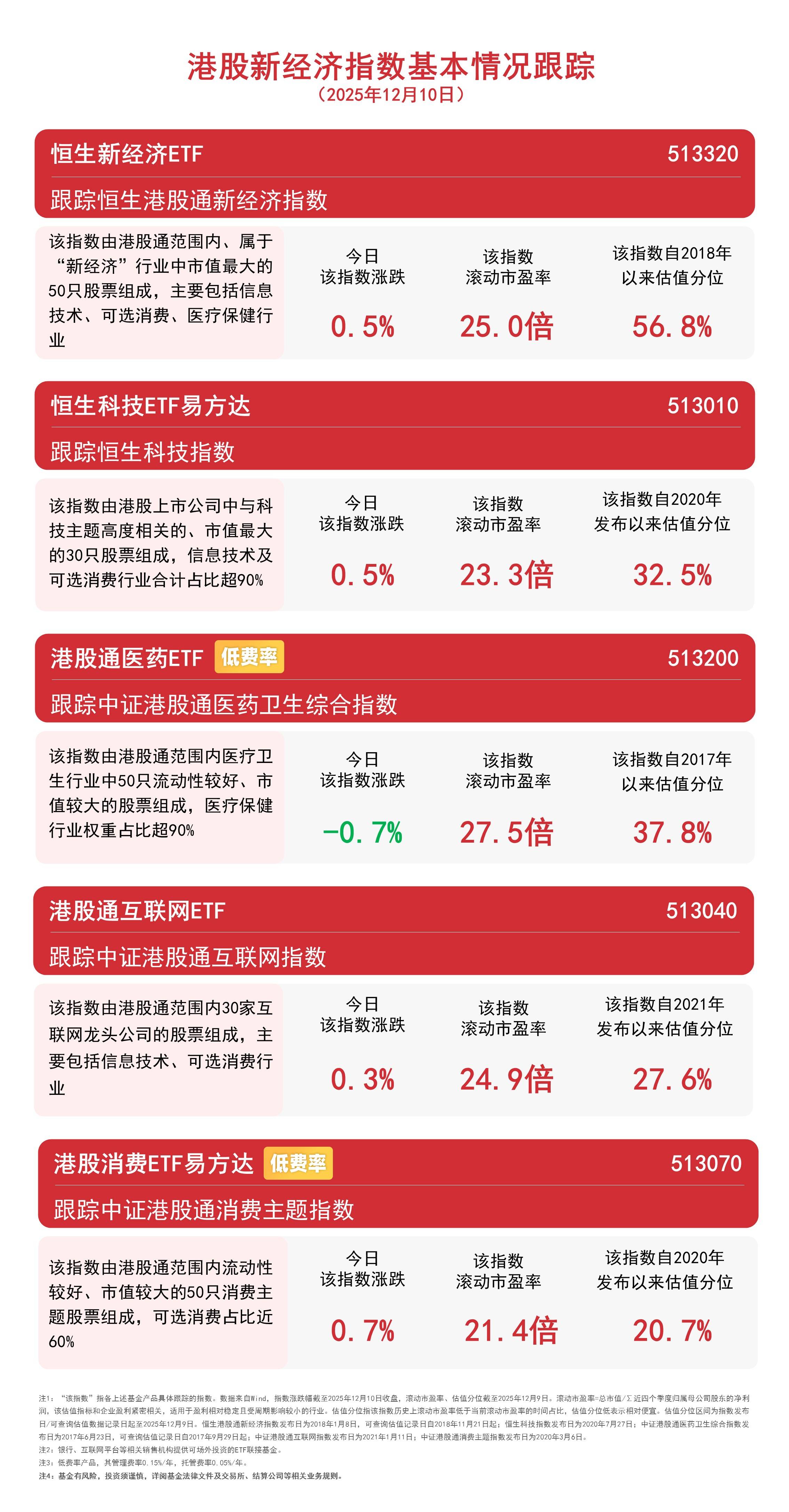
港股互联网板块配置价值不断强化,恒生科技ETF易方达(513010)、港股通互联网ETF(513040)受关注
Sou Hu Cai Jing· 2025-12-10 10:39
Group 1 - The core viewpoint of the article highlights the performance of various indices related to Hong Kong stocks, with the Consumer Theme Index rising by 0.7% and the Hang Seng Technology Index increasing by 0.5% [1] - The net inflow for the Hang Seng Technology ETF and the Hong Kong Internet ETF in the current month reached 960 million and 450 million respectively, indicating strong investor interest [1] - Analysis suggests that Hong Kong internet companies have a first-mover advantage in AI-native applications and smart hardware integration due to their platform scale, data resources, and cloud computing infrastructure [1] Group 2 - The article notes that as super applications, intelligent agent platforms, and full-link AIGC capabilities mature, the profitability structure of leading internet companies in advertising, cloud services, local life, and e-commerce efficiency is expected to improve [1] - The industry valuation is currently at a historically low level, and the trend of AI investment converting to revenue is becoming clearer, enhancing the long-term allocation value of the sector [1]
香港证监会、港交所联合致函保荐人!
中国基金报· 2025-12-10 10:28
Core Viewpoint - The Hong Kong Stock Exchange (HKEX) has confirmed a joint letter with the Hong Kong Securities and Futures Commission (SFC) to IPO sponsors regarding concerns over the declining quality of recent listing applications and non-compliance issues [8]. Market Performance - On December 10, the Hong Kong stock market saw a rebound, with the Hang Seng Index rising by 0.42% to close at 25,540.78 points, and the Hang Seng Tech Index increasing by 0.48% to 5,581.10 points. The market turnover was HKD 1,933.92 billion, down from HKD 2,102.36 billion the previous trading day [2]. - Among the constituents of the Hang Seng Index, 43 stocks rose while 42 fell. Notable gainers included WH Group, which rose by 5.01%, Haidilao by 3.45%, and CSPC Pharmaceutical by 3.19% [3]. Individual Stock Highlights - WH Group (Code: 0288) closed at HKD 8.590, up 5.01% with a year-to-date increase of 65.77% [4]. - Haidilao (Code: 6862) closed at HKD 14.100, up 3.45%, but has seen a year-to-date decline of 6.10% [4]. - CSPC Pharmaceutical (Code: 1093) closed at HKD 7.770, up 3.19%, with a year-to-date increase of 67.18% [4]. - Alibaba (Code: 9988) had a turnover of HKD 93.22 billion, rising by 1.52% with a year-to-date increase of 89.04% [5]. Vanke Enterprises - Vanke Enterprises experienced a significant surge, with its stock price reaching a maximum increase of 18.56% on December 10, closing at HKD 3.78 per share, up 13.17% for the day [10]. - The company held a bondholders' meeting on December 10 to discuss the extension of its first bond, "22 Vanke MTN004." The company announced that it would not adjust the interest rate of "21 Vanke 02," maintaining it at 3.98% [12]. ETF Launch - The Southern Eastern UK Index Covered Call Option Active ETF is set to launch on December 11 on the Hong Kong Stock Exchange. This ETF will primarily invest in the constituents of the Hang Seng China Enterprises Index and aims to generate income through option premiums [15]. Investment Opportunities - UBS Wealth Management highlighted that the Chinese technology sector represents one of the most significant global opportunities, driven by ample liquidity and expected corporate earnings growth of up to 37% in 2026 [16].
美国10月职位空缺升至五个月来最高水平,但裁员人数出现增多
Sou Hu Cai Jing· 2025-12-10 00:43
Group 1 - The number of job vacancies in the U.S. rose slightly to 7.67 million in October, up from 7.66 million in September, marking the highest level in five months [1] - The increase in job vacancies was primarily driven by a few sectors, including retail, wholesale, and healthcare, with the healthcare industry being the largest contributor to employment growth this year [1] - The number of layoffs in October increased to 1.85 million, the highest since the beginning of 2023, mainly driven by the accommodation and food services sector [1] Group 2 - Hiring decreased by 218,000 after a surge in the previous month, indicating a slowdown in the labor market [1] - The resignation rate in October fell to its lowest level since May 2020, suggesting a potential shift in workforce dynamics [1] - The U.S. Bureau of Labor Statistics noted that due to a government shutdown, the regular methods for adjusting the job vacancy data for October were temporarily suspended [1]
中泰国际每日晨讯-20251209
ZHONGTAI INTERNATIONAL SECURITIES· 2025-12-09 02:21
Market Overview - On December 8, the Hang Seng Index fell below the 26,000-point mark, closing down 319 points (1.2%) at 25,765 points, with a total market turnover of HKD 206.2 billion[1] - The market is awaiting the Federal Reserve's interest rate decision, with expectations of a 0.25% rate cut[1] - The net inflow of Hong Kong Stock Connect was HKD 1.54 billion[1] Sector Performance - Chinese brokerage stocks rose after the China Securities Regulatory Commission announced a slight easing of regulations, with Huatai Securities up 5.2%, China Merchants Securities up 2.8%, and CITIC Securities up 1.7%[1] - Major Chinese banks saw declines, with China Construction Bank down 4.0%, China Merchants Bank down 3.5%, and Industrial and Commercial Bank of China down 3.5%[1] - Pop Mart's stock dropped 8.5% amid concerns over declining sales growth for Labubu products[1] U.S. Market Insights - The Dow Jones Index closed down 215 points (0.4%) at 47,739 points, while the Nasdaq fell 32 points (0.1%) to 23,545 points, and the S&P 500 dropped 23 points to 6,846 points[2] - Investors expect the Federal Reserve to cut rates by 0.25% on Thursday, supported by a milder core PCE index[2] Macroeconomic Data - China's total import and export value in November was USD 549.03 billion, up 4.3% year-on-year, with exports rising 5.9% and imports increasing by 1.9%[3] - The trade surplus was USD 111.68 billion, exceeding market expectations of USD 103.1 billion[3] - In the real estate sector, new home sales in 30 major cities fell 33.3% year-on-year, with significant declines across all city tiers[3] Industry Trends - The automotive sector anticipates increased lithium battery production in December, leading to improved industry conditions and price increases, with CATL up 3.3% and Ganfeng Lithium up 7.0%[4] - The healthcare sector saw a 1.5% decline in the Hang Seng Healthcare Index, despite the addition of 114 new drugs to the national medical insurance list, benefiting several major pharmaceutical companies[4] - The renewable energy and utility sectors experienced declines, with major utility stocks falling between 1.0% and 2.8%[5]
高盛:从资产到阿尔法:David Kostin 谈美国股票
Goldman Sachs· 2025-12-08 00:41
Investment Rating - The report indicates a positive outlook for the U.S. stock market in 2026, with expectations of a market increase exceeding 20% [2]. Core Insights - The market sentiment at the beginning of the year was optimistic, with a stable upward trend following the volatility caused by the April 2nd event. The VIX index stabilized around 19, suggesting a favorable market outlook for 2026 [2][3]. - Strong performance in Q3, with company earnings growing nearly 9% year-over-year, has provided stability to the market [4]. - The report highlights the potential for investment in healthcare, consumer sectors benefiting from tax reforms, and companies that can leverage AI for long-term revenue growth [6]. Summary by Sections Market Performance - The U.S. stock market performed well in 2025, with hedge funds rising approximately 12% and the S&P 500 index increasing about 17%. However, only about 29% of mutual funds outperformed their benchmarks due to challenges in adjusting positions during market volatility [4][5]. AI Market Analysis - In the AI sector, public market valuations, such as Nvidia's, are deemed reasonable with a price-to-earnings ratio around 30, while private market valuations may indicate a bubble due to unsustainable capital and pricing [5]. Investment Strategies - "Smart money" is currently focusing on undervalued sectors like healthcare, consumer markets benefiting from tax reforms, and companies poised to gain from AI advancements [6][7]. - Mutual funds are slightly underweighting the largest stocks to avoid concentration, while hedge funds are actively holding these stocks due to their strong performance and rapid growth [7]. Long-term Market Projections - Goldman Sachs forecasts a 10-year annualized total return for the S&P 500 between 3% and 10%, with a median of 6.5%. However, actual returns may be on the lower end of this range due to high current valuations and concentrated portfolios [3][9].
智通港股通占比异动统计|12月8日
智通财经网· 2025-12-08 00:39
Core Insights - The article highlights the changes in the Hong Kong Stock Connect holdings, indicating significant increases and decreases in ownership percentages for various companies [1][2][3]. Group 1: Companies with Increased Holdings - Southern Port Meit Technology (03442) saw an increase of 1.35%, bringing its latest holding percentage to 28.06% [2]. - Lion Group (02562) experienced a 1.19% increase, with a current holding of 29.47% [2]. - Jihong Co., Ltd. (02603) had a 0.75% increase, resulting in a holding percentage of 53.34% [2]. - Over the last five trading days, Jihong Co., Ltd. (02603) had the highest increase of 19.83%, with a holding percentage of 53.34% [3]. - Lion Group (02562) also increased by 4.76%, reaching 29.47% [3]. - Guanghe Tong (00638) saw a 3.73% increase, with a holding percentage of 8.70% [3]. Group 2: Companies with Decreased Holdings - Haotian International Investment (01341) experienced the largest decrease of -0.93%, with a current holding of 67.66% [2]. - Longpan Technology (02465) saw a reduction of -0.83%, bringing its holding to 45.65% [2]. - Weimeng Group (02013) decreased by -0.59%, resulting in a holding percentage of 27.09% [2]. - Over the last five trading days, Huaxia Hengsheng Biotechnology (03069) had the largest decrease of -3.37%, with a holding percentage of 9.42% [3]. - Beijing Automotive (01958) decreased by -2.09%, now holding 24.73% [3]. - Kanglong Chemical (03759) saw a reduction of -2.08%, with a holding percentage of 55.34% [3].
2026年香港市场中国焦点策略:坚定看好港股,预计本轮牛市将走的更远、更久
Bank of China Securities· 2025-12-05 12:24
Group 1 - The report maintains an optimistic outlook for the Hong Kong stock market in 2026, predicting that the current bull market will continue to extend further and last longer, with the Hang Seng Index expected to reach 30,100 points by the end of 2026, based on a forecasted P/E ratio of 13.0 times [2][33] - Key investment opportunities are identified in areas such as strengthening the real economy, promoting technological innovation, developing new productive forces, and expanding domestic demand, which are critical directions outlined in the 14th Five-Year Plan [2][36] - The report emphasizes that sectors related to technological innovation and new productive forces are likely to be the most important investment themes in the coming years, suggesting a focus on consumer leading companies, undervalued high-yield state-owned enterprises, and domestic brands benefiting from accelerated substitution processes [2][36] Group 2 - The Hong Kong stock market showed strong performance in the first 11 months of 2025, with the Hang Seng Index rising by 28.9% and the Hang Seng Tech Index increasing by 25.3%, placing it among the top global stock markets [3][4] - All industry sectors within the Hang Seng classification experienced gains, with materials, healthcare, and information technology sectors performing particularly well, increasing by 134.3%, 74.1%, and 39.7% respectively [4][7] - The report notes that the average daily trading volume in the Hong Kong stock market reached HKD 2,558 billion, a 95% increase year-on-year, and net inflows from southbound trading amounted to RMB 12,806 billion, significantly higher than the previous year's RMB 6,543 billion [3][21] Group 3 - The report indicates that liquidity in the Hong Kong financial market remains ample, with the banking system's surplus rising significantly due to interventions by the Hong Kong Monetary Authority [15][16] - It highlights that southbound trading has played a crucial role in supporting the stability and recovery of the Hong Kong market amid rising geopolitical risks, with companies with mainland backgrounds accounting for 80.59% of the total market capitalization [21][22] - The report anticipates that southbound trading will achieve a net inflow of RMB 1.5 trillion in 2026, surpassing the expected net inflow of RMB 1.33 trillion in 2025 [21][22] Group 4 - The report discusses the normalcy of significant pullbacks during a bull market, noting that the Hang Seng Index experienced a 6.1% decline and the Hang Seng Tech Index a 16.6% decline from late September to late November 2025, which is considered a typical adjustment within historical bull markets [25][29] - It attributes the recent market adjustments to increased internal and external uncertainties, including geopolitical tensions and economic slowdowns, which have led to cautious investor sentiment [26][27] - Historical data shows that during past bull markets, the Hang Seng Index has experienced average pullbacks ranging from 6% to 20%, indicating that the current adjustments do not fundamentally alter the upward trend of the market [29] Group 5 - The report emphasizes the importance of economic construction as a central focus, suggesting that the recent political statements will boost confidence among entrepreneurs and investors, thereby enhancing the fundamentals of listed companies [33][36] - It outlines that the 14th Five-Year Plan prioritizes the strengthening of the real economy, technological self-reliance, and the expansion of domestic demand, which are expected to drive future market growth [35][36] - The report concludes that the increasing recognition of China's AI technology and the presence of high-quality investment targets in the Hong Kong market will attract both domestic and international capital, fostering a positive investment environment [37]