贵金属

Search documents
金价突然大跳水!批发跌零售坚挺,黄金行情要已经变天了!
Sou Hu Cai Jing· 2026-02-26 15:29
Core Viewpoint - The gold market experienced a significant drop in international prices, with a decline of over $140 in a single day, yet retail prices for gold jewelry remained stable or even increased, highlighting a disparity between wholesale and retail markets [1][4][12]. Group 1: Market Dynamics - On February 25, 2026, international gold prices fell sharply from a high of $5237.71 per ounce to a low of $5093.17, marking a drop of 1.75% [1]. - In the domestic market, Shanghai Gold Exchange reported a slight decline in gold T D products and futures contracts, with prices at 1146 yuan per gram and 1148.14 yuan per gram, respectively [3]. - Despite the drop in wholesale prices, major retail brands like Chow Sang Sang and Lao Feng Xiang maintained prices around 1565-1570 yuan per gram, with some even increasing prices slightly [4]. Group 2: Consumer Behavior and Pricing Strategy - The demand for gold jewelry, particularly for weddings, creates a rigid consumer need that supports retail prices despite fluctuations in gold prices [4]. - Retail prices for gold jewelry include not only the cost of gold but also craftsmanship, brand premiums, and other operational costs, making them less sensitive to changes in raw material prices [4][5]. - Retailers employ a pricing strategy that does not immediately adjust to changes in raw material costs, providing consumers with price stability and reducing the frequency of price changes [5]. Group 3: Market Influences - The sharp decline in gold prices was influenced by profit-taking after a rapid increase in prices, as well as changing expectations regarding the Federal Reserve's interest rate policies [7][8]. - Market sentiment shifted as the probability of a rate cut by the Federal Reserve decreased, leading to a stronger dollar and pressure on gold prices [8]. - The disparity between wholesale and retail prices reflects the added value of branding and craftsmanship in the retail market, with wholesale prices significantly lower than retail prices [10]. Group 4: Long-term Outlook - Financial institutions like UBS and Goldman Sachs have set optimistic long-term price targets for gold, with UBS projecting $6200 per ounce and Goldman Sachs estimating around $5500 by year-end, indicating a complex market sentiment [10]. - The volatility observed in the gold market illustrates its dual nature as both an investment asset influenced by macroeconomic factors and a consumer good supported by cultural demand [12].


地缘扰动和关税博弈强化中盘蓝筹涨价逻辑
Orient Securities· 2026-02-26 14:14
Group 1 - The report emphasizes that geopolitical disturbances and tariff negotiations are reinforcing the price increase logic for mid-cap blue chips, particularly in cyclical sectors such as non-ferrous metals, chemicals, and agriculture [7][10][34] - The recent geopolitical tensions, including the U.S. tariff disputes and the situation in Iran, have significantly supported precious metal prices, indicating potential price increases for strategic metals [10][12][15] - The report highlights the establishment of a national unified electricity market in China, which is expected to enhance the multi-dimensional value of electricity resources, with a timeline for market implementation set for 2027 [12][15] Group 2 - The real estate market shows stable trends during the Spring Festival, but the cyclical turning point remains to be observed, with expectations of policy easing and improvements in core city markets [13][15][34] - Consumer demand is diversifying, with increased foot traffic during the Spring Festival indicating a shift towards a consumption-driven growth model, supported by technological advancements and high levels of openness [14][15] - The report notes that mid-cap blue chips present a favorable risk profile, with overall market risks being manageable despite some fluctuations in short-term sentiment across various indices [16][34] Group 3 - The report identifies a trend of short-term volatility in hot sectors, with mid-cap blue chips showing resilience, while other sectors like basic chemicals and power grid equipment maintain stable medium-term uncertainties [21][25][31] - The analysis of trading behavior indicates a shift from strong trends to fluctuations in previously high-performing sectors, with only the power equipment sector maintaining its trend [21][25][31] - The report suggests that the overall market sentiment is gradually improving, with mid-cap indices showing slight recoveries in short-term emotions, while uncertainties in the mid-term remain relatively stable [16][25][34]
施罗德:对内地和香港股市看法正面,看好医疗护理及贵金属板块
Xin Lang Cai Jing· 2026-02-26 13:33
Group 1 - The investment outlook for the mainland and Hong Kong stock markets is positive, supported by factors such as a weakening US dollar, declining interest rates in the mainland, and reasonable valuation levels [1] - The focus will be on companies with strong earnings performance, particularly in the healthcare and precious metals sectors [1] - Healthcare stocks are expected to benefit from ample liquidity and government support for innovative drugs, with a preference for industry leaders and companies with late-stage drug pipelines [1] Group 2 - Schroders has recently re-engaged in commercial property loans in Hong Kong, indicating that the commercial real estate market is in a bottoming process, dependent on the overall performance of the Hong Kong economy [1]
十大宏观趋势分析报告
Sou Hu Cai Jing· 2026-02-26 12:31
Group 1 - The core viewpoint of the report is that China's economy will continue to experience "reparative growth" in 2026, with the real estate sector being a key variable affecting the overall economic landscape [2][13][26] - The real estate cycle is defined as an "L-shaped" bottoming phase, indicating that it will neither continue to decline deeply nor experience a V-shaped recovery, but will stabilize gradually [2][26] - The report emphasizes that real estate is no longer the primary driver of economic growth, with a shift in policy focus towards a "new development model" that includes affordable housing construction and urban renewal [2][26] Group 2 - Inflation is expected to rise moderately, with nominal GDP growth projected to rebound from 4% in 2025 to 5% in 2026, which is crucial for improving corporate profits and household incomes [3][30][38] - The report notes that the prolonged period of low inflation has pressured corporate profit margins, leading to a perception that earning money has become increasingly difficult [3][30] - The anticipated recovery in inflation is expected to be driven by stable food prices and a rebound in core service consumption, which will positively impact nominal GDP growth [3][30][38] Group 3 - Fiscal policy is expected to become more proactive, shifting from large-scale stimulus to optimizing expenditure structures, focusing on supporting livelihoods and technology rather than traditional infrastructure [4][13][26] - The report predicts that the fiscal deficit rate may remain high, around 4%, but emphasizes the importance of where the funds are allocated [4][15][26] - There is a notable shift in fiscal spending towards social security, employment, and technology, indicating a focus on long-term competitiveness and addressing demographic challenges [4][15][26] Group 4 - The consumption engine is transitioning from goods consumption to service consumption, with an expected increase in the household consumption rate [5][14][26] - In 2025, the "trade-in" policy for appliances and automobiles was a major driver of consumption, but by 2026, service consumption is expected to take over, supported by increased transfer income and improved nominal GDP [5][14][26] - The report highlights that young families, with higher marginal consumption tendencies, will particularly drive growth in service sectors such as dining, tourism, and healthcare [5][14][26] Group 5 - Investment growth is expected to stabilize and rebound, with a narrowing decline in real estate development investment, while manufacturing and infrastructure investments will act as stabilizers [6][14][26] - The report notes that fixed asset investment experienced negative growth in 2025, but factors such as relaxed housing policies in first-tier cities and increased fiscal support for investment may lead to a turnaround in 2026 [6][14][26] - Predictions indicate a 10% decline in real estate development investment, while manufacturing and infrastructure investments are expected to grow by 5%, leading to an overall fixed asset investment growth of around 2% [6][14][26] Group 6 - The transition from old to new economic drivers is accelerating, with capital expenditure in "new economy" sectors like artificial intelligence replacing traditional real estate and infrastructure investments [7][14][26] - The report confirms this shift through macro-level data and micro-level corporate spending, indicating that technology firms are maintaining high growth in capital expenditure while real estate companies are contracting [7][14][26] - This "temperature difference" in capital allocation reveals the core drivers of future growth, emphasizing the need for technological innovation and equipment upgrades rather than reliance on traditional construction [7][14][26] Group 7 - The global liquidity environment is expected to remain accommodative, with both the Federal Reserve and the People's Bank of China likely to pursue easing measures [8][15][26] - The report suggests that if financial markets face pressure, the Federal Reserve will likely inject liquidity again, while China may also implement a reserve requirement ratio cut and interest rate reduction in 2026 [8][15][26] - This "loose monetary" environment is seen as a crucial support for stock markets and resource performance [8][15][26] Group 8 - The US dollar is expected to maintain a strong position, while the Chinese yuan may appreciate further, driven by internal and external economic rebalancing [9][15][26] - The report explains that the strong fundamentals of the US economy compared to Europe and Japan support a strong dollar, while easing trade tensions between China and the US may increase demand for the yuan [9][15][26] - The appreciation of the yuan is viewed as a reflection of China's shift from external demand reliance to internal-driven growth, which will attract international capital inflows [9][15][26] Group 9 - A-shares are seen as having more favorable opportunities compared to bonds, with a "slow bull" market foundation remaining solid [10][15][26] - The report highlights that the friendly policy environment and rising inflation will benefit corporate profit recovery, while rising bond yields will enhance the relative attractiveness of stocks [10][15][26] - The re-evaluation of technology assets, particularly in AI, and the expectation of re-inflation are expected to guide the recovery of traditional economic fundamentals [10][15][26] Group 10 - Resource commodities, especially precious and non-ferrous metals, are expected to see their strategic value continue to rise, facing long-term opportunities [11][15][26] - The report identifies three key factors: the favorable impact of a global loose monetary environment on commodity prices, increased demand for non-ferrous metals driven by the AI revolution and high-end manufacturing, and the geopolitical uncertainties leading to a "security premium" for critical minerals [11][15][26] - Particularly for gold, the report suggests that its status as a reserve asset is returning, with prices likely to rise in the context of loose monetary policy and high debt levels [11][15][26]

和讯投顾黄琼珂:震荡延续,后面怎么走?
Sou Hu Cai Jing· 2026-02-26 09:20
Core Viewpoint - The market is experiencing a divergence with the index reaching around 4150 points but failing to break through, indicating a potential "volume stagnation" signal that increases the likelihood of a pullback [1] Market Analysis - The trading volume remains around 2.5 trillion, suggesting a lack of strong momentum in the market [1] - The Shanghai Composite Index has shown a divergence pattern on the 60-minute chart, indicating the need for patience in trading [1] Sector Rotation - There is no absolute leading sector in the current market; recent strong performers like oil and precious metals have seen a pullback [1] - The market is currently experiencing sector rotation, with aerospace showing unusual activity and AI technology sectors seeing a flow of funds [1] Investment Strategy - Investors are advised to be patient and wait for structural investment opportunities similar to those seen during the 14th Five-Year Plan, particularly as the 15th Five-Year Plan approaches [1] - It is emphasized that taking early positions and being cautious about chasing after rising stocks is crucial for better outcomes [1]
美军航母的厕所暂时救了伊朗,贵金属黄金应声下跌
Sou Hu Cai Jing· 2026-02-26 08:35
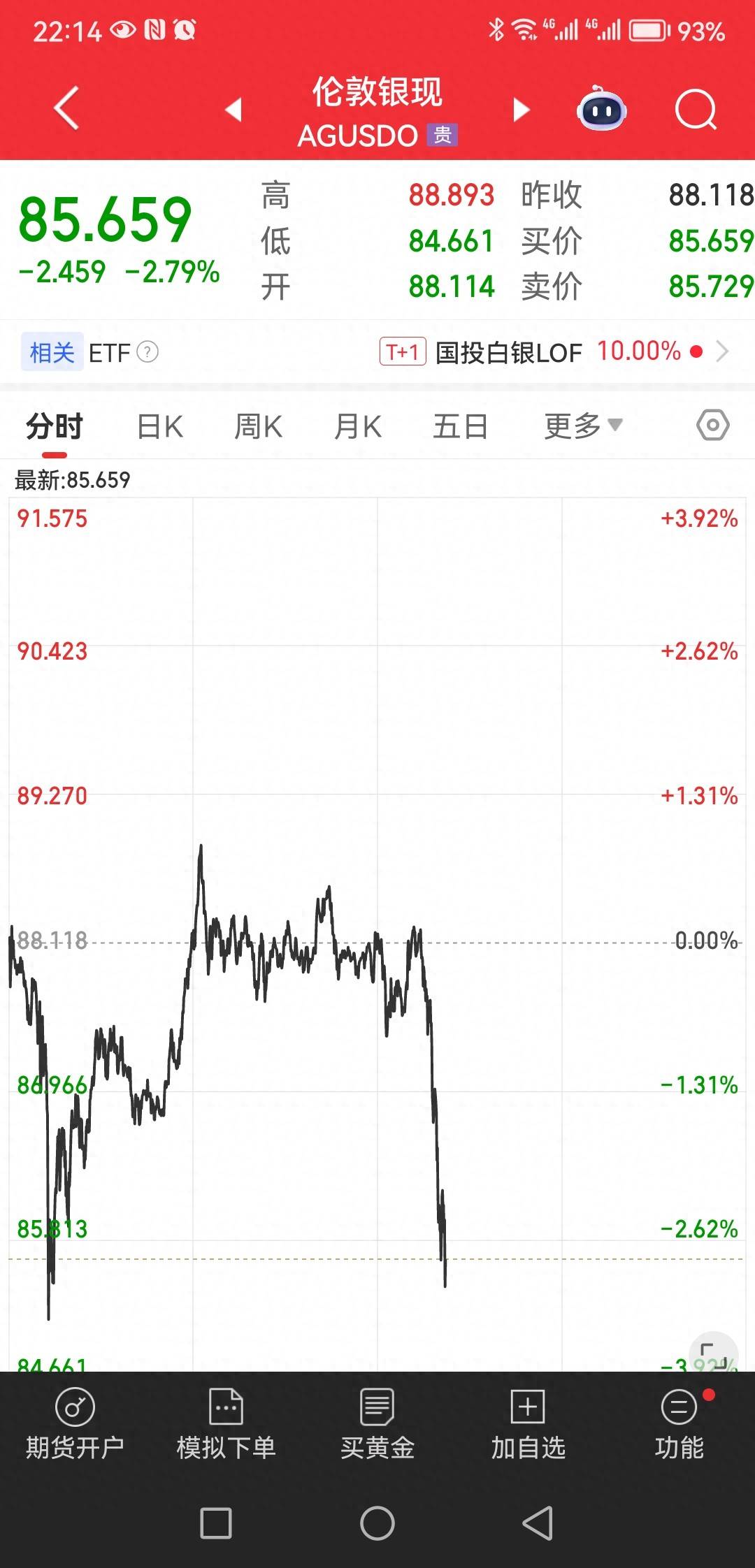
Group 1 - The USS Ford, the largest and most advanced aircraft carrier of the US Navy, faced a significant operational issue as 90% of its 650 toilets malfunctioned, leading to a temporary stop in Greece for repairs [1] - This incident occurred just before former President Trump announced plans for a limited military action against Iran, causing a delay in military operations and providing Iran with a crucial opportunity for negotiation [1] Group 2 - The precious metals market reacted sharply to the news, with gold prices dropping below the psychological level of 5130 points, reflecting a 2.22% decrease, erasing previous gains [3] - London silver also experienced a decline of 2.78%, indicating a correlated movement in the international precious metals market [3] - The A-share market's precious metals sector saw a rebound, primarily as a corrective measure following previous increases during the Spring Festival, but may face risks due to the downward trend in external markets [3]
宏观利好共振,有色板块迎投资窗口?从“硬资产轮动”到有色重估:机构眼中的2026主线
Xin Lang Cai Jing· 2026-02-26 08:33
Core Viewpoint - The recent performance of precious metals, particularly gold and silver, has shown a strong upward trend driven by "safe-haven" and "stagflation trading" dynamics, with gold prices surpassing $5240 per ounce as of February 24, 2026 [1][7]. Group 1: Safe-Haven Logic - Multiple macroeconomic uncertainties globally are providing fundamental support for the prices of non-ferrous metals, including precious metals [3][9]. - The reversal of U.S. tariff policies, following a Supreme Court ruling against large-scale tariffs from the Trump administration, indicates prolonged trade friction and increased market risk aversion [3][9]. - Geopolitical uncertainties, such as the lack of progress in Russia-Ukraine negotiations and potential military conflicts between the U.S. and Iran, are heightening global risk aversion [3][9]. - Analysts from Goldman Sachs suggest that rising macro and geopolitical risks are driving investors to diversify into "hard assets," with precious metals and copper showing significant price appreciation potential [3][9]. Group 2: Stagflation Trading - Recent U.S. economic data indicates a slowdown, with the actual GDP growth for 2025 projected at 2.2%, down from 2.8% in 2024, marking the lowest growth since 2021 [3][9]. - The Personal Consumption Expenditures (PCE) price index for December 2025 is expected to rise by 3.0%, significantly above the Federal Reserve's 2% inflation target, raising concerns about stagflation [3][9]. - Stagflation, characterized by stagnant economic growth and high inflation, typically benefits commodities due to their inflation-hedging properties [3][9]. Group 3: Focus on Non-Ferrous Core Assets - As the market enters a "profit-driven growth phase" in 2026, the strong cyclical nature of non-ferrous metals is expected to manifest, supported by domestic re-inflation narratives [4][11]. - The ongoing issuance of the Silver Hua Zhongzheng Non-Ferrous Metals ETF provides a convenient investment tool for investors looking to capitalize on core assets in the non-ferrous sector [4][11]. - The top five sectors in the Zhongzheng Non-Ferrous Metals Index as of February 24, 2026, are copper (29.6%), gold (14.9%), aluminum (14.7%), rare earths (8.3%), and lithium (6.5%), reflecting a broad representation of the industry [6][13].

【黄金etf持仓量】2月25日黄金ETF较上一交易日增加3.43吨
Jin Tou Wang· 2026-02-26 08:13
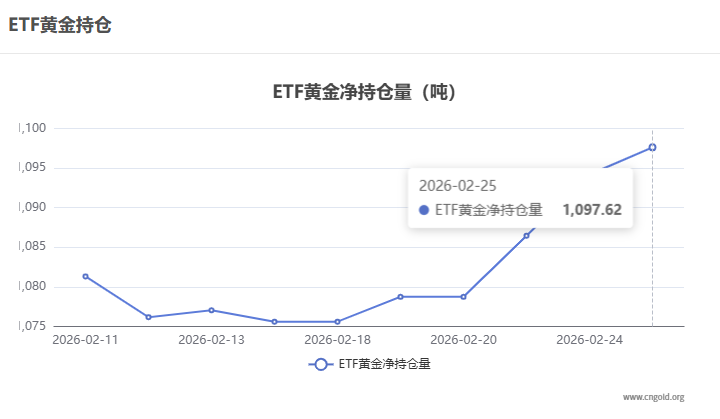
摘要全球最大黄金ETF--SPDRGoldTrust持仓报告显示,2月25日黄金etf持有量为1097.62吨,较上一交易 日增加3.43吨。周三(2月25日)截止收盘,现货黄金报5164.57美元/盎司,涨幅0.43%,日内最高上探至 5217.48美元/盎司,最低触5126.18美元/盎司。 【市场要闻速递】 芝商所金属期货于凌晨3:45正式恢复交易。 2月20日当夜美国最高法院驳回特朗普全球关税政策,援引《国际紧急经济权力法》推动的相关关税将 不再有效,后续可能产生的天量退税对美元信用形成削弱,该判决与不及预期的经济数据共同推动黄金 上行突破5100美元/盎司。 特朗普宣布签署行政令,将在150天内对全球进口至美国的商品征收10%的从价进口关税。此项临时进 口关税将于美国东部时间2月24日零时01分(北京时间13时01分)生效。 全球最大黄金ETF--SPDR Gold Trust持仓报告显示,2月25日黄金etf持有量为1097.62吨,较上一交易日 增加3.43吨。周三(2月25日)截止收盘,现货黄金报5164.57美元/盎司,涨幅0.43%,日内最高上探至 5217.48美元/盎司,最低触5126 ...
本轮黄金牛市仍相当“年轻”!知名机构:今年这一时间点金价恐触及6750美元
Sou Hu Cai Jing· 2026-02-26 06:09
Core Viewpoint - Gold prices have rebounded to $5,200 per ounce, significantly lower than the historical high of nearly $5,600 per ounce in January, but analysts believe the current bull market is still relatively young [1][2]. Group 1: Market Analysis - The current gold and silver prices have potential for further increases, with gold rising over 200% and silver approximately 350% during the 39-month cycle [1]. - Historical standards suggest that if gold prices align with average cycle duration and performance, they could reach $6,750 per ounce by October, ahead of the U.S. midterm elections [1]. - The macroeconomic backdrop is characterized by significant structural changes, including high debt levels and persistent fiscal deficits, which reinforce the notion of "fiscal dominance" [1]. Group 2: Demand Factors - Central banks remain a core anchor for investment demand, with emerging market central banks holding about 7,500 tons of gold, needing an additional 22,000 tons to match the average levels of developed market central banks [2]. - The retail market for gold has diversified, with strong sales from retailers like Costco and growing interest in gold-backed tokens from digital exchanges, indicating robust physical gold demand [2]. Group 3: Investor Sentiment - Institutional investment in gold is still considered insufficient, suggesting potential for growth in this area [3]. - A further weakening of the U.S. dollar could trigger a new upward movement in gold prices, as the current decline of 13% is viewed as mild [4].
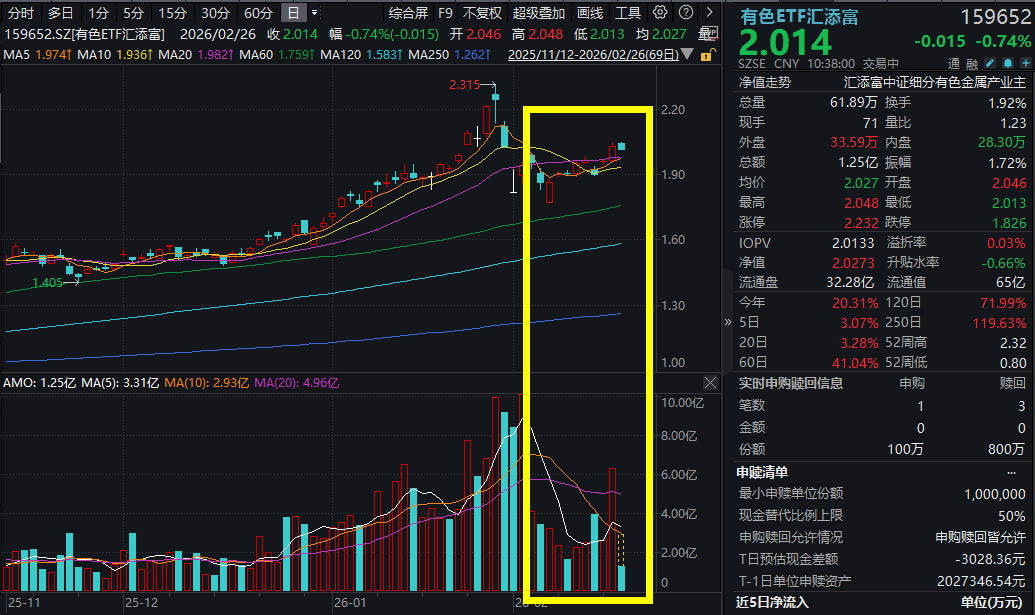
津巴布韦突发,锂矿出口禁令!影响几何?有色ETF汇添富(159652)早盘异动!金银铜回调是否到位?机构激辩有色“击球”时机
Sou Hu Cai Jing· 2026-02-26 03:17
Core Viewpoint - The A-share market experienced fluctuations, with the non-ferrous sector showing mixed performance, particularly influenced by recent geopolitical tensions and policy changes affecting lithium exports from Zimbabwe [1][5][6]. Group 1: Market Performance - As of February 26, the A-share market saw the Shanghai Composite Index retreat, with the non-ferrous ETF Huatai-PineBridge (159652) down by 0.74% [1]. - The non-ferrous ETF's key components showed varied performance, with small metals and lithium stocks leading gains, while major players like Zijin Mining and Luoyang Molybdenum experienced pullbacks [1][2]. Group 2: Lithium Market Impact - Zimbabwe's Ministry of Mines announced an immediate ban on all lithium ore and concentrate exports, significantly impacting global lithium supply dynamics [5][6]. - This ban is expected to drive lithium prices up, as Zimbabwe accounted for approximately 12% of global lithium production in 2026, with China being a primary importer [6][7]. Group 3: Precious Metals Outlook - Precious metals, including gold and silver, saw price increases due to heightened geopolitical tensions and inflation expectations, with Morgan Stanley projecting gold prices to reach $6,300 per ounce by the end of 2026 [3]. - The recent rise in lithium stocks in the U.S. market reflects the immediate market reaction to Zimbabwe's export ban, with lithium carbonate futures surging over 4% [3][5]. Group 4: Strategic Metal Policies - The trend of resource nationalism is likely to continue, with countries implementing stricter export controls on strategic metals like lithium, cobalt, and nickel, which may lead to further supply disruptions [7]. - Analysts suggest that the recent policy changes in Zimbabwe are part of a broader strategy to enhance local processing capabilities and retain more value from mineral resources [5][6]. Group 5: Investment Opportunities - The non-ferrous sector is viewed as having significant investment potential, driven by macroeconomic factors, supply constraints, and emerging demand from new industries such as AI and renewable energy [8][10]. - The Huatai-PineBridge non-ferrous ETF is highlighted for its comprehensive exposure to various metal sectors, including gold, copper, aluminum, and lithium, making it a favorable investment vehicle [10][12].