证券业

Search documents
央行新规正式实施——“现金”变“存款” 数字人民币迈入2.0时代
Sou Hu Cai Jing· 2026-01-13 01:52
Group 1: Core Insights - The People's Bank of China has officially implemented the "Action Plan" for enhancing the management and service system of digital RMB, marking the transition to the 2.0 era of digital currency [3][4] - By the end of November 2025, digital RMB is expected to process 3.48 billion transactions with a total transaction amount of 16.7 trillion yuan [3][4] Group 2: Changes in Digital RMB - The digital RMB will evolve from a digital cash model to a digital deposit currency model, allowing for interest accrual on wallet balances held at banks [5][6] - The new model will expand the application scenarios of digital RMB across various sectors, including retail, education, and cross-border payments, enhancing its usability [5][6] Group 3: Dual-Layer Architecture - The "Action Plan" optimizes the dual-layer operational framework, where the central bank sets the rules and standards while commercial banks manage customer wallets and ensure compliance [7][8] - This upgrade is expected to increase commercial banks' motivation to promote digital RMB, aligning their responsibilities and benefits [7][8] Group 4: Technological Advantages - China's approach to digital RMB combines account-based management with blockchain efficiency, aiming for lower costs and higher efficiency in digital payments [9][10] - The integration of blockchain technology is expected to enhance the security and traceability of transactions, benefiting various financial applications [9][10] Group 5: Internationalization and Cross-Border Payments - The establishment of an international digital RMB operation center in Shanghai aims to improve cross-border payment efficiency and facilitate the internationalization of the RMB [10] - By the end of November 2025, the multilateral central bank digital currency bridge is projected to handle 4,047 cross-border payment transactions, with digital RMB accounting for approximately 95.3% of the transaction volume [10]


每日债市速递 | 银行间市场资金面出现收敛
Sou Hu Cai Jing· 2026-01-13 00:31
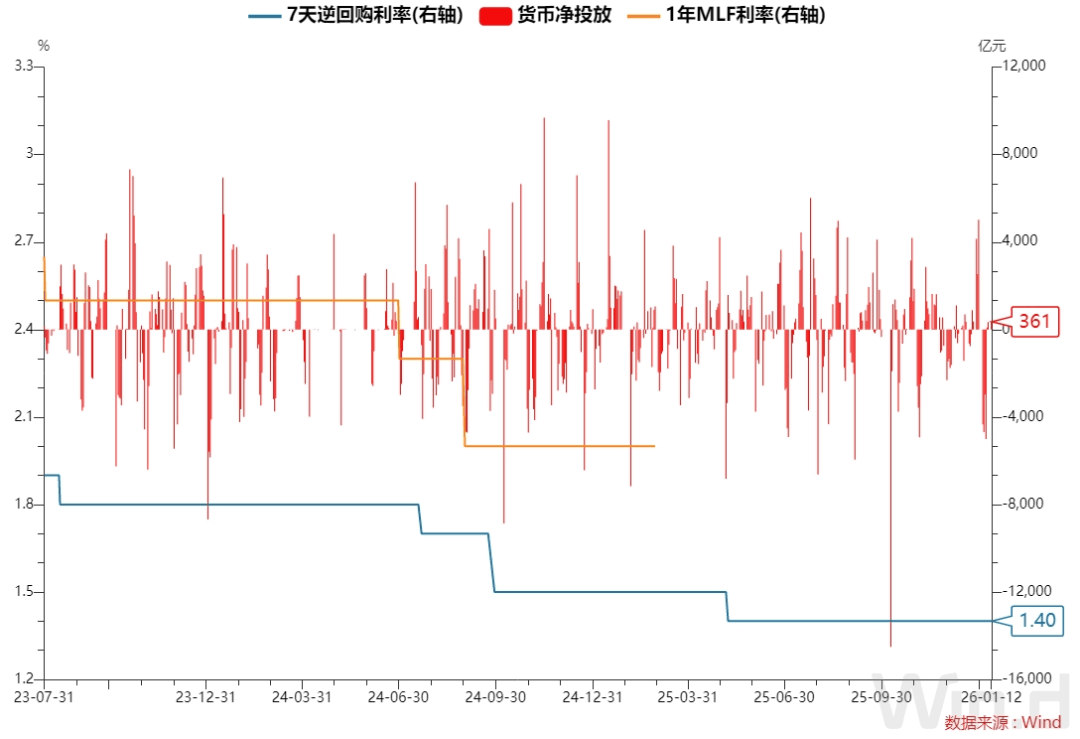
Monetary Policy Operations - The central bank announced a 7-day reverse repurchase operation of 861 billion yuan at a fixed rate of 1.40% on January 12, with a net injection of 361 billion yuan after accounting for 500 billion yuan in maturing repos [1][4]. Market Liquidity - The interbank market liquidity has tightened, with the weighted average rate of DR001 rising over 5 basis points to 1.32%. Overnight rates in the anonymous click (X-repo) system increased by 10 basis points to 1.35%, with supply reduced to several hundred billion [2][4]. - The latest overnight financing rate in the U.S. stands at 3.64% [2]. Interbank Certificates of Deposit - The latest transaction rate for one-year interbank certificates of deposit among major banks is at 1.64%, showing a slight increase from the previous day [6][7]. Government Investment Funds - Four departments jointly issued guidelines to strengthen the planning and direction of government investment funds, introducing 14 policy measures focusing on investment in emerging and future industries, including new-generation information technology, renewable energy, and artificial intelligence [10][11]. Bond Market Developments - The yields on major interbank bonds have generally declined, with the 30-year government bond futures contract rising by 0.30%, the 10-year by 0.06%, and the 5-year by 0.05% [8][10]. - Recent negative events in the bond market include disciplinary actions against executives of Sunac Real Estate Group for failing to disclose overdue debts and considerations by China Overseas Hongyang Group to issue dim sum bonds [12]. Non-Standard Assets Risks - Recent disclosures indicate various non-standard asset risks, including defaults and risk warnings related to trust plans and private equity funds [14].
“存款” 数字人民币迈入2.0时代
Xin Hua Wang· 2026-01-12 23:38
Core Viewpoint - The People's Bank of China has launched the "Action Plan" to strengthen the management and service system of digital RMB, marking the transition to the 2.0 era of digital currency, with significant implications for individuals, businesses, and banks [1][2]. Group 1: Changes in Digital RMB - The "Action Plan" indicates a shift from digital cash to digital deposit currency, with digital RMB now having attributes of commercial bank liabilities and being based on accounts [2][3]. - Digital RMB will now accrue interest for users, enhancing its appeal for both individuals and businesses [3]. - The digital RMB has achieved full-scenario currency capabilities, applicable in various sectors including retail, education, and cross-border payments [3]. Group 2: Optimization of the Dual-Layer Architecture - The "Action Plan" optimizes the dual-layer operational system, where the central bank sets rules and standards while commercial banks manage user wallets and ensure compliance [4][5]. - This upgrade encourages commercial banks to actively promote digital RMB, aligning their responsibilities and benefits [4][6]. Group 3: Technological Advantages - China's digital RMB development integrates account-based management with blockchain efficiency, aiming for lower costs and higher efficiency in payment services [7]. - The use of blockchain technology enhances security and traceability, making it advantageous for various financial applications [7]. Group 4: Internationalization and Cross-Border Payments - The establishment of a digital RMB international operation center in Shanghai aims to improve cross-border payment efficiency, facilitating the internationalization of the RMB [8]. - As of November 2025, the multilateral central bank digital currency bridge has processed significant cross-border transactions, with digital RMB accounting for approximately 95.3% of the total transaction volume [8].
利率周报(2026.1.5-2026.1.11):CPI同比阶段性回升-20260112
Hua Yuan Zheng Quan· 2026-01-12 14:03
1. Report Industry Investment Rating No relevant content provided. 2. Report Core Viewpoints - In December 2025, China's prices recovered. CPI rose 0.8% year-on-year, reaching a new high since March 2023, with food prices playing a significant role, and core CPI remaining stable. PPI's year-on-year decline narrowed to -1.9%, with three consecutive months of positive month-on-month growth, and prices in upstream and new-quality productivity-related industries were well-supported. In 2026, the central bank may continue its moderately loose monetary policy, with a new focus on "optimizing supply." It may focus on price recovery, keeping financing costs low, strengthening the prevention and control of financing platform debt risks, and promoting financial opening-up. In the US, the December non-farm payrolls were lower than expected, but the unemployment rate decreased. Traders postponed the first interest rate cut in 2026 to June, with an expected total cut of 50BP for the year [2][4][118]. 3. Summary by Relevant Catalogs 3.1 Macro News - **CPI and PPI Trends**: In December 2025, CPI rose 0.8% year-on-year, with food prices rising 1.1% and contributing significantly. Core CPI was stable at 1.2%. PPI's year-on-year decline narrowed to -1.9%, and it had three consecutive months of positive month-on-month growth [4][13][29]. - **Factors Affecting CPI**: Food prices, especially fresh vegetables and fruits, drove CPI growth, while energy prices, affected by international oil prices, restricted CPI growth [19]. - **Factors Affecting PPI**: Domestic policies, seasonal demand, input factors, and new-quality productivity all influenced PPI trends. Upstream prices were supported by policies and seasonal demand, and new-quality productivity-related industries contributed to price increases [33][38]. - **Central Bank Policy**: The 2026 central bank work conference added "optimizing supply" as a policy focus, emphasizing balanced credit supply, reasonable price recovery, and support for financing platform debt risk resolution [43]. - **US Non-farm Payrolls**: In December 2025, US non-farm payrolls increased by 50,000, lower than expected, and the unemployment rate decreased to 4.4%. Traders postponed the first interest rate cut to June, with an expected 50BP cut for the year [4][48]. 3.2 Meso-level High-frequency Data - **Consumption**: Passenger car retail and wholesale volumes increased year-on-year, but movie box office revenue decreased. Three major household appliances' retail volume and revenue showed mixed trends [4][9][54]. - **Transportation**: Passenger transportation activities were relatively high, with increases in migration, flight numbers, and subway ridership. However, freight transportation, including postal, railway, and highway, decreased [4][9][59]. - **Industry**: Most industrial indicators showed a year-on-year decline, including steel production, coal consumption, and factory operating rates [4][9][64]. - **Real Estate**: The real estate market continued to decline, with decreases in housing sales area and land transactions [9][76][80]. - **Prices**: Food prices showed mixed trends, with pork prices down and vegetable prices up. Industrial product prices also varied, with some rising and some falling [4][9][90]. 3.3 Bond and Foreign Exchange Markets - **Bond Yields**: Most government bond yields increased, with significant adjustments at the long end. The yields of national debt, policy bank bonds, local government bonds, and interbank certificates of deposit all changed to varying degrees [4][104][109]. - **Foreign Exchange Rates**: The US dollar to RMB exchange rate decreased, and the yields of ten-year government bonds in the US, Japan, the UK, and Germany also changed [113][117]. 3.4 Investment Recommendations - The bond market in 2026 may perform better than expected. Attention should be paid to the potential rebound of long-term bonds. It is recommended to focus on long-term bond trading opportunities, allocate 3 - 5Y capital bonds for coupon income, and explore multi-asset investment opportunities [4].
【笔记20260112— 巴菲特连夜来开户】
债券笔记· 2026-01-12 10:25
Group 1 - The market is experiencing a 17-day consecutive rise, with trading volume reaching a historical high, indicating strong bullish sentiment [6] - The interbank funding environment is balanced and slightly loose, with DR001 rising to approximately 1.33% and DR007 around 1.49% [4][3] - The bond market shows stability, with the 10-year government bond yield slightly declining to around 1.888% after opening higher [6] Group 2 - The "stock-bond seesaw" effect is not significant, as stock prices surge while bond yields fluctuate downwards [6] - Recent geopolitical risks have led to a rise in gold prices, reflecting market uncertainty [6] - The central bank conducted a reverse repurchase operation of 861 billion yuan, with a net injection of 361 billion yuan after 500 billion yuan matured [3]
加强科技金融与产业金融的深度融合
Jin Rong Shi Bao· 2026-01-12 03:32
Core Viewpoint - The integration of technology finance and industrial finance is essential for promoting technological innovation and industrial innovation during the "14th Five-Year Plan" period, which is crucial for achieving high-level technological self-reliance and leading new productive forces [1][2]. Group 1: Importance of Integration - Strengthening the deep integration of technology finance and industrial finance is a strategic choice to shape new development momentum and gain an advantage in international competition during the "14th Five-Year Plan" period [2][3]. - The integration aims to eliminate barriers between technology, industry, and finance, allowing technological innovation to fuel industrial innovation and upgrades, while financial resources can support both sectors [3]. Group 2: Current Challenges - There are significant challenges in achieving cross-departmental policy coordination, as differences in core concerns among technology, industry, and finance departments hinder unified resource allocation and project selection [5]. - Structural mismatches exist between financial supply and the demands of technological and industrial innovation, particularly in the areas of financing stages, financial structure, and the need for patient capital [6][7]. Group 3: Strategic Measures for Future Integration - Establishing a cross-departmental policy coordination mechanism is crucial for fostering a resilient national innovation ecosystem, which includes creating a "coordinating office" for joint approvals and assessments [9]. - Innovating a diversified financial supply that covers the entire lifecycle of enterprises is necessary, including promoting venture capital and enhancing bank credit to support technology-driven enterprises [10]. - Deepening financial services for industrial chains and clusters is essential, focusing on data-driven credit models and tailored financial products to address the unique needs of different stages of enterprise development [11][12]. Group 4: Digital Empowerment and Risk Management - Implementing a data governance model that integrates data elements, assets, and value chains is vital for enhancing financial services and supporting technological innovation [13]. - Optimizing the regulatory framework and establishing a risk-sharing system is necessary to adapt to the uncertainties inherent in technological and industrial innovation, including developing a multi-layered risk warning system [14].
【早报】证监会提高“吹哨人”奖励标准;天普股份股价异常波动公告涉嫌重大遗漏被立案调查
财联社· 2026-01-11 23:14
Macroeconomic News - The State Council, led by Premier Li Qiang, has implemented a package policy to promote domestic demand through coordinated fiscal and financial measures, emphasizing the need for social capital to participate in consumption and investment expansion [4]. - The China Securities Regulatory Commission (CSRC) aims to enhance the institutional environment for long-term investments, encouraging various types of long-term funds to increase their market participation [4][3]. - The CSRC has introduced a new reward system for whistleblowers reporting securities and futures violations, significantly increasing the reward standards, with a maximum reward of 1 million yuan [4][3]. Industry News - The State Administration for Market Regulation is investigating the competitive landscape of the food delivery platform service industry under the Anti-Monopoly Law [6]. - The Ministry of Finance and the State Taxation Administration announced the cancellation of the VAT export tax rebate for photovoltaic products starting April 1, 2026, and will reduce the VAT export tax rebate rate for battery products from 9% to 6% during 2026 [6]. - The retail market for passenger vehicles in December 2025 saw a decline of 14.5% year-on-year, with expectations for the overall vehicle market in 2026 to remain flat compared to 2025 [6]. - The pressure from rising storage costs has begun to affect the consumer electronics sector, leading to price increases for key products like smartphones and laptops [6]. - China has applied for frequency resources for over 200,000 satellites from the International Telecommunication Union (ITU), indicating a strategic focus on satellite internet development [6]. Company News - The CSRC has launched an investigation into Tianpu Co., Ltd. for significant omissions in announcements regarding abnormal stock trading, with the company stating it has no AI-related technology or personnel [9]. - Wanda's proposal to extend a $400 million bond, due on February 13, 2026, with an interest rate of 11%, has been approved [11]. - Defu Technology announced the termination of its acquisition of 100% equity in Luxembourg Copper Foil due to regulatory conditions imposed by the Luxembourg Ministry of Economy [11]. - Aerospace Changguang has forecasted a net loss of approximately 220 million yuan for the year 2025 [12].

江苏武进不锈股份有限公司关于使用闲置自有资金进行委托理财进展的公告
Shang Hai Zheng Quan Bao· 2026-01-11 18:54
Core Viewpoint - The company is utilizing idle self-owned funds for entrusted wealth management, with a total amount of up to RMB 80 million approved for investment in various financial products, ensuring normal operational liquidity while aiming to enhance capital efficiency and returns for shareholders [3][6]. Group 1: Basic Situation of Entrusted Wealth Management - The company held board meetings on April 24, 2025, and a shareholder meeting on May 21, 2025, to approve the use of idle self-owned funds for cash management, with a maximum amount of RMB 80 million [3]. - The investment scope includes purchasing wealth management products, trust products, bonds, financial derivatives, and participating in asset management plans, with individual product terms not exceeding one year [3]. Group 2: Progress and Risk Situation of Entrusted Wealth Management - As of the announcement date, the company has rolled over RMB 26 million in idle funds to purchase wealth management products from reputable institutions, including CITIC Securities, Shanghai Pudong Development Bank, and others [5]. - The total amount of entrusted wealth management as of the announcement date is RMB 26 million, accounting for 9.99% of the company's latest audited net assets of RMB 260.14 million [6]. Group 3: Impact on the Company and Risk Control Measures - The use of idle funds for entrusted wealth management will not significantly impact the company's main business, financial status, or cash flow, as it is conducted under the premise of ensuring daily operational funding needs [6]. - The company implements strict screening of issuers, ensuring they have legal operating qualifications and strong financial security capabilities, with a maximum product term of one year [6][7]. - The finance department is responsible for internal supervision of the use and custody of funds, maintaining a ledger for management and ensuring proper accounting [7].

【智库圆桌】发展科技金融激发创新活力
Xin Lang Cai Jing· 2026-01-11 00:40
Core Viewpoint - The development of technology finance is crucial for promoting the dual advancement of technology and finance, as emphasized in China's economic planning and regulatory frameworks [1][3][4]. Group 1: Importance of Technology Finance - Technology finance is positioned as a key support for achieving high-level technological self-reliance and building a strong technological nation [2][3]. - The development of technology finance helps accelerate breakthroughs in critical core technologies and supports the transformation and upgrading of traditional industries [3][4]. - It broadens the boundaries of financial services, creating new growth points for financial institutions amid narrowing net interest margins [3]. Group 2: Policy and Structural Developments - The implementation of the "14th Five-Year Plan" emphasizes the construction of a financial service system that aligns with technological innovation [4][6]. - By the end of 2025, the banking and insurance sectors are expected to enhance their financial service mechanisms to better support technological innovation [4]. - The scale of technology finance continues to expand, with significant increases in loan balances for high-tech enterprises and technology-based SMEs, indicating a growing financial service coverage [4][5]. Group 3: Enhancements in Financial Services - The People's Bank of China has introduced various financial tools to support major technological projects and SMEs in their growth phases [5]. - Financial support for advanced manufacturing, high-tech manufacturing, and strategic emerging industries has been continuously strengthened, with notable annual growth rates in relevant loans [5]. - The establishment of multiple technology finance reform pilot zones aims to reduce financing costs for technology enterprises and optimize financial resource allocation [13][14]. Group 4: Role of Patient Capital - Patient capital is essential for supporting long-term technological innovation, focusing on projects with long-term returns rather than short-term profits [8][9]. - The development of patient capital is crucial for guiding production factors towards new quality productivity, which is characterized by high technology and efficiency [9][10]. - Initiatives to encourage patient capital investment in technology innovation include increasing the investment ratio of pension and insurance funds in early-stage hard technology funds [11][12]. Group 5: Challenges and Future Directions - Despite the potential of patient capital, challenges such as an unbalanced supply structure and a lack of market-driven capital remain [11][12]. - Future efforts should focus on optimizing the market ecosystem, enhancing incentive mechanisms, and strengthening cross-cycle capabilities to attract more long-term capital into technology innovation [12][17]. - The establishment of technology finance reform pilot zones has shown promise, but further improvements in policy support and market mechanisms are necessary to enhance the sustainability of financial support for technology innovation [17].
今日金价大跌1月10日
Sou Hu Cai Jing· 2026-01-10 17:50
Core Viewpoint - The gold market is experiencing fluctuations in prices, with various factors influencing both gold and silver prices, including industrial demand and investment sentiment. Group 1: Gold and Silver Prices - As of January 10, the international spot gold price slightly decreased by 0.03% to $4,475.8 per ounce, while the basic gold price in China remained stable at 993 yuan per gram [1] - The price of gold bars varies significantly among banks, with Agricultural Bank's "Chuan Shi Zhi Bao" rising to 1,017.05 yuan per gram, while the Shanghai Gold Exchange lists gold bars at 989 yuan per gram [1] - The price of gold jewelry from leading brands ranges from 1,158 to 1,398 yuan per gram, with different brands reflecting varying levels of premium and market positioning [1] Group 2: Trading Dynamics - The Shanghai Gold Exchange reported a 0.40% increase in Au9999 to 1,007 yuan per gram, while the 100g gold price fell by 0.47% to 1,006 yuan per gram [2] - The trading dynamics show mixed movements, with AuT D at 996.54 yuan per gram (down 0.45%) and silver T D experiencing a significant rise of 4.25% to 20,060 yuan per kilogram [2] Group 3: Collectibles and Gold-Silver Ratio - The 2026 Panda gold set is priced at 60,084 yuan, highlighting the transition of gold from everyday use to collectible status [3] - The gold-silver ratio currently stands at 59, indicating a potential for mean reversion, as it has decreased over 40% since April [3] Group 4: Institutional Perspectives - Institutions emphasize the importance of the gold-silver ratio as a navigational tool for investors, suggesting a reallocation between gold and silver [5] - Regular investment in gold ETFs is recommended to mitigate the challenges of liquidating physical gold while smoothing out price volatility [5] Group 5: Long-term Market Insights - The ongoing accumulation of gold by central banks for 14 consecutive months, alongside the depreciation of the dollar and policy uncertainties, suggests that the narrative around gold extends beyond mere price fluctuations [6]