国防军工

Search documents
砸完你的 砸你的
Datayes· 2026-01-21 10:54
Core Viewpoint - The article discusses the recent performance of the A-share market, highlighting significant gains in technology stocks, particularly in the semiconductor sector, driven by supply shortages and price increases in CPUs and memory chips [1][18]. Group 1: Market Performance - On January 21, the three major indices in the A-share market collectively rose, with the Shanghai Composite Index increasing by 0.08%, the Shenzhen Component Index by 0.70%, and the ChiNext Index by 0.53% [18]. - The total trading volume across the three markets was 26,240 billion, a decrease of 1,804.27 billion from the previous day, with over 300 stocks rising [18]. - A total of 91 stocks hit the daily limit up, with the maximum consecutive limit up reaching 16 [18]. Group 2: Semiconductor Sector - The semiconductor sector saw a significant rebound, with domestic chip stocks surging. Notably, Longxin Technology hit the daily limit up, and several other stocks like Yingfang Micro and Tongfu Microelectronics also reached their daily limits [18]. - The increase in stock prices is attributed to a shortage in memory chips, with U.S. companies like Micron, Seagate, and SanDisk hitting record highs [18]. - Intel and AMD are expected to raise server CPU prices by 10%-15% in 2026, further driving interest in the semiconductor supply chain [2][18]. Group 3: CPU Demand and AI Impact - The demand for CPUs is projected to increase significantly due to the rise of AI agents, with estimates suggesting a need for up to 1,760,899 CPUs in optimistic scenarios for 2024, compared to a global shipment of 3,200 million CPUs [3]. - The article emphasizes that CPUs may become a bottleneck before GPUs in AI applications, as they are crucial for generating and evaluating tasks in reinforcement learning [11]. - A new paradigm proposed in the DeepSeek paper highlights the importance of CPU memory in handling large parameters, suggesting a shift in how AI models are structured [11][12]. Group 4: Material Costs and Industry Outlook - Japanese semiconductor material manufacturer Resonac announced a price increase of over 30% for PCB materials starting March 1, which could impact the overall cost structure in the semiconductor industry [12]. - Goldman Sachs projects a compound annual growth rate of 34% for optical modules from 2026 to 2028, with expected shipments reaching 94 million units by 2028, indicating a positive outlook for the optical communication sector [18].



1月21日主力资金流向日报
Zheng Quan Shi Bao Wang· 2026-01-21 09:25
Market Overview - On January 21, the Shanghai Composite Index rose by 0.08%, the Shenzhen Component Index increased by 0.70%, the ChiNext Index went up by 0.54%, and the CSI 300 Index gained 0.09% [1] - Among the tradable A-shares, 3,095 stocks rose, accounting for 56.64%, while 2,197 stocks declined [1] Capital Flow - The net inflow of main funds for the day was 11.983 billion yuan [1] - The ChiNext saw a net outflow of 5.221 billion yuan, while the STAR Market had a net inflow of 3.457 billion yuan [1] - The CSI 300 constituent stocks experienced a net inflow of 13.627 billion yuan [1] Industry Performance - Out of the 18 primary industries classified by Shenwan, 14 saw net inflows of main funds, with the electronic industry leading with a net inflow of 16.369 billion yuan and a daily increase of 2.62% [1] - The non-ferrous metals industry also performed well, with a daily increase of 2.79% and a net inflow of 7.289 billion yuan [1] - Conversely, 17 industries experienced net outflows, with the electric equipment industry leading the outflow at 6.688 billion yuan despite a slight increase of 0.21% [1] Detailed Industry Data - The electronic industry had a daily increase of 2.62% with a capital inflow of 16.369 billion yuan [2] - The non-ferrous metals industry rose by 2.79% with a capital inflow of 7.289 billion yuan [2] - The banking sector saw a decline of 1.58% with a capital outflow of 4.47 billion yuan [2] - The coal industry decreased by 1.57% with a minimal capital inflow of 0.34 billion yuan [2] - The defense and military industry had a slight decline of 0.06% with a significant capital outflow of 2.906 billion yuan [2] Individual Stock Performance - A total of 2,282 stocks experienced net inflows, with 1,015 stocks having inflows exceeding 10 million yuan [2] - The stock with the highest net inflow was Zhongke Shuguang, which rose by 6.93% with a net inflow of 1.651 billion yuan [2] - Other notable stocks with significant inflows included China Great Wall and Industrial Fulian, with net inflows of 1.498 billion yuan and 1.486 billion yuan, respectively [2] - Conversely, 136 stocks had net outflows exceeding 100 million yuan, with XW Communication, Tebian Electric, and Shanzigaoke leading the outflows at 1.692 billion yuan, 1.270 billion yuan, and 1.048 billion yuan, respectively [2]





食品饮料行业今日跌1.53%,主力资金净流出24.16亿元
Zheng Quan Shi Bao Wang· 2026-01-21 09:20
Market Overview - The Shanghai Composite Index rose by 0.08% on January 21, with 18 out of the 28 sectors experiencing gains. The top-performing sectors were non-ferrous metals and electronics, with increases of 2.79% and 2.62% respectively [1] - The banking and coal sectors saw the largest declines, with drops of 1.58% and 1.57% respectively [1] Capital Flow Analysis - The net inflow of capital in the two markets was 11.983 billion yuan, with 14 sectors receiving net inflows. The electronics sector led with a net inflow of 16.369 billion yuan, while the non-ferrous metals sector followed with a net inflow of 7.289 billion yuan [1] - Conversely, 17 sectors experienced net outflows, with the power equipment sector seeing the largest outflow of 6.688 billion yuan, followed by the defense and military sector with an outflow of 2.906 billion yuan [1] Food and Beverage Sector Performance - The food and beverage sector declined by 1.53%, with a net outflow of 2.416 billion yuan. Out of 124 stocks in this sector, 23 rose while 97 fell, including one stock that hit the daily limit down [2] - The top three stocks with the highest net inflows in the food and beverage sector were "Hao Xiang Ni" with 61.106 million yuan, "*ST Chun Tian" with 12.8997 million yuan, and "Wei Zhi Xiang" with 12.7381 million yuan [2] - Major stocks with significant net outflows included Kweichow Moutai with 9.52 billion yuan, Wuliangye with 3.66 billion yuan, and Shanxi Fenjiu with 1.33 billion yuan [2][4] Food and Beverage Sector Capital Inflow and Outflow - The capital inflow leaderboard in the food and beverage sector included "Hao Xiang Ni" (+8.11%), "*ST Chun Tian" (+4.85%), and "Wei Zhi Xiang" (+1.43%) [2] - The capital outflow leaderboard featured Kweichow Moutai (-1.64%), Wuliangye (-1.77%), and Shanxi Fenjiu (-2.34%) [4]




A股平均股价14.68元 33股股价不足2元
Zheng Quan Shi Bao Wang· 2026-01-21 09:18
Core Viewpoint - The average stock price of A-shares is 14.68 yuan, with 33 stocks priced below 2 yuan, the lowest being *ST Changyao at 0.64 yuan [1] Group 1: Stock Price Distribution - As of January 21, the Shanghai Composite Index closed at 4116.94 points, with an average A-share price of 14.68 yuan [1] - There are 33 stocks priced below 2 yuan, with *ST Changyao having the lowest price at 0.64 yuan, followed by *ST Aowei at 0.81 yuan and *ST Lifang at 0.96 yuan [1] - Among the low-priced stocks, 8 are ST stocks, accounting for 24.24% of the total [1] Group 2: Market Performance of Low-Priced Stocks - Out of the low-priced stocks, 10 saw an increase today, with *ST Changyao rising by 20.75%, *ST Lifang by 20.00%, and *ST Jinke by 1.37% [1] - Conversely, 19 stocks experienced declines, with Dongtong Tui dropping by 6.52%, *ST Aowei by 4.71%, and Yongtai Energy by 1.20% [1] Group 3: Low-Priced Stock Rankings - The table lists various low-priced stocks, including their latest closing prices, daily change percentages, turnover rates, and industry classifications [1][2] - Notable stocks include *ST Changyao (0.64 yuan, +20.75%), *ST Aowei (0.81 yuan, -4.71%), and *ST Lifang (0.96 yuan, +20.00%) [1][2]


对冲AI泡沫完美组合:清洁能源、关键金属、基建和国防?
Hua Er Jie Jian Wen· 2026-01-21 08:57
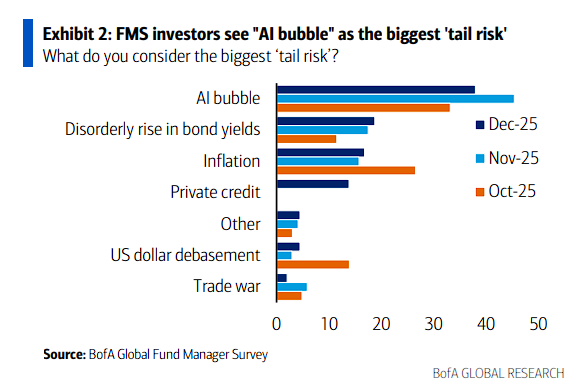
在AI叙事主导市场的当下,资本拥挤带来的脆弱性已不容忽视。美银表示,当AI狂热退潮,真正的机 会藏在那些支撑AI物理运行的"硬资产"中。 1月21日,据追风交易台消息,美银在最新的研报中称,虽然AI是一场根本性的技术革命,但估值过高 和时间周期的不确定性已成为不可忽视的风险。38%的基金经理现在将"AI泡沫"视为最大的尾部风险。 研报称,美银提出的"完美对冲"策略并非做空AI,而是转向"转型投资"(Transition Investing)。与其 直接押注高估值的AI科技股,不如布局AI革命背后必须依赖的物理基础设施:清洁能源、电网基建、 关键金属以及国防安全。 美银的核心逻辑在于:AI的尽头是电力和资源。该行预测到2030年,全球AI相关资本支出将超过1.2万 亿美元。这笔巨资将不可避免地流入到为数据中心提供动力的能源、构建硬件的金属以及保护技术的国 防领域。 与此同时,美银还认为,这些领域拥有政策支持、地缘政治驱动和供应链基本面的支撑,即便AI泡沫 破裂,它们也能提供相对的韧性。 清洁能源:从AI配角到主角的转变 美银指出,投资AI的最佳方式可能是不直接持有AI股票。国防、基础设施和转型金属等策略是AI革 ...
FICC日报:指数震荡调整-20260121
Hua Tai Qi Huo· 2026-01-21 05:21
Report Summary 1. Report Industry Investment Rating There is no information provided regarding the report's industry investment rating. 2. Core Viewpoints - Overseas factors such as Trump's remarks and concerns about Japan's fiscal deterioration have led to a decline in major global indexes. Domestically, market enthusiasm has cooled under policy guidance, with a decrease in trading volume and index levels. Currently, investors can focus on the entry opportunities for IC [1][3]. 3. Summary by Directory Macro - economic Charts - The report presents charts showing the relationships between the US dollar index, US Treasury yields, RMB exchange rate, and A - share trends, as well as the relationship between US Treasury yields and A - share styles [6][8][10]. Spot Market Tracking Charts - A - share indexes showed mixed performance. The Shanghai Composite Index closed at 4113.65 points, down 0.01%; the ChiNext Index fell 1.79%. Industries such as petroleum and petrochemicals, building materials, real estate, and transportation led the gains, while communications, national defense and military industry, and computer industries led the losses. The trading volume of the Shanghai and Shenzhen stock markets was 2.8 trillion yuan. Overseas, the three major US stock indexes all closed down, with the Nasdaq falling 2.39% to 22954.32 points [1]. - The daily performance table of major domestic stock indexes shows the closing prices and daily changes on January 20, 2026, and January 19, 2026 [13]. Stock Index Futures Tracking Charts - In the futures market, the current - month contracts of IH and IC were at a premium. The trading volume and open interest of stock index futures increased simultaneously [2]. - The table of stock index futures trading volume and open interest shows the current values and changes of IF, IH, IC, and IM contracts [15]. - The table of stock index futures basis shows the current values and changes of the basis of IF, IH, IC, and IM contracts for the current - month, next - month, current - quarter, and next - quarter contracts [38]. - The table of stock index futures inter - period spreads shows the current values and changes of inter - period spreads for different contract combinations of IF, IH, IC, and IM [43][44].
银泰证券鑫新闻:研究所日报
Yintai Securities· 2026-01-21 02:50
Fiscal Policy and Investment - The overall fiscal expenditure for 2026 will "only increase" and focus on key areas to "strengthen" support, with a special bond issuance of 500 billion yuan for private investment[2] - A 500 billion yuan guarantee plan for private investment aims to guide banks in providing loans to small and micro enterprises[2] - The implementation of interest subsidies for loans in 14 key industrial chains is expected to support social investment activities and consumption[2] Market Performance - On January 20, the Shanghai Composite Index fell by 0.01%, while the Shenzhen Component Index dropped by 0.97%, with total trading volume at 27,776.57 billion yuan, an increase of 693.09 billion yuan from the previous trading day[3] - Major global stock indices experienced declines, with the NASDAQ, S&P 500, and Dow Jones down by 2.39%, 2.06%, and 1.76% respectively[3] - The 10-year government bond yield in China decreased by 1.66 basis points to 1.8260%[3] Currency and Commodity Trends - The US dollar index closed at 98.5413, down by 0.51%, while the offshore RMB appreciated by 10 basis points to 6.9559[4] - Gold prices rose above $4,762 per ounce, and silver prices peaked at $95 per ounce amid increased global risk aversion[2] Sector Performance - The oil and petrochemical, construction materials, and real estate sectors led gains with increases of 1.74%, 1.71%, and 1.55% respectively[3] - The telecommunications, defense, and computer sectors saw declines of 3.23%, 2.87%, and 1.94% respectively[3]
未知机构:东财策略每日复盘20260120一市场概况1月20日A股震-20260121
未知机构· 2026-01-21 02:20
【东财策略】每日复盘20260120 一、市场概况 1月20日A股震荡下行,三大指数集体收跌。 截至收盘,沪指跌0.01%收报4113点,深证成指跌0.97%,创业板指跌1.79%;两市成交额2.78万亿,较昨日小幅放 量。 全天上涨2233家,下跌3102家。 二、行业表现 【东财策略】每日复盘20260120 一、市场概况 1月20日A股震荡下行,三大指数集体收跌。 截至收盘,沪指跌0.01%收报4113点,深证成指跌0.97%,创业板指跌1.79%;两市成交额2.78万亿,较昨日小幅放 量。 全天上涨2233家,下跌3102家。 二、行业表现 分行业看,申万一级行业中,涨幅前五位是石油石化(+1.74%)、建筑材料(+ 截至目前,LPR已连续8个月保持不变。 3)盈方微于今日复牌并披露重大资产重组进展,拟收购上海肖克利及富士德中国100%股权以强化半导体分销业 务。 四、后市展望和思考 融资端约束叠加题材澄清、业绩扰动,行情更可能从"高弹性主线"转向"可验证线索"主导的轮动:一是涨价与供给 收敛的资源、化工链,二是地产链的低位修复与政策预期交易,三是年报预告驱动的业绩线索。 分行业看,申万一级行业中,涨 ...
华泰期货:股指震荡调整,当前可重点关注IC的入场机会
Xin Lang Cai Jing· 2026-01-21 01:47
热点栏目 自选股 数据中心 行情中心 资金流向 模拟交易 客户端 来源:华泰期货 作者: 汪雅航 市场分析 关注财政政策。宏观方面,财政金融协同促内需一揽子政策出炉。其中,首次设立5000亿元民间投资专 项担保计划,引导银行新增投放5000亿元中小微企业民间投资贷款。首次实施中小微企业贷款贴息政 策,覆盖新能源汽车、工业母机等14个"重点产业链及上下游产业"、生产性服务业领域,以及农林牧渔 相关领域。优化实施服务业经营主体贷款贴息、个人消费贷贴息、设备更新贷款贴息等政策,个人信用 卡账单分期纳入贴息范围。海外方面,特朗普在记者会上表示,如果现行关税工具受限,他"可以使用 其他方式",例如通过"许可制度"等替代手段。他强调,目前正在使用的方式是"最好、最强、最快、最 简单、最不复杂的",但并非唯一选择。 指数震荡调整。现货市场,A股三大指数震荡调整,上证指数0.01%收于4113.65点,创业板指跌 1.79%。行业方面,板块指数涨跌互现,石油石化、建筑材料、房地产、交通运输行业领涨,通信、国 防军工、计算机行业跌幅居前。当日沪深两市成交额为2.8万亿元。海外方面,美国三大股指全线收 跌,纳指跌2.39%报22 ...

每日解盘:三大指数收跌,化工板块逆势爆发,贵金属概念延续强势-1月20日
Sou Hu Cai Jing· 2026-01-21 01:05
Market Overview - The three major indices collectively declined on January 20, 2026, with the Shanghai Composite Index down 0.01% to 4113.65 points, the Shenzhen Component down 0.97% to 14155.63 points, and the ChiNext Index down 1.79% to 3277.98 points [2] - The total trading volume in the two markets was 27,775 billion yuan, an increase of approximately 694 billion yuan compared to the previous trading day [2] Market Observation - The market opened high but closed low, with core broad-based indices showing more declines than gains. The China Securities Dividend Index and Dividend Index led the gains, while the Growth and Sci-Tech Innovation 50 indices led the declines [3] Index Performance - The A-share market saw varied performance across indices, with the Dividend Low Volatility Index up 1.5% while the ChiNext Index fell by 1.8%. The Shanghai Composite Index remained flat over the day [4] - Over the past five days, the Shanghai Composite Index is down 0.6%, while the ChiNext Index has seen a decline of 1.3% [4] Sector Performance - The oil and petrochemical, construction materials, and real estate sectors saw gains, with oil and petrochemical up 1.7%, construction materials up 1.7%, and real estate up 1.5% [5][6] - Conversely, sectors such as communication, defense, aerospace, and computing experienced declines, with the computing sector down 1.9% [5][6] Hot Industry - Oil and Petrochemical - The oil and petrochemical sector rose by 1.7%, with East China Securities noting that while pressures remain, there is potential for recovery. Key conditions for an upward cycle include rising oil prices, supply-side capacity clearance, and demand-side stimulation through monetary easing [7] - The World Bank forecasts moderate GDP growth in 2026 and 2027, indicating potential for recovery in the sector as capital expenditures decrease and outdated capacities are eliminated [7] Fiscal Policy Insights - The Ministry of Finance announced that overall fiscal spending in 2026 will continue to increase, with a focus on improving structure and efficiency [8] - The government debt ratio remains low compared to G20 averages, with a projected fiscal deficit rate of around 4% for 2025, an increase of 1 percentage point from the previous year [8] - A special guarantee plan for private investment has been introduced, with a total quota of 500 billion yuan to support small and medium-sized enterprises [9]