
中游制造

Search documents
创业板指本月回撤超6%
第一财经· 2025-11-17 06:55
Core Viewpoint - The technology sector has experienced significant fluctuations in 2023, with the ChiNext Index showing a maximum increase of 90% from April 7 to October 30, but has faced a pullback of nearly 8% since November, indicating a shift in market dynamics [3][4]. Market Performance - The ChiNext Index has retraced 6.4% in November, with various indices such as the ChiNext 50 and ChiNext 300 experiencing declines of 7.6% and 5.32% respectively [4][5]. - The top ten weighted stocks in the ChiNext Index, particularly in the computing power sector, have seen significant declines, with stocks like Zhongji Xuchuang and Shenghong Technology dropping 10.09% and 16.31% respectively [5]. Fund Management Insights - Fund reports indicate that TMT (Technology, Media, and Telecommunications) holdings reached a historical high of nearly 40%, leading to a shift in investment strategies as funds move towards lower valuation sectors [5][6]. - Analysts suggest that the recent adjustments in the computing power sector are due to prior rapid increases and a strategic shift in capital allocation [5]. AI Market Developments - Alibaba's announcement of its "Qianwen" project to enter the AI to C market has sparked renewed interest in AI applications, leading to notable stock price increases in related companies [6]. - Despite volatility in the computing power sector, brokerages maintain an optimistic outlook, citing strong ongoing demand driven by AI [6]. Earnings Performance - In Q3 2025, companies listed on the ChiNext continued to show strong performance, with over 70% achieving profitability and more than 50% reporting net profit growth [8]. - The computing power sector, particularly the "Yizhongtian" portfolio, reported a net profit of 14.924 billion yuan, a 134% increase year-on-year [8]. Market Outlook - Short-term market expectations suggest a return to endogenous drivers, with a stable earnings outlook despite recent macroeconomic weaknesses [9]. - The market is anticipated to enter a phase of consolidation and potential upward movement, pending new catalysts towards the end of the year [9].


创业板指本月回撤超6% 券商再喊“调整就是机会”
Di Yi Cai Jing· 2025-11-17 06:24
Group 1 - The technology sector has seen significant growth this year, with the ChiNext Index reaching a maximum increase of 90% from April 7 to October 30 [2] - However, since November, the momentum that previously drove the ChiNext Index has weakened, with a maximum drawdown of nearly 8% as of November 17 [2][3] - Major stocks in the ChiNext Index, such as Ningde Times, have experienced declines, with Ningde Times opening down nearly 4% and closing down 4.13% due to a significant shareholder's plan to sell shares [2] Group 2 - The ChiNext Index has retraced 6.4% since November, with various indices within the "Chuang" series also showing declines, such as the ChiNext 50 down 7.6% and the ChiNext 300 down 5.32% [3] - The computing power sector has seen notable declines, with stocks like Zhongji Xuchuang down 10.09% and Shenghong Technology down 16.31% this month [3] - Market sentiment suggests that the recent adjustments in the computing power sector are due to previous rapid increases and a shift in funds towards "high cut low" strategies [3] Group 3 - Fund reports indicate that TMT holdings reached nearly 40%, a historical high, with trading volumes also at elevated levels, prompting a shift in market focus from technology growth to dividend and cyclical sectors [4] - Following Alibaba's announcement of its "Qianwen" project, there has been a surge in AI-related stocks, with companies like Xuanyuan International and Dongfang Guoxin seeing significant price increases [4] - Analysts remain optimistic about the computing power sector, citing strong demand driven by AI, and view recent adjustments as potential buying opportunities [4] Group 4 - By Q3 2025, companies listed on the ChiNext continued to show strong performance, with over 70% achieving profitability and over 50% reporting profit growth [5] - The computing power sector, particularly within the electronic communication industry, has experienced substantial profit growth, with the "Yizhongtian" portfolio's net profit reaching 14.924 billion yuan, 2.34 times that of the previous year [5] - Market expectations suggest a return to endogenous drivers in the short term, with a narrow range of fluctuations anticipated as the market awaits new catalysts [5]

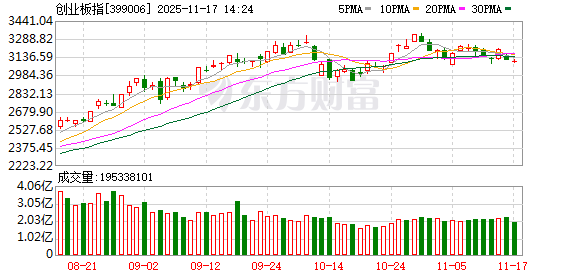
创业板指本月回撤超6%,券商再喊“调整就是机会”
Di Yi Cai Jing· 2025-11-17 06:19
Core Viewpoint - The technology sector has experienced significant fluctuations, with the ChiNext Index showing a maximum drawdown of nearly 8% since November, despite a strong performance earlier in the year [1][2]. Group 1: Market Performance - The ChiNext Index has seen a drawdown of 6.4% in November, with various indices such as the ChiNext 50 and ChiNext 300 experiencing declines of 7.6% and 5.32% respectively [2]. - Major stocks in the computing power sector have faced substantial declines, with companies like Zhongji Xuchuang and Shenghong Technology dropping 10.09% and 16.31% respectively [2]. - The computing power sector has accumulated significant gains prior to the recent adjustments, leading to a shift in market strategy towards "buying low" [2]. Group 2: Fund Holdings and Market Sentiment - TMT sector holdings in funds reached a historical high of nearly 40%, indicating a peak in trading activity and stock prices [3]. - Following Alibaba's announcement of its "Qianwen" project, there has been a resurgence in AI-related stocks, with companies like Xuanyuan International and Dongfang Guoxin seeing gains of over 13% [3]. - Analysts maintain a positive outlook on the computing power sector, suggesting that the current adjustments present investment opportunities due to sustained demand driven by AI [3]. Group 3: Earnings and Future Outlook - By Q3 2025, companies listed on the ChiNext continued to show strong revenue and profit growth, with over 70% achieving profitability [4]. - The computing power sector, particularly the "Yizhongtian" combination, reported a net profit of 14.924 billion, a 2.34 times increase from the previous year [4]. - The market is expected to experience a period of consolidation, with potential upward movements contingent on future catalysts [5].
策略周末谈:做时间的朋友
Western Securities· 2025-11-02 12:42
Core Conclusions - The bull market is entering its second phase, transitioning from a "technology bull" to a "wealth bull" [1] - After the "super macro month" in October, the market is expected to favor cyclical stocks as a better allocation choice due to high valuations and potential adjustments if EPS does not improve [1][5] - Current market conditions present an optimal window for investing in cyclical stocks, supported by five key reasons [1] Reason 1: Cyclical Stocks as "Friends of Time" - Since Q3, the market has begun to trade based on changes in profitability (△ROE), indicating a return to investment in economic recovery [21] - Cyclical stocks have lagged behind in price compared to improvements in fundamentals, making them more favorable during market adjustments [21][24] Reason 2: Potential Requirements of the "14th Five-Year Plan" - The "14th Five-Year Plan" suggests that by 2035, per capita GDP should reach the level of moderately developed countries, requiring an annual growth rate of 4.1% plus inflation and currency appreciation [2][30] - Achieving this goal necessitates a combination of moderate inflation and currency appreciation to establish a growth baseline for cyclical industries [2][31] Reason 3: Cross-Border Capital Inflow, Repeating 2019-2021 - Recent reports emphasize that cross-border capital inflow will effectively support domestic demand, with signs of cyclical improvement already emerging [3][33] - The return of cross-border capital is expected to drive a revaluation of global commodities and domestic manufacturing, similar to the core asset bull market seen post-pandemic [3][36] Reason 4: New Regulations for Public Funds Guiding "Rebalancing" - The introduction of new regulations for public funds is expected to lead to a rebalancing of holdings between TMT and cyclical stocks [4][39] - As public funds have not significantly increased new issuances, the shift from cyclical to TMT stocks has resulted in a decrease in the pricing power of TMT stocks [4][40] Reason 5: Slowdown in Incremental Capital Inflows, Entering a Competitive Phase - Since September, there has been a noticeable slowdown in the inflow of various types of capital, indicating a shift in market dynamics [5][44] - The market is transitioning into a phase of competition, with cyclical stocks likely to benefit from this change [5][51] Investment Recommendations: Transitioning from "Technology Bull" to "Wealth Bull" - The report suggests continuing to invest in cyclical stocks, particularly in sectors such as non-ferrous metals, new consumption, and high-end manufacturing, as these areas are expected to benefit from the current economic conditions [5][54]
天风证券:如何判断四季度的风格切换?
Zhi Tong Cai Jing· 2025-10-20 13:20
Group 1 - The core viewpoint is that in the context of a fully realized profit effect for the year, funding behavior in the fourth quarter is likely to become conservative, with a market style shift towards "profit quality + valuation safety" in large-cap blue chips [1][2] - The overall market is expected to show a risk rebalancing characteristic in the fourth quarter, with the Shanghai and Shenzhen 300 and performance strategies showing positive excess returns relative to the entire A-share market, indicating a return to fundamental certainty as the trading focus shifts from "high elasticity" to "high stability" [2][3] - Leading sectors in the fourth quarter are concentrated in financial, stable, and cyclical sectors, reflecting a decline in investor risk appetite and a demand to lock in annual returns [2][3] Group 2 - Two logical scenarios are observed for the fourth quarter: one is the "lagging recovery + profit-taking from high gains" logic, where previously underperforming sectors may recover, while high-performing assets may see a pullback; the second is the stability of main lines, where certain sectors maintain their strength [3] - Attention should be paid to whether the conditions for switching to undervalued sectors are maturing and whether the prosperity of high-valued sectors can be sustained; currently, some financial, cyclical, and consumer sectors remain at historically low valuations, indicating potential for switching [3]

流动性和基本面的双重视角
2025-09-15 14:57
Summary of Key Points from Conference Call Records Industry Overview - The financial data for August 2025 indicates a year-on-year growth rate of social financing at 8.8%, with a continuous decline in loan growth. The cumulative new loans from January to August decreased by approximately 1 trillion yuan compared to the previous year, with significant reductions in household credit [1][4] - The upstream resource and real estate chain industries continue to decline, while the consumer and infrastructure sectors show positive signals. The midstream manufacturing and TMT (Technology, Media, and Telecommunications) sectors perform strongly, and the financial industry releases favorable signals [2][11] Core Insights and Arguments - The central bank's monetary policy remains multi-targeted, requiring a balance between internal and external factors. It is crucial to monitor the impact of fiscal policy on social financing and maintain a moderately loose monetary policy to support reasonable growth in money supply [6][7] - The A-share market has experienced a rebound after a period of volatility, particularly in the technology growth sector. The market is expected to focus on performance and policy in September and October, with the upcoming 20th Central Committee's Fourth Plenary Session influencing market expectations [8][9] - In the first half of 2025, the overall revenue growth rate of A-shares turned positive, with a year-on-year increase of 0.03%. However, the revenue growth rate of non-financial sectors declined, while the net profit growth rate remained positive at 2.44% [9][10] Important but Potentially Overlooked Content - The phenomenon of "residential deposit migration" began to show signs from July, with household deposits declining for two consecutive months and the growth rate falling below M2. This trend indicates a shift of funds towards non-bank sectors, such as stocks and other equity assets [5][11] - The financial sector shows signs of recovery, with banks, securities, and insurance industries reporting positive net profit growth. The TMT sector continues to exhibit high levels of prosperity, particularly in the semiconductor and consumer electronics segments [16] - The infrastructure sector displays a mixed performance, with certain sub-sectors like airports experiencing high growth, while logistics shows signs of recovery due to policy changes [17] - Future investment opportunities should be analyzed based on growth potential (net profit growth), stability (ROE), and valuation matching. Key sectors to watch include precious metals, cement, and TMT, particularly in gaming software development [18][19]
A股策略周报20250914:转换的真相-20250914
SINOLINK SECURITIES· 2025-09-14 10:27
Group 1 - The report indicates a shift in market logic, moving from a focus solely on AI trends to a broader consideration of macroeconomic fundamentals and recovery [3][12][13] - The Shanghai Composite Index has recently surpassed previous highs, while the TMT sector has not reached new highs, suggesting a market expansion into other sectors such as real estate, steel, and non-ferrous metals [3][12][17] - Historical comparisons are made to the market trends of 2020-2021, highlighting the importance of understanding the underlying logic of market transitions rather than merely focusing on growth versus value styles [3][12][13] Group 2 - Recent data shows resilience in non-US exports and a recovery in profit margins within the midstream manufacturing sector, indicating a positive trend in China's economic activity [4][20][25] - In August 2025, China's export growth was 4.4%, primarily affected by a decline in exports to the US, while exports to the EU and ASEAN continued to improve [4][20][24] - The report notes a structural improvement in inflation data, with core CPI showing a rebound, suggesting a potential reversal of the capital outflow that has previously contributed to price declines [4][25][31] Group 3 - The report highlights an increased expectation for interest rate cuts by the Federal Reserve, with market sentiment shifting towards a more accommodative monetary policy to support economic recovery [5][34][37] - Employment data in the US indicates rising risks, with significant downward revisions to non-farm payrolls and an increase in initial jobless claims, suggesting a cautious outlook for the labor market [5][34][36] - The anticipated interest rate cuts are expected to stimulate both manufacturing and real estate investments, with historical trends indicating a rebound in these sectors following previous rate cuts [5][44][47] Group 4 - The report emphasizes that the main drivers of market transitions are changes in underlying logic rather than traditional style shifts, with a focus on sectors benefiting from domestic recovery and global demand [6][51] - Key sectors identified for investment include upstream resources (copper, aluminum, oil, gold), capital goods (lithium batteries, wind power equipment, engineering machinery), and raw materials (basic chemicals, fiberglass, paper, steel) [6][51] - The report also points to emerging opportunities in domestic consumption-related sectors such as food and beverage, tourism, and insurance, as profit recovery takes hold [6][51]
港股国企ETF(159519)盘中上涨2%,市场流动性改善提振信心
Sou Hu Cai Jing· 2025-09-10 07:28
Core Viewpoint - The Hong Kong stock market's state-owned enterprise ETF (159519) has seen a 2% increase, indicating a potential recovery in the midstream manufacturing sector's supply-demand dynamics, expected to improve around mid-2026 [1]. Industry Summary - The midstream manufacturing sector is showing signs of improvement, with the negative impact on profitability from supply-demand dynamics and scale effects diminishing as of the second quarter of 2025 [1]. - Positive effects from overseas policy stimulation and optimized industry competition are beginning to manifest [1]. - The technology and emerging industries are experiencing a rebound, with significant room for expansion in the future [1]. - Solid-state batteries and electric power equipment are emerging as new market hotspots, while AI computing power remains highly prosperous with potential for valuation increases [1]. - The global market share in the photovoltaic and chemical industries is benefiting from increased concentration and short-term expectations of price alliances due to the trend of "anti-involution" [1]. Investment Opportunities - The Hong Kong state-owned enterprise ETF (159519) tracks the mainland state-owned index (H11153), which primarily selects Chinese state-owned enterprises listed in Hong Kong, covering sectors such as finance, energy, and communication services, focusing on large blue-chip companies [1]. - Investors without stock accounts can consider the Cathay CSI Hong Kong Mainland State-Owned Enterprise ETF Initiated Link (QDII) A (021044) and C (021045) [1].
华夏基金:市场的调整不会一蹴而就且下行空间有限
天天基金网· 2025-09-03 10:34
Group 1 - The market adjustment will not be abrupt, and the downside space is limited [2][3] - Recent market trends indicate a phase of adjustment due to previous rapid increases and the release of structural risks [3] - The current A-share market sentiment remains quite active, with trading volumes and margin balances frequently exceeding 20 trillion [4][5] Group 2 - A-share earnings have reached a confirmation point, entering a mild recovery phase, with significant structural differentiation [6][7] - The market is leaning towards growth, with technology manufacturing driven by the AI cycle and domestic substitution becoming a core engine [7] - The upcoming Politburo meeting at the end of October may serve as a watershed moment for A-share trends, with liquidity expected to drive continued growth [8][9] Group 3 - Two main investment themes to focus on include the "anti-involution" theme, with low valuations in lithium, photovoltaic, and chemical sectors, and the TMT sector, which historically leads market uptrends [9]

策略周观点:中报透露出哪些景气线索?
2025-09-01 02:01
Summary of Key Points from Conference Call Records Industry Overview - The TMT (Technology, Media, and Telecommunications) sector's transaction volume has exceeded 40%, indicating strong market interest but not necessarily signaling a peak [1][2] - The overall A-share market is expected to enter an active replenishment cycle by the fourth quarter of 2025, driven by improving domestic fundamentals and liquidity [1][4] Financial Performance - In the 2025 mid-year report, non-financial equity revenue decreased by 0.4% year-on-year, while net profit attributable to shareholders grew by 2.3%, showing a decline compared to the first quarter [1][5] - The return on equity (ROE) for the entire A-share non-financial sector is expected to stabilize in the fourth quarter after a slowdown in its decline [1][5] Market Dynamics - The current market shows high congestion in components, semiconductors, and communication devices, while software, gaming, and fintech applications are less congested [3] - The non-financial industry prosperity index has risen for three consecutive months, indicating a potential turning point in the revenue cycle [3][10] Inventory and Capacity Cycles - Most sectors are experiencing a dual decline in revenue and inventory growth, reflecting a deepening active destocking phase [6] - The construction and consumption sectors have been in active destocking for five consecutive quarters, while the export chain and TMT sectors remain in a high active replenishment state [6][7] Investment Opportunities - Industries such as chemicals and steel, which have seen a decline in revenue but an increase in advance payments, are expected to experience a revenue growth turning point in the next two quarters [8] - The computer, optical, and electrical engineering sectors are anticipated to continue in a state of dual improvement in supply and demand [8] Sector-Specific Insights - The AI industry is showing positive trends, with significant capital expenditure and production increases in related sectors such as communication equipment and storage devices [11][12] - The engineering machinery sector is recovering, with increased sales and operational hours observed in the third quarter [18] Consumer Trends - Consumer goods sectors, including beer, food, and dairy products, are showing signs of recovery, closely linked to restaurant data [19] - The real estate market is experiencing mixed signals, with new home sales declining year-on-year but showing signs of stabilization in first-tier cities [20] Recommendations - Short-term investment strategies should focus on strong sectors such as AI, pharmaceuticals, and military-related industries, while also considering undervalued consumer and non-bank financial sectors benefiting from currency appreciation [23][24]