旅游等

Search documents
当好消费体制机制改革排头兵
Xin Lang Cai Jing· 2025-12-21 18:36
Core Viewpoint - The article emphasizes the importance of innovative and diversified consumption scenarios to expand domestic demand and enhance consumer experience, particularly through the integration of new business models and formats [1][4]. Group 1: New Consumption Models and Scenarios - The Ministry of Commerce and the Ministry of Finance have initiated pilot programs in 50 cities, including Beijing, to explore new consumption models and scenarios, focusing on enhancing quality supply and stimulating consumer potential [2][6]. - The pilot programs aim to address the insufficient supply of high-quality consumption and to foster innovation in consumption formats, thereby expanding premium consumption supply [2][3]. Group 2: Beijing's Role and Achievements - Beijing's selection as a pilot city is attributed to its large population, strong economic influence, and significant development potential, having attracted over 5,000 brand flagship stores since 2019 [3][4]. - The city has established itself as an international consumption center, with a consumption index reaching 109.9 in 2022, reflecting a 19.6% increase since the end of 2020 [3]. Group 3: Integration of Culture and Economy - The article highlights the effectiveness of cross-industry integration in enhancing consumption vitality, particularly through collaborations with well-known intellectual properties (IPs) to create culturally rich products that resonate with consumers [5]. - The pilot programs in Beijing will also focus on fostering "IP+" new consumption scenarios, integrating cultural consumption into daily life [5][6].
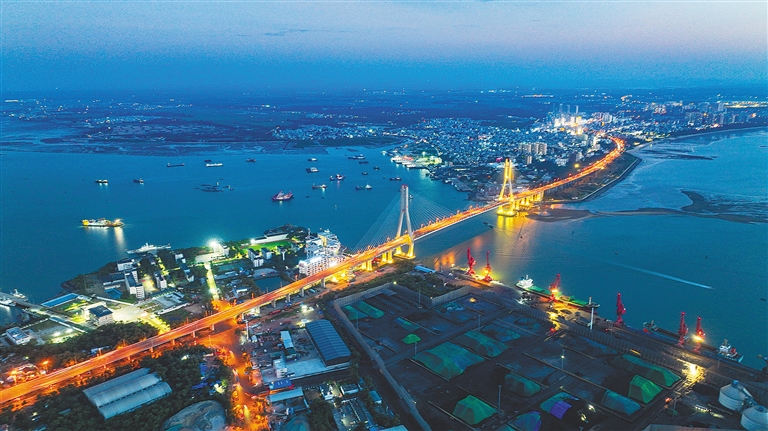
儋州环新英湾区域:高标准打造海南自贸港“样板间”
Hai Nan Ri Bao· 2025-12-19 01:58
Core Viewpoint - The Danzhou Huanxin Yingwan area is being developed as a model for Hainan Free Trade Port, focusing on the integration of port, industry, city, and technology to drive regional development and attract investment [5][6][7]. Group 1: Development Strategy - Danzhou is implementing a coordinated development strategy, aiming to achieve a phased goal of "three years to gain momentum, five years to take shape, and ten years to establish a city" [5]. - The area is positioned as a key hub for the integration of the Yangpu Economic Development Zone and Danzhou Industrial Park, promoting collaborative development [5][10]. Group 2: Infrastructure and Urban Development - The Huanxin Yingwan area has seen significant improvements in infrastructure, with a range of key industrial projects being launched and completed, contributing to urban quality and functionality [5][9]. - A new neighborhood center has opened, serving as a multifunctional business complex and a new landmark for the Huanxin Yingwan New City [9]. Group 3: Industry Focus - The development plan emphasizes the establishment of a diverse industrial ecosystem, focusing on high-tech, modern services, and high-end tourism, while also integrating traditional industries like petrochemicals and logistics [7][12]. - The area aims to create a complete industrial chain, particularly in sectors such as digital economy, healthcare, and education [12]. Group 4: Future Planning and Goals - By 2026, the Danzhou government plans to enhance collaborative mechanisms in industry development, investment attraction, and event hosting, aiming to create a model for regional coordinated development [13]. - The focus will be on key sectors such as new materials, biomedicine, renewable energy, and digital economy, with an emphasis on optimizing the business environment and reducing operational costs for enterprises [13][14].

东南亚消费行业11月跟踪报告:通胀温和且分化,多数消费跑输指数
Haitong Securities International· 2025-12-19 00:47
Investment Rating - The report does not explicitly provide an investment rating for the Southeast Asia consumer sector, but it indicates that most consumer sectors are underperforming the index, suggesting a cautious outlook for investments in this area [1]. Core Insights - Inflation in Southeast Asia is described as moderate and uneven, with varying impacts across different countries. Indonesia's CPI increased by 2.72%, Thailand's decreased by 0.49%, Vietnam's rose by 3.25%, and the Philippines saw a 1.5% increase, indicating a controlled inflation environment conducive to consumer recovery [3][12][22][37]. - Consumer confidence is recovering in Indonesia, with the consumer confidence index rising to 124.0, reflecting optimism about economic prospects. In Thailand, the consumer confidence index increased to 50.9, driven by government stimulus and improved trade conditions [17][25]. - Retail sales in Indonesia and Vietnam show robust growth, with Indonesia's food and beverage retail index growing by 8.2% year-on-year, while Vietnam's retail sales increased by 7.1% [4][39]. Economic Data Summary - Indonesia's GDP growth for Q3 2025 was 5.04%, supported by strong consumer spending and investment, although it showed a slight slowdown compared to Q2 2025 [12]. - Thailand's GDP growth for Q3 2025 was 1.2%, driven by consumer spending and tourism, but overall growth remains moderate [20]. - Singapore's GDP grew by 4.2% in Q3 2025, primarily due to manufacturing and service sector recovery, indicating a stable economic environment [28]. - Vietnam's GDP growth reached 8.23% in Q3 2025, reflecting strong performance in industrial and service sectors, although challenges remain from external demand fluctuations [35]. Consumer Sector Performance - The consumer sector in Southeast Asia shows signs of resilience, with Indonesia's consumer confidence and retail sales indicating strong demand. However, the overall performance of consumer stocks has lagged behind the market index in several countries [4][11]. - In Thailand, consumer spending remains cautious, with inflation pressures being low, which may limit growth in consumer sectors [22]. - Malaysia's consumer sector is recovering, with GDP growth of 5.2% in Q3 2025, supported by domestic demand and investment [42].
更大力度提振消费!三部门发文→
Sou Hu Cai Jing· 2025-12-15 06:16
Core Viewpoint - The recent Central Economic Work Conference emphasizes the need for financial institutions to enhance support for expanding domestic demand, with a focus on boosting consumption through coordinated efforts between commerce and finance [1][10]. Group 1: Financial Support for Consumption - Financial support will be increased in key areas of consumption, including upgrading product consumption and expanding service consumption [1][2]. - Innovative financial products and services will be developed to cater to the characteristics of service consumption, such as home services, hospitality, and entertainment [2][4]. - The development of financing services for intangible assets like intellectual property and technology achievements will be prioritized, along with tailored financial products for small and micro enterprises [4]. Group 2: New Consumption Models - Financial institutions are encouraged to collaborate with platforms and key merchants to enhance payment options like installment plans and digital currencies, addressing consumer upgrade needs [6]. - There will be a focus on developing new consumption scenarios, including green consumption, digital consumption, and AI-driven consumption [7]. - Financial services will be integrated to support new business models and consumption activities, such as "Buy in China" initiatives and the development of urban consumption centers [7]. Group 3: Rural and County-Level Consumption - Financial support will be provided for county-level consumption initiatives, including seasonal commercial activities and rural product sales [11]. - The development of rural logistics and cold chain facilities will be supported through targeted financing [11]. - Financial institutions are encouraged to participate in local consumption promotion activities, offering tailored products and services to enhance consumer engagement [11].

刚刚,大利好来了!
天天基金网· 2025-12-15 01:24
Core Viewpoint - The article discusses the release of a notification aimed at strengthening collaboration between the business and financial systems to boost and expand consumption in China [2][4]. Group 1: Strengthening Collaboration - The notification outlines 11 policy measures across three main areas, emphasizing the need for local departments to enhance communication and collaboration, and to create mechanisms for cooperation [4][8]. - It encourages local governments to utilize digital currency and various financial tools to improve the effectiveness of consumption promotion policies [7][9]. Group 2: Financial Support for Key Consumption Areas - Financial institutions are urged to focus on five key areas: upgrading product consumption, expanding service consumption, nurturing new consumption types, innovating diverse consumption scenarios, and supporting consumption assistance [5][10]. - Specific measures include enhancing financial services for durable goods and digital products, and developing tailored financial products to meet consumer needs [10][11]. Group 3: Expanding Government-Financial-Enterprise Cooperation - The notification promotes joint consumption promotion activities involving financial institutions, local governments, and businesses to reach a wider audience [14][15]. - It emphasizes the importance of information sharing between local business departments and financial institutions to facilitate precise service delivery [15][16].
展望“十五五” | 广东省发布“十五五”规划建议:着力打造新兴支柱产业,实施产业创新工程
Xin Lang Cai Jing· 2025-12-11 10:16
Core Viewpoint - The Guangdong Provincial Committee emphasizes the importance of the 15th Five-Year Plan in advancing China's modernization, highlighting the achievements during the 14th Five-Year Plan and setting ambitious goals for economic and social development in the upcoming period [3][4][7]. Group 1: Achievements During the 14th Five-Year Plan - Guangdong has achieved significant economic growth, reaching a total economic output of 14 trillion yuan, with over 7 million new urban jobs created and a rise in per capita disposable income outpacing economic growth [3][4]. - The province has made strides in high-quality development, technological innovation, and ecological improvements, showcasing a balanced and coordinated development approach [3][4][10]. Group 2: Historical Context and Development Environment - The 15th Five-Year Plan period is seen as crucial for consolidating the foundations of socialist modernization and creating new advantages for Guangdong [4][5]. - The province faces both opportunities and challenges, including global geopolitical shifts and the need for technological advancements to maintain competitive advantages [5][6]. Group 3: Guiding Principles and Goals for the 15th Five-Year Plan - The guiding principles include upholding the leadership of the Communist Party, prioritizing people-centered development, and focusing on high-quality growth [8][9]. - Key goals include achieving significant improvements in economic quality, enhancing self-reliance in technology, and promoting coordinated urban and rural development [10][11]. Group 4: Economic and Social Development Strategies - Strategies include deepening reforms, expanding openness, and enhancing the quality of the business environment to stimulate economic vitality [31][33]. - The plan emphasizes the importance of integrating domestic and international markets, fostering innovation, and developing a modern industrial system [30][36]. Group 5: Infrastructure and Technological Development - The plan outlines the need for a modern infrastructure system that supports economic activities and enhances resilience [21][22]. - It highlights the importance of technological self-reliance and innovation as key drivers for economic transformation and productivity enhancement [22][24]. Group 6: Consumer Market and Investment - The strategy focuses on boosting domestic consumption and investment, with initiatives aimed at enhancing consumer spending and optimizing investment structures [28][29]. - The plan aims to create a unified national market, facilitating resource sharing and economic integration across regions [30].

【大涨解读】大消费:重要会议再强调内需主导,消费股携手发力,行业或成政策突破方向
Xuan Gu Bao· 2025-12-09 05:36
Group 1 - Consumer stocks have shown strength, with Dongbai Group achieving three consecutive trading limits, and companies like Yonghui Supermarket and Nanjing Tourism also experiencing significant gains [1] - Notable stock performances include Maoye Commercial with a 10.02% increase, Anji Food with a 9.99% rise, and Dongbai Group at 9.99%, indicating a positive trend in the retail sector [2] Group 2 - A recent meeting emphasized the importance of domestic demand, aiming to build a strong domestic market and promote innovation-driven growth [3] - The meeting highlighted the need for policies that integrate consumption and investment, allowing local governments more flexibility to implement measures that stimulate consumption and investment [4] - The focus on domestic demand is expected to continue, with projections indicating a significant increase in household consumption rates and a potential gap in per capita service consumption that may drive policy changes [4]

创业板指探底回升涨超1% 两市成交额萎缩至1.55万亿元
Mei Ri Jing Ji Xin Wen· 2025-12-04 07:15
(文章来源:每日经济新闻) 每经AI快讯,12月4日截至收盘,沪指跌0.06%,深成指涨0.4%,创业板指涨1.01%。沪深两市成交额 1.55万亿元,较上一个交易日缩量1210亿元。盘面上,市场热点快速轮动,全市场超3800只个股下跌。 从板块来看,机器人概念爆发,睿能科技、骏亚科技等10余股涨停。商业航天概念延续强势,航天机电 5天3板。福建板块表现活跃,安记食品3连板。摩尔线程概念快速拉升,联美控股、初灵信息涨停。下 跌方面,大消费板块震荡调整,同庆楼、海欣食品跌停。海南板块集体走弱,罗牛山跌停。板块方面, 机器人、商业航天等板块涨幅居前,海南、旅游、食品等板块跌幅居前。 ...

中国超大规模市场重塑全球增长格局
Jing Ji Ri Bao· 2025-12-03 01:01
Core Insights - The global economy is facing significant downward risks, while the Chinese market demonstrates resilience and offers strategic opportunities for global enterprises due to its unique scale and competitive advantages [1][8]. Consumption Market - China's consumer market is characterized by continuous growth in scale, structural optimization, and improving quality, leading to a significant competitive advantage [2]. - From 2014 to 2024, China's total retail sales of consumer goods are projected to grow from 26.2 trillion yuan to 48.3 trillion yuan, reflecting both total volume and structural optimization [2]. - By 2024, final consumption expenditure is expected to contribute 44.5% to economic growth, solidifying its role as the primary driver of economic expansion [2]. Investment Market - China's investment market is attractive due to its complete industrial system, continuously upgrading industrial structure, and significant investment returns [4]. - China is the only country with all industrial categories recognized by the United Nations, showcasing strong resilience in its manufacturing sector [4]. - The urbanization rate is projected to reach 67% by 2024, indicating substantial investment demand potential [4]. Innovation Ecosystem - China's innovation ecosystem benefits from a vast array of application scenarios, rapid technological iteration, and a strong talent pool [5]. - China ranks 10th in the Global Innovation Index, marking a significant rise and leading among middle-income economies [5]. - As of July 2024, 250 million people in China have received higher education, providing a robust talent reserve for innovation [5][6]. Market Environment - The continuous improvement of China's market environment is evident through deepened institutional openness, optimized business conditions, and the establishment of fair competition [7]. - Since the establishment of the first free trade zone in 2013, significant institutional innovations have been replicated nationwide, enhancing foreign investment conditions [7]. - By the end of 2024, the total number of registered business entities in China is expected to reach 189 million, fostering a collaborative development environment among state-owned, private, and foreign enterprises [7]. Overall Market Advantages - China's market advantages are comprehensive and systemic, characterized by a large and continuously upgrading consumer market, a solid and improving investment environment, a vibrant and talent-rich innovation ecosystem, and an increasingly open and transparent institutional environment [8]. - In the face of global economic uncertainties, China's stability and growth potential are particularly valuable, with expectations of maintaining a high contribution rate to global economic growth over the next five years [8].
供需互促 赋能产业升级民生改善
Yang Shi Wang· 2025-12-02 12:29
Group 1 - The core idea of the news emphasizes the importance of guiding enterprises to produce products that meet consumer needs, promoting a positive interaction between supply and demand, and stimulating market vitality and industrial upgrades [1] - The "14th Five-Year Plan" suggests leveraging new demand to drive new supply, which in turn creates new demand, thereby enhancing consumption and investment [1] - Various regions are accelerating efforts to encourage enterprises to develop customized and diversified services that resonate with consumer preferences [1] Group 2 - The launch of the first ice and snow tourism train in Harbin features meals tailored for the elderly, highlighting the trend of catering to specific demographic needs [3] - Enterprises are increasingly focusing on the preferences of different consumer groups, including the youth, who are driving the "Guochao" (national trend) consumption with culturally infused products [3] - There is a push to develop energy-efficient appliances and promote green products in rural markets, alongside initiatives for electric vehicles and green building materials [3] Group 3 - The retail sales of AI glasses and smartwatches have increased by 23.1% in the first ten months of the year, indicating a growing consumer interest in smart wearable technology [5] - In October, sales of first-level energy-efficient appliances rose by over 10% year-on-year, while organic food sales saw an increase of over 8%, reflecting a shift towards high-quality and green consumption [5] - The government has released a policy document aimed at enhancing the adaptability of consumer goods supply and demand, marking a significant step in promoting consumption following the "14th Five-Year Plan" [5]