消费

Search documents
2026公募投资展望:这些方向被看好
Zhong Guo Zheng Quan Bao· 2026-02-19 10:53
Group 1 - A-shares are presenting structural opportunities amidst fluctuations, with public funds initiating a new round of investments in sectors like artificial intelligence, semiconductors, and consumption due to moderate economic recovery and accelerated industrial upgrades [1] - The manufacturing investment and A-share capital expenditure contraction are driving supply-demand rebalancing, providing support for corporate profits, while fiscal changes in special bonds will impact A-share pricing [2] - The market is expected to continue attracting significant incremental capital inflows in 2026, with major contributions from insurance funds and financing, while individual investors are primarily high-net-worth individuals with high-risk preferences [2] Group 2 - The AI sector is a focal point for public fund strategies, with expectations for continued strong performance in the AI industry chain in the first half of 2026, driven by breakthroughs in AI model capabilities and significant growth in annual recurring revenue from AI-native applications [4] - The semiconductor industry is experiencing rapid changes driven by AI large models, with a focus on domestic production and R&D, while non-AI semiconductor sectors may face pressure [5] - The consumption sector is anticipated to see a resurgence in investment opportunities in 2026, driven by the release of wealth effects and an upgrade in high-end and service consumption demands [5]
巴菲特,最新调仓曝光!
Zhong Guo Ji Jin Bao· 2026-02-18 06:09
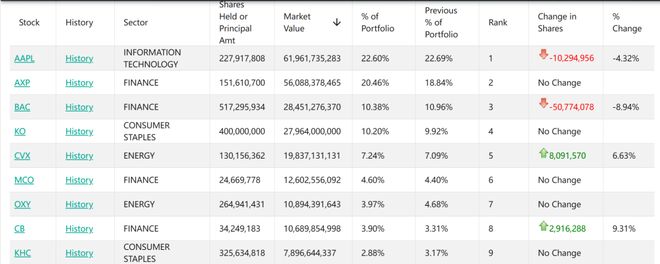
Core Viewpoint - The article reveals the portfolio adjustments made by Berkshire Hathaway during Warren Buffett's last quarter as CEO, highlighting a shift in holdings with reductions in technology stocks and increases in energy, consumer, and financial sectors [2][4]. Group 1: Overall Portfolio Changes - As of the end of Q4 2025, Berkshire's total portfolio size increased to $274 billion from $267 billion in the previous quarter, with the top ten holdings accounting for 88.26% of the portfolio [2]. - The top ten holdings remained unchanged in terms of companies, but there were slight adjustments in their rankings [2]. Group 2: Major Stock Adjustments - Berkshire reduced its stake in Apple by over 10.29 million shares, a decrease of 4.32%, marking the third consecutive quarter of reduction, with a market value decline of approximately $2.8 billion [4][7]. - A significant reduction in Amazon shares was noted, with a 77.24% decrease in holdings, dropping its portfolio share from 0.82% to 0.19%, leaving nearly 2.3 million shares [5]. - The stake in Bank of America was also reduced, with nearly 50.8 million shares sold, resulting in an 8.94% decrease in holdings [6]. Group 3: New Investments and Increases - Berkshire initiated a new position in The New York Times, purchasing 5.0657 million shares valued at over $350 million, ranking it 30th in the portfolio [8]. - The company increased its holdings in Chevron by over 8.09 million shares, a 6.63% increase, and in Chubb Limited by nearly 2.92 million shares, a 9.31% increase [9]. - Additionally, there was a 12.34% increase in holdings of Domino's Pizza, raising its market value to $1.4 billion [9]. Group 4: Stable Holdings - Coca-Cola and Kraft Heinz holdings remained unchanged, with Coca-Cola valued at $27.96 billion, maintaining its position as the fourth-largest holding [11]. - Berkshire is the largest shareholder of Kraft Heinz, holding approximately 27.5% of the company, which is undergoing a split into two independent publicly traded companies [11].





MSCI中国指数大调仓,37只股票新纳入,高盛测算14亿美元净流入居全球首位
Jin Rong Jie· 2026-02-14 08:49
Group 1 - MSCI announced the results of its quarterly index review on February 11, 2026, which included the addition of 37 stocks to the MSCI China Index and the removal of 16 stocks [1] - The adjustments will take effect after the market closes on February 27, 2026 [1] Group 2 - Goldman Sachs estimated that the MSCI core index adjustment will trigger over $17 billion and $14 billion in two-way passive trading in the Asia-Pacific and global emerging markets, with net inflows of approximately $1.6 billion and $450 million respectively [3] - Chinese stocks are expected to receive about $1.4 billion in net passive fund inflows, leading globally, while markets in France, the UK, and the US are projected to experience significant outflows [3] Group 3 - In the Asia-Pacific region, the main beneficiaries of passive fund inflows include technology hardware and semiconductors (+$2.2 billion), capital goods (+$930 million), and software and services (+$480 million), while sectors like consumer, transportation, and travel services are facing passive reductions [3] - In the Chinese market, the main paths for fund inflows are through semiconductors and related hardware, AI software and autonomous driving applications, and upstream resources and materials [4] Group 4 - Goldman Sachs predicts that newly added stocks such as SenseTime, Changfei Optical Fiber, Hesai Technology, and Pony.ai will each see at least $200 million in potential net passive fund inflows [4] - Historical data shows that stocks added to the MSCI index or with increased free float factors typically outperform those removed or with decreased factors between the announcement and effective dates [4]

月度前瞻 | 开年经济“新变化”?(申万宏观·赵伟团队)
赵伟宏观探索· 2026-02-13 16:02
Core Viewpoint - The article discusses the economic changes at the beginning of 2026, highlighting the resilience of the economy despite previous downward pressures, with a focus on production, demand, and price trends [8][66]. Economic Monthly Data - Industrial value-added growth is projected to be 4.8% in November 2025, 5.2% in December 2025, and 5.4% in January-February 2026 [2]. - Fixed asset investment is expected to decline by -2.6% in November 2025, -3.8% in December 2025, and -9.8% in January-February 2026 [2]. - Real estate investment is forecasted to drop significantly by -15.9% in November 2025, -17.2% in December 2025, and -31.1% in January-February 2026 [2]. Production Changes - Manufacturing PMI fell to 49.3% in January 2026, indicating a significant drop in production, likely due to the early return of workers during the Spring Festival [3][10]. - Despite the drop in January, the average PMI over the past two months shows a recovery trend, increasing by 0.5 percentage points to 49.7% compared to November 2025 [10]. - The operating rate of blast furnaces in the metallurgical chain increased by 2.2 percentage points compared to December 2025, reflecting a recovery in production [14]. Demand Highlights - Export demand is expected to remain strong due to a delayed Spring Festival, extending the "rush for exports" window, with foreign trade cargo volume increasing by 13.9% year-on-year [5][25]. - Social retail sales are projected to see a slight recovery in January-February 2026, with an expected growth of around 1.9% due to the long holiday period and increased service consumption support [31]. Investment Outlook - Investment is anticipated to improve moderately due to supportive policies and increased government debt financing, with a positive outlook for infrastructure investment [6][39]. - The operating rates for asphalt and grinding are expected to maintain resilience, indicating stable investment activity in early 2026 [39]. Price Trends - PPI is expected to show weak recovery, with January PPI projected to rise to -1.4% year-on-year, while CPI is anticipated to exhibit a "V-shaped" trend due to the timing of the Spring Festival [46][56]. - The core CPI is expected to remain low, influenced by weak demand and reduced government subsidies, despite some support from rising gold prices [56].

恒生指数重磅调整!宁德时代、洛阳钼业、老铺黄金被纳入
Mei Ri Jing Ji Xin Wen· 2026-02-13 14:19
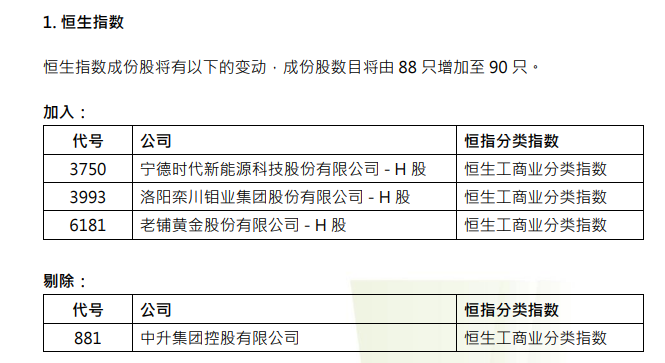
Group 1 - The Hang Seng Index Company announced the quarterly review results for the Hang Seng Index series, effective from March 9, 2026, after market close on March 6, 2026 [1] - The Hang Seng Index will add three stocks: Contemporary Amperex Technology Co., Limited (03750), Luoyang Molybdenum Co., Ltd. (03993), and Laopuhuang Co., Ltd. (06181), while removing Zhongsheng Group Holdings Limited (00881), increasing the number of constituent stocks from 88 to 90 [1] - Laopuhuang has seen a significant price increase, with a cumulative rise of nearly 20% since the beginning of 2026 [1] Group 2 - The Hang Seng China Enterprises Index will maintain 50 constituent stocks, adding Beike-W (02423) and Horizon Robotics-W (09660), while removing China Resources Beer (00291) and Mengniu Dairy (02319) [2] - The Hang Seng Composite Index will add 53 stocks, including Bank of East Asia (00023), and remove 28 stocks, including Shui On Land (00272), increasing the number of constituent stocks from 507 to 532 [5] - The Hang Seng Technology Index will not change, maintaining 30 constituent stocks [6] Group 3 - The total assets under management for products tracking the Hang Seng Index series is approximately $117.7 billion as of December 2025 [6] - The adjustments in index constituents may trigger passive fund rebalancing, potentially leading to increased trading volume for related stocks as the effective date approaches [6] - The inclusion of new economy enterprises in sectors like renewable energy, new consumption, and biotechnology is expected to enhance the growth potential and investment attractiveness of the indices, reducing the weight of traditional industries [6]


科技+资源+消费共振 鹏华基金ETF矩阵为马年投资提供组合工具
Cai Fu Zai Xian· 2026-02-13 10:04
Core Insights - The A-share market in 2026 is experiencing structural advancement, with high-quality ETF products becoming essential tools for investors to capture structural opportunities [1] - Penghua Fund's ETF products have shown remarkable performance, achieving historical scale highs across key sectors, indicating strong market recognition and laying a solid foundation for 2026 [1] Fund Performance - As of February 12, 2026, multiple ETFs under Penghua Fund have seen steady scale growth, with significant increases in assets under management, particularly in the Sci-Tech sector [2] - The Sci-Tech bond ETF series has been particularly successful, with six out of twelve ETFs reaching new scale highs in 2026, catering to diverse investor needs [2] - The Sci-Tech bond ETF Penghua (551030) surpassed 25 billion yuan in scale on January 1, 2026, establishing itself as a benchmark product in the Sci-Tech bond sector [2] - Other notable products include the Sci-Tech AI ETF (588410) and the Sci-Tech 50 Enhanced ETF (588460), which reached scales of 0.695 billion yuan and 1.208 billion yuan respectively [2] - The flagship Sci-Tech 100 ETF Penghua (588220) achieved a scale of 11.394 billion yuan on January 19, 2026, focusing on growth opportunities in small and medium-sized enterprises on the Sci-Tech board [2] Sector Analysis - The cyclical ETFs have also performed well, benefiting from the recovery expectations in the cyclical sector, with three ETFs reaching new scale highs in 2026 [3] - The Chemical ETF (159870) reached a scale of 36.21 billion yuan on February 11, 2026, becoming a key player in the cyclical ETF space [3] - The Oil ETF Penghua (159697) reached a scale of 1.89 billion yuan on February 12, 2026, accurately tracking the oil sector's performance [3] - The Non-ferrous Metals ETF Penghua (159880) achieved a scale of 1.969 billion yuan on January 29, 2026, capturing opportunities in the non-ferrous metals industry [3] - The Hong Kong Consumption ETF Penghua (159265) also saw scale growth, reaching 0.461 billion yuan on February 5, 2026, as the Hong Kong consumption sector recovers [3] Manager Insights - Fund managers emphasize a shift from "total-driven" to "structural-driven" economic growth, with technology and industrial upgrades becoming core growth drivers [4] - In the Sci-Tech sector, AI technology is expected to deepen integration with industries, driving demand for chips and accelerating the domestic substitution process in the semiconductor industry [4] - Fund managers suggest that investors should focus on "high-low switching" investment opportunities, particularly in the chemical sector, which is poised for a recovery [5] - The Hong Kong consumption sector is highlighted for its resilience, with a focus on fundamental performance and long-term investment value [5]
[2月12日]指数估值数据(不同品种为何涨幅不同;红利指数估值表更新;领马年红包封面)
银行螺丝钉· 2026-02-12 13:48
Core Viewpoint - The article discusses the current state of the stock market, highlighting the performance of different indices and sectors, and emphasizes the importance of understanding the underlying fundamentals of various investment styles to identify potential opportunities and risks in the market [2][4][10]. Market Performance - The overall market showed a slight increase, with the Shanghai Composite Index and Shenzhen Component Index experiencing minor gains, while the CSI 500 index saw a more significant rise [2]. - The market is characterized by a rotation among different investment styles, with value stocks declining after a previous rise, and growth stocks rebounding after a decline [2][4]. - The Hong Kong stock market experienced a pullback after three consecutive days of gains, with dividend indices showing less volatility compared to technology stocks [2][4]. Earnings and Valuation Insights - In 2024, A-share companies are expected to see a year-on-year decline in earnings, leading to a low valuation star rating of 5.9 [2][4]. - By 2025, earnings growth for A-share companies is projected to be between 5% and 10%, with specific sectors like technology and healthcare showing significant growth rates [4][10]. - The article categorizes companies based on their earnings growth rates into three tiers: 1. **First Tier**: Companies in a booming cycle with earnings growth exceeding 20%, such as A-share technology and Hong Kong healthcare stocks [4]. 2. **Second Tier**: Companies in a recovery phase with earnings growth between a few percent to over 10%, including dividend and low-volatility stocks [4]. 3. **Third Tier**: Companies in a downturn, such as food and beverage sectors, with minimal growth [4]. Investment Strategy - The article emphasizes the importance of diversifying investments across different styles, especially during market downturns, to mitigate risks and capture potential future gains as fundamentals improve [4][10]. - It suggests that patience is required for investments, particularly in low-valued stocks that may take time to recover [5][10]. - The article also provides a valuation table for dividend indices, indicating which stocks are undervalued and suitable for investment [5][7]. Conclusion - The article concludes with a focus on the importance of understanding market dynamics and the fundamentals of different sectors to make informed investment decisions, highlighting the potential for significant returns in the future as market conditions evolve [4][10].
平均两天换一个“老板”!上市公司控股权变更潮涌
证券时报· 2026-02-12 12:55
Core Viewpoint - The article highlights a significant trend in the A-share market, where there has been a surge in control changes among listed companies, reflecting increased market activity and strategic repositioning by various stakeholders [2][12]. Group 1: Control Changes in Listed Companies - Since 2025, at least 150 listed companies have announced plans for control changes, averaging one company every two days [2][3]. - As of 2026, over 60 companies have reported progress on control changes, indicating a continuation of this trend [2]. - The majority of control changes are occurring in traditional industries such as chemicals, textiles, and consumer goods, with acquirers including individuals, state-owned enterprises, and investment firms [2][5]. Group 2: Industry Distribution of Control Changes - The distribution of control changes shows that traditional industries dominate, with 12.77% of changes in the oil and petrochemical sector, and significant activity in environmental services, construction, and light manufacturing [5][7]. - Other sectors like agriculture, textiles, and real estate also show notable percentages of control changes, indicating a broad impact across various industries [5][7]. Group 3: Market Capitalization of Companies Involved - A significant portion of companies undergoing control changes are small-cap firms, with 169 companies having a market capitalization below 10 billion yuan, accounting for nearly 80% of the total [8][9]. - Companies with a market cap below 5 billion yuan represent 47.44%, while those between 5 billion and 10 billion yuan make up 31.16% [9][10]. Group 4: Motivations Behind Control Changes - The motivations for these control changes include financial distress among original controlling shareholders, strategic shifts in traditional industries, and pressures from debt [12][14]. - The trend is also driven by the need for new capital and resources to enhance company governance and operational efficiency [11][12]. Group 5: Types of Acquirers - The acquirers in these control changes are primarily state-owned enterprises, industrial capital, and limited partnership firms, with state-owned entities frequently taking over to optimize industrial layouts and stabilize the market [14]. - Industrial capital is also a significant player, often seeking to enhance synergies and expand into new business areas [14].



一季度中国经济前瞻:宏观政策保持稳健扩张
Xin Lang Cai Jing· 2026-02-12 12:12
Core Viewpoint - The IMF has adjusted the global economic growth forecast for 2026 to 3.3%, an increase of 0.2 percentage points from the previous prediction, with China remaining a key driver of global economic growth [2][10]. Economic Outlook - KPMG's report anticipates that under current policy support, China's domestic economic growth will remain stable in 2026, with an expected recovery in demand as macro policies are effectively implemented [2][10]. - The report indicates that China's economy is projected to reach 140 trillion yuan in 2025, with a real GDP growth of 5.0%, achieving the target growth rate set at the beginning of the year [3][11]. Supply and Demand Dynamics - The economy is experiencing structural disparities in supply and demand, with traditional industries facing challenges due to intense competition and slow capacity clearance, leading to weak demand and supply expansion [3][11]. - The report highlights the need for coordinated efforts from both demand and supply sides, as well as improvements in institutional mechanisms and external environments to promote sustained recovery in domestic demand [4][12]. Investment and Consumption - Investment in key areas and major projects needs to be supported to stabilize effective investment, while enhancing social welfare investments to stimulate consumer potential [4][12]. - The retail sales of consumer goods are expected to grow by 3.7% in 2025, with a slight increase of 0.2 percentage points from the previous year, indicating a shift towards quality and experiential consumption [4][13]. Policy Support and Financial Tools - Continuous policy support is essential to consolidate the recovery foundation and stimulate growth, including innovative use of financial tools such as special government bonds and policy financing [5][15]. - The establishment of the National Venture Capital Guidance Fund aims to attract diverse capital to support the development of strategic emerging industries [6][15]. Macroeconomic Management - Fiscal policy should play a more prominent role in counter-cyclical adjustments, focusing on effectively expanding domestic demand and improving policy implementation effectiveness [7][16]. - The report emphasizes the importance of enhancing the business environment and supporting enterprises in expanding international markets to create a virtuous cycle of income growth and domestic demand expansion [7][16].
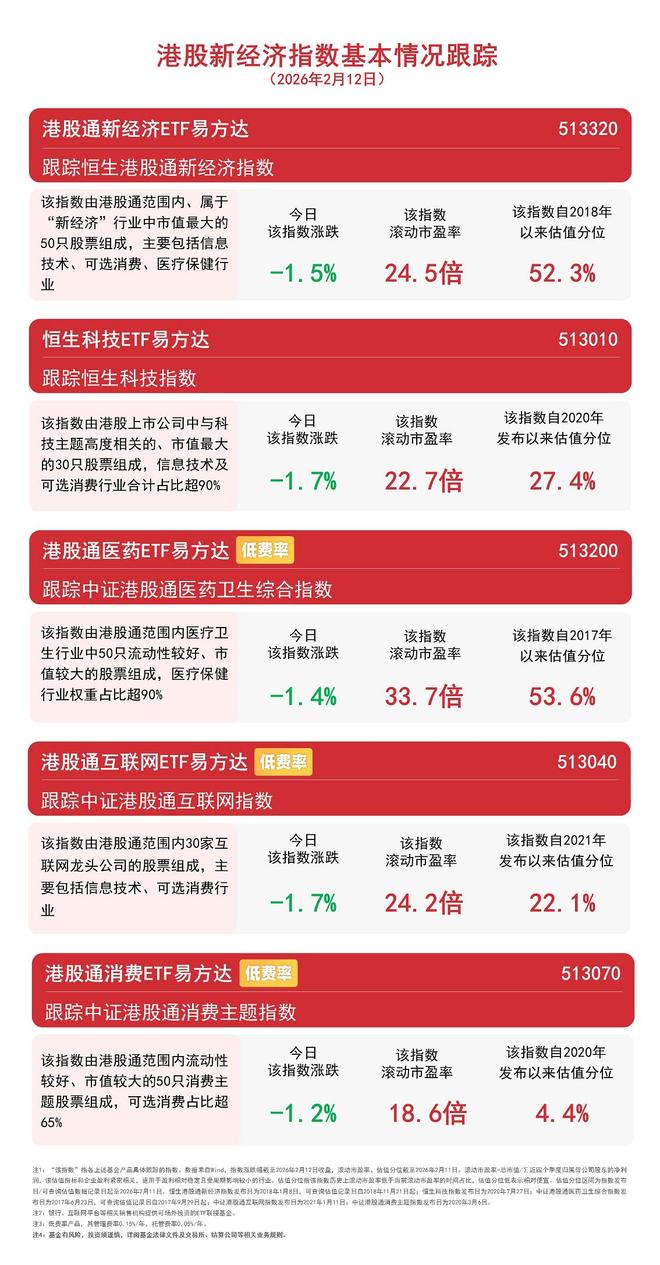
港股科技板块低位震荡,恒生科技ETF易方达(513010)、港股通互联网ETF易方达(513040)等产品受关注
Mei Ri Jing Ji Xin Wen· 2026-02-12 10:40
Core Viewpoint - The Hong Kong stock market indices related to consumption, healthcare, and new economy sectors experienced declines, with the consumer theme index down by 1.2%, the healthcare index down by 1.4%, and the new economy index down by 1.5% [1]. Group 1: Market Performance - The Hang Seng Technology Index and the CSI Hong Kong Stock Connect Internet Index both fell by 1.7% [1]. - The recent 10 trading days saw net inflows of 2.3 billion yuan into the E Fund Hang Seng Technology ETF (513010) and 800 million yuan into the E Fund Hong Kong Stock Connect Internet ETF (513040), both reaching record high sizes since their inception [1]. Group 2: Index Composition - The CSI Hong Kong Stock Connect Consumer Theme Index consists of 50 major consumer stocks with good liquidity and large market capitalization, with a significant portion in consumer discretionary [4]. - The index has a rolling price-to-earnings ratio of 18.6 times and a valuation percentile of 4.4% since its inception in 2020 [4].