科技股

Search documents
深夜全球资产大跌!纳指跌超1% 黄金、白银齐跌 比特币跌破6.7万美元 美伊谈判传来最新消息丨美股开盘
Mei Ri Jing Ji Xin Wen· 2026-02-17 15:53
Market Overview - The U.S. stock market opened lower with all three major indices declining: Dow Jones down 0.36%, S&P 500 down 0.75%, and Nasdaq down 1.16% [1] - The Chicago Board Options Exchange Volatility Index (VIX), known as the "fear index," reached 22.50, up from around 17 at the beginning of last week [1] Major Technology Stocks - Major tech stocks opened lower, with Tesla down over 3%, Google down over 2%, and Microsoft and Nvidia down over 1.4%. Apple, however, saw a slight increase of 1.17%, while Amazon fell by 1.31% [2] - Year-to-date, the index of the seven major tech companies has decreased by 7.2% [2] Individual Stock Performance - Apple (AAPL) was at $258.77, up 1.17% [3] - Facebook (Meta Platforms) was at $632.41, down 1.15% [3] - Amazon (AMZN) was at $196.19, down 1.31% [3] - Microsoft (MSFT) was at $395.33, down 1.49% [3] - Nvidia (NVDA) was at $179.85, down 1.62% [3] - Google (Alphabet) was at $299.46, down 2.14% [3] - Tesla (TSLA) was at $404.23, down 3.16% [3] - TSMC shares fell by 1.9%, Broadcom by 1.4%, Oracle by 3.26%, and Micron Technology by 3.1% [3] Gold and Silver Stocks - U.S. gold stocks fell, with Harmony Gold down 6%, Kinross down 4.6%, and Pan American Silver down 4.4% [4] Chinese Stocks - The Nasdaq Golden Dragon China Index rose by 0.05%, closing at 7595.70 points [5] - Chinese stocks showed mixed performance, with Century Internet up over 3%, NIO, Vipshop, and Pinduoduo up over 1%, while Kingsoft Cloud fell over 2% [5] Precious Metals - Precious metals saw declines, with spot gold dropping below $4850 and spot silver also falling below $72, marking new lows since February 6 [6] - As of the latest update, spot gold was down 2.64% and spot silver down 5.5% [6] Oil Prices - WTI crude oil fell by 1.76%, trading at $62.61 per barrel, while Brent crude oil dropped by 1.6% to $67.55 per barrel [8] Cryptocurrency - Bitcoin fell below $67,000, down 2.9% for the day, with over 77,000 people liquidated in the global market [10]


纳指期货下跌 受AI支出焦虑及竞争担忧拖累
Xin Lang Cai Jing· 2026-02-17 10:19
Market Overview - US stock index futures declined amid light trading as investors returned from the Presidents' Day holiday, entering a week with reduced trading hours [1][7] - Concerns over ongoing AI spending and competitive pressures continue to weigh on the tech-heavy Nasdaq index, which saw futures drop by 0.7% [1][9] - European markets opened quietly, with most blue-chip indices rising, including the FTSE 100, which increased by 0.4% [2][8] Currency and Commodities - The US dollar rose to an 11-day high against a basket of currencies, supported by risk-averse capital flows as traders returned from the holiday [3][9] - Gold prices fell below $5,000 per ounce, with New York gold futures down by 2.2% to $4,937.40 [6][12] - Oil prices declined ahead of direct talks between the US and Iran, with Brent crude down by 0.9% to $68 per barrel [5][11] Economic Data and Expectations - Investors are awaiting key economic indicators, including the ADP employment data and inflation figures from the US and Japan, to be released later in the week [1][5] - The market anticipates the release of the Federal Reserve's meeting minutes and fourth-quarter economic growth data, which may provide insights into future interest rate cuts [3][9] Stock Performance - The Nasdaq index futures fell by 0.6% in pre-market trading, with most of the "Magnificent 7" tech stocks declining, except for Amazon, which rose by 0.2% [1][7] - The Nikkei index closed down 0.2%, marking its fourth consecutive day of decline, with SoftBank shares dropping by 5.1% [2][7]

1.3万亿美元的“AI幻灭”:微软(MSFT.US)、亚马逊(AMZN.US)领跌,投资者不再为愿景买单
Zhi Tong Cai Jing· 2026-02-17 06:29
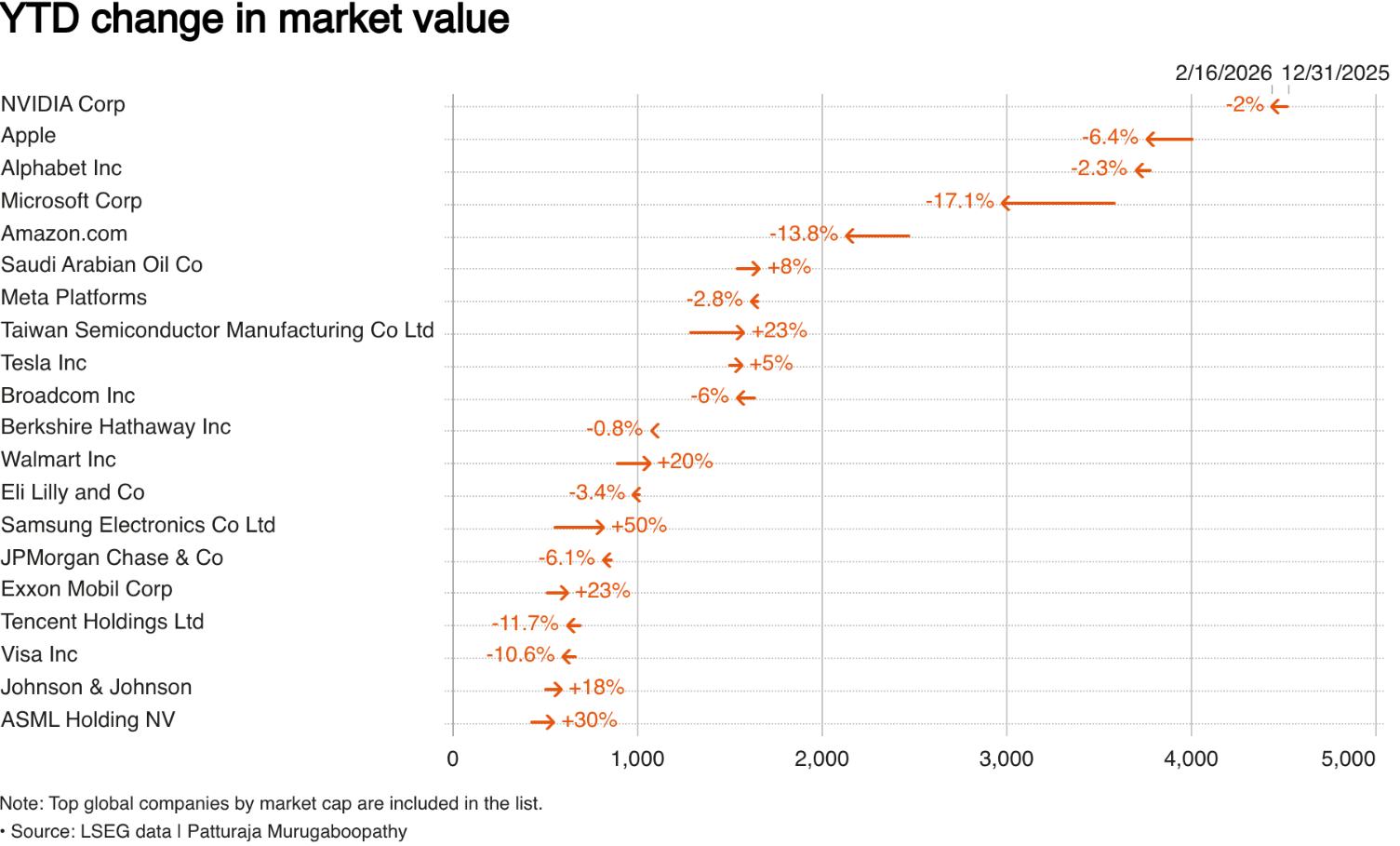
Core Viewpoint - The significant decline in the market value of major tech stocks is attributed to investor skepticism regarding the returns on massive investments in artificial intelligence, leading to a total market value loss exceeding $1.3 trillion since January 2026 [1]. Group 1: Impact on Major Tech Stocks - Microsoft has experienced a market value drop of approximately $613 billion, with its current valuation around $2.98 trillion [2]. - Amazon's market value has decreased by about $343 billion, currently valued at $2.13 trillion, reflecting a year-to-date decline of approximately 13.85% [3]. - Apple's market value has shrunk by $256.4 billion, now standing at $3.76 trillion, while Alphabet's valuation has decreased by $879.6 billion to $3.7 trillion [4]. Group 2: Investor Sentiment and Spending Concerns - Investors are increasingly focused on short-term financial transparency rather than long-term AI goals, indicating a shift in sentiment from previous speculative enthusiasm [5]. - Amazon's announcement of a projected 50% increase in capital investments this year has heightened concerns about rising costs in the AI development sector [6]. - Microsoft faces intense competition from Google's Gemini model and Anthropic's Claude Cowork AI, raising fears about profit compression and the adoption of its AI solutions [7]. Group 3: Emerging Companies - Taiwan Semiconductor Manufacturing Company (TSMC) has seen its market value increase by $293.9 billion, now valued at approximately $1.58 trillion [8]. - Samsung Electronics' market value has risen by $272.9 billion, reaching $817 billion [8]. - Walmart's market value has grown by $179.2 billion, now at $1.07 trillion, contrasting sharply with the losses of major tech stocks [8].


RadexMarkets瑞德克斯:市场全线遭遇抛售
Xin Lang Cai Jing· 2026-02-16 16:41
Market Overview - Global financial markets are experiencing significant volatility due to macroeconomic data and industry technological changes [1] - Investors are showing extreme caution ahead of key inflation data, leading to notable sell-off pressure across markets [1] - Precious metals, particularly gold and silver, have seen sharp declines, with gold dropping $160 to around $4920 per ounce and silver experiencing a double-digit percentage drop to $75 per ounce [1] Industry Impact - The impact of artificial intelligence (AI) is extending from the software sector to the logistics and transportation industry [2] - Traditional freight giants are facing severe setbacks, with Universal Logistics (ULH) down 10% and CH Robinson (CHRW) down over 14% following the announcement of AI freight scaling tools by Algorhythm Holdings (RIME) [2][5] - The technology sector is also underperforming, with Cisco Systems (CSCO) down 12% and Apple (AAPL) down 5%, contributing to a decline in the Nasdaq Composite Index [2][5] - Despite some companies seeing stock price increases of 30% due to AI announcements, the expectation of technological replacement is reshaping valuation logic and exacerbating the overall vulnerability of tech stocks [2][5] Labor Market and Monetary Policy - The latest non-farm payroll data for January shows an addition of 130,000 jobs, exceeding expectations by a factor of two, with the unemployment rate unexpectedly dropping to 4.3% [3][5] - Strong labor market data, combined with a projected year-on-year CPI inflation rate of only 2.5%, which remains above target, makes monetary policy easing unlikely in the near term [3][5] - The robust labor market and persistent inflation pressures create a closed loop, effectively blocking the possibility of the Federal Reserve initiating interest rate cuts in the short term [3][5] Future Outlook - Interest rate traders have reached a consensus that the Federal Reserve is likely to maintain interest rates in March [6] - Market confidence is expected to take time to rebuild amid multiple headwinds, including a $2 drop in oil prices due to oversupply concerns and ongoing declines in cryptocurrency [6] - As the next FOMC meeting is over a month away, the market will continue to digest inflation pressures and the industry pain caused by technological changes [6]



黄金涨3.98%、白银9.7%同步走高,这波行情背后透露了什么市场玄机?
Sou Hu Cai Jing· 2026-02-15 05:54
Group 1: Market Movements - Silver surged by 9.7% and gold by 3.98% on February 7, just a week after experiencing significant declines of 36% and over 12% respectively on January 31 [1][3] - The volatility in precious metals was not merely a technical adjustment but was triggered by the nomination of Kevin Warsh as the new Federal Reserve Chairman, leading to global liquidity fears [3][4] - The extreme price fluctuations caused chaos in the physical market, with some jewelry stores halting sales of investment silver bars due to drastic price changes [3][4] Group 2: Economic Implications - Warsh's nomination raised concerns about monetary tightening, as he advocates for both interest rate cuts and balance sheet reduction, creating a paradox in market expectations [4][9] - The narrative of "de-dollarization" has been sharply corrected, with central banks increasing gold purchases, particularly China, which bought gold for 13 consecutive months [6][11] - The silver market is facing a supply shortage, with COMEX registered inventories dropping to 103 million ounces while open interest reached 429 million ounces, indicating a mismatch that could lead to forced liquidations [6][11] Group 3: Investor Behavior - There is a sharp division in market sentiment regarding future trends, with some analysts believing in the long-term decline of U.S. debt sustainability and dollar credibility, while others see potential recovery if Warsh successfully implements his policies [8][13] - The volatility has led to significant movements in funds, with some capital flowing from precious metals to U.S. Treasuries as investors reassess liquidity risks [11][13] - The current market conditions have made it difficult for ordinary investors to navigate, with high volatility and uncertainty dominating trading strategies [13]

美银:如何理解开年全球市场?“可负担性”才是 2026 的总叙事:“主街”要赢一次,AI叙事巨变,日元是“关键”
美股IPO· 2026-02-15 00:08
Core Viewpoint - The report by Bank of America’s Michael Hartnett team indicates a significant shift in investment focus from "Wall Street elites" to "Main Street" ordinary citizens, driven by "affordability" politics under the Trump administration, leading to a rise in small-cap value stocks and pressure on tech giants [1][3]. Group 1: Market Dynamics - The current market is experiencing a historic rotation from large-cap growth stocks to small-cap value stocks, marking a significant change in asset allocation [3][5]. - The AI narrative is shifting from "AI awe" to "AI poverty," putting pressure on technology stocks as the costs associated with AI development rise [3][11]. - The correlation between the Japanese yen and the Nikkei index has turned positive for the first time since 2005, indicating a potential long-term bull market, although a rapid appreciation of the yen could trigger global deleveraging [3][17][20]. Group 2: Winners and Losers - "Main Street" assets are benefiting from inflationary pressures, with notable performances from silver (+56%), the KOSPI index (+34%), and Brazilian stocks (+30%) since October [5][8]. - Conversely, "Wall Street" wealth bubble assets are facing sell-offs, with the "Magnificent Seven" stocks down by 8% and Bitcoin plummeting by 41% [8][9]. Group 3: Future Outlook - The report suggests that the current market paradigm shift is just the beginning of a new era, with emerging markets and small-cap stocks expected to lead the next phase of growth [25][33]. - The potential for a significant policy or earnings event, such as a major tech company cutting capital expenditures, could reverse current market trends [10][14]. - The report emphasizes that the U.S. government is unlikely to allow 30-year Treasury yields to exceed 5%, which would be a critical turning point for small-cap value stocks relative to large-cap growth stocks [29][21].
特朗普对华下黑手!160%关税砸向中国,美国这次制裁,损失惨重
Sou Hu Cai Jing· 2026-02-14 14:19
Group 1 - The article discusses the impact of Trump's imposition of tariffs exceeding 160% on Chinese graphite products, which was intended to pressure China but ultimately harmed U.S. industries, particularly Tesla [1][9][22] - The U.S. market experienced a significant downturn, with the Dow Jones dropping 669 points and the Nasdaq falling by 2.03%, attributed to fears surrounding the AI bubble and ambiguous signals from the Federal Reserve [3][24] - The tariffs imposed by the U.S. Department of Commerce resulted in anti-dumping duties ranging from 93.5% to 102.72%, along with additional countervailing duties, leading to a total tax rate that far exceeded the value of the goods [9][11] Group 2 - The U.S. is heavily reliant on Chinese graphite, importing nearly 180,000 tons annually, with 59% dependency on natural graphite and 68% on synthetic graphite, indicating a lack of domestic alternatives [20][22] - The tariffs created a paradox where U.S. companies, like Tesla, faced skyrocketing raw material costs or potential production halts due to the absence of local supply chains, leading to a significant drop in Tesla's stock price [16][22] - The article highlights China's dominance in the graphite market, producing 127,000 tons in 2024, which accounted for 78% of global production, and controlling 90% of battery-grade refining capacity, making it difficult for the U.S. to establish a competitive supply chain [26][28][30]

黄金站上5000美元,美股苦笑着:这份CPI报告让市场“分裂”?
Sou Hu Cai Jing· 2026-02-14 13:00
Group 1 - The core point of the article is the mixed market reaction to the January Consumer Price Index (CPI) data, which showed a year-on-year increase of 2.4%, lower than the expected 2.5% and down from the previous 2.7% [1][2] - The CPI data revealed a significant slowdown in housing costs, with a month-on-month increase of only 0.2% and a year-on-year increase of 3%, providing relief to middle and low-income households [4] - Energy prices also saw a notable decline, with a month-on-month drop of 1.5%, including a 3.2% decrease in gasoline prices, which is seen as a positive development for the Federal Reserve [4] Group 2 - The bond market reacted immediately to the CPI data, with expectations for a rate cut in June rising from 49.9% to 83%, and some traders even anticipating three rate cuts within the year [5] - Despite the positive CPI data, concerns remain about the core CPI, which increased by 0.3% month-on-month and 2.5% year-on-year, particularly due to rising prices in services like airfare and personal care [4][5] - The divergence in market reactions is attributed to the fact that while lower interest rates are beneficial for tech companies, concerns about economic slowdown and profit growth persist, leading to declines in major tech stocks [6][7] Group 3 - Ordinary consumers may struggle to feel the impact of the reported inflation decrease, as they focus on absolute price levels rather than the rate of increase, which has accumulated significant price hikes over the years [8][9] - The article highlights the gap between macroeconomic data and individual experiences, indicating that while the CPI of 2.4% is acceptable for policy adjustments, many households still face high costs, such as a 3% increase in housing and 4% for dining out [9]

黄仁勋跌出全球富豪榜前十,黄仁勋2个月身家缩水超30亿美元
Xin Lang Cai Jing· 2026-02-14 12:24
Core Viewpoint - The article highlights the significant decline in the wealth of tech executives, particularly NVIDIA CEO Jensen Huang, who has fallen out of the top ten on the global billionaire list due to a drop in stock prices, reflecting a broader trend of investor withdrawal from the tech sector [1] Group 1: Wealth Changes - Jensen Huang's wealth has decreased by over $3 billion since the beginning of the year, bringing his total net worth to $151 billion [1] - Other tech industry billionaires have also experienced substantial losses, indicating a widespread downturn in the sector [1] Group 2: Billionaire Rankings - The Walton siblings, founders of Walmart, have entered the global top ten, collectively amassing a fortune exceeding $450 billion [1] - Despite the decline in wealth among many tech executives, Elon Musk's net worth has continued to increase [1]


跌入熊市!超10万亿“大溃败”!两大巨头,疯狂减持!
券商中国· 2026-02-14 06:02
美股风格大变局! 今年以来,Mag7杀跌惨重。微软是首家进入熊市的Mag7成员,股价于1月29日跌入熊市。截至周五收盘,微软股价较近期高点下跌27.8%。Meta可能成为下一个跌 入熊市的Mag7成员,截至周五收盘,较去年高点累跌19.6%,距离熊市的20%跌幅门槛仅差0.4%。 据券商中国记者统计,今年以来,Mag7市值皆出现了显著收缩,总市值蒸发约1.51万亿美元。 | 序号 | 证券代码 | 证券简称 | 总市值1 | 总市值1 | | | --- | --- | --- | --- | --- | --- | | | | | [交易日期] 2026-2-14 [单位] 亿元 | [交易日期] 2025-12-31 [单位] 亿元 | | | 1 | MSFT.O | 微软(MICROSOFT) | 29,800.5346 | | 35,928.1298 | | 2 | AMZN.O | 亚马逊(AMAZON) | 21.339.9492 | | 24.450.7626 | | 3 | NVDA.O | 英伟达(NVIDIA) | 44,422.8300 | | 45,319.5000 | | ব | ...