资产管理业

Search documents
专访香港证监会前主席梁定邦:重构数字金融基础设施是"必答题"
2 1 Shi Ji Jing Ji Bao Dao· 2025-11-12 23:39
Core Insights - Hong Kong's IPO financing has regained the top position globally in the first three quarters of the year, but it faces significant challenges from global financial technology advancements, particularly from the US, India, and Singapore [2] - The future development of Hong Kong's financial sector hinges on three strategic opportunities: the internationalization of the Renminbi, financial technology innovation, and the integration of the Guangdong-Hong Kong-Macao Greater Bay Area [2][17] - The current financial landscape necessitates immediate action, as delays could result in missed opportunities for Hong Kong to maintain its status as an international financial center [2][17] Financial Market Foundations - Hong Kong's financial market success is built on three pillars: the rule of law, high professional standards, and capital freedom [3][4] - The total assets of Hong Kong's banking sector are approximately ten times its GDP, with a GDP of around $400 billion and banking assets reaching $4 trillion [4] - Hong Kong is the largest offshore Renminbi center, handling about 80% of global offshore Renminbi transactions, and has a stable currency system with the Hong Kong dollar pegged to the US dollar [4] Capital Inflows and Economic Structure - Current capital inflows into Hong Kong are primarily concentrated in the stock market, with limited impact on the real estate sector [5] - The service sector constitutes over 93% of Hong Kong's GDP, indicating that capital should ideally flow into this area to benefit the real economy [5][6] - Hong Kong's GDP growth is close to 4% this year, reflecting positive trends in consumption and services, although some sectors like dining still face challenges [6] Commodity Market Development - Hong Kong has the potential to develop a commodities market, particularly in gold, due to changing dynamics in mainland Chinese enterprises and their need for an offshore trading hub [7][8] - The establishment of a gold trading infrastructure, including expanded storage facilities, positions Hong Kong as a key player in the region [7] Renminbi Internationalization - The internationalization of the Renminbi requires integration into payment systems and trade financing, with projects like mBridge facilitating cross-border payments using digital currencies [10][11] - mBridge has demonstrated economic benefits by reducing costs and increasing efficiency in commodity trading, highlighting the need for further development in trade financing systems [11] Asset Tokenization - Asset tokenization aims to streamline financial transactions by merging trading, clearing, and settlement processes into a single system, enhancing efficiency [12][13] - The successful implementation of asset tokenization in Hong Kong could position it as a leader in financial innovation, especially with the support of central bank digital currencies [12][14] Regulatory Framework and Innovation - Hong Kong's regulatory approach is characterized by a "sandbox" model, allowing for controlled experimentation with new financial technologies [15][16] - The need for a flexible regulatory framework is emphasized to balance innovation and risk management, ensuring that Hong Kong remains competitive in the fintech space [15][16] Future Opportunities and Challenges - The primary opportunity for Hong Kong lies in building a new digital capital market infrastructure through asset tokenization and central bank digital currencies [22] - Major challenges include geopolitical risks, talent competition, and the urgency to innovate in response to global advancements in financial technology [22]


英国政治风暴+预算案临近:英国资产在恐慌抛售与追捧间摇摆 通胀挂钩债券被疯抢
智通财经网· 2025-11-12 13:43
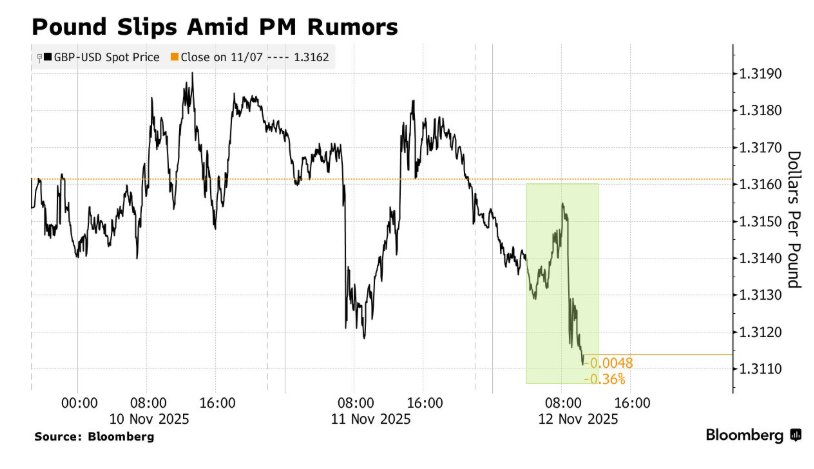
Group 1 - The latest political turmoil in the UK is negatively impacting asset performance, with increasing market volatility as a controversial budget proposal approaches [1][2] - Speculation regarding Health Secretary Wes Streeting challenging Prime Minister Keir Starmer has raised concerns among Wall Street strategists, indicating that such rumors could harm UK assets in the long term [2][4] - The British pound has depreciated by 0.4%, trading at 1.3105 USD, while the yield on 10-year UK government bonds has increased by 3 basis points [2][4] Group 2 - The upcoming budget announcement on November 26 is expected to include tax rate increases to balance the budget, which could further dampen market sentiment [2][4] - Political uncertainty is seen as detrimental to both the pound and UK government bonds, with past political missteps leading to significant market reactions [4] - The trade-weighted strength of the pound has fallen to its lowest level since January, reflecting ongoing concerns about fiscal deficits [4] Group 3 - A record demand for inflation-linked bonds has been observed ahead of the budget, alleviating some concerns about debt sustainability [6][7] - The recent issuance of inflation-linked bonds totaled £4.25 billion, with investors submitting over £69 billion (approximately $91 billion) in bids, indicating strong market interest [6][7] - The UK government bond market has shown strong performance in October, attracting major investment firms, which may provide some relief to the Chancellor [6][7]
12月是否降息?“美联储内部存在严重分歧”
第一财经· 2025-11-01 00:24
Core Viewpoint - The Federal Reserve's decision to lower interest rates by 25 basis points has created uncertainty regarding future policy directions, with Chairman Powell indicating that a December rate cut is "far from a done deal" [3][4][5]. Group 1: Federal Reserve's Decision and Internal Disagreements - The Federal Reserve's policy-making committee voted 10-2 to lower the benchmark interest rate to a range of 3.75%-4.00%, marking the first instance of "dual opposition" since 2019 [5]. - There are significant internal divisions within the Federal Reserve, with some officials expressing caution about further rate cuts due to persistent inflation concerns [6][7]. - Dallas Fed President Logan stated that unless there is clear evidence of a faster-than-expected decline in inflation or a cooling labor market, another rate cut in December is unlikely [7]. Group 2: Economic Outlook and Market Reactions - Financial markets have reduced their expectations for a December rate cut to 60%, down from over 95% earlier in the week, reflecting uncertainty in the economic outlook [10]. - Economists from Deutsche Bank, Montreal Bank, and Goldman Sachs maintain their view that the Fed will cut rates again in December, while Wilmington Trust's chief economist believes employment data will support a rate cut [11]. - Oxford Economics' senior economist noted that the likelihood of a recession in the next 12 months remains low, suggesting that inflation risks will weigh more heavily in the Fed's policy considerations moving forward [12].

地区联储“倒戈”!分歧或进一步显现,美联储12月如何抉择
Di Yi Cai Jing· 2025-10-31 22:53
Core Views - The Federal Reserve's decision to lower the benchmark interest rate by 25 basis points has led to internal divisions among its members, with some advocating for maintaining the current rate and others pushing for a more aggressive reduction [2][3][4]. Summary by Sections Interest Rate Decision - The Federal Reserve voted 10-2 to lower the benchmark interest rate to a range of 3.75%-4.00%, marking the first instance of "dual dissent" since 2019 [2]. - Kansas City Fed President Jeff Schmid argued for maintaining the current rate, citing a balanced labor market and potential long-term negative impacts on inflation if the Fed's commitment to the 2% target is questioned [2]. Internal Divisions - Several regional Fed presidents expressed skepticism about the need for further rate cuts, emphasizing the ongoing inflation risks and the need for clear evidence of economic downturns before making such decisions [3][4]. - Dallas Fed President Lorie Logan stated that unless there is clear evidence of faster-than-expected inflation decline or a cooling labor market, the likelihood of another rate cut in December is low [3]. Market Expectations - Market expectations for a rate cut in December have dropped significantly from over 95% to around 60%, reflecting uncertainty due to government shutdowns and missing economic data [6]. - Economists from Deutsche Bank, Montreal Bank, and Goldman Sachs still believe a rate cut will occur in December, while others argue that the current economic indicators do not support such a move [6][7]. Future Considerations - The upcoming public speeches from Fed officials will be crucial in setting the tone for the December meeting, as their views may influence the market's assessment of future rate cuts [5]. - Analysts suggest that the threshold for further rate cuts may be higher than previously anticipated, requiring more substantial evidence to justify such actions [7].
避险潮再起 美债收益率跌幅全线扩大
Zhi Tong Cai Jing· 2025-10-17 07:20
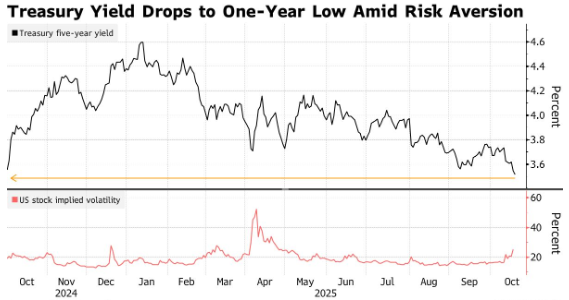
Group 1 - US Treasury prices continue to rise, with mid-term yields dropping to their lowest point in a year due to concerns over regional bank failures and ongoing trade tensions, prompting investors to seek safe-haven assets [1][2] - The 5-year US Treasury yield decreased by 4 basis points to 3.51%, the lowest level since early October 2024, while the 2-year yield fell to levels not seen since 2022, and the benchmark 10-year yield dropped below 4% [1][2] - Spot gold prices reached a historical high of $4,380, reflecting heightened demand for gold as a safe-haven asset during periods of political and economic turmoil [1] Group 2 - Concerns over problematic loans disclosed by two regional US banks have intensified fears of a broader crisis, leading to a surge in demand for US Treasuries as part of a global risk-off trend [2] - The US fiscal deficit and trade tensions have further weakened risk sentiment, with the 10-year Australian Treasury yield falling to 4.09%, the lowest since early April, and Japanese Treasury yields also declining [2] - Recent comments from Federal Reserve officials have supported the bond market, reinforcing expectations for more accommodative policies, with indications of potential rate cuts of 25 basis points [2]
海外宏观周报:全球避险情绪升温-20251013
Ping An Securities· 2025-10-13 03:20
Market Overview - Global financial markets experienced increased volatility, with US and European stocks declining while gold, US Treasuries, and the US dollar index rose[2] - On October 10, the S&P 500 index fell nearly 3% due to Trump's tariff threats, resulting in a weekly decline of 2.4%[2] - The Stoxx 600 index in Europe dropped 1.25% on the same day, with a weekly decline of 1.1%[2] Economic Policies - In the US, President Trump indicated plans to cut federal projects favored by Democrats amid a government shutdown stalemate, with permanent layoffs of federal employees confirmed[3] - The Federal Reserve's September meeting minutes showed a willingness for further rate cuts, with a 98.3% probability of a 25 basis point cut in October[3][7] - The Michigan consumer confidence index for October slightly decreased to 55, a five-month low, but still above market expectations[3][5] Asset Performance - US Treasury yields fell across all maturities, with the 10-year yield down 8 basis points to 4.05%[14] - Brent and WTI crude oil prices fell by 2.8% and 3.3%, respectively, closing at $62.7 and $58.9 per barrel[17] - Gold prices rose by 2.3% to $3974.5 per ounce, while silver increased by 6.6% to $50.8 per ounce[17] Currency Movements - The US dollar index rose by 1.13% to 98.82, while the euro and yen fell by 1.01% and 2.42%, respectively[19] - The Chinese yuan depreciated slightly against the dollar, closing at 7.1232[19]
法国危机再次暴露市场焦虑,欧元区金融稳定面临考验
Xin Hua Cai Jing· 2025-10-11 06:26
Core Viewpoint - The political uncertainty in France has intensified, leading to significant market volatility and raising concerns about the sustainability of France's fiscal situation and the overall stability of the Eurozone [1][2][6]. Market Reactions - Following Prime Minister Le Maire's resignation, the French CAC 40 index dropped by 1.36%, falling below the 8000-point mark, while the 10-year government bond yield surged to 3.61%, a recent high [2][4]. - The spread between French and German 10-year bonds widened to 88 basis points, up from approximately 50 basis points before the political turmoil, indicating increased risk perception [2][6]. - The euro depreciated against the dollar, reflecting investors' reassessment of political risks in France [2][7]. Economic and Fiscal Pressure - The French economy is projected to grow only 0.8% in 2025, significantly below the Eurozone average, with consumer and business confidence declining [4][5]. - The French Ministry of Finance anticipates a fiscal deficit of 5.4% of GDP in 2025, exceeding the EU's 3% limit, with warnings that the deficit must be reduced to at least 4.8% by 2026 to avoid uncontrolled debt levels [4][5]. - The dissolution of the National Assembly in June 2024 is estimated to have caused an economic loss of approximately €40 billion, including €29 billion in tax revenue losses [4][5]. Implications for Eurozone Stability - The volatility in the French bond market has raised concerns about "financial fragmentation" within the Eurozone, potentially prompting the European Central Bank (ECB) to consider intervention measures [6][8]. - Analysts suggest that if the bond market instability continues, it could threaten the ECB's control over overall financial conditions, necessitating intervention even if strict criteria are not met [6][8]. - The political risk in France is viewed as a critical variable affecting the financial order of the Eurozone, with potential implications for the euro's value and overall market confidence [6][8]. Investment Strategies - Asset management firms have been adjusting their portfolios, reducing exposure to French government bonds while strategically navigating short-term market fluctuations [2][3]. - The focus has shifted towards Spain and Italy as investment priorities due to the ongoing political instability in France [3][4]. - Market participants remain cautious, with a notable increase in risk premiums, while stock investors are adopting a wait-and-see approach regarding political developments [8].
【财经分析】法国危机再次暴露市场焦虑 欧元区金融稳定面临考验
Xin Hua Cai Jing· 2025-10-11 00:54
Core Viewpoint - France's political uncertainty has intensified, leading to significant market volatility and raising concerns about the sustainability of its fiscal policies and overall market confidence [1][2][8] Market Reactions - Following Prime Minister Le Maire's resignation, the French CAC 40 index dropped by 2.1% intraday and closed down 1.36%, falling below 8000 points [2] - The yield on French 10-year government bonds surged to 3.61%, a recent high, before slightly retreating to 3.57% [2] - The euro to dollar exchange rate fell to 1.165, indicating a rapid reassessment of political risks by investors [2] Bond Market Dynamics - The spread between French and German 10-year bonds widened to 88 basis points, up from approximately 50 basis points before the political turmoil [2] - Asset management firms like Candriam have adjusted their strategies, maintaining positions in French bonds despite the increased risk premium [2][3] Economic and Fiscal Pressures - The French economy is projected to grow only 0.8% in 2025, significantly below the Eurozone average, with consumer and business confidence declining [4] - The French Ministry of Finance anticipates a fiscal deficit of 5.4% of GDP in 2025, exceeding the EU's 3% limit [4][5] - The dissolution of the National Assembly is estimated to have caused an economic loss of approximately €40 billion, including €29 billion in tax revenue losses [4] Implications for the Eurozone - The volatility in the French bond market raises concerns about "financial fragmentation" within the Eurozone, potentially prompting the European Central Bank (ECB) to intervene [6][8] - Analysts suggest that if the political situation does not stabilize, the risk premium on Eurozone bonds may increase systematically [6][8] Investor Sentiment - Investors are cautious, with bond investors remaining vigilant and equity investors adopting a wait-and-see approach regarding political developments [8] - The potential for early elections and ongoing fiscal challenges could suppress investor interest in the euro [7][8]
黄金与白银领跑 瑞郎与比特币上位 日元“避险光环”褪色
智通财经网· 2025-10-09 02:32
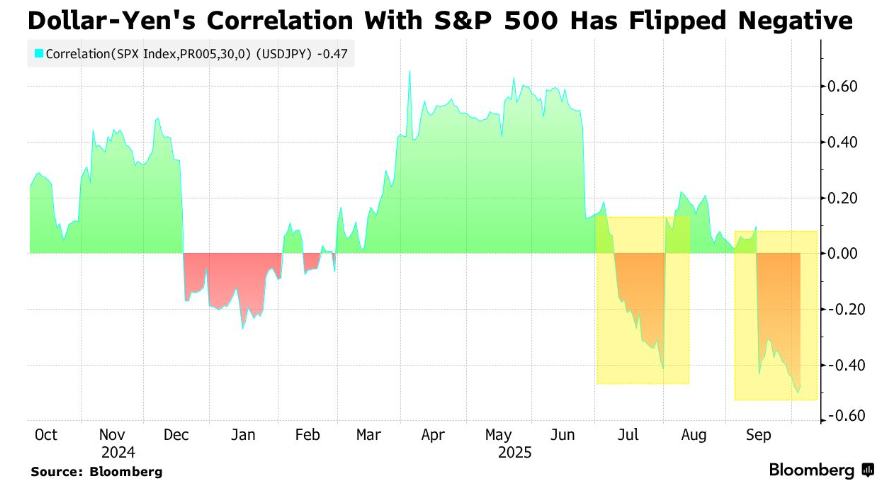
Core Viewpoint - The Japanese yen is increasingly losing its status as a reliable safe-haven asset amid rising skepticism in the market, leading to a significant depreciation trend against the US dollar, reaching an eight-month low [1][2]. Group 1: Yen's Current Status - The yen's traditional role as a safe-haven currency is being questioned due to Japan's unique financial environment and political uncertainties, prompting investors to seek alternative hedging options like gold, silver, and the Swiss franc [1][2][5]. - The recent political developments, including the unexpected victory of a conservative candidate in Japan's ruling party election, have further exacerbated the yen's depreciation, with the exchange rate surpassing the critical 150 mark against the dollar [2][5]. - Historical patterns of yen appreciation during market turmoil are no longer reliable, as the yen has shown a negative correlation with the S&P 500 index during periods of risk asset sell-offs [2][5]. Group 2: Market Sentiment and Investment Strategies - Investors are increasingly reducing their net long positions in the yen, with a nearly 40% cut in net long positions by global asset managers since late April, while hedge funds are predominantly shorting the yen [6][8]. - Alternative hedging options, such as the Swiss franc, are gaining traction among professional traders, with the franc showing more reliable and cost-effective hedging properties compared to the yen [8]. - Gold has surged over 54% this year, driven by global uncertainties, and is viewed as a more favorable investment compared to the yen, with top investment firms predicting further increases in gold prices [8][9]. Group 3: Long-term Outlook for the Yen - Despite the current challenges, the yen's long-term appeal as a defensive asset is not entirely diminished, as market expectations regarding the Bank of Japan's interest rate policies continue to influence its value [9][10]. - The recent "Kishida trade" reflects market speculation on renewed fiscal stimulus and monetary easing under the new leadership, which has led to increased volatility in the financial markets [9][10]. - The yen's reliability as a safe-haven currency is being undermined by its increasing susceptibility to speculative capital flows, indicating a shift away from its historical role [9][10].
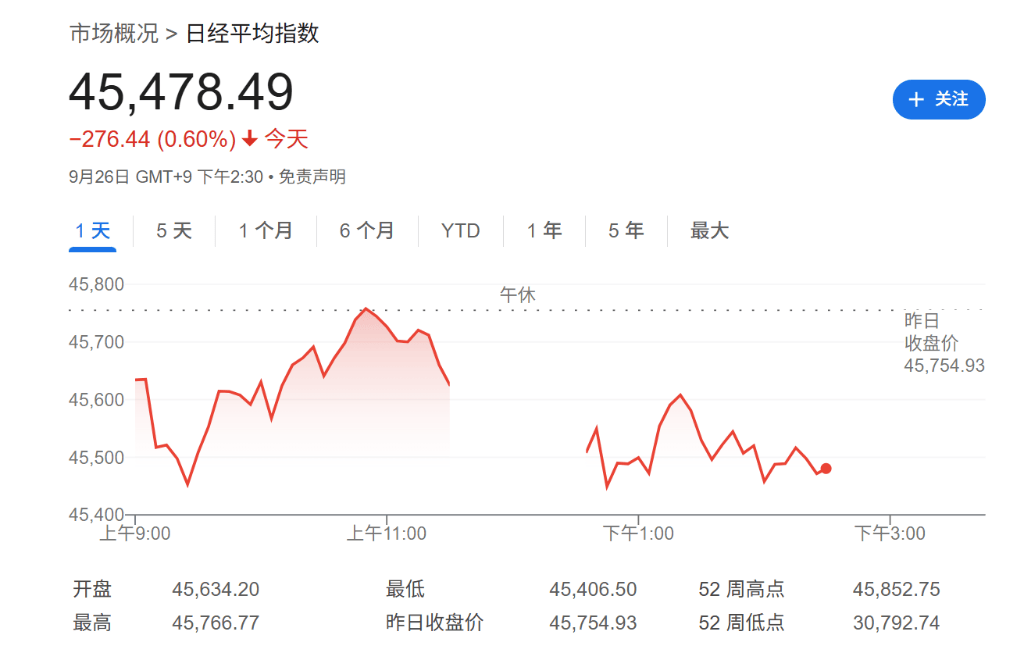
特朗普新关税威胁,亚洲股市集体下挫,韩国首尔综指跌逾2%,金银回调
Sou Hu Cai Jing· 2025-09-26 06:44
Group 1: Tariff Announcement and Market Reaction - President Trump announced a new round of tariffs on various imported products, effective October 1, including 50% on kitchen cabinets and bathroom sinks, 30% on imported furniture, and 100% on patented and branded drugs [1] - The announcement triggered a risk-off sentiment in global markets, with major Asian stock indices declining, particularly Japan and South Korea [1][2] - The new tariffs added uncertainty to an already tense market environment, as investors were closely monitoring upcoming inflation reports for clues on future interest rate movements [1] Group 2: Impact on Asian Markets - The Nikkei 225 index in Japan fell approximately 0.6% to 45,478 points, with significant declines in pharmaceutical stocks, including a 5.2% drop for Sumitomo Pharma and a 3.9% drop for Chugai Pharmaceutical [2] - The South Korean KOSPI index dropped 2.5% to 3,384.58 points, marking its third consecutive day of decline amid growing concerns over prolonged tariff negotiations with the U.S. [4] - Other markets showed weakness, with the Indian BSE Sensex index down 0.7%, while the Australian S&P/ASX 200 index managed a slight increase of 0.2% [4] Group 3: U.S. Market Performance - U.S. stock markets experienced a three-day decline prior to Trump's tariff announcement, primarily due to stronger-than-expected economic data that raised doubts about the Federal Reserve's future rate cuts [4] - The strong economic performance has led to skepticism regarding the continuation of rate cuts, which have been a significant driver of U.S. stock market gains this year [4] - The U.S. dollar index decreased by 0.1% to 98.36, while the euro rose by 0.1% to 1.1680 [4] Group 4: Oil Market Dynamics - Despite the overall market downturn, oil prices rose, with Brent crude futures reaching $69.67 per barrel and West Texas Intermediate crude up 0.3% to $64.59 per barrel [9] - The increase in oil prices was driven by geopolitical tensions and an unexpected decline in U.S. crude oil inventories, pushing benchmark prices to their highest levels since August 1 [12]