
银行理财

Search documents
今年首月理财“开门红”缺席
Di Yi Cai Jing Zi Xun· 2026-02-11 20:58
Core Viewpoint - The banking wealth management market in January 2026 did not experience the traditional "opening red" seasonality, with a decrease in scale instead of growth, indicating a structural adjustment period ahead for the market [2][3]. Group 1: Market Performance - In January 2026, the banking wealth management market saw a decline of 178.8 billion yuan, bringing the total scale to 33.18 trillion yuan, which is a month-on-month decrease of 1.142 trillion yuan [3]. - The decline in January is notable as it contrasts with the seasonal growth observed in previous years, except for the significant drop in 2023 due to a "redemption wave" [3]. - Among the 14 wealth management companies with over 1 trillion yuan in management scale, the total scale decreased by approximately 122.2 billion yuan, marking a second consecutive month of decline [3]. Group 2: Product Issuance and Performance - The issuance of new wealth management products decreased, with 2,533 new products launched in January, down by 305 from the previous month [4]. - The average performance benchmark for newly issued products slightly decreased by 0.01 to 0.02 percentage points, with open-ended and closed-end products yielding 1.82% and 2.36%, respectively [4]. - Despite the scale decline, the net value of pure debt wealth management products maintained positive growth, although the growth rate has narrowed [4]. Group 3: Reasons for Scale Reduction - The decline in January's wealth management scale is attributed to several factors, including the inertia of the year-end return effect and increased cash demand from residents as the Spring Festival approaches [6]. - Banks' internal resource allocation has shifted focus towards loan and deposit marketing, which has temporarily weakened wealth management sales [6]. - Market sentiment has also shifted, with some funds reallocating towards equity assets due to improved stock market conditions [6]. Group 4: Institutional Responses - Wealth management companies are adjusting by reducing fees to enhance product competitiveness, with some institutions lowering management and service fees to zero for certain products [8]. - There is a noticeable acceleration in product innovation, with companies exploring diverse strategies to enhance returns, such as participating in A-share IPOs and launching new multi-asset products [8]. - The trend of refined management is emerging, with companies considering third-party valuation tools to smooth net value fluctuations and developing regular dividend products to enhance investor experience [9]. Group 5: Market Outlook - Analysts maintain a cautiously optimistic outlook, predicting a potential rebound of approximately 1 trillion yuan in February, with an overall annual growth forecast of around 3 trillion yuan [9]. - The release of maturing deposits and sustained low deposit rates are expected to channel funds into wealth management and insurance products [9]. - However, it is noted that deposits remain the primary choice for residents, indicating that growth in the wealth management market may stem more from structural shifts rather than an overall increase in risk appetite [9].


银行理财1月份规模狂掉1万亿?一定要高度重视背后的影响
Xin Lang Cai Jing· 2026-02-11 15:24
Core Viewpoint - The significant drop in the scale of bank wealth management products in January indicates a major shift in the industry, reflecting a healthy correction of inflated growth driven by unsustainable business models [1][4][26]. Group 1: Industry Scale Changes - In January, the scale of 14 leading bank wealth management subsidiaries decreased by over 800 billion, accounting for approximately 75% of the total wealth management industry scale, which was over 33 trillion at the end of 2025 [1][25]. - The total industry scale is estimated to have dropped by over 1 trillion in January, marking a substantial decline compared to previous years where the scale remained relatively stable [3][25]. Group 2: Business Model Implications - The decline in scale is seen as a necessary adjustment, as the previous growth was largely fueled by "retained earnings" and "ranking models," which artificially inflated yield levels [4][27]. - The end of the "ranking model" signifies a downward adjustment in the yield of pure debt wealth management products, which will lower the actual risk-free rate for Chinese residents and potentially increase the valuation of all risk assets [5][28]. Group 3: Future Industry Dynamics - The shift away from old business models necessitates a focus on research capabilities, product line structuring, and channel service improvements, leading to a transformation in wealth management product structures [5][28]. - The rise of multi-asset wealth management products indicates a growing trend towards diversification and a need for wealth management firms to adapt to changing market conditions [5][28]. Group 4: Market Environment - The low interest rate environment is pushing the industry towards a multi-asset investment approach, emphasizing the importance of asset allocation for both investment advisors and individual investors [5][29]. - The current market dynamics suggest that firms lacking the ability to provide effective asset allocation will struggle to remain competitive in the evolving landscape [5][29].
今年首月理财“开门红”缺席
第一财经· 2026-02-11 14:57
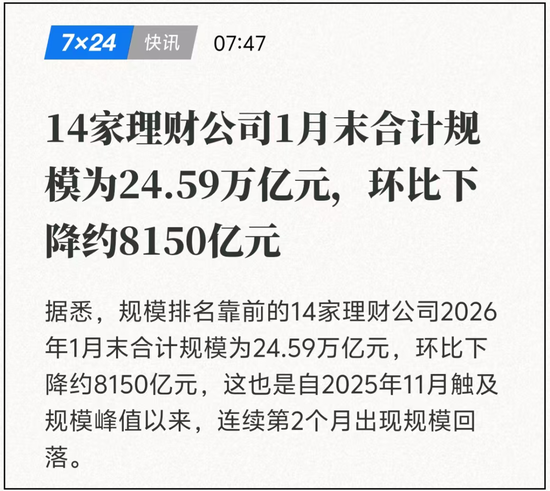
2026.02. 11 在往年春节前后往往迎来季节性扩张的银行理财市场,2026年开年却显得克制。 多家机构数据显示,1月银行理财规模不增反降,未现传统意义上的"开门红"。规模波动背后,是资 金在存款、理财、保险与权益资产之间的再平衡,也是理财公司在费率、产品与投资策略层面的主动 调整。业内人士认为,随着到期存款陆续释放,理财市场或进入新一轮结构调整期,全年规模有望增 长3万亿元左右。 1月理财规模缩减千亿 多家市场机构测算的数据显示,2026年首月,银行理财市场未现"开门红"。华西证券发布的数据显 示,今年1月份最后一周(1月26日至1月30日),银行理财规模再度承压至33.18万亿元,环比下 降1788亿元。从全月看,在去年12月理财规模回表约5100亿元的背景下,今年1月并未如市场预期 般回升,而是延续缩量态势,月度环比下降1142亿元。 回溯近四年数据,除2023年受"赎回潮"冲击出现大幅下滑外,2022年至2025年1月理财规模大多 呈季节性增长。今年1月的回落因此显得颇为反常。 从机构层面看,不同理财公司规模出现分化。Wind数据显示,截至2026年1月末,管理规模超万亿 元的14家银行理财公司( ...

银行理财1月份规模狂掉1万亿?一定要高度重视背后的影响
表舅是养基大户· 2026-02-11 13:35
Core Viewpoint - The significant drop in the scale of bank wealth management products in January indicates a major shift in the industry, suggesting that the previous growth was unsustainable and that a transformation in business models is necessary [1][6]. Group 1: Industry Scale Changes - In January, the scale of 14 leading bank wealth management subsidiaries decreased by over 800 billion, which represents approximately 75% of the total wealth management industry scale, indicating a total industry drop of over 1 trillion [1][3]. - The scale drop of 1 trillion is substantial, especially when compared to a decrease of over 1200 billion in January 2024 and an increase of about 500 billion in January 2025, highlighting a significant shift in investor behavior [3]. Group 2: Business Model Transformation - The release of retained earnings and the end of the "ranking" business model for wealth management companies signal a need for a focus on research capabilities, product line layout, and channel service capabilities [4][7]. - The competition landscape in the wealth management industry is expected to undergo drastic changes, with a shift away from unsustainable business practices towards more robust investment strategies [5][7]. Group 3: Market Implications - The decline in wealth management scale reflects a healthy adjustment in the industry, as it removes inflated growth driven by unsustainable practices [6]. - The end of the previous business model will lead to a decrease in pure debt wealth management yields, which will lower the actual risk-free rate for Chinese residents, potentially increasing the valuation of risk assets [7]. - The transition in wealth management is not just a change for wealth management subsidiaries but requires a comprehensive transformation across management and sales channels [7]. Group 4: Investment Strategy Recommendations - The current low-interest-rate environment necessitates a multi-asset investment approach, emphasizing the importance of asset allocation for both investment advisors and individual investors [7][8]. - The rise of multi-asset wealth management products indicates a shift in investor preferences, with a significant increase in the allocation towards fixed income and public funds [7].

银行理财发行产品环比减少45款,宁银理财获配电科蓝天新股
Xin Lang Cai Jing· 2026-02-11 13:05
Group 1 - The issuance of bank wealth management products has decreased recently, with a total of 633 new products launched last week, a decrease of 45 products compared to the previous week [1][8] - The performance benchmarks for newly issued products have declined, with both open-ended and closed-end products experiencing a drop [2][9] - The average performance benchmark for open-ended products was 1.79%, down 0.05 percentage points, while closed-end products had an average benchmark of 2.35%, down 0.03 percentage points [3][10] Group 2 - As of February 11, there were 40,898 existing wealth management products in the market, with fixed-income products making up 93.05% of the total [4][11] - The average annualized yield for existing open-ended fixed-income wealth management products (excluding current management) was 2.61%, down 0.68 percentage points from the previous month [4][11] Group 3 - Ningyin Wealth Management successfully participated in the IPO of the commercial aerospace company "Electric Science Blue Sky," with six products allocated shares, achieving a first-day closing increase of 596% [7][14] - The company has participated in 45 new stock subscriptions with a high allocation rate of 91%, accumulating over 18 million yuan in allocated funds [7][14] - Wealth management funds are increasingly participating in stock subscriptions as a means to achieve excess returns and expand into the equity market [7][14][15]

规模缩水千亿,今年首月理财“开门红”缺席
Di Yi Cai Jing· 2026-02-11 12:51
Core Viewpoint - The banking wealth management market is experiencing a contraction in January 2026, with expectations for a rebound of approximately 1 trillion yuan in February, driven by the release of maturing deposits and a structural adjustment in the market [1][7]. Group 1: Market Performance - In January 2026, the banking wealth management scale decreased by 178.8 billion yuan, reaching 33.18 trillion yuan, marking a month-on-month decline of 1.142 trillion yuan [2]. - The decline in January is notable as it contrasts with the seasonal growth typically observed in previous years, where the market usually sees a "New Year opening" boost [2][4]. - The top 14 wealth management companies, managing over 1 trillion yuan, saw a combined scale decrease of approximately 122.2 billion yuan, continuing a downward trend for the second consecutive month [2]. Group 2: Product Issuance and Performance - The issuance of new wealth management products in January 2026 fell to 2,533, a decrease of 305 from the previous month, with average performance benchmarks slightly adjusted downwards [3]. - Despite the scale contraction, the net value of pure debt wealth management products maintained positive growth, indicating stability in product performance [3]. - The average annualized yield for open-ended fixed-income wealth management products rose to 3.00%, an increase of 1.29 percentage points month-on-month [3]. Group 3: Reasons for Contraction - The decline in wealth management scale is attributed to several factors, including the inertia of year-end balance sheet effects and increased cash demand from residents as the Spring Festival approaches [4]. - Banks are focusing on loan and deposit marketing strategies, which has temporarily weakened wealth management sales [4]. - Market sentiment has shifted towards equities, diverting funds away from wealth management products [4][5]. Group 4: Company Responses - Wealth management companies are responding to scale pressures by reducing fees and innovating product offerings to enhance competitiveness [6]. - Several institutions have lowered management and service fees, with some products even reaching "zero fee" status to attract investors [6]. - Companies are also exploring diverse investment strategies, including participation in A-share IPOs and launching new product lines to adapt to market conditions [6]. Group 5: Future Outlook - Analysts express cautious optimism for February, predicting a potential recovery of around 1 trillion yuan in wealth management scale, with an overall annual growth expectation of approximately 3 trillion yuan [7]. - The historical trend indicates that wealth management scales typically experience fluctuations around the Spring Festival, with a rebound expected post-holiday as liquidity returns to the market [7].
2026年1月银行理财市场月报:银行理财大事记:理财市场降费潮又起,中小银行代销路谋新
HWABAO SECURITIES· 2026-02-11 12:24
Investment Rating - The report indicates a positive outlook for the banking wealth management industry, highlighting a new wave of fee reductions and innovative strategies among institutions [4]. Core Insights - The banking wealth management market has seen a significant increase in scale, reaching 33.29 trillion yuan by the end of 2025, with a structural shift towards fixed-income products and an expansion of mixed-asset offerings [4][12]. - The average yield of wealth management products has dropped below 2% for the first time, reflecting a challenging market environment influenced by declining interest rates and increased competition [12][18]. - Regulatory changes, including the implementation of new public fund sales regulations, aim to lower investor costs and promote long-term investment strategies [4][12]. Summary by Sections Market Overview - As of January, the total market size of wealth management products was 31.57 trillion yuan, a slight decrease of 0.10% month-on-month but an increase of 5.75% year-on-year [5][10]. - The average annualized yield for wealth management products was reported at 1.98%, marking a significant decline from previous years [12][18]. Product Dynamics - The new issuance of wealth management products in January saw an increase, maintaining a focus on three main characteristics: fixed-income plus products, closed-end products, and 1-3 year term products [6][12]. - The closed-end product compliance rate reached 86.66%, while the open-end product compliance rate was 66.53%, both showing improvements from the previous month [6][12]. Regulatory and Industry Developments - The report highlights a new wave of fee reductions across the industry, with many institutions lowering management and service fees to enhance product attractiveness [4][12]. - The introduction of the new public fund sales regulations is expected to provide greater flexibility in fee structures, benefiting the bond market and indirectly supporting the wealth management sector [12][18]. Innovation and Strategic Shifts - Institutions are increasingly focusing on innovative strategies, such as the introduction of new product types and enhanced investor engagement through technology [4][12]. - The report notes that smaller banks are shifting towards a distribution model to adapt to regulatory pressures and market dynamics, emphasizing the importance of channel partnerships [12][18].
银行理财周度跟踪:理财掘金商业航天打新,“套利+”捕捉高确定性收益
HWABAO SECURITIES· 2026-02-11 12:24
Investment Rating - The report does not explicitly provide an investment rating for the industry or specific companies [1]. Core Insights - The report highlights the increasing focus on bank wealth management products, particularly in the context of commercial aerospace investments and the introduction of new "arbitrage+" strategies aimed at capturing high certainty returns [4][10]. - The performance of cash management products remains stable, with a near 7-day annualized yield of 1.28%, while money market funds saw a slight increase to 1.17% [13][15]. - The report notes a rise in the net loss ratio of bank wealth management products to 0.96%, indicating a potential increase in redemption pressure if the credit spread continues to widen [21][24]. Summary by Sections 1. Industry Innovation Dynamics - Ningyin Wealth Management successfully participated in the IPO of "Electric Science Blue Sky," which saw a first-day closing increase of 596%, with six of its products included in the allocation [10]. - Su Yin Wealth Management launched the "arbitrage+" series of wealth management products, focusing on short holding periods of 45 and 100 days, utilizing pricing discrepancies across various markets to generate returns [12]. 2. Yield Performance - Cash management products recorded a near 7-day annualized yield of 1.28%, remaining stable compared to the previous week, while money market funds increased to 1.17% [13][15]. - The yields of pure fixed income and fixed income+ products generally declined, influenced by various market factors including weaker PMI data and increased risk aversion [16][18]. 3. Net Loss Ratio Tracking - The net loss ratio for bank wealth management products increased to 0.96%, up by 0.38 percentage points, with a widening credit spread of 0.06 basis points [21][24].
收益7303亿元!理财市场晒出年度“成绩单”
Xin Lang Cai Jing· 2026-02-11 12:19
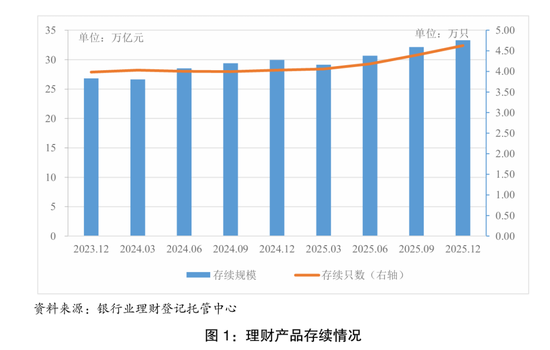
来源:金融时报 近日,银行业理财登记托管中心发布《中国银行业理财市场年度报告(2025年)》。报告显示,截至 2025年末,理财市场存续规模达33.29万亿元,较年初增长11.15%;理财产品全年为投资者创造收益 7303亿元,平均收益率为1.98%。更多投资者进入银行理财市场"掘金",截至2025年末,持有理财产品 的投资者数量已达1.43亿个,较年初增长14.37%。 规模与投资者数量双增 截至2025年末,银行理财市场存续规模33.29万亿元,较年初增长11.15%。其中理财公司存续产品只数 3.37万只,存续规模30.71万亿元,较年初增加16.72%,占全市场的比例达到92.25%。 "存款持续降息后理财产品具备性价比优势;存续浮盈释放也支撑产品业绩、投资者实际体感仍较好, 共同支撑理财行业景气度。"对此,中金公司研究表示。 从资产配置情况看,2025年理财产品资产配置以固收类为主,投向债券类、非标准化债券类资产、权益 类资产余额分别为18.52万亿元、1.82万亿元、0.66万亿元,分别占总投资资产的51.93%、5.10%、 1.85%。 持有理财产品的投资者数量达到1.43亿个,14.37%的 ...
2026年1月银行理财市场月报:银行理财大事记:理财市场降费潮又起,中小银行代销路谋新-20260211
HWABAO SECURITIES· 2026-02-11 11:34
Investment Rating - The report does not explicitly provide an investment rating for the banking wealth management industry Core Insights - The banking wealth management market is experiencing a new wave of fee reductions, with many institutions lowering management and sales service fees to enhance product attractiveness [4][12] - As of January 2026, the total scale of the banking wealth management market reached 33.29 trillion yuan, with a structural dominance of fixed-income products and an expansion of mixed products [4][12] - The average yield of wealth management products has fallen below 2% for the first time, indicating significant pressure on returns [12][18] Summary by Sections Market Overview - In January 2026, the total scale of wealth management products was 31.57 trillion yuan, a slight decrease of 0.10% month-on-month but an increase of 5.75% year-on-year [5][10] - The average annualized yield for cash management products was recorded at 1.28%, down 7.45 basis points month-on-month, while pure fixed-income products saw an annualized yield of 2.67%, up 0.55 percentage points [5][10] New Product Issuance - The issuance of new wealth management products in January increased, maintaining three main characteristics: dominance of fixed-income plus products, closed-end products, and 1-3 year term products [6][8] - The performance benchmark for newly issued wealth management products showed a trend of divergence in adjustments [6][8] Regulatory and Industry Dynamics - The implementation of new public fund sales regulations aims to lower investor costs and promote long-term investment, with a focus on reducing redemption fees and extending transition periods [4][12] - The report highlights a trend of "fee reduction" among wealth management companies, driven by competitive pressures and the need to attract funds amid declining deposit rates [12][18] Asset Allocation Trends - The report indicates a shift in asset allocation towards increased investments in public funds and bank deposits, with public fund investments reaching 1.82 trillion yuan, accounting for 5.10% of the total [12][18] - The proportion of bond assets in wealth management allocations has decreased, with credit bonds and interbank certificates of deposit seeing significant declines [12][18] Innovation and Market Adaptation - Wealth management companies are actively exploring new strategies, such as the introduction of innovative products like "micro-wave fixed income" strategies and participation in IPOs to capture opportunities in the technology sector [4][12][18] - The report notes that some wealth management products are using short-term high yields as a strategy to attract investments, which may raise regulatory concerns [12][18]