锂离子电池制造

Search documents
税收数据显示:2025年我国科技创新与产业创新融合发展加快
Yang Shi Xin Wen· 2026-01-27 03:30
Group 1 - The core viewpoint of the articles highlights the accelerated integration of technological innovation and industrial innovation in China by 2025, showcasing significant growth in strategic emerging industries and advancements in technology transfer [1][2] Group 2 - Strategic emerging industries are experiencing robust growth, with high-tech industry sales revenue projected to increase by 13.9% year-on-year in 2025. High-tech manufacturing and high-tech service sectors are expected to grow by 10.1% and 16.6% respectively [1] - Key sectors such as lithium battery manufacturing, service robots, industrial robots, and biopharmaceuticals are showing remarkable sales growth, with increases of 25.1%, 60.7%, 17.4%, and 7.7% respectively [1] Group 3 - The conversion of scientific and technological achievements is gaining momentum, with sales revenue in the scientific research and technical service industry expected to rise by 20.4% year-on-year in 2025. Knowledge-intensive industries are projected to see a 10.7% increase in sales revenue [1] - The national technology contract transaction amount is anticipated to grow by 19.1%, indicating a stronger application of technological achievements [1] Group 4 - The integration of digital technology with the real economy is deepening, with core digital economy industries expected to see a sales revenue increase of 9.4% in 2025. Digital product manufacturing and digital technology application sectors are projected to grow by 9.4% and 13.8% respectively [2] - Enterprises are increasing their procurement of digital technology, with a year-on-year growth of 9.6%, and manufacturing sector procurement expected to rise by 10.4% [2] Group 5 - Traditional industries are accelerating their transformation and upgrading, particularly in automation, with significant increases in procurement of automation equipment in sectors like petrochemicals, steelmaking, and ironmaking, showing growth rates of 17.3%, 11.7%, and 12.7% respectively [2]
增长5.5% 全省经济运行稳中有进
Si Chuan Ri Bao· 2026-01-22 00:22
Group 1: Agricultural Production - The overall grain production reached 36.625 million tons, an increase of 0.8% compared to the previous year [2][3] - The total number of pigs slaughtered was 62.48 million, reflecting a growth of 1.6% year-on-year [2] Group 2: Industrial Economy - The industrial added value above designated size grew by 6.5% year-on-year, with a product sales rate of 96.1% [2][4] - Among 41 major industries, 33 reported an increase in added value [2] - Key industrial products showed significant growth: natural gas production increased by 10.9%, industrial robots by 45.9%, lithium-ion batteries by 45.1%, automobiles by 29.6%, LCD screens by 21.6%, integrated circuits by 15.4%, and smartwatches by 9.2% [2] Group 3: High-Tech Industry - The added value of high-tech manufacturing above designated size increased by 12.3% year-on-year [3] - Notable growth in specific sectors: electronic and communication equipment manufacturing increased by 20.2%, and aerospace and equipment manufacturing grew by 19.0% [3] Group 4: Service Industry - The added value of the service industry grew by 6.1% year-on-year [3] - Growth in specific service sectors: leasing and business services increased by 14.4%, information transmission, software, and IT services by 9.8%, wholesale and retail by 7.0%, financial services by 6.2%, and accommodation and catering by 5.3% [3] Group 5: Consumer Market - The total retail sales of consumer goods reached 2,913.54 billion yuan, an increase of 5.1% year-on-year [4] - Breakdown of retail sales: catering revenue was 402.67 billion yuan (up 3.7%), and commodity retail was 2,510.87 billion yuan (up 5.4%) [4] - Significant growth in specific product categories: telecommunications equipment retail increased by 50.8%, gold and jewelry by 32.6%, grain and food by 12.4%, automobiles by 8.9%, cosmetics by 8.3%, and pharmaceuticals by 5.8% [4]
王有捐:2025年CPI总体平稳 PPI低位回升
Guo Jia Tong Ji Ju· 2026-01-19 03:35
Group 1: Consumer Price Index (CPI) Trends - The overall consumer market in 2025 is stable and gradually improving, with CPI showing monthly fluctuations and a year-on-year increase of 0.8% in December, the highest since March 2023 [2] - Food prices decreased by 1.5% for the year, impacting CPI by approximately 0.27 percentage points, with significant declines in pork and egg prices [3] - Core CPI has been rising since March 2025, maintaining a year-on-year increase of over 1% for four consecutive months, reaching 1.2% in December [4] Group 2: Producer Price Index (PPI) Trends - The PPI for 2025 decreased by 2.6%, but the decline narrowed in the second half of the year, with a year-on-year decrease of only 1.9% in December [5] - The optimization of market competition and capacity management in key industries has led to a recovery in prices, particularly in coal and new energy sectors [6] - External factors, such as rising international metal prices, have contributed to price increases in related domestic industries, with non-ferrous metal mining prices up by 17.2% [7]
上月PPI环比涨幅扩大
Zhong Guo Hua Gong Bao· 2026-01-13 02:51
Core Viewpoint - The Producer Price Index (PPI) in December 2025 showed a year-on-year decline of 1.9%, with a narrowing decrease compared to the previous month, while a month-on-month increase of 0.2% was observed, indicating a mixed trend in industrial prices driven by supply-demand dynamics and external factors [1]. Group 1: PPI Trends - The year-on-year PPI decline of 1.9% reflects a narrowing of 0.3 percentage points from the previous month [1]. - The month-on-month PPI increased by 0.2%, which is an expansion of 0.1 percentage points compared to the prior month [1]. Group 2: Price Influences - Improvement in supply-demand structure led to price increases in certain sectors, such as a 1.0% rise in lithium-ion battery manufacturing prices for three consecutive months [1]. - Seasonal demand increases contributed to price rises in gas production and supply (1.2%) and electricity and heat production and supply (1.0%) [1]. - Input factors caused a divergence in prices for non-ferrous metals and oil-related industries, with international crude oil prices leading to declines of 2.3% in domestic oil extraction and 0.9% in refined oil product manufacturing [1]. Group 3: Policy Impact and Sector Performance - Continuous effectiveness of macro policies has resulted in positive price changes in certain industries, with the construction of a unified national market contributing to a narrowing of year-on-year price declines [1]. - The growth of new productive forces has led to price increases in related sectors, including a 9.0% rise in biomass liquid fuel prices, 5.5% in graphite and carbon product manufacturing, 2.4% in integrated circuit finished products, and 0.9% in waste resource recycling [1]. - The effective release of consumer potential has also driven year-on-year price increases in relevant industries [1].
扩内需政策效果显现,2025年12月CPI超预期增长
Hua Xia Shi Bao· 2026-01-10 04:12
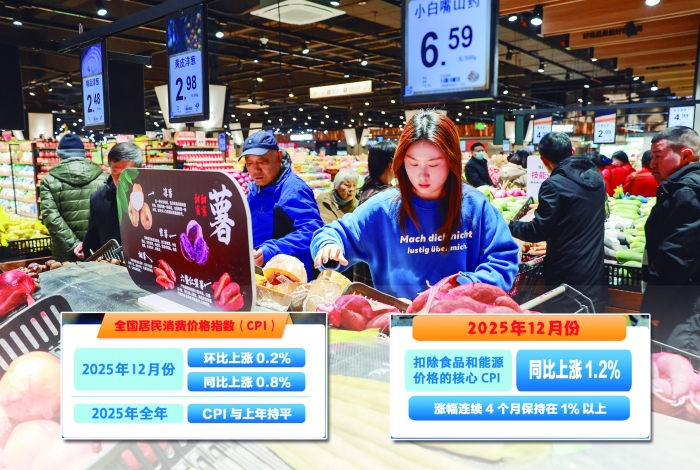
Group 1 - The core consumer demand is increasing, leading to a rise in the Consumer Price Index (CPI) for December, which increased by 0.2% month-on-month and 0.8% year-on-year, exceeding market expectations [2][3] - The core CPI, excluding food and energy, rose by 1.2% year-on-year, indicating stable domestic demand [2][4] - The Producer Price Index (PPI) showed a month-on-month increase of 0.2% and a year-on-year decrease of 1.9%, with the decline narrowing due to improved supply-demand structures [5][6] Group 2 - Prices of communication tools, maternal and infant products, entertainment durable goods, and household appliances increased by 1.4% to 3.0% month-on-month, reflecting the effectiveness of consumption-boosting policies [3][4] - Food prices rose by 1.1% year-on-year, contributing significantly to the CPI increase, while pork prices decreased by 1.7% due to sufficient supply [4][5] - The prices of durable goods showed overall improvement, with household appliances rising by 1.4% month-on-month, marking a historical high [4][5] Group 3 - The energy prices decreased by 0.5%, with gasoline prices falling by 1.2% due to international oil price fluctuations [4][5] - The prices in the coal mining and washing industry and coal processing rose by 1.3% and 0.8% respectively, continuing a five-month upward trend [5][6] - New production capacities in digital economy-related industries are driving price increases, with significant rises in prices for external storage devices (15.3%) and biomass liquid fuels (9.0%) [6]


2025年12月居民消费价格指数同比上涨0.8%
Ren Min Ri Bao· 2026-01-10 00:43
Group 1 - The consumer price index (CPI) increased by 0.2% month-on-month and 0.8% year-on-year, reaching the highest level since March 2023, primarily driven by rising food prices [1][2] - Food prices rose by 1.1%, contributing approximately 0.17 percentage points to the year-on-year CPI increase, while energy prices decreased by 3.8% [1][2] - The core CPI, excluding food and energy, maintained a year-on-year increase of 1.2% for four consecutive months [1] Group 2 - The producer price index (PPI) rose by 0.2% month-on-month, marking the third consecutive month of increase, with a year-on-year decline of 1.9% [2] - Key industries such as coal mining and lithium-ion battery manufacturing saw price increases, with coal mining prices rising by 1.3% and lithium-ion battery prices by 1.0% [2] - The decline in PPI year-on-year has narrowed by 0.3 percentage points compared to the previous month, indicating positive changes in some industry prices due to ongoing macroeconomic policies [2]
21社论丨优化供需结构,持续提振投资与消费预期
Xin Lang Cai Jing· 2026-01-09 22:52
Group 1 - The latest data from the National Bureau of Statistics indicates that the domestic CPI rose by 0.8% year-on-year in December 2025, surpassing the previous value of 0.7%, while the month-on-month CPI shifted from a decline of 0.1% to an increase of 0.2%, reaching a near three-year high [1] - The month-on-month increase in CPI was primarily driven by rising prices of industrial consumer goods excluding energy, which increased by 0.6%, contributing approximately 0.16 percentage points to the CPI increase [1] - The year-on-year CPI increase of 0.8% was mainly attributed to a larger rise in food prices, with fresh vegetables and fruits seeing price increases of 18.2% and 4.4%, respectively [1] Group 2 - The main factors affecting CPI include energy and automobile prices, with energy prices declining by 0.5% month-on-month due to international oil price fluctuations, and domestic gasoline prices decreasing by 1.2% [2] - The month-on-month PPI increase has expanded, and the year-on-year decline has narrowed, indicating a need for further consolidation of the upward trend [2] - The improvement in PPI is influenced by international commodity prices, with domestic prices in the non-ferrous metal mining and smelting industries rising by 3.7% and 2.8% respectively [3] Group 3 - The current price recovery is a direct result of the coordinated efforts of demand-side expansion and supply-side governance policies in 2025, characterized by structural features and policy-driven characteristics [3] - The ability to maintain this trend and translate it into widespread investment and consumption expectations will determine whether the economy can enter a virtuous cycle of "moderate price recovery - improved corporate profits - balance sheet repair - expanded domestic demand" in 2026 [3] - There is a need to actively expand domestic demand and improve supply-demand relationships to promote a smooth transmission of PPI to CPI, thereby enhancing corporate profits and consumer confidence [4]
扩内需政策助力供需关系改善
Zheng Quan Ri Bao· 2026-01-09 22:52
Group 1: CPI Analysis - In December 2025, the Consumer Price Index (CPI) increased by 0.2% month-on-month and 0.8% year-on-year, with core CPI (excluding food and energy) rising by 1.2% year-on-year [1][3] - The rise in CPI was primarily driven by increased prices in non-energy industrial consumer goods, with a 0.6% increase in these prices contributing approximately 0.16 percentage points to the month-on-month CPI increase [2] - Food prices rose by 0.3%, contributing about 0.05 percentage points to the month-on-month CPI increase, with notable increases in fresh fruits and seafood prices due to heightened pre-holiday demand [2][4] Group 2: PPI Analysis - The Producer Price Index (PPI) rose by 0.2% month-on-month in December 2025, marking the third consecutive month of increase, while the year-on-year decline narrowed to 1.9% [5] - The month-on-month PPI increase was attributed to improved supply-demand dynamics in certain industries and rising prices in non-ferrous metals, reflecting a seasonal demand increase [6] - Positive changes in PPI were noted in various sectors, including a reduction in price declines for coal mining, lithium-ion battery manufacturing, and photovoltaic equipment, indicating a strengthening market competition [6] Group 3: Economic Outlook - The overall changes in CPI and PPI in December indicate a stable and improving economic environment in China, with a gradual recovery in demand and ongoing structural optimization in supply [7]
2025年12月居民消费价格指数同比上涨0.8% 回升至2023年3月以来最高
Ren Min Ri Bao· 2026-01-09 22:10
Group 1 - The core viewpoint of the articles indicates that consumer demand is increasing due to effective policies aimed at expanding domestic demand and promoting consumption, leading to a rise in the Consumer Price Index (CPI) [1][2] - The CPI increased by 0.2% month-on-month and 0.8% year-on-year, with the year-on-year increase being the highest since March 2023, primarily driven by a 1.1% rise in food prices [1][2] - The core CPI has maintained a year-on-year increase of over 1% for four consecutive months, indicating stable underlying inflation trends [1] Group 2 - The Producer Price Index (PPI) rose by 0.2% month-on-month, marking the third consecutive month of increase, with improvements in supply-demand structure contributing to price rises in certain industries [2] - Key industries such as coal mining and lithium-ion battery manufacturing have seen price increases, with coal mining prices rising by 1.3% and lithium-ion battery prices by 1.0%, both continuing their upward trend for several months [2] - The year-on-year decline in PPI narrowed to 1.9%, reflecting the positive impact of macroeconomic policies and improved market competition, with price declines in certain sectors also showing signs of stabilization [2]
扩内需促消费政策显效2025年物价呈温和回升态势
Shang Hai Zheng Quan Bao· 2026-01-09 18:38
Core Viewpoint - The expansion of domestic demand and consumption policies is showing effectiveness, leading to a moderate recovery in prices and improved supply-demand relationships in key industries [2][6][7]. Group 1: CPI and PPI Trends - In December 2025, the Consumer Price Index (CPI) increased by 0.8% year-on-year, marking the highest level since March 2023, with food prices significantly contributing to this rise [2][3]. - The Producer Price Index (PPI) decreased by 1.9% year-on-year in December, but the decline was narrower than in November, indicating positive changes in certain industries due to improved market competition [4][6]. - The core CPI, excluding food and energy, rose by 1.2% year-on-year, maintaining a growth rate above 1% for four consecutive months, reflecting stable demand recovery [3][6]. Group 2: Industry-Specific Insights - Prices in the coal mining, lithium-ion battery manufacturing, and photovoltaic equipment sectors showed reduced declines, indicating a positive trend in market competition and production capacity management [4][5]. - The price of lithium-ion batteries and cement manufacturing increased by 1.0% and 0.5% month-on-month, respectively, demonstrating a recovery in these key industries [4][5]. - The prices of external storage devices and bio-liquid fuels rose by 15.3% and 9.0% year-on-year, respectively, driven by the growth of new productive forces [5]. Group 3: Future Outlook - Experts predict that with continued policy support for domestic demand and consumption, the CPI is expected to show a steady upward trend in 2026, with food prices returning to a reasonable fluctuation range [6][7]. - The overall economic operation is expected to improve, with demand gradually recovering and supply-side structural optimization continuing [7].