
高耗能行业

Search documents
数据点评 | 1月PMI:春节效应前置(申万宏观·赵伟团队)
申万宏源宏观· 2026-01-31 14:49
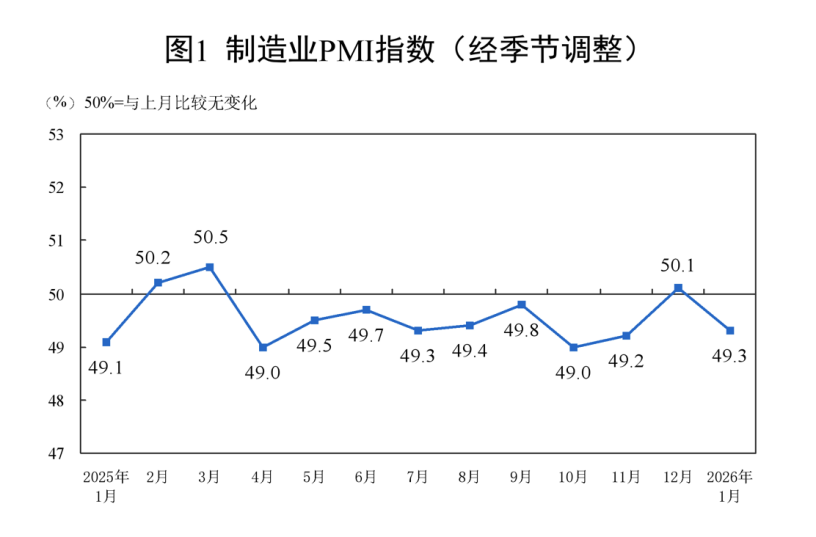
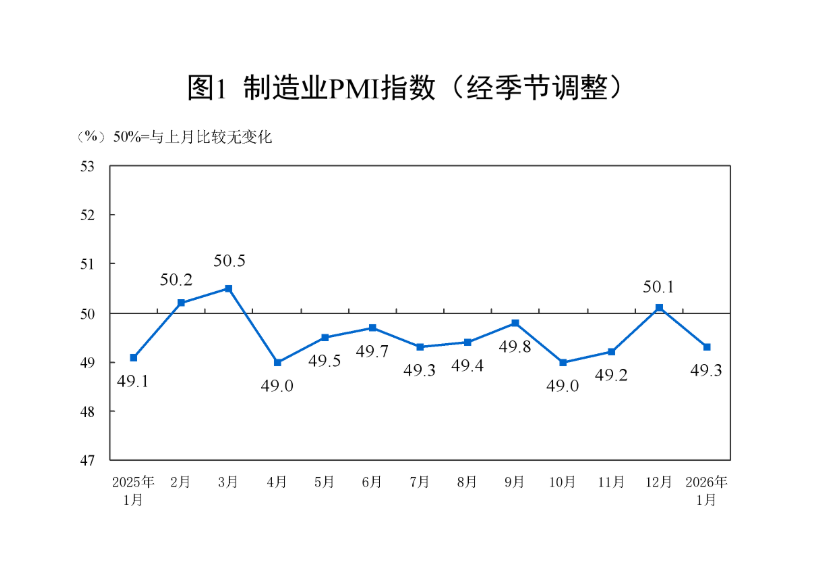
Core Viewpoint - The significant decline in January PMI is primarily attributed to the early return of workers for the 2026 Spring Festival and weak domestic demand, with manufacturing PMI dropping to 49.3% from 50.1% and non-manufacturing PMI falling to 49.4% from 50.2% [2][7][61] Group 1: Manufacturing PMI Analysis - The manufacturing PMI fell below the neutral line, decreasing by 0.8 percentage points to 49.3%, influenced by statistical factors and the early return of workers [2][8][61] - The manufacturing production index declined by 1.1 percentage points to 50.6%, while the new orders index decreased by 1.6 percentage points to 49.2% [5][41][64] - The purchasing index for manufacturing dropped significantly by 2.4 percentage points to 48.7%, indicating a notable contraction in supply [3][15][62] Group 2: Sector-Specific Insights - Labor-intensive sectors such as consumer goods and high-energy industries experienced a more pronounced decline in PMI, with consumer goods PMI falling by 2.1 percentage points to 48.3% and high-energy PMI down by 1 percentage point to 47.9% [3][22][62] - In contrast, capital-intensive sectors like high-tech and equipment manufacturing saw smaller declines, with PMIs of 52% and 50.1%, respectively [3][22][62] Group 3: Non-Manufacturing PMI Insights - The non-manufacturing sector showed asymmetric effects from the early return of workers, with the construction PMI dropping to 48.8%, a decline of 4 percentage points, while the service sector PMI only slightly decreased by 0.2 percentage points to 49.5% [4][25][62] - The construction sector's decline is more significant than the average historical drop of 1.4 percentage points for January since 2017 [4][25][62] Group 4: Economic Outlook - The early Spring Festival may disrupt PMI readings for January and February, but the overall economic recovery trend is expected to continue, supported by travel and consumption during the holiday [4][34][63] - Recent policies aimed at boosting service consumption are anticipated to support the service sector's recovery, with a focus on changes in consumer demand [4][34][63]

1月PMI为49.3%!传统淡季下企业生产仍继续扩张|快讯
Hua Xia Shi Bao· 2026-01-31 05:31
文/张智 从企业规模来看,大型企业PMI继续高于临界点。大型企业PMI为50.3%,仍位于扩张区间,大型企业 支撑作用持续显现;中、小型企业PMI分别为48.7%和47.4%,比上月下降1.1个和1.2个百分点,景气水 平有所回落。 一个亮点是,高技术制造业持续领跑。高技术制造业PMI为52.0%,连续两个月位于52.0%及以上较高水 平,相关行业发展态势持续向好。装备制造业PMI为50.1%,保持在扩张区间。消费品行业和高耗能行 业PMI分别为48.3%和47.9%,景气水平有所回落。 企业预期保持乐观。生产经营活动预期指数为52.6%,继续高于临界点。从行业看,农副食品加工、食 品及酒饮料精制茶等行业生产经营活动预期指数连续两个月位于56.0%以上较高景气区间,相关企业对 近期行业发展信心较强。 编辑:徐芸茜 1月份,制造业采购经理指数(PMI)为49.3%,比上月下降0.8个百分点,但传统淡季下企业生产仍继 续扩张。 具体来看,生产指数为50.6%,高于临界点,制造业生产保持扩张;新订单指数为49.2%,市场需求有 所回落。从行业看,农副食品加工、铁路船舶航空航天设备等行业生产指数和新订单指数均高于 5 ...
资本市场服务等行业市场活跃度较高!国家统计局最新发布
Xin Lang Cai Jing· 2026-01-31 05:00
国家统计局1月31日发布数据显示,1月份,制造业采购经理指数(PMI)、非制造业商务活动指数和综合PMI产出指数分别为49.3%、49.4%和49.8%,比 上月下降0.8个、0.8个和0.9个百分点,经济景气水平有所回落。 从行业看,货币金融服务、资本市场服务、保险等行业商务活动指数均高于65.0%,市场活跃度较高。 出厂价格指数近20个月来首次升至临界点以上 "1月份,部分制造业行业进入传统淡季,加之市场有效需求仍显不足,制造业PMI为49.3%,景气水平较上月下降。"国家统计局服务业调查中心首席统计 师霍丽慧表示。 高技术制造业持续领跑。1月份,高技术制造业PMI为52.0%,连续两个月位于52.0%及以上较高水平,相关行业发展态势持续向好。装备制造业PMI为 50.1%,保持在扩张区间。消费品行业和高耗能行业PMI分别为48.3%和47.9%,景气水平有所回落。 企业预期保持乐观。1月份,生产经营活动预期指数为52.6%,继续高于临界点。从行业看,农副食品加工、食品及酒饮料精制茶等行业生产经营活动预 期指数连续两个月位于56.0%以上较高景气区间,相关企业对近期行业发展信心较强。 "1月份,受季节性因 ...
国家统计局:1月制造业PMI为49.3% 景气水平较上月下降 生产继续保持扩张
Guo Jia Tong Ji Ju· 2026-01-31 01:42
Group 1: Manufacturing PMI Overview - In January 2026, the Manufacturing Purchasing Managers' Index (PMI) was reported at 49.3%, a decrease of 0.8 percentage points from the previous month, indicating a tightening in market demand while production continues to expand [1][5] - The production index stood at 50.6%, remaining above the critical point, suggesting ongoing expansion in manufacturing production despite a decline in new orders index to 49.2% [5][6] - High-tech manufacturing PMI was recorded at 52.0%, indicating a sustained positive trend, while equipment manufacturing PMI was at 50.1%, also in the expansion zone [7] Group 2: Non-Manufacturing PMI Overview - The Non-Manufacturing Business Activity Index was reported at 49.4%, down 0.8 percentage points from the previous month, reflecting a general decline in non-manufacturing sector activity [3][8] - The service sector's business activity index was at 49.5%, with financial services and capital market services showing high activity levels above 65.0%, while the real estate sector dropped below 40.0% [8] - The construction sector's business activity index fell to 48.8%, a significant decrease of 4.0 percentage points, indicating a notable decline in construction activity [8] Group 3: Comprehensive PMI Insights - The Comprehensive PMI Output Index was at 49.8%, down 0.9 percentage points from the previous month, suggesting a slowdown in overall business activities [3][9] - The manufacturing production index and non-manufacturing business activity index contributed to the comprehensive PMI, recorded at 50.6% and 49.4% respectively [9]
国家统计局服务业调查中心首席统计师霍丽慧解读2026年1月中国采购经理指数
Guo Jia Tong Ji Ju· 2026-01-31 01:35
——国家统计局服务业调查中心首席统计师霍丽慧解读2026年1月中国采购经理指数 2026年1月31日国家统计局服务业调查中心和中国物流与采购联合会发布了中国采购经理指数。对此, 国家统计局服务业调查中心首席统计师霍丽慧进行了解读。 1月份,制造业采购经理指数、非制造业商务活动指数和综合PMI产出指数分别为49.3%、49.4%和 49.8%,比上月下降0.8个、0.8个和0.9个百分点,经济景气水平有所回落。 一、制造业采购经理指数有所下降,生产继续保持扩张 1月份,部分制造业行业进入传统淡季,加之市场有效需求仍显不足,制造业PMI为49.3%,景气水平较 上月下降。 (一)企业生产继续扩张。生产指数为50.6%,高于临界点,制造业生产保持扩张;新订单指数为49.2%, 市场需求有所回落。从行业看,农副食品加工、铁路船舶航空航天设备等行业生产指数和新订单指数均 高于56.0%,产需释放较快;石油煤炭及其他燃料加工、汽车等行业两个指数均低于临界点,相关行业 市场需求放缓,企业生产有所回落。 1月份中国采购经理指数有所回落 (四)高技术制造业持续领跑。高技术制造业PMI为52.0%,连续两个月位于52.0%及以上 ...
我国年用电量首破10万亿千瓦时
Xin Lang Cai Jing· 2026-01-17 21:49
Core Insights - China's total electricity consumption surpassed 10 trillion kilowatt-hours in July and August 2025, marking a historic global record for a single country, equivalent to more than double the annual electricity consumption of the United States and exceeding the combined annual consumption of the EU, Russia, India, and Japan [1][2][5] - The increase in electricity consumption from 5 trillion to 10 trillion kilowatt-hours occurred in just over a decade, highlighting China's unique growth rate among major economies and reflecting improvements in energy security [2][3] Group 1: Factors Driving Electricity Consumption - The growth in electricity consumption is driven by a stable macroeconomic environment and increased demand for residential electricity due to high temperatures and enhanced electrification [2][3] - High-end manufacturing has emerged as a core engine for electricity consumption growth, with electricity usage in the new energy vehicle and wind power equipment manufacturing sectors increasing by over 20% and 30%, respectively [3] - The rapid development of the digital economy and emerging technologies has created new electricity consumption points, with internet and related services seeing over 30% growth, and the charging and swapping industry approaching a 50% increase in electricity consumption [3] Group 2: Energy Supply and Infrastructure - China has established a collaborative supply system involving power sources, grids, and demand to support the 10 trillion kilowatt-hours achievement, ensuring stable and orderly operation of the electricity system [3] - On the supply side, coal power continues to provide a safety net, while hydropower, nuclear power, and thermal power work together to maintain a solid foundation, with renewable energy sources like wind and solar playing a significant role in increasing capacity [3] - The construction of a unified national electricity market is accelerating, with policies such as time-of-use pricing and peak-valley pricing being implemented to guide users in managing electricity demand dynamically [3] Group 3: Structural Changes in Energy Consumption - While electricity consumption in emerging industries is steadily increasing, the overall growth rate of high-energy-consuming industries is declining, with sectors like black metal smelting and non-metal mineral products experiencing a downward trend [4] - High-energy-consuming industries are undergoing structural adjustments and energy-saving transformations, leading to a gradual exit of outdated production capacity and the widespread application of advanced energy-saving technologies [4] - The continuous decline in energy consumption per unit of GDP indicates a shift towards a greener and more efficient economic model, enhancing the quality of GDP growth [4][5]
用电量首破10万亿千瓦时:见证中国经济的活力
Xin Hua Wang· 2026-01-17 10:41
Core Insights - China's total electricity consumption is projected to exceed 10 trillion kilowatt-hours by 2025, marking a historic milestone and reflecting the resilience of its large-scale economy [1][2] - This consumption level is more than double that of the United States and surpasses the combined annual electricity usage of the EU, Russia, India, and Japan [1] Group 1: Factors Driving Electricity Consumption - The growth in electricity consumption is supported by a stable macroeconomic environment and increased demand for residential electricity due to high temperatures and enhanced electrification [2] - The rapid increase from 5 trillion to 10 trillion kilowatt-hours in just over a decade is unprecedented among major economies, highlighting China's manufacturing prowess and improved energy security [2] Group 2: Sectoral Contributions to Electricity Demand - High-end manufacturing is becoming a key driver of electricity consumption, with sectors like new energy vehicles and wind power equipment expected to see growth rates exceeding 20% and 30%, respectively [3] - The digital economy and emerging technologies are creating new electricity demand points, with infrastructure like charging stations and 5G bases driving over 30% growth in related sectors [3] Group 3: Energy Supply and Management - A robust energy supply system has been established, integrating power generation, grid management, and demand-side measures to ensure stable electricity supply [3] - The energy mix includes coal, hydropower, nuclear, and renewable sources, with significant investments in energy storage and grid infrastructure to manage fluctuations [3] Group 4: Trends in High Energy Consumption Industries - While emerging industries are seeing steady increases in electricity consumption, traditional high-energy sectors like black metal smelting are experiencing a decline [4] - The overall trend in high-energy industries is towards structural adjustment and energy efficiency improvements, contributing to a decrease in energy consumption per unit of GDP [4]
欧盟“绿色壁垒”会挡住自己发展
Huan Qiu Shi Bao· 2026-01-05 07:26
Group 1 - The EU's Carbon Border Adjustment Mechanism (CBAM) has officially come into effect, imposing carbon tariffs on high-carbon products such as steel, aluminum, cement, fertilizers, electricity, and hydrogen [1] - The mechanism has faced criticism from both within the EU and from major trading partners like China, India, and Brazil, who argue that the carbon emission default values are too lenient [1][2] - CBAM is part of the EU's broader green policy aimed at achieving a 55% reduction in carbon emissions by 2030 and carbon neutrality by 2050, as mandated by the European Climate Law [1][2] Group 2 - The implementation of CBAM may lead to significant additional carbon costs for China's steel and aluminum industries, potentially amounting to tens of billions of RMB annually [3] - The EU plans to expand the scope of high-carbon products covered by CBAM to include 180 items, such as machinery, automotive parts, and household appliances by 2028, which could create trade imbalances and discrimination against developing countries [3] - The mechanism reflects the EU's declining hard power and international competitiveness, as it resorts to trade protectionism under the guise of environmental policy [3][4] Group 3 - There are internal dissenting voices within Europe, such as the German Chamber of Commerce, which argues for collaboration with other countries rather than imposing unilateral standards [4] - The dual standards of the EU's green policies may ultimately harm relationships with trading partners and jeopardize future economic development in Europe [4]
制造业PMI时隔8个月重返扩张区间
Jin Rong Shi Bao· 2026-01-05 01:27
Core Viewpoint - The overall economic sentiment in China is improving as indicated by the rise in the Purchasing Managers' Index (PMI) across manufacturing and non-manufacturing sectors, suggesting a recovery in market demand and production activities [1][2][4]. Manufacturing Sector - In December 2025, the manufacturing PMI rose to 50.1%, an increase of 0.9 percentage points from the previous month, marking the first time it entered the expansion zone since April 2025 [1][2]. - The production index and new orders index were reported at 51.7% and 50.8%, respectively, with significant increases of 1.7 and 1.6 percentage points, indicating a strong recovery in market demand [2]. - The new export orders index increased by 1.4 percentage points to 49.0%, reflecting a positive shift in external trade conditions [2]. - The PMI for large enterprises reached 50.8%, up 1.5 percentage points, while medium-sized enterprises saw a rise to 49.8%. Small enterprises, however, experienced a decline to 48.6% [3]. Non-Manufacturing Sector - The non-manufacturing business activity index rose to 50.2%, an increase of 0.7 percentage points from the previous month, indicating improved sentiment in the service sector [4]. - The service sector PMI was reported at 49.7%, showing a slight recovery of 0.2 percentage points, with certain industries like telecommunications and financial services experiencing rapid growth [4]. Construction Sector - The construction PMI surged to 52.8%, a significant increase of 3.2 percentage points, returning to the expansion zone for the first time in five months, driven by new policy financial tools and favorable weather conditions [5]. - The business activity expectation index for the construction sector was reported at 57.4%, indicating optimism among construction enterprises regarding future developments [5]. Overall Economic Outlook - The comprehensive PMI output index reached 50.7%, indicating an overall expansion in production and business activities compared to the previous month [5]. - Analysts expect that the supportive measures for economic growth will continue to bolster the manufacturing sector, although consumer demand remains weak and requires further improvement [5].

12月PMI反季节性回升的中观线索
GF SECURITIES· 2026-01-04 05:24
Manufacturing Sector - In December 2025, the manufacturing PMI increased by 0.9 points to 50.1, significantly above the seasonal trend where the average decline over the past 10 years was 0.3 points[3] - Only 4 out of 15 sub-sectors are in the expansion zone, a decrease of 4 from November, with specialized equipment, non-metallic mineral products, and agricultural products falling below the prosperity line[3] - High-tech manufacturing PMI rose to 52.5, up 2.4 points from the previous month, indicating strong growth in this sector[3] Industry Performance - The pharmaceutical, automotive, textile, and computer communication sectors lead in prosperity, with PMI values between 55-60, while the chemical, metal products, and non-metallic mineral sectors are between 45-50[4] - The pharmaceutical sector's production and demand may be influenced by the flu season, while the petrochemical sector stabilized with a production increase of 15 points[5] - The electrical machinery sector saw a 1.3-point increase in PMI, driven by strong demand in home appliances and new energy sectors[6] Emerging Industries - Emerging industries such as biotechnology, new energy vehicles, and next-generation information technology maintain high prosperity levels, with biotechnology PMI rising by 2.7 points[7] - Among seven emerging industries, biotechnology has the highest prosperity level at 60, while new energy vehicles and next-generation information technology are between 50-55[7] Construction Sector - The construction sector's PMI rose by 3.2 points to 52.9, marking a return to expansion after four months[9] - The real estate sector saw a slight increase of 0.5 points, with construction activities improving due to favorable policies and funding availability[8] - New orders in the construction sector increased by 1.3 points, with real estate new orders rising by 8.2 points[10] Service Sector - The service sector's business activity index increased by 0.2 points to 49.7, with online information technology services and postal services leading the growth[12] - The hospitality and catering sectors experienced the lowest prosperity levels, with indices below 45, reflecting weak consumer activity[12] - The financial services sector remains strong, with indices above 60, indicating robust performance in monetary and capital market services[12]