金属

Search documents
资讯早班车-2025-12-02-20251202
Bao Cheng Qi Huo· 2025-12-02 01:58
1. Report Industry Investment Rating No relevant information provided. 2. Core Viewpoints of the Report - In the short - term, supply - demand and prices are the two major economic concerns. The manufacturing industry was in a state of passive de - stocking in November, and the relationship between production and demand improved slightly. However, the sustainability needs to be observed, and the endogenous demand in consumption and real estate needs to be strengthened. The price index has been repaired, with the front - end stronger than the back - end in structure [28]. - After the December Politburo meeting, the general policy direction for 2026 will be set, and the subsequent Central Economic Work Conference will make further deployments. Key areas of focus include monetary policy, fiscal policy, technological self - reliance, etc. The overall environment is favorable for the market [28]. 3. Summary of Each Section 3.1 Macro Data Overview - GDP growth rate in Q3 2025 was 4.8% year - on - year, down from 5.2% in the previous quarter but up from 4.6% in the same period last year [1]. - In November 2025, the manufacturing PMI was 49.2%, slightly up from 49.0% in the previous month but down from 50.3% in the same period last year; the non - manufacturing PMI for business activities was 49.5%, down from 50.1% in the previous month and 50.0% in the same period last year [1]. - In October 2025, the monthly increase in social financing scale was 816.1 billion yuan, significantly lower than 3529.9 billion yuan in the previous month but higher than 1412.0 billion yuan in the same period last year [1]. 3.2 Commodity Investment Reference 3.2.1 Comprehensive - From December 3, 2025, the speculative trading margin standard for the polysilicon futures PS2601 contract will be adjusted to 13%, and the hedging trading margin standard to 12%. The daily opening volume limit for non - futures company members or clients will be 500 lots [2]. - China's S&P manufacturing PMI in November was 49.9, down from 50.6 in the previous month [3]. - On December 1, 36 domestic commodity varieties had positive basis, and 30 had negative basis [3]. - The Bank of Japan Governor signaled a possible interest rate hike [3]. 3.2.2 Metals - Due to supply shortages and expectations of Fed rate cuts, silver prices soared to record highs. On Monday, spot silver reached over $58 per ounce, with a year - to - date increase of over 100% [4]. - On December 1, the price of battery - grade lithium carbonate rose to 94,400 yuan/ton, and the price of lithium hydroxide rose to 82,500 yuan/ton [5]. - As of November 28, lead, aluminum, and nickel inventories decreased, while zinc inventory increased [6]. 3.2.3 Coal, Coking, Steel, and Minerals - The China Iron and Steel Association emphasized accelerating key iron ore projects to enhance the industry's resource security capacity [8]. - Saudi Arabia launched a new round of mineral exploration tenders covering 13,000 square kilometers [8]. - Indonesia set the benchmark prices for different grades of coal for the first half of December [8]. 3.2.4 Energy and Chemicals - Two shale gas industry standards will be implemented on March 28, 2026, to support shale gas development [10]. - On December 1, international oil prices rose due to geopolitical risks and supply - side factors [10]. - Saudi Aramco and Algerian National Oil Company raised LPG prices by 3% - 5% in December [10]. 3.2.5 Agricultural Products - The domestic corn market has been rising strongly, with significant price increases in major ports [11]. - On December 1, the domestic live - hog futures contract 2601 was at a low level, and the spot market prices mostly fell [11]. - The USDA reported weekly export sales data for various agricultural products in the US [11][12]. 3.3 Financial News Compilation 3.3.1 Open Market - On December 1, the central bank conducted 107.6 billion yuan of 7 - day reverse repurchase operations, with a net withdrawal of 231.1 billion yuan [14]. 3.3.2 Key News - French President Macron will visit China from December 3 - 5 [15]. - The CSRC is promoting the pilot of commercial real estate investment trusts (REITs) to support the real estate market [16]. - As of the end of October, the balance of loans in the Yangtze River Delta region showed certain growth trends [17]. - In November, new energy vehicle sales rankings were released, with BYD leading [17]. 3.3.3 Bond Market Summary - The Chinese bond market was mostly strong and volatile. Interest - rate bond yields mostly declined, and treasury - bond futures had mixed performance [21]. - Exchange - traded bonds, especially Vanke bonds, generally declined [21]. - The CSI Convertible Bond Index rose 0.10% [22]. 3.3.4 Foreign Exchange Market - The on - shore RMB against the US dollar rose 69 basis points on December 1 [27]. - The US dollar index fell 0.03% in New York trading [27]. 3.3.5 Research Report Highlights - Huatai Fixed - Income commented on the November official manufacturing PMI, highlighting supply - demand and price concerns [28]. - Guosheng Macro's Xiong Yuan released a report on the possible policy directions after the December Politburo meeting [28]. 3.3.6 Today's Reminders - On December 2, 155 bonds will be listed, 101 bonds will be issued, 54 bonds will be settled, and 135 bonds will pay principal and interest [29][30]. 3.4 Stock Market Key News - A - shares rose unilaterally, with technology themes active. The Shanghai Composite Index rose 0.65%, and the trading volume expanded to 1.89 trillion yuan [31]. - The Hong Kong Hang Seng Index rose 0.67%, and the Southbound funds had a net purchase of HK$2.148 billion [31]. - Shenzhen Stock Exchange will adjust samples of multiple indices on December 15 [31].
美国关税改写铜市逻辑!大宗商品巨头惊呼:铜市 “超级行情” 来了
Jin Rong Jie· 2025-12-01 14:27
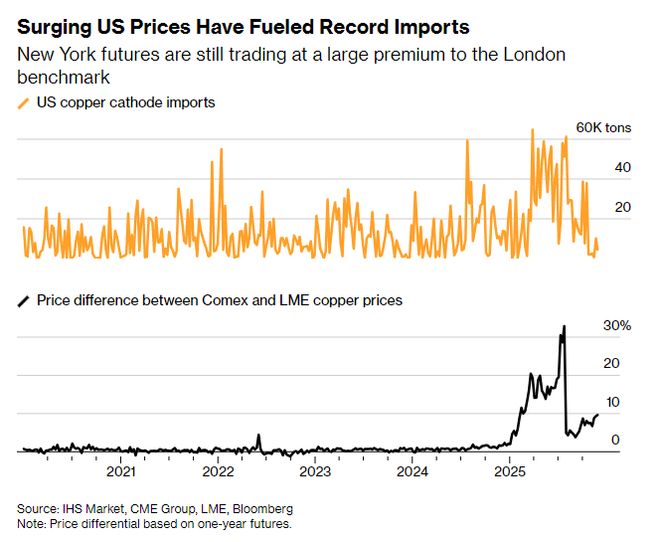
Group 1 - Mercuria Energy Group's metal business head, Kostas Bintas, has reiterated a bullish outlook on copper prices, warning that the influx of copper shipments to the U.S. may lead to inventory depletion in other regions [1] - Recent trading activity has been influenced by uncertainties surrounding future tariff policies, prompting traders to increase copper exports to the U.S. and target high copper premiums on the COMEX [1][2] - Bintas indicated that the resumption of profitable U.S. arbitrage trading could result in copper supply shortages in other regions, leading to further price increases [1] Group 2 - Bintas noted that the LME copper price, which is near historical peaks, still has room for upward movement, predicting that if current trends continue, supply tightness will worsen and copper prices will rise further [2] - Since Trump's tariff announcement in July, U.S. copper import growth has slowed, but Mercuria expects imports to increase again in the coming months, potentially nearing record levels in Q1 2026 [2] - Bintas's bullish forecast reflects a broader market expectation for long-term copper price increases, with competitors also warning of supply gaps due to mining disruptions [4] Group 3 - The market is becoming increasingly aware that despite weak demand, copper resources continue to flow to the U.S., which may lead to supply shortages in China and other markets [4] - The role of China as a marginal buyer has shifted to the U.S., with traders driving up premiums for copper deliverable on COMEX contracts [5] - Bintas anticipates that the current high premiums will eventually be accepted by Asian buyers, predicting that the market dynamics will lead to a "dual-track market" where LME and Shanghai Futures Exchange prices will respond to U.S. market changes [7]

中信金属:截至2025年9月19日公司A股股东人数为68191户
Zheng Quan Ri Bao Wang· 2025-12-01 13:44
Group 1 - The core point of the article is that CITIC Metal (601061) reported its A-share shareholder count as of September 19, 2025, which stands at 68,191 households [1] Group 2 - The data was provided in response to investor inquiries on the interactive platform [1] - The information is sourced from China Securities Depository and Clearing Corporation Limited [1]

白银和伦铜双双创历史新高,原因详解
Hua Er Jie Jian Wen· 2025-12-01 10:02
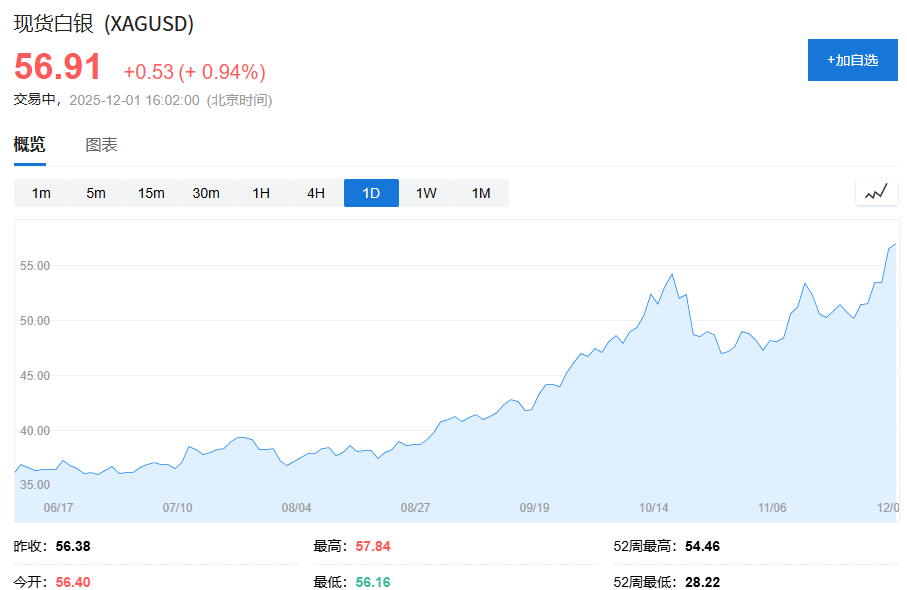
Core Viewpoint - The prices of silver and copper have surged to historical highs due to tightening global supply and expectations of monetary policy easing, reflecting a strong optimistic sentiment in the precious metals market and highlighting specific supply-demand imbalances for silver and copper [1][3][7]. Supply and Demand Dynamics - Silver prices reached an all-time high of over $57 per ounce on December 1, with a daily increase of approximately 1%, while silver futures on the New York Mercantile Exchange hit $57.81 [1][3]. - Concerns over supply shortages and expectations of interest rate cuts by the Federal Reserve have driven the rapid price increase [3][10]. - China's silver inventory has fallen to a seven-year low, directly linked to record export volumes in October, with over 660 tons exported, marking a historical peak [8][9]. - The significant inventory depletion in China is attributed to cross-border tariff arbitrage activities, exacerbating global supply tightness [3][8]. Market Trends and Investor Sentiment - The copper price also reached a record high of $11,210.5 per ton on the London Metal Exchange, with a 13% increase since late August, driven by similar supply constraints and arbitrage activities [4][7]. - The interconnected rise of silver and copper prices illustrates the core narrative of the current commodity market, emphasizing supply shortages as a key price driver [7][9]. - Analysts predict that the ongoing supply tightness could lead to further depletion of copper inventories in regions outside the U.S. [7][8]. Monetary Policy Impact - Expectations of monetary easing by the Federal Reserve have provided solid support for the precious metals market, enhancing the appeal of non-yielding assets like silver [10][11]. - Recent dovish comments from Federal Reserve officials have reinforced market expectations for a potential rate cut in December, further boosting confidence in a low-interest-rate environment [11].
【掘金板块牛熊】消费电子大幅走强 有色金属板块走高 AI应用概念走弱
第一财经· 2025-12-01 06:11
Group 1 - The article highlights the strong performance of the consumer electronics sector in the A-share market, with stocks like Beilong Precision and Meg Smart reaching the daily limit [1] - It notes a collective high opening for metal sectors such as silver and copper, with companies like Xingye Silver Tin and Silver Nonferrous rising over 7% [1] - The AI application concept is mentioned as experiencing significant declines, with companies like Guotou Intelligent and Yidian Tianxia leading the drop [1] Group 2 - The article emphasizes the importance of tracking capital migration and understanding the logic behind stock selection by institutions and retail investors [1] - It suggests that the "Longhu Niuxiong" report provides insights into market trends and helps investors align with market rhythms for wealth growth [1]





周度观点精粹-20251201
Zhong Xin Qi Huo· 2025-12-01 05:51
Report Overview - This is a weekly view summary from CITIC Futures Research Institute, covering various commodity sectors and providing short - term and medium - term outlooks for each commodity. 1. Report Industry Investment Rating - The report does not explicitly provide an overall industry investment rating. Instead, it gives individual ratings for each commodity, mainly including "oscillating", "oscillating strongly", and "oscillating weakly". 2. Core Viewpoints - The market is in a state of shrinking volume, with potential unlocking and reduction pressure, and a policy window period. Capital is congested and waiting to be released, suggesting a long - term and short - term investment strategy with a dumbbell structure. - For different commodities, their prices are affected by factors such as supply and demand, cost, policy, and macro - economic environment, showing different trends of oscillation, oscillation strongly, or oscillation weakly. 3. Summary by Commodity Categories Financial - **Stock Index**: Market conditions suggest an oscillating trend [3]. - **Treasury Bonds**: With the central bank's bond trading and potential implementation of total - volume monetary policy tools, the market is expected to oscillate strongly in the fourth quarter. Current suggestions are for curve steepening and arbitrage opportunities [3]. Precious Metals - **Gold and Silver**: Weekly attention is on US PMI and ADP employment data. The price ranges for London gold are [4000, 4400] and for London silver are [53, 60], showing an oscillating trend [3]. Base Metals - **Copper**: Supply constraints and increasing supply disturbances lead to an oscillating strongly trend [3]. - **Aluminum**: Short - term macro - mood fluctuations and a stable fundamental situation result in an oscillating strongly trend. In the medium - term, with limited supply growth and resilient demand, the price center is expected to rise [3]. - **Alumina**: Excess supply in reality but low - level valuation leads to an oscillating trend [3]. - **Aluminum Alloy**: Short - term cost support and stable supply - demand result in an oscillating strongly trend. In the medium - term, strengthened cost support and potential policy disturbances also lead to an oscillating strongly trend [3]. - **Zinc**: Rising inventory, "squeezing position" situation, weakening downstream demand in the off - season, and high supply lead to an oscillating trend [3]. - **Tin**: Tight supply at the mine end provides strong price support, resulting in an oscillating strongly trend [3]. - **Lead**: High procurement demand, production decline due to smelter maintenance, and potential supply shortage lead to an oscillating trend [3]. - **Nickel**: Loose current supply - demand leads to a short - term oscillating weakly trend. Uncertainty in future supply from Indonesia means a medium - to - long - term oscillating trend [3]. - **Stainless Steel**: Fundamental factors and cost support lead to an oscillating trend [3]. New Energy Metals - **Lithium Carbonate**: Short - term tight supply - demand balance, medium - term supply surplus, and recent supply gap lead to wide - range price fluctuations and an oscillating trend [3]. - **Polysilicon**: Policy support and weakening demand result in a wide - range oscillating trend. Attention is on year - end policy signals and the warehouse receipt registration process [3]. - **Industrial Silicon**: Potential demand decline in the organic silicon industry and inventory pressure lead to an oscillating trend. Attention is on new warehouse receipt registration progress [3]. - **Cobalt**: Escalating conflicts in the Democratic Republic of Congo increase potential risks, leading to an oscillating strongly trend [3]. Energy - **Crude Oil**: Oscillating and waiting for guidance from OPEC+ meetings and geopolitical factors [3]. - **Natural Gas**: European gas prices are oscillating, and US gas prices may be strongly oscillating in the short - term [3]. - **Steam Coal**: Attention is on supply - side policies and inventory replenishment rhythm. The medium - to - long - term price range of (570 - 770) is still a significant reference [3]. - **High - Sulfur and Low - Sulfur Fuel Oil**: Oscillating downward [3]. - **Asphalt**: Futures prices are oscillating downward [3]. - **LPG**: Attention is on whether the optimistic expectations for Saudi Arabia on December 8 can be fulfilled. The basis is low, and the upside space is limited, showing an oscillating trend [3]. Chemicals - **Benzene Ethylene**: Accumulating inventory pressure in December leads to a short - term oscillating trend [3]. - **PX**: Affected by sentiment and cost in the short - term, the price range is [6650, 6950], and PXN is expected to oscillate between [250, 290] dollars per ton [3]. - **PTA**: Affected by cost and market sentiment, the price range is [4650, 4850], and the processing fee for the 01 contract is in the range of [220, 300] yuan per ton [3]. - **Ethylene Glycol**: Prices are expected to continue oscillating in the low - level range, and the EG01 - 05 spread should be cautiously arbitraged at high levels [3]. - **Short - Fiber**: The absolute price follows raw material fluctuations, and the processing fee fluctuates between 950 - 1100 yuan per ton. A short - PF and long - TA position can be lightly attempted [3]. - **Bottle Chips**: The processing fee has strong support at the bottom of the short - term range but also faces significant upward pressure, and the absolute price follows raw material fluctuations [3]. - **Methanol**: After the overseas information is confirmed, the futures price rebounds but shows signs of weakness. Attention is on whether the coastal inventory can continue to be digested [3]. - **PP and PE**: The upside space is limited, and attention is on maintenance changes, showing an oscillating trend [3]. - **Caustic Soda**: A decline in electricity prices in December lowers the cost, and the futures price may decline. If upstream production is cut or the warehouse receipt logic before delivery is fermented, the price may stabilize [3]. - **PVC**: Short - term 01 contract shows a small - scale rebound due to position games. Without positive factors, the price may return to a weak trend in the medium - to - long - term [3]. - **Urea**: The supply - demand pattern is supply - strong and demand - weak. Short - term storage progress may return to normal, and the price is expected to oscillate in the short - term. Attention is on the overall progress of off - season storage [3]. Agriculture - **Soybeans and Soybean Meal**: With an increasing expectation of the Fed's interest - rate cut in December, speculation on South American soybeans, and China's return to the US soybean market, US soybeans and domestic soybeans are expected to oscillate strongly at high levels. The oil mill's soybean meal inventory decline is slow, and the basis is rising. The bean - rapeseed meal spread is expected to oscillate strongly. Attention is on the long position opportunity of the M2605 contract after the main contract change [3]. - **Edible Oils (Soybean Oil, Palm Oil, and Rapeseed Oil)**: With a narrowing expected increase in palm oil production in November, a stable market sentiment, cost support for domestic soybean oil, tight domestic rapeseed supply, and inventory reduction of rapeseed oil, edible oils are expected to oscillate strongly in the near future [3]. - **Corn**: In the short - term, it is oscillating strongly. Before the inventory of the middle and lower reaches is effectively repaired, the price is likely to oscillate at a high level [3]. - **Pigs**: In the near - term, the pig price continues to be weak due to high - level production capacity and large - scale pig slaughter at the end of the year. In the long - term, production capacity reduction expectations support the far - month contract price. The pig industry shows a pattern of "weak reality + strong expectation", and attention is on the reverse - arbitrage strategy opportunity [3]. - **Apples**: With strong support for the spot price, positive expectations from Tomb - Sweeping Festival stockpiling and possible weather speculation, the futures price is relatively firm. Attention is on low - buying opportunities after price corrections and future weather changes in the producing areas [3]. - **Rubber**: It is not the time for a trend - forming market, and the current price is closer to the upper - level pressure. For arbitrage, the RU - MR spread has reached a phased high, and it is advisable to wait and see [3]. - **Cotton**: In the short - term, it oscillates within a range. In the long - term, with a low valuation, it is expected to oscillate strongly, and it is advisable to buy on dips [3]. - **Paper Pulp**: The futures price oscillates widely due to the issue of warehouse receipts [3]. - **Sugar**: In the medium - to - long - term, due to expected supply surplus in the new sugar - making season, the price has a downward driving force, and a short - selling strategy on rallies is recommended [3]. Shipping - **Container Shipping on the European Route**: Shows an oscillating trend. The market's expectation of resuming navigation in the first half of 2026 has increased, but there is still pressure on the far - month contract, and it is difficult to fully resume navigation in the first quarter [3].
工业金属板块多股高开,白银有色涨超7%
Mei Ri Jing Ji Xin Wen· 2025-12-01 01:40
Group 1 - The industrial metal sector saw multiple stocks open higher on December 1, with silver rising over 7% [1] - Shenghe Resources increased by more than 6%, while Jiangxi Copper and Shengton Mining also experienced gains [1]


联合研究|组合推荐:长江研究2025年12月金股推荐
Changjiang Securities· 2025-11-30 09:14
Economic Outlook - Domestic policy expectations are rising in December, and the probability of a Federal Reserve rate cut is increasing, which may lead to improved external liquidity and a potential market rebound[5] - Key focus areas include the upcoming Central Economic Work Conference and the potential for a Federal Reserve rate cut, which could lead to a valuation recovery in the technology sector[5] Investment Strategy - The report emphasizes three main investment themes: 1. Technology growth sectors, particularly AI hardware like optical modules and semiconductors, as well as energy storage and lithium battery sectors[5] 2. Market hot spots such as robotics and innovative pharmaceuticals, which are expected to rebound[5] 3. Chemical industries benefiting from "anti-involution" policies that optimize supply-demand dynamics[5] Recommended Stocks - Key recommended sectors include metals, chemicals, electric new energy, machinery, banking, automotive, pharmaceuticals, electronics, communications, and media[5] - Specific stock recommendations include: - Metals: Huaxi Nonferrous (华锡有色) with an expected EPS growth from 1.04 in 2024 to 2.17 in 2027[28] - Chemicals: Yara International (亚钾国际) with an expected EPS growth from 1.02 in 2024 to 5.87 in 2027[28] - Electric New Energy: Slin (斯菱股份) with an expected EPS growth from 1.73 in 2024 to 2.21 in 2027[28] - Machinery: Hengli Hydraulic (恒立液压) with an expected EPS growth from 1.87 in 2024 to 3.18 in 2027[28] - Banking: Bank of Communications (交通银行) with a projected PB of 0.58x in 2025[18] - Automotive: Top Group (拓普集团) with an expected EPS growth from 1.78 in 2024 to 2.38 in 2027[28] - Pharmaceuticals: Junshi Biosciences (君实生物) with a projected EPS turnaround by 2027[28] - Electronics: Dongshan Precision (东山精密) with an expected EPS growth from 0.64 in 2024 to 3.72 in 2027[28] - Communications: Zhongji Xuchuang (中际旭创) with projected net profits of 105.19 billion in 2025[26] - Media: Kaiying Network (恺英网络) with a projected EPS growth from 0.76 in 2024 to 1.47 in 2027[28] Risk Factors - Economic recovery may fall short of expectations due to slow employment growth, declining corporate revenues, and reduced market demand[30] - Significant changes in individual stock fundamentals could adversely affect performance[30]





芯片巨头,突然暴涨
Zhong Guo Ji Jin Bao· 2025-11-29 00:17
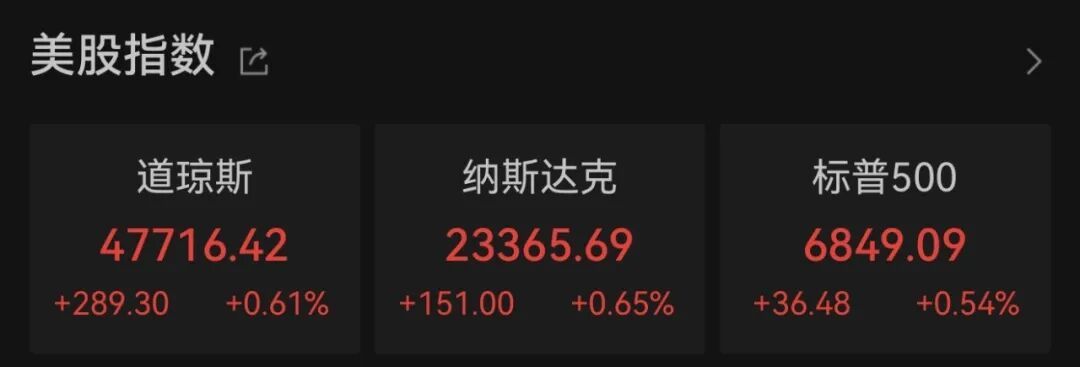
Market Performance - Major U.S. stock indices experienced significant gains, with the Dow Jones up 289.30 points (0.61%) closing at 47,716.42, the Nasdaq rising 151.00 points (0.65%) to 23,365.69, and the S&P 500 increasing by 36.48 points (0.54%) to 6,849.09 [2] - For the week, the Dow Jones saw a cumulative increase of 3.18%, the S&P 500 rose by 3.73%, and the Nasdaq gained 4.91% [4] Technology Sector - Intel's stock surged over 10%, marking its best single-day performance since September 18 [1][6] - Other major tech stocks also saw gains, including Facebook (up over 2%), Amazon (up over 1%), and Microsoft (up over 1%), while Nvidia experienced a decline of over 1% [6] - The Philadelphia Semiconductor Index rose by 1.82%, with notable increases in stocks like Micron Technology (up over 2%) and Qualcomm (up over 1%) [7][8] Commodities - WTI crude oil prices fell for the fourth consecutive month, closing at $58.55 per barrel, marking the longest monthly decline since March 2023 [10] - Silver and copper prices reached record highs, with silver rising 5.7% to $56.46 per ounce and copper climbing 2.5% to a peak of $11,210.50 per ton before settling up 2.2% [11]

国泰海通|海外策略:一页纸精读行业比较数据:11月
国泰海通证券研究· 2025-11-27 14:14
Investment Chain - Prices of tin, silver, and gold have risen since November 2025. [1] - Fixed asset investment growth rate has decreased to -1.70% as of October 2025, with real estate development investment down by -14.70%. [1] - Manufacturing fixed asset investment growth rate is at 2.7%, while infrastructure investment growth rate is at 1.51%. [1] - Prices of copper, aluminum, lead, zinc, and nickel have decreased, while power coal prices slightly increased to 698 RMB/ton. [1] Consumption Chain - Consumer confidence index rose to 89.60 in September 2025. [2] - Nominal growth rate for October 2025 fell to 2.90%, with cumulative nominal growth rate down by 4.30%. [2] - Sales area of commercial housing saw a cumulative year-on-year decline of -7.63% in October 2025. [2] - Automobile sales growth rate decreased to 8.82% in October 2025, and home appliance retail sales fell by -10.25%. [2] Export Chain - Export growth rate to the US increased in October 2025, while exports to the EU, Japan, and ASEAN saw a decline. [3] - Cumulative export growth rates for products like agricultural goods, toys, furniture, and steel have decreased. [3] - The overall export growth rate fell to 20.21% in October 2025, with textile exports down by -9.10%. [3] Price Chain - Pork prices increased to 12.24 RMB/kg as of November 19, 2025, while oil prices decreased to 57.95 USD/barrel. [4] - Prices for cotton and white sugar have declined, while MDI prices showed mixed trends. [4] - New credit increased to 220 billion RMB in October 2025, with life insurance premium income growth rate down to 12.68%. [4]