
半导体

Search documents
腾讯、阿里、百度、京东,集体上涨
第一财经· 2026-03-24 09:14
Market Performance - The Hang Seng Index rose by 2.79%, marking its largest single-day increase in nearly 10 months, closing at 25,063.71 points [1] - The Hang Seng Technology Index increased by 2.51%, closing at 4,830.89 points [1] Sector Performance - The biotechnology sector saw a significant rise, with the Hang Seng Biotechnology Index up by 4.00%, closing at 14,002.88 points [2] - The Hang Seng China Enterprises Index rose by 2.31%, closing at 8,499.53 points [2] - The Hang Seng Composite Index increased by 2.86%, closing at 3,780.95 points [2] Notable Stock Movements - Major tech stocks experienced substantial gains, with BYD Co. Ltd. up by 4.49% to 107.000, and Li Auto up by 4.32% to 67.600 [3] - Lenovo Group rose by 4.29% to 9.240, while Hua Hong Semiconductor increased by 4.26% to 86.850 [3] - Other notable increases included NIO up by 3.95% to 45.840, Tencent Holdings up by 3.13% to 514.000, and Alibaba up by 2.92% to 123.200 [3] Precious Metals Sector - The precious metals sector led the market, with notable gains such as Old Peking Gold rising over 16% to 648.500, and Chifeng Jilong Gold Mining up nearly 13% to 35.600 [4] - Other significant increases included Lingbao Gold up by 9.95% to 23.640 and WanGuo Gold Group up by 9.54% to 12.060 [4] AI Application Sector - The AI application industry chain saw a strong performance, with MINIMAX-W rising over 12% to 1,030.000, and Zhiyuan up over 11% to 655.000 [5][6] - Kingsoft Cloud increased by over 5%, reflecting positive sentiment in the AI sector [5]


越跌越买!宽基ETF上周吸金91亿【周观ETF】
和讯· 2026-03-24 08:55
Group 1 - The A-share market experienced significant fluctuations from March 16 to March 20, with a total ETF market size dropping nearly 150 billion, returning to 5.1 trillion [3] - The broad market indices, such as the Shanghai Composite Index and Shenzhen Component Index, saw declines of 3.38% and 2.9% respectively, while broad-based ETFs attracted net inflows of 9.1 billion, indicating a "buy the dip" strategy among investors [4][7] - The inflows were particularly strong in large-cap indices like the CSI 300 and mid-cap indices like the CSI 500, with net inflows of 6.558 billion and 4.644 billion respectively, suggesting institutional recognition of the current price levels as having a safety margin [7] Group 2 - In contrast to the broad-based ETFs, industry-specific ETFs faced significant outflows, with a total net outflow exceeding 26.2 billion, primarily affecting the chemical and non-ferrous metal sectors [8][9] - The chemical sector saw a reduction of nearly 12 billion in ETF size, with net outflows exceeding 5.5 billion and a decline of 11.28% in index value, while the non-ferrous metal sector experienced net outflows over 3.4 billion and a drop exceeding 12% [9] - The outflows in the chemical sector were attributed to the rapid decline of geopolitical premiums and falling international oil prices, which weakened cost support for chemical products [11][12]

黄仁勋暴论核弹:AGI已经实现,Ilya错了,程序员有10亿
量子位· 2026-03-24 08:47
Core Viewpoint - The article discusses the recent statements made by Jensen Huang, CEO of NVIDIA, regarding the achievement of Artificial General Intelligence (AGI) and its implications for the future of technology and society [1][2][3]. Group 1: AGI and Future Outlook - Huang asserts that AGI has already been achieved, emphasizing that this is not merely speculation but a conclusion drawn from various dimensions including technology, society, and human nature [3][8]. - He introduces the concept of OpenClaw as a transformative product in the token era, likening it to the iPhone, suggesting that intelligence will become a tradable commodity in the form of tokens [8][120]. - Huang predicts that the number of programmers will increase from 30 million to 1 billion, as coding becomes less about writing and more about problem-solving [210]. Group 2: Scaling Laws and Data - Huang believes that pre-training has not reached its peak, and synthetic data will continue to expand the scale of data available for AI [4][18]. - He argues that reasoning is a complex process that cannot be simplified to lightweight computations, contrasting it with pre-training which he likens to reading [6][20]. - The next scaling law, termed "agentic scaling," involves the creation of agentic individuals capable of generating and utilizing vast amounts of data [22][24]. Group 3: Energy and Data Center Design - Huang highlights the inefficiencies in current energy grid designs, suggesting that data centers should be rethought to utilize idle power more effectively [46][50]. - He proposes that data centers should be designed to gracefully degrade performance during peak energy demands, rather than requiring constant maximum output [57][58]. - Huang emphasizes the importance of collaboration with power companies to create flexible energy supply agreements [56][59]. Group 4: Cultural and Competitive Landscape - Huang notes that a significant portion of AI researchers are based in China, attributing this to a strong educational system and a competitive environment across various provinces [76][80]. - He describes the cultural factors that contribute to rapid knowledge sharing and innovation in China, including the importance of relationships and open communication among engineers [85][86]. - Huang believes that the rise of AI will not eliminate jobs but will transform them, enhancing the roles of professionals across various fields [226][237]. Group 5: Management Philosophy - Huang's management style focuses on collaboration and open communication, often involving large groups in problem-solving discussions [128][130]. - He emphasizes the importance of curiosity and continuous learning in leadership, encouraging a culture of shared insights and collective decision-making [131][135]. - Huang believes that maintaining humility and a willingness to learn from others is crucial for effective leadership [158][161].


SemiAnalysis:GTC 2026深度解读,推理王国全面扩张
傅里叶的猫· 2026-03-24 08:33
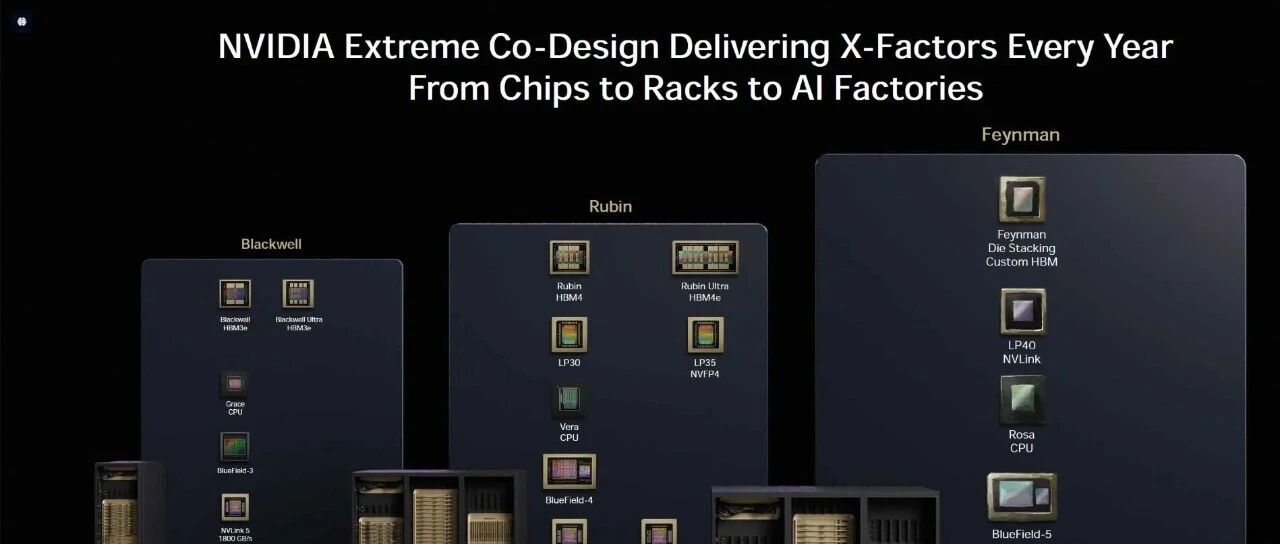
Core Insights - The article provides a detailed review of GTC 2026, focusing on Groq's LPU architecture, supply chain considerations, and the latest innovations in AI processing technology [1][3]. Groq LPU Architecture - Groq's core product, the LPU, is designed specifically for language model inference, emphasizing ultra-low latency compared to NVIDIA's GPUs, which focus on high throughput [3]. - The LPU architecture features distinct functional "slices" for various operations, enhancing efficiency in processing [3][4]. - A key innovation is the use of single-level SRAM instead of traditional multi-level caches, which allows for more predictable hardware execution and reduced latency [4]. Development History of LPU - The first-generation LPU utilized GlobalFoundries' 14nm process, achieving 750 TFLOPs of INT8 performance with 230MB of SRAM [5]. - The second generation faced technical issues with Samsung's SF4X process, preventing mass production [5][6]. - The third generation, LP30, also uses Samsung's SF4 process, doubling SRAM to 500MB and achieving 1.2 PFLOPs FP8 performance [6]. SRAM Advantages and Disadvantages - SRAM provides extremely low latency and high bandwidth but comes with high costs and low density, limiting total throughput due to capacity constraints [9][10]. Attention-FFN Separation Technology - The article discusses the innovative Attention-FFN separation technology (AFD), which optimally allocates tasks between GPUs and LPUs based on their performance characteristics [15][17]. - AFD allows GPUs to handle attention operations while LPUs manage FFN tasks, improving overall efficiency and throughput [18][19]. LPX Rack System Design - The LPX rack system features 32 LPU compute trays and is designed for high-density interconnectivity, with significant improvements over previous models [26][28]. - Each compute tray includes multiple components, including LPU, FPGA, and CPU, facilitating efficient data processing and communication [32][33]. Kyber Rack Updates - The Kyber rack has undergone significant updates, doubling the density of compute blades while halving the number of chassis, optimizing system design [36][37]. CPO Roadmap - NVIDIA has introduced a roadmap for CPO (Co-Packaged Optics), focusing on larger-scale computing systems rather than just within the Rubin Ultra Kyber rack [45][46]. Supply Chain Insights - The article highlights the strategic partnerships and supply chain dynamics, including the role of AlphaWave in providing SerDes IP and the challenges faced by suppliers [64][65]. Ecosystem Strategy - NVIDIA's strategy emphasizes a comprehensive ecosystem that integrates hardware, software, and networking solutions, positioning itself as a platform company rather than just a chip manufacturer [67][68].
神工股份(688233):国内外存储景气提业绩,硅部件新引擎已启动
NORTHEAST SECURITIES· 2026-03-24 08:28
Investment Rating - The report initiates coverage with a "Buy" rating for the company, indicating a positive outlook for the stock over the next six months [6]. Core Insights - The company achieved a revenue of 438 million yuan in 2025, representing a year-on-year growth of 44.68%, and a net profit attributable to shareholders of 102 million yuan, up 147.96% year-on-year [1]. - The significant profit growth is driven by the storage industry cycle, with the company's silicon material capacity ranking among the top globally, benefiting from increased production and capital expenditure from advanced logic and storage manufacturers [1][2]. - The company's revenue structure is shifting towards silicon components, which have shown rapid growth over the past three years, with high gross margins exceeding 76% for large-diameter silicon materials [2]. - The demand for silicon components is closely linked to the operational rates of wafer fabs and etching intensity, with AI driving increased capital expenditure in computing centers, providing a stable demand foundation for upstream materials [3]. Financial Summary - The company forecasts revenues of 778 million yuan, 1.08 billion yuan, and 1.36 billion yuan for 2026, 2027, and 2028, respectively, with net profits projected at 230 million yuan, 408 million yuan, and 530 million yuan for the same years [5]. - The net profit margin is expected to rise to approximately 23% in 2025, significantly higher than 14% in 2024, reflecting improved operational efficiency and cost management [1]. - The company is positioned to benefit from the semiconductor industry's upward cycle and domestic substitution trends, maintaining a competitive edge in the high-barrier silicon sector [3].

2026年建筑春季投资策略:寻找科技产业链中高价值/高通胀/高壁垒环节的高弹性引领者
GUOTAI HAITONG SECURITIES· 2026-03-24 08:27
Investment Rating - The report provides a positive investment rating for the AI industry, indicating strong growth potential and opportunities for investment [12][28]. Core Insights - The AI industry is projected to grow significantly, with an expected market size of 1.2 trillion by 2030, reflecting a compound annual growth rate (CAGR) of 19% from 2026 [5][12]. - The report highlights the increasing demand for AI chips, servers, and related infrastructure, driven by advancements in AI applications across various sectors such as finance, telecommunications, and healthcare [6][20]. - The integration of AI technologies in industries like autonomous driving, smart logistics, and entertainment is expected to enhance operational efficiencies and create new revenue streams [6][20]. Summary by Sections Industry Overview - The AI industry is characterized by a robust supply chain, including upstream components like AI chips and servers, midstream infrastructure such as data centers, and downstream applications across multiple sectors [6][20]. - The report emphasizes the importance of IT infrastructure and cooling systems in supporting AI operations, which are critical for maintaining performance and efficiency [6]. Market Trends - The AI market is witnessing a shift towards more energy-efficient solutions, with a focus on reducing power consumption in AI operations, projected to decrease from 8 kW to 5 kW by 2026 [5][12]. - The report notes a significant increase in the adoption of AI technologies, with IDC services expected to grow by 149.1% by 2025, indicating a strong market demand [12]. Financial Projections - The report forecasts substantial revenue growth for key players in the AI sector, with some companies expected to achieve net profit margins exceeding 30% by 2025 [12][28]. - Specific companies within the AI industry are highlighted for their strong financial performance, with projected revenues reaching billions, showcasing the lucrative nature of the market [12][28].
全球市场周报:多国央行暂缓降息,股市进一步承压-20260324
Guoyuan Securities· 2026-03-24 08:13
[Table_Summary] 报告要点: 货币政策与地区冲突共同压制全球股市 n.qq.com/s/TX4TkTX0RZ7LRUsFAF59cQ[Table_Main] 宏观研究|全球市场专题 2026 年 3 月 24 日 证券研究报告 [Table_Title] 多国央行暂缓降息,股市进一步承压 ——全球市场周报 2026 年 3 月 14 日至 3 月 20 日,全球金融市场步入了一个极具动荡的 深度调整期。这一周的市场被地缘冲突和多国央行议息会议所主导,特 别是中东局势的全面升级,霍尔木兹海峡这一全球石油和液化天然气 (LNG)的咽喉要道实际上已处于关闭状态。本周英国央行、欧洲央行、 日本央行和美联储等多国央行均维持利率不变,投资者不得不面对一个 被动的局面,一方面,能源成本的激增正在侵蚀企业的利润并抑制消费 支出;另一方面,短期内迅速恶化的通胀预期使得美联储等主要央行难 以采取有效手段来对冲经济放缓的风险,全球金融体系的风险进一步暴 露。这促使资金从成长型资产转向防御性标的。霍尔木兹海峡持续断行 凸显了中东冲突的严重性,而这直接引发了自 1970 年代以来最严重的 能源断供风险。与 1973 年美 ...
三安光电昨跌停今再跌7% 中国银河光大证券高位唱多
Zhong Guo Jing Ji Wang· 2026-03-24 07:35
Core Viewpoint - Sanan Optoelectronics (600703.SH) experienced a significant stock price decline following the announcement of its actual controller being detained for investigation, raising concerns about corporate governance and potential impacts on operations [1] Group 1: Company Announcement - Sanan Optoelectronics reported a stock price of 13.85 yuan, down 6.98%, after a previous day’s drop of 9.98% to 14.89 yuan [1] - The company received a notification from Fujian Sanan Group regarding the detention and investigation of its actual controller, Lin Xiucheng, by the National Supervisory Commission [1] - Lin Xiucheng has not held any position in the company since July 10, 2017 [1] Group 2: Company Operations - Sanan Optoelectronics stated that its production and operational management remain normal despite the recent developments [1] - The company emphasized its robust organizational structure and governance system, asserting that the situation will not have a significant impact on its operations [1] Group 3: Historical Stock Performance - The stock price of Sanan Optoelectronics reached an all-time high of 44.92 yuan on August 4, 2021 [2] - Analysts from China Galaxy Securities and Everbright Securities had previously issued positive ratings for the company, highlighting growth in the LED sector and integrated circuit business [2]

黄仁勋150分钟访谈:Agent 是“Token 的 iPhone 时刻”|Jinqiu Select
锦秋集· 2026-03-24 07:24
Core Insights - The core moat of companies in the AI era is not just the product itself but the ability to integrate technology, ecosystem, organization, and infrastructure into a complete system [1][2]. NVIDIA's Technology and Vision - Jensen Huang defines AI infrastructure as a problem of "extreme collaborative design," where algorithms, chips, networks, power, cooling, software, and organizational structure must be optimized in sync [3]. - The Amdahl's Law has become critical in large-scale distributed AI, indicating that faster computation does not equate to faster systems, as network and scheduling can become bottlenecks [4]. - NVIDIA's competitive focus has shifted from "chip-level" to "rack-level, pod-level, and data center-level" engineering capabilities [5]. - Power is viewed as a major constraint, but it can be continuously optimized through "tokens per second per watt" [6]. - Over the past decade, computational scale has increased by approximately 1 million times, far exceeding traditional Moore's Law projections [7]. - The NVL72 and Vera Rubin architectures have integrated "supercomputing" into the supply chain, making the manufacturing system itself a core capability [8]. - A single rack contains about 1.3 million components, and a Rubin Pod exceeds a scale of over 10,000 chips, indicating a complexity that has entered the realm of industrial systems engineering [9]. NVIDIA's Frontiers and Trends - Huang categorizes AI scaling into four types: pre-training scaling, post-training scaling, test-time scaling, and agentic scaling [10]. - In his view, inference is not light computation; it is essentially "thinking," thus requiring more computational power than many expect [11]. - The next critical phase is not the capability of individual models but the "concurrent replication capability" of agent systems [12]. - The significance of OpenClaw for agent systems is likened to the impact of ChatGPT on generative AI [13]. - NVIDIA proposes a "2/3 permission constraint" for agent security, where access to sensitive data, code execution, and external communication cannot all be open simultaneously [14]. Organizational Design for Systems - Huang manages over 60 direct reports and intentionally builds a "high-density information flow" organization rather than a traditional hierarchical structure [17]. - He emphasizes that the company's architecture should reflect its environment and desired outputs, indicating that organizational design is crucial for systemic output [26]. Transition from Accelerators to Computing Platforms - NVIDIA initially started as an accelerator company but recognized the need to evolve into a general computing company to expand its market impact [36][37]. - The introduction of CUDA was a strategic decision that significantly broadened the application of NVIDIA's technology, despite initial profit margin pressures [42][50]. Scaling Laws and Future Challenges - Huang believes that the limitations of high-quality data will not hinder the achievement of intelligent AI, as the model size will continue to grow with the availability of synthetic data [65]. - Post-training scaling will expand as computational power becomes the limiting factor rather than data volume [66]. - Test-time scaling reveals that inference is a complex, computation-intensive process, and the development of agent systems will create a feedback loop enhancing training and testing phases [67]. Energy Efficiency and Supply Chain Dynamics - Power is a significant concern, but NVIDIA is focused on increasing the number of tokens generated per watt while also seeking to secure more power [82][84]. - Huang has actively engaged with supply chain partners to ensure they understand NVIDIA's growth dynamics and future needs, fostering trust and collaboration [86][92]. China's Rapid Technological Advancement - China has produced many world-class companies and engineering teams due to a combination of high-quality education, competitive local markets, and a culture that values open-source collaboration [119][120].

东海证券晨会纪要-20260324
Donghai Securities· 2026-03-24 05:53
Group 1 - The report highlights the significant growth in the domestic cloud business, particularly following the GTC conference where NVIDIA showcased its AI computing platform, Vera Rubin, and projected sales exceeding $1 trillion by 2027 for its Blackwell and Rubin products [5][6] - Alibaba and Tencent reported substantial growth in their cloud businesses, with Alibaba's cloud revenue reaching 43.284 billion RMB in Q4 2025, a 36% increase, and Tencent's cloud services seeing nearly 20% year-on-year growth [7] - The semiconductor industry in China remains optimistic, with opportunities in equipment, materials, and AI sectors despite a global downturn in semiconductor stocks [5][10] Group 2 - The report discusses the transition from a scarce reserve framework to an ample reserve framework by the Federal Reserve post-2008 financial crisis, emphasizing the need for constant monitoring of reserve demand [12][13] - The "Wash Path" aims to return to a scarce reserve state, allowing the Fed to control reserve supply through open market operations, which could influence interest rates and market liquidity [14][15] - The report outlines the potential impacts of the "Wash Path" on the tech sector, suggesting that easing bank regulations and interest rate cuts could support high-valuation tech stocks [16] Group 3 - The asset allocation report indicates a shift in global commodity supply and demand, with concerns over energy supply shortages due to geopolitical tensions, particularly in the Middle East [19][20] - The report suggests focusing on essential consumer goods and AI infrastructure as key investment opportunities amid ongoing market volatility [19][20] - The domestic equity market showed a significant decline, with major indices experiencing substantial drops, indicating a bearish sentiment among investors [23][24]