
社会服务

Search documents
低价股一览 24股股价不足2元
Zheng Quan Shi Bao Wang· 2025-09-18 09:39
Group 1 - The average stock price of A-shares is 13.49 yuan, with 24 stocks priced below 2 yuan, the lowest being *ST Gao Hong at 0.51 yuan [1] - Among the low-priced stocks, 12 are ST stocks, accounting for 50% of the total [1] - The Shanghai Composite Index closed at 3831.66 points as of September 18 [1] Group 2 - Among the low-priced stocks, 11 increased in price today, with the highest gainers being Yongtai Energy (up 10.32%), Liao Port Co. (up 2.75%), and *ST Su Wu (up 2.15%) [1] - Conversely, 11 stocks decreased in price, with the largest declines seen in Rongsheng Development (down 8.54%), *ST Gao Hong (down 5.56%), and Zhitian Tui (down 5.36%) [1] - The stock price performance of low-priced stocks shows a mixed trend, indicating volatility in this segment [1]


【盘中播报】沪指跌0.58% 有色金属行业跌幅最大
Zheng Quan Shi Bao Wang· 2025-09-18 06:53
Market Overview - The Shanghai Composite Index decreased by 0.58% as of 13:59, with a trading volume of 1,432.68 million shares and a transaction amount of 23,552.31 billion yuan, representing a 21.19% increase compared to the previous trading day [1] Industry Performance - The electronic industry showed the highest increase of 2.11%, with a transaction amount of 4,800.88 billion yuan, up by 31.39% from the previous day, led by Saiwei Microelectronics which rose by 18.44% [1] - The communication sector increased by 0.86%, with a transaction amount of 1,416.41 billion yuan, up by 39.23%, driven by Dekeli which surged by 20.00% [1] - The defense and military industry rose by 0.44%, with a transaction amount of 545.06 billion yuan, up by 47.50%, led by Huafeng Technology which increased by 20.00% [1] Declining Industries - The non-ferrous metals sector experienced the largest decline of 2.61%, with a transaction amount of 906.78 billion yuan, up by 9.87%, led by Electric Alloy which fell by 8.00% [2] - The non-bank financial sector decreased by 2.15%, with a transaction amount of 883.62 billion yuan, up by 8.68%, led by Great Wall Securities which dropped by 5.02% [2] - The coal industry fell by 1.84%, with a transaction amount of 100.31 billion yuan, down by 20.85%, led by Yanzhou Coal which decreased by 3.74% [2]
FICC日报:电力设备领涨,指数震荡上行-20250918
Hua Tai Qi Huo· 2025-09-18 02:51
Report Industry Investment Rating No relevant information provided. Core View of the Report - The Fed's interest rate cut process has entered a new stage, and emerging markets are expected to迎来 stronger upward momentum. The current market is still dominated by liquidity. There is a need for asset allocation adjustment among foreign investors, institutions, and residents in the domestic market. There is room for further increase in the equity market, and funds actively buy during the correction phase. The market is judged to maintain a bullish pattern. The technology sector and themes related to "anti-involution" continue to be active, and the CSI 1000 and CSI 500 indices are expected to continue their relatively strong performance [3]. Summary by Related Catalogs Market Analysis - Domestically, the State Council Information Office held a press conference to introduce policies and measures to expand service consumption. China will select about 50 pilot cities for new consumption formats, models, and scenarios, introduce a series of policy documents, promote the application of artificial intelligence in service consumption, and use structural monetary policy tools to increase capital supply in the consumption field. During the consumption month, more than 25,000 cultural and tourism consumption activities will be carried out across the country, and more than 330 million yuan in consumption subsidies will be issued. Overseas, the Fed cut interest rates by 25 basis points as expected, lowering the federal funds rate to 4.00%-4.25%, the first rate cut this year and the first since a nine-month pause. Powell said that employment growth has slowed, the risk of employment decline has increased, the labor market is less active than before and slightly weak; inflation has recently risen and is still slightly high; commodity inflation has accelerated, and the decline in service inflation continues; the risk of persistent inflation needs to be managed, and the inflation risk tends to the upside. The probability of the Fed cutting interest rates in October is expected to exceed 90% according to US interest rate futures [1]. Spot Market - A-share indices closed with an upward trend. The Shanghai Composite Index rose 0.37% to close at 3876.34 points, and the ChiNext Index rose 1.95%. In terms of industries, most sector indices rose, with the power equipment, automobile, coal, and home appliance industries leading the gains, while the agriculture, forestry, animal husbandry and fishery, commerce and trade retail, and social service industries leading the losses. The trading volume of the Shanghai and Shenzhen stock markets was 2.4 trillion yuan on the day. Overseas, the three major US stock indices closed mixed, with the Dow Jones Industrial Average rising 0.57% to 46018.32 points [2]. Futures Market - In terms of basis, this Friday is the delivery day of the current-month contract, and the basis tends to converge. In terms of trading volume and open interest, the trading volume of stock index futures increased, and the open interest of IH increased [2]. Strategy - The Fed's interest rate cut process has entered a new stage, and emerging markets are expected to迎来 stronger upward momentum. The current market is still dominated by liquidity. There is a need for asset allocation adjustment among foreign investors, institutions, and residents in the domestic market. There is room for further increase in the equity market, and funds actively buy during the correction phase. The market is judged to maintain a bullish pattern. The technology sector and themes related to "anti-involution" continue to be active, and the CSI 1000 and CSI 500 indices are expected to continue their relatively strong performance [3]. Macroeconomic Charts - Include charts such as the US dollar index and A-share trends, US Treasury yields and A-share trends, RMB exchange rate and A-share trends, and US Treasury yields and A-share style trends [10][9]. Spot Market Tracking Charts - The table shows the daily performance of major domestic stock indices on September 17, 2025, including the Shanghai Composite Index, Shenzhen Component Index, ChiNext Index, CSI 300 Index, SSE 50 Index, CSI 500 Index, and CSI 1000 Index, along with their daily changes [12]. Futures Market Tracking Charts - The table shows the open interest and trading volume of stock index futures (IF, IH, IC, IM), as well as the basis (futures - spot) and inter - delivery spread of stock index futures [15][36][44].
电子板块净流入76亿元居首,龙虎榜机构抢筹多股
Zheng Quan Shi Bao· 2025-09-17 13:28
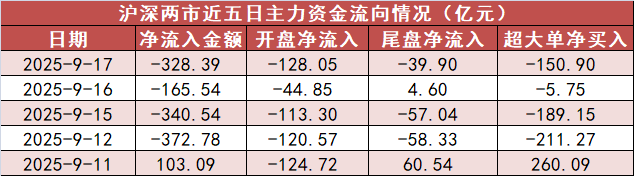
9月17日,A股市场整体上涨。 截至收盘,上证指数收报3876.34点,上涨0.37%,深证成指收报13215.46点,上涨1.16%,创业板指收报3147.35点,上涨1.95%,北证50指数下跌0.6%。A 股市场合计成交24031.86亿元,较上一交易日增加358.82亿元。 A股市场全天主力资金净流出328.39亿元 今日A股市场主力资金开盘净流出128.05亿元,尾盘净流出39.9亿元,A股市场全天主力资金净流出328.39亿元。 | | | 沪深两市近五日主力资金流向情况(亿元) | | | | --- | --- | --- | --- | --- | | 日期 | | 净流入金额 开盘净流入 | | 尾盘净流入 超大单净买入 | | 2025-9-17 | -328. 39 | -128. 05 | -39.90 | -150. 90 | | 2025-9-16 | -165.54 | -44. 85 | 4. 60 | -5. 75 | | 2025-9-15 | -340. 54 | -113. 30 | -57.04 | -189. 15 | | 2025-9-12 | -372.78 ...

市场抢跑,新一轮上涨行情启动?
Sou Hu Cai Jing· 2025-09-17 10:21
Core Viewpoint - The A-share and Hong Kong stock markets experienced a strong rally, driven by the technology growth sector, with significant gains in the ChiNext Index and the Hang Seng Technology Index, indicating a positive market sentiment ahead of anticipated Federal Reserve interest rate cuts [1][2]. Market Performance - A-share market continued its upward trend, with the ChiNext Index breaking through 3100 points, closing up 1.95% at 3147.35 points. The Shanghai Composite Index rose 0.37% to 3876.34 points, while the Shenzhen Component increased by 1.16% to 13215.46 points. The total market turnover reached 2.4 trillion yuan, an increase of 359 billion yuan from the previous trading day [2]. - In the Hong Kong market, the Hang Seng Index rose 1.78% to 26908.39 points, and the Hang Seng Technology Index surged 4.22% to 6334.24 points, with significant inflows from southbound funds totaling 9.441 billion HKD [2]. Industry Highlights and Driving Logic - The A-share market saw a dual drive from high-end manufacturing and technology sectors, with the new energy industry chain experiencing a broad rally. The power equipment sector led with a 2.55% increase, while the automotive sector rose 2.05%, supported by better-than-expected new energy vehicle export data [3]. - In the Hong Kong market, technology and education sectors saw significant gains, with the Sapphire Index soaring 7.45% and the online education index rising 6.66%, driven by improved policy expectations [3]. Underperforming Sectors and Driving Logic - In the A-share market, consumer and cyclical sectors showed weak performance, with the agriculture, forestry, animal husbandry, and fishery sector declining by 1.02% due to falling pork prices. The retail and social services sectors also faced declines of 0.98% and 0.86%, respectively, due to weak consumption data [4]. - In the Hong Kong market, the precious metals and healthcare sectors faced significant declines, with the precious metals index dropping 2.20% amid concerns over overbought conditions in gold [4]. Investment Strategy Recommendations - The market exhibited a structural characteristic of "growth dominance, value consolidation," with a focus on technology and high-end manufacturing in the medium to long term. The A-share market is advised to focus on "new energy + hard technology" dual lines, particularly in the lithium battery and semiconductor sectors [5][6]. - For the Hong Kong market, a strategy focusing on "technology leaders + policy beneficiaries" is recommended, particularly in AI chips and cloud computing sectors, which still have upward potential [5][6].
12.11亿元主力资金今日撤离社会服务板块
Zheng Quan Shi Bao Wang· 2025-09-17 08:51
Market Overview - The Shanghai Composite Index rose by 0.37% on September 17, with 20 industries experiencing gains, led by the power equipment and automotive sectors, which increased by 2.55% and 2.05% respectively [1] - Conversely, the agriculture, forestry, animal husbandry, and fishery sectors, along with retail trade, saw declines of 1.02% and 0.98% respectively [1] Capital Flow Analysis - The main capital outflow from the two markets totaled 38.306 billion yuan, with five industries seeing net inflows [1] - The power equipment industry led the net inflow with 1.835 billion yuan, followed by the automotive sector with 1.142 billion yuan [1] - A total of 26 industries experienced net capital outflows, with the non-bank financial sector leading at 5.229 billion yuan, followed by the computer industry with 4.455 billion yuan [1] Social Services Sector Performance - The social services sector declined by 0.86%, with a net capital outflow of 1.211 billion yuan [2] - Out of 78 stocks in this sector, 18 rose, including one that hit the daily limit, while 60 fell [2] - The top net inflow stock in this sector was Yunnan Tourism, with a net inflow of 136 million yuan, followed by Ancar Detection and Emei Mountain A with inflows of 69.9 million yuan and 39.8 million yuan respectively [2][4] - The stocks with the highest net outflows included Caesar Travel, West Region Tourism, and Zhongxin Tourism, with outflows of 196 million yuan, 110 million yuan, and 90.7 million yuan respectively [2]



10:30,A股突然拉升!宁德时代,新高
Zheng Quan Shi Bao· 2025-09-17 05:02
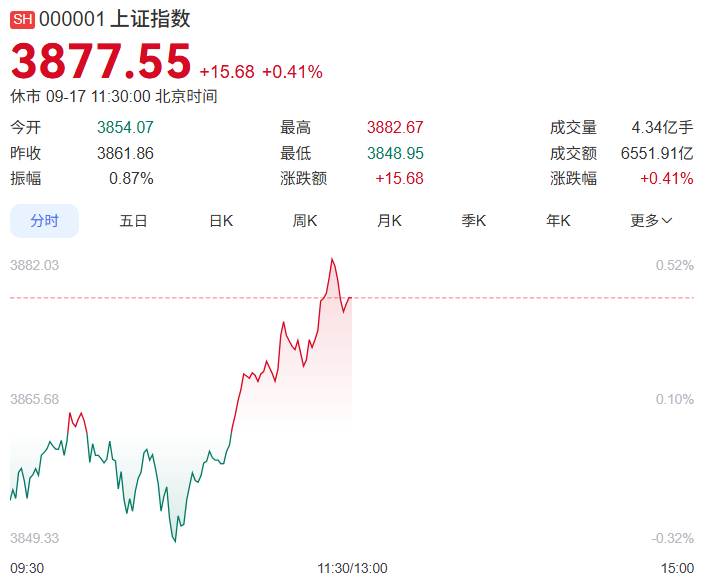
Market Performance - The A-share market experienced a narrow fluctuation in the morning of September 17, 2023, with a sudden collective rise in the three major indices around 10:30 AM, leading to all indices turning positive. The ChiNext Index rose over 1.5%, reaching a nearly three-year high, while the leading stock, CATL, hit a new high in its adjusted price [1][2] - By midday, the Shanghai Composite Index increased by 0.41%, the Shenzhen Component Index rose by 1.02%, and the ChiNext Index saw a gain of 1.74% [2] Stock Highlights - CATL, a leading stock in the ChiNext Index, surged with its adjusted price reaching a historical high, with an intraday increase approaching 8%. Other notable stocks included Changying Precision, which saw an intraday rise exceeding 16%, along with Sanhua Group, Yilian Network, Xinwangda, and Changchuan Technology, which also performed strongly [4] - In the Hong Kong market, the Hang Seng Index rose significantly, reaching a nearly four-year high, with Baidu Group-SW experiencing an intraday increase of over 12% and a cumulative rise of over 40% since September [9][10] Sector Performance - In terms of sector performance, the top gainers included the electric equipment, automotive, coal, and home appliance sectors, while the social services and agriculture sectors faced declines [7]

10:30,A股突然拉升!宁德时代,新高!
Zheng Quan Shi Bao· 2025-09-17 04:02
宁德时代(300750)引爆行情。 A股市场今天早盘窄幅震荡,10:30左右三大股指突然集体拉升,其中创业板指走势强劲,盘中再度创出近三年多新高。截至中午收盘,上证指数上涨 0.41%,深证成指上涨1.02%,创业板指上涨1.74%。 创业板指成份股中,龙头股宁德时代大涨,盘中复权价再创历史新高,涨幅一度接近8%。长盈精密(300115)大涨,盘中涨幅一度超过16%。此外,三 环集团(300408)、亿联网络(300628)、欣旺达(300207)、长川科技(300604)等多股盘中涨幅也居于市场前列。 行业板块方面,若按照申万一级行业划分,电力设备、汽车、煤炭、家用电器等板块盘中涨幅居前,社会服务、农林牧渔等板块盘中跌幅居前。 *ST东通四个交易日股价"腰斩" A股市场今天(9月17日)早盘窄幅震荡,10:30左右三大股指突然集体拉升,并全部翻红。其中创业板指涨超1.5%,盘中创出近三年多新高,龙头股宁德 时代复权价再创新高。 港股市场今天上午亦整体上行,恒生指数盘中再度刷新近四年新高。 创业板指大涨 "宁王"复权价再创新高 今天上午*ST东通(300379)股价再度跌停,这是该股连续第3个交易日"20cm ...

兴业证券:美联储降息后各大类资产如何表现?
智通财经网· 2025-09-16 23:04
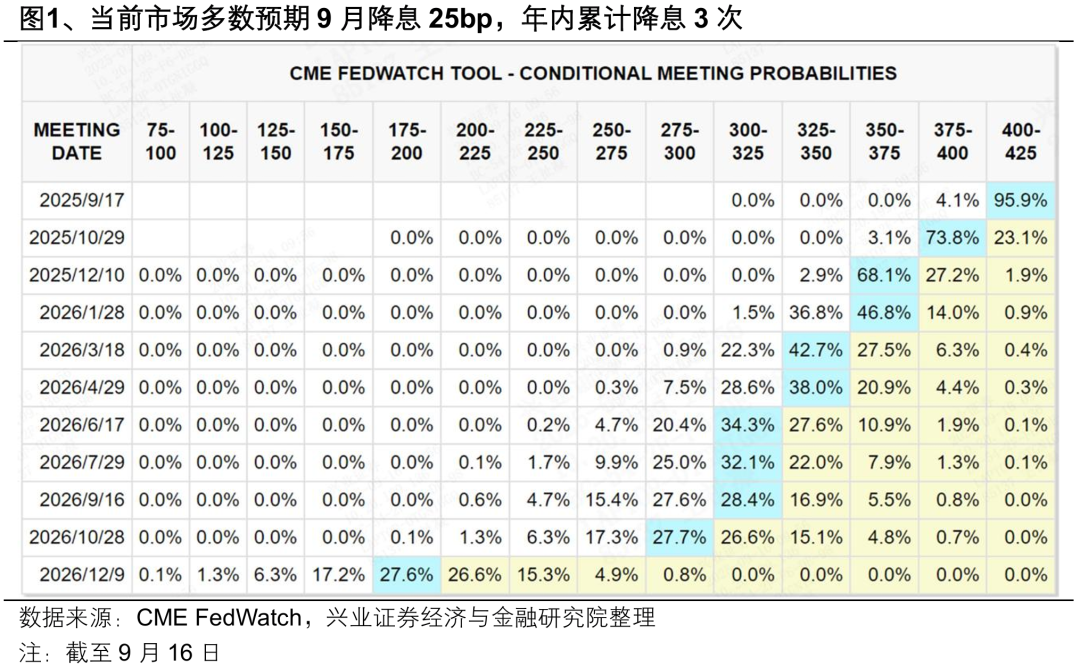
Core Viewpoint - The Federal Reserve is expected to initiate a new round of interest rate cuts, with a 95% probability of a 25 basis point "preventive rate cut" in September [2][3]. Group 1: Market Reactions to Rate Cuts - Historical analysis shows that "preventive rate cuts" and "recessionary rate cuts" have different impacts on major asset prices [3][4]. - Following preventive rate cuts, A-shares benefit from liquidity easing and improved risk appetite, particularly in sectors like TMT (Technology, Media, Telecommunications), food and beverage, social services, beauty care, and biomedicine [4][8]. - In contrast, during recessionary rate cuts, A-shares and Hong Kong stocks tend to decline due to global economic downturns, with defensive assets like non-bank financials, banks, and cyclical sectors such as petrochemicals and chemicals performing better [4][8]. Group 2: Sector Performance Analysis - Under preventive rate cuts, various sectors show significant average price changes: - Technology sector (Electronics) sees an average increase of 19.07% over 10 days, 35.64% over 30 days, and 33.10% over 60 days [8]. - Consumer sectors (Food & Beverage) experience increases of 16.14%, 22.26%, and 19.22% respectively [8]. - For recessionary rate cuts, sectors like non-essential consumer goods and technology also perform well, but defensive sectors like energy and telecommunications gain prominence [9]. Group 3: Broader Market Implications - The U.S. stock market is expected to respond positively to preventive rate cuts, with fundamentals driving overall market performance [9]. - The dollar and U.S. Treasury yields are influenced by the same dynamics, with preventive cuts initially suppressing the dollar but later leading to an upward trend as fundamentals improve [11][14]. - Gold prices may initially rise due to liquidity easing but could decline as economic expectations improve and the dollar strengthens [16].

波动降低后是更好的参与时机
China Post Securities· 2025-09-15 11:38
Market Performance Review - The A-share market recovered from last week's decline, with significant volatility remaining a characteristic feature. Major indices mostly rose, with the ChiNext index rebounding by 5.48% after a previous drop of 5.42%. The CSI A50 and SSE 50, which are heavily weighted by large-cap stocks, lagged behind in terms of growth. Growth style stocks showed a strong rebound, while financial stocks had smaller gains. Small-cap stocks significantly outperformed large-cap stocks, with the Ning and Mao indices both rising, the Ning combination increasing by 1.95% and the Mao index slightly up by 0.40% [3][12][29]. Industry Overview - The industry saw a general rebound but lacked a clear leading theme. Among the Shenwan first-level industries, electronics (6.15%), real estate (5.98%), agriculture, forestry, animal husbandry, and fishery (4.81%), media (4.27%), and non-ferrous metals (3.76%) led the gains. Conversely, sectors like social services (-0.28%), pharmaceuticals and biology (-0.36%), oil and petrochemicals (-0.41%), banking (-0.66%), and comprehensive (-1.43%) performed poorly. The current market is still entangled in narratives around AI infrastructure investment, potential Fed rate cuts, and anti-involution policies [4][13][29]. Future Outlook and Investment Views - The report suggests that lower volatility presents better participation opportunities. Although there was a significant single-day rise in the A-share market, it does not imply that short-term downward volatility risks have been fully alleviated. Intense bull-bear battles are common at the tail end of a trend, indicating that time is needed for consolidation before the next upward phase. Future volatility in the A-share market is expected to be more influenced by overseas factors, particularly following disappointing U.S. non-farm payroll data in August, which solidifies expectations for a Fed rate cut in September. The A-share market will likely use the rate cut as a key pricing logic point after completing its adjustment [4][29]. Stock Selection Strategy - The report emphasizes that individual stock alpha logic is superior to industry beta logic, focusing on identifying "turnaround" opportunities in individual stocks. The TMT growth sectors, represented by AI applications, computing power chains, and optical modules, which have been adjusting since March, are expected to see valuation recovery opportunities. The report highlights that simply buying stocks with "earnings exceeding expectations" during the mid-year reporting season may not yield sustained relative returns. Instead, the "turnaround" strategy is deemed more effective for performance discovery during this period. The report constructs a portfolio of stocks expected to exceed earnings expectations for the mid-year report, aiming to capture excess returns from individual stock alpha in September and October [5][29].