软件

Search documents
高盛推出“抗AI冲击”主题投资组合,看好甲骨文和微软等
Ge Long Hui A P P· 2026-02-14 12:05
Group 1 - Goldman Sachs has launched a new "anti-AI impact" thematic investment portfolio, betting on companies less likely to be affected by AI disruptions [1] - The portfolio includes a long position in companies that require physical execution, are heavily regulated, or must be accountable by humans, which are difficult to replace with AI [1] - On the short side, the strategy targets companies with workflows that could be gradually automated by AI, such as Duolingo and Semrush [1] Group 2 - Goldman Sachs is optimistic about AI infrastructure-related companies, covering areas like computing power, cloud services, data facilities, development tools, and cybersecurity, with Oracle and Microsoft as representative firms [1]

畅捷通股价异动:技术面承压与板块拖累成主因
Xin Lang Cai Jing· 2026-02-14 11:53
Company Performance - The company reported a mid-year revenue of 483 million yuan for 2025, reflecting a year-on-year growth of 6.7%, with a net profit of 33.51 million yuan indicating a turnaround [4] - AI-driven cloud subscription revenue accounts for 71% of total revenue, suggesting a sustainable profit model [4] - Current valuation metrics show a price-to-earnings ratio (TTM) of 27.94 times and a price-to-book ratio of 2.30 times, indicating a debate on whether the valuation aligns with growth [4] Stock Price Movement - On February 13, the stock price closed at 7.24 HKD, down 3.21% from the previous day, with a trading volume of only 32,400 shares and a turnover rate of 0.02% [1] - The stock has shown high historical volatility, with a price range fluctuation of 109.42% from April to September 2025, including a single-day increase of 23.38% on September 24, 2025 [5] Market and Sector Context - The Hang Seng Index fell by 1.72% on the same day, while the application software sector rose by 1.61%, indicating that the individual stock performance was significantly weaker than the sector [2] - The IT services II sector declined by 0.76% and the domestic software sector fell by 0.44%, reflecting a general downturn in technology stock sentiment [2] - Market liquidity was reduced due to the suspension of Hong Kong Stock Connect services during the Spring Festival, exacerbating volatility in small-cap stocks [2][3] Capital Flow - On February 13, there was no net inflow of major funds into the stock, with retail investors contributing a net inflow of 46,200 HKD and an average transaction price of 7.313 HKD [3] - The stock has not been covered by investment banks in the past 90 days, leading to low market attention and a predominance of retail-driven capital flow, which can lead to price fluctuations due to limited trading [3]
“我们正在目睹一场AI创造性破坏席卷全球各行各业”!高盛合伙人:本质上,这是一次“护城河检查”
硬AI· 2026-02-14 11:37
Core Viewpoint - The market is experiencing a "sell first, ask questions later" panic, fundamentally testing the economic moats of companies, with a focus on those with real competitive advantages, tangible assets, and industrial stocks. The aerospace sector is viewed positively, while caution is advised regarding bank stocks [2][3][15]. Group 1: Market Sentiment and AI Impact - A "creative destruction" driven by AI is sweeping across various industries, fundamentally testing the competitive advantages of companies [3][6]. - The initial perception of AI as a positive market factor has shifted to a rapid assessment of which companies can withstand technological disruptions [3][6]. - The sentiment of "sell first, ask questions later" is spreading, with accelerated selling but no clear catalysts beyond AI concerns [3][6]. Group 2: Valuation and Market Dynamics - Valuation multiples are difficult to anchor; once questioned, they tend to decline, with public company valuations dropping from over 30 times earnings to just above 20 times [8]. - The turmoil is spreading from public markets to private equity and private credit, particularly affecting the leveraged loan market [8]. Group 3: Investment Recommendations - Companies with genuine economic moats and tangible assets should be prioritized for investment, with a particular focus on the aerospace sector and industrial stocks benefiting from the investment cycle [15]. - Real estate investment trusts (REITs) in Europe, particularly German residential properties, are seen as favorable, while office REITs are to be avoided [15]. - Bank stocks are viewed as vulnerable due to multiple risks, including crowded positions in Europe, unaccounted AI disruption, and regulatory risks from potential political shifts in the U.S. [16]. Group 4: CTA Selling Signals - There is a need to be cautious of CTA (Commodity Trading Advisor) selling signals in major U.S. indices, with an estimated $1.5 to $2 billion in U.S. stock sales expected in the coming week [4][18]. - The S&P 500 has fallen below key moving averages, and a breach of the mid-term threshold of 6723 points could accelerate selling [18]. Group 5: Future Market Outlook - The current environment favors companies with real economic moats and tangible value, as AI continues to lower barriers to entry, leading to a market of clear winners and losers [21]. - Emerging markets are perceived as relatively clearer safe havens, with global trading dynamics expected to drive superior performance [21].


"杭州六小龙"首家冲刺资本市场,群核科技获港股上市备案通知书,2025年上半年已扭亏为盈
Jin Rong Jie· 2026-02-14 11:27
Group 1 - Manycore Tech Inc. has received a notification for overseas listing, planning to issue up to approximately 312 million shares on the Hong Kong Stock Exchange, with JPMorgan and CCB International as joint sponsors [1][4] - Manycore Tech is part of the "Hangzhou Six Little Dragons" and aims to be the first among them to go public [1][3] - The company was founded in 2011 by Huang Xiaohuang, Chen Hang, and Zhu Hao, who have backgrounds in NVIDIA, Microsoft, Amazon, and the National Supercomputing Application Center [3] Group 2 - Manycore Tech is the largest space design software provider in China, with a market share of approximately 23.2% based on projected 2024 revenue [3] - Revenue is expected to grow from 601 million yuan in 2022 to 755 million yuan in 2024, with a 9.4% year-on-year increase in the first half of 2025, reaching 399 million yuan [3][4] - The gross profit margin is projected to increase from 72.7% to 82.1% during the same period [3] Group 3 - The co-founders hold significant shares: Huang Xiaohuang at 15.46%, Chen Hang at 11.04%, and Zhu Hao at 4.22% [4] - The company has received investments from several institutions, including IDG Capital, GGV Capital, and Hillhouse Capital [4] - Funds raised from the IPO will be primarily used for international expansion, product upgrades, domestic sales promotion, core technology investment, and general operational purposes [4]


能源、必选消费和美债领涨2026!华尔街的“AI交易”被“AI颠覆”了
华尔街见闻· 2026-02-14 10:53
Group 1 - The core viewpoint of the article is that AI, initially seen as a strong investment theme, has transformed into a threat, particularly impacting light-asset companies that may be replaced by AI rather than the tech giants developing it [1][6][7] - The S&P 500 index experienced its worst performance since November until a rebound on Friday due to mild inflation data, highlighting the widespread panic regarding AI disruption across various markets [2][4] - The profitability expansion accumulated by white-collar industries such as software companies, wealth management firms, and tax advisors over the past decade has been revalued within weeks, affecting even the private credit market that lends to these companies [3] Group 2 - Wall Street's previously confident bets have failed dramatically over six weeks, with cash allocations hitting a historical low and hedge positions at their minimum, leading to a collapse of consensus trades [5][8] - The sectors that have performed well include energy, consumer staples, and U.S. Treasury bonds, while the consensus bets on AI have faltered significantly [5] - Investors are questioning the return timelines of large capital expenditures by tech giants and whether remaining cash can continue to support stock buybacks, with more stocks being harmed by AI than helped [8][9] Group 3 - Two forces are exacerbating volatility in the U.S. stock market: low cash allocations and interconnected leverage networks that can trigger sell-offs across seemingly unrelated investments [12][13] - The VIX index recently surpassed the widely watched 20 mark, indicating rising market stress, even though it does not show panic, as the skew of put options remains historically high [18][19] - The performance of investment-grade bond ETFs relative to high-yield bond ETFs has improved, with the U.S. 10-year Treasury yield reaching a two-month low [20][21] Group 4 - Investors are adjusting their strategies, with the S&P 500 index still hovering near historical highs and credit spreads at ten-year lows, but there is an increase in hedging activities as indicated by the rising put-call ratio [22][24] - ETFs tracking companies with high shareholder returns attracted $3.6 billion in new funds this month, indicating a shift in investor focus [25] - Analysts suggest that if negative news regarding AI disruption subsides and volatility decreases, the U.S. stock market may support upward movement, but there is a conflict between market consensus and resilient economic indicators [26]

本周,“AI颠覆一切”的狼终于来了
Hua Er Jie Jian Wen· 2026-02-14 09:07
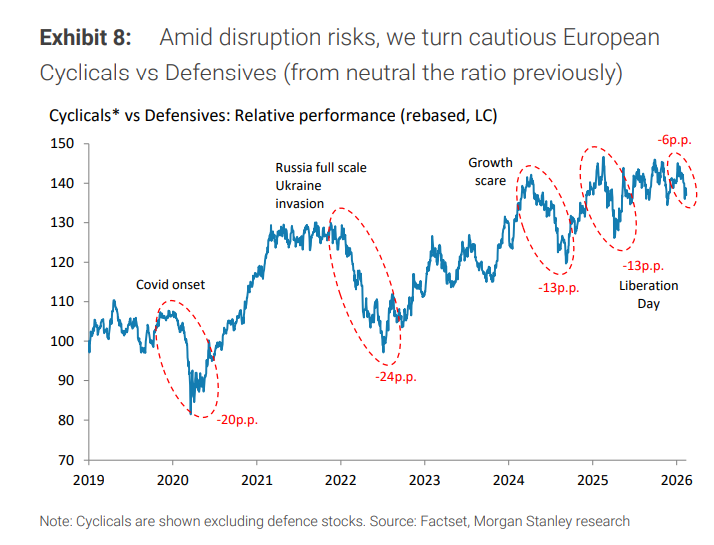
Core Insights - The market is increasingly recognizing the imminent threat of AI disruption, with the perceived risk in the MSCI Europe index rising from 4% to 24% in just over a month, including the banking sector [1][9] - Morgan Stanley has shifted its stance from neutral to cautious regarding cyclical stocks versus defensive stocks, highlighting opportunities in the European credit market for downside protection [1][15] AI Capability Advancements - The latest AI model, GPT-5.2, has achieved human expert-level performance in 71% of professional tasks, marking a significant leap in AI capabilities [5][8] - The speed of AI advancements is accelerating, with predictions that upcoming models in 2026 will far exceed current capabilities due to increased computational power [8] Market Disruption Dynamics - Initial concerns about AI's impact on the software industry have rapidly expanded to broader economic disruption risks, reminiscent of market reactions during the early COVID-19 pandemic [9][10] - Approximately 10% of the MSCI Europe index (excluding banks) is now viewed as facing substantial AI disruption risks, with this figure rising to 24% when including banks [9][10] Valuation Trends - The valuation of "disruption stocks" has decreased from a peak P/E ratio of 24x to 16.4x, with further downward potential indicated by comparisons to "uncontested disruption stocks" [10] Resilience Assessment Framework - Morgan Stanley proposes a framework to evaluate sectors and stocks based on five dimensions of risk exposure, identifying utilities, semiconductors, defense, and tobacco as the most resilient sectors [11] - Sectors such as software, commercial services, and banking are identified as facing the highest disruption risk [11] Non-AI Replicable Assets - The report emphasizes the rising value of assets that cannot be replicated by AI, including physical assets, regulatory barriers, and unique human experiences [4][12][14] Credit Market Insights - Despite AI disruption concerns affecting some credit markets, European investment-grade spreads remain low, presenting opportunities for investors to hedge against potential downturns [15] Computing Power Demand - There is a significant and growing demand for computing power, with projections indicating that the growth rate of demand will outpace current supply forecasts [16][21] - The intensity of computing requirements for AI queries is increasing rapidly, with predictions that companies may need to double their computing power every six months [19][21]



黄仁勋,跌出全球十大富翁
Xin Lang Cai Jing· 2026-02-14 07:19
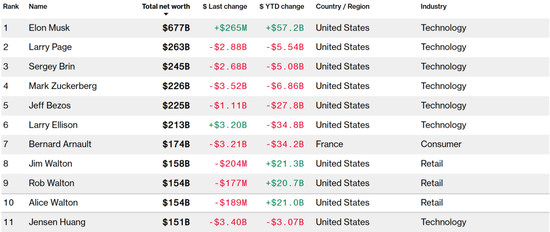
Market Overview - The US stock market is experiencing a sell-off triggered by artificial intelligence, with software and fintech stocks declining over the past week, prompting investors to seek safer assets like consumer staples [1][4] - This market movement has led to changes in the global billionaire rankings, with Nvidia CEO Jensen Huang dropping out of the top ten, his wealth now at $151 billion, having decreased by over $3 billion year-to-date [1][4] Billionaire Rankings - Elon Musk remains the wealthiest individual with a net worth of $677 billion, having increased by $572 million this year [2][6] - Larry Page and Sergey Brin, co-founders of Google, have seen their fortunes decline by over $5 billion each this year, reflecting a broader trend among tech billionaires [5][6] - Larry Ellison, chairman of Oracle, has experienced the most significant wealth drop, down $34.8 billion to $213 billion, a decrease of over 45% from his peak [3][6] Retail Sector Performance - The Walton siblings (Jim, Rob, and Alice) have entered the top ten billionaire list, with a combined net worth of $465.8 billion, benefiting from Walmart's stock price increase of over 18% this year [3][6] - Walmart's digital transformation has been a key driver of its stock performance, helping the retailer capture market share and attract more online shoppers while maintaining its low-price strategy [3][6] - Walmart's market capitalization surpassed $1 trillion earlier this month, setting a new record for US retailers amid the turmoil in the tech sector [3][6]
如何理解开年全球市场?“可负担性”才是 2026 的总叙事:“主街”要赢一次,AI叙事巨变,日元是“关键”
Hua Er Jie Jian Wen· 2026-02-14 05:53
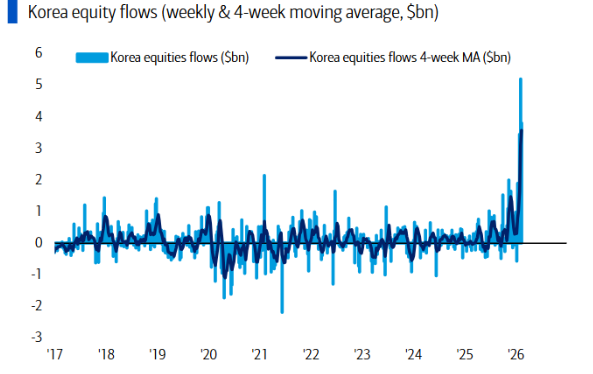
Core Insights - The global market is undergoing a paradigm shift as money moves away from previously favored assets towards those benefiting "Main Street" rather than "Wall Street" [1][2] Group 1: Market Trends - Year-to-date, gold has risen by 13.4%, oil by 9.5%, and international stocks by 8.7%, while U.S. stocks have declined by 0.2% and Bitcoin has plummeted by 25% [1] - A historic rotation from large-cap growth stocks to small-cap value stocks has begun in the U.S. [1] - Assets benefiting "Main Street" have performed well, including silver (+56%), the KOSPI index (+34%), and Brazilian stocks (+30%) since late October [2] Group 2: AI Narrative Shift - The market's perception of artificial intelligence is shifting from "AI awe" to "AI poor," indicating a focus on the costs and disruptions associated with AI [6] - Over the past five months, debt issuance by large AI companies has reached $170 billion, significantly higher than the average of $30 billion per year from 2020 to 2024 [6] Group 3: Currency and Global Liquidity - The correlation between the Japanese yen and the Nikkei index has turned positive for the first time since 2005, signaling a potential structural bull market [10][13] - A rapid appreciation of the yen could lead to increased selling pressure on various assets, including cryptocurrencies and energy [13] Group 4: Investment Strategy and Future Outlook - The current "bull-bear indicator" reading of 9.4 suggests a high level of market enthusiasm, indicating potential short-term pullback risks [14] - Historical precedents show that significant political or financial events often trigger major asset rotations, and the current environment may be at the start of a new "great rotation" [15] - Emerging markets and small-cap stocks are expected to outperform large-cap growth stocks due to rising populism and high costs associated with the AI arms race [15][21]
能源、必选消费和美债领涨2026!华尔街的“AI交易”被“AI颠覆”了
美股IPO· 2026-02-14 04:12
Group 1 - The core viewpoint of the article is that the initial optimism surrounding AI as a strong investment theme has shifted to concerns about its disruptive potential, particularly for asset-light companies that may be replaced by AI technologies [3][7][22] - The S&P 500 index experienced significant volatility, with its performance deteriorating to the worst levels since November, exacerbated by fears of AI disruption spreading across various markets [4][5] - The financial sector has been notably affected, with a marked decline in performance, while utility stocks have emerged as a safe haven amid AI-related concerns [5][6] Group 2 - Investor sentiment has shifted dramatically, with many now questioning the return timelines on large capital expenditures by tech giants and the sustainability of stock buybacks [8][10] - The market is undergoing a revaluation, particularly in the software sector, raising fears of contagion effects that could impact other industries [9][10] - Extreme positioning and leverage in the market are amplifying volatility, with a significant drop in cash allocations and a lack of downside protection among fund managers [11][12] Group 3 - There has been a notable increase in hedging activities, as evidenced by rising volumes of put options, indicating a growing concern for downside risks [19][20] - The Chicago Board Options Exchange's put-call ratio has surged since January, reflecting heightened investor caution [20] - Despite current volatility, the S&P 500 remains near historical highs, and credit spreads are at ten-year lows, suggesting that a market collapse has not yet materialized [18][22]

索罗斯Q4调仓路线图:猛砍Snowflake,狂买微软、英伟达,新建仓黄金股
美股IPO· 2026-02-14 04:12
Core Viewpoint - Soros Fund Management made significant adjustments to its investment portfolio in the fourth quarter, focusing on increasing exposure to tech giants while engaging in "buy high, sell low" strategies for energy and cryptocurrency stocks [1]. Group 1: Technology Sector Investments - The fund substantially increased its holdings in core technology stocks, including adding 161,000 shares of Microsoft (MSFT.US), 118,000 shares of Nvidia (NVDA.US), and approximately 66,000 shares of Apple [3]. - In the software and mobility sectors, the fund also increased its positions by acquiring approximately 216,000 shares of Atlassian (TEAM.US), 55,000 shares of Salesforce (CRM.US), and 119,000 shares of Uber (UBER.US) [3]. Group 2: Defensive and Growth Investments - In the defensive sector and consumer space, the fund increased its holdings in utility company Exelon (EXC.US) by approximately 488,000 shares and in gaming giant Electronic Arts (EA.US) by about 318,000 shares [3]. Group 3: Reduction in High Volatility and Financial Stocks - The fund reduced its positions in high-volatility and financial stocks, significantly cutting approximately 168,000 shares of Snowflake (SNOW.US) [4]. - It also reduced its holdings in Circle Internet Group (CRCL.US) by about 151,000 shares and in Interactive Brokers (IBKR.US) by approximately 813,000 shares, indicating a cautious stance towards the financial brokerage sector [5][6]. Group 4: New Positions and Exits - The fund opened new positions by purchasing gold-related assets such as New Gold (NGD.US) and established positions in DigitalBridge (DBRG.US), Blue Owl Capital (OWL.US), Exact Sciences (EXAS.US), and Xcel Energy (XEL.US) [7]. - It completely exited positions in KeyCorp (KEY.US), CareTrust REIT (CTRE.US), Cipher Mining (CIFR.US), and KKR & Co. (KKR.US), indicating a shift away from traditional banking and certain cryptocurrency mining stocks towards more stable or defensive sectors [7]. Group 5: Overall Strategy - The overall strategy of Soros Fund Management in the fourth quarter reflects a clear approach: embracing AI and core tech assets like Microsoft and Nvidia while avoiding high-volatility cloud and data companies like Snowflake, and hedging against macroeconomic uncertainties by investing in gold stocks. This "pick and choose" adjustment strategy highlights the pursuit of certainty and safety margins amid global economic uncertainties [7].