
创新药

Search documents
中国手术机器人行业近况更新:华创医药投资观点&研究专题周周谈·第161期-20260131
Huachuang Securities· 2026-01-31 15:16
Investment Rating - The report does not explicitly state an investment rating for the surgical robot industry, but it highlights a positive outlook for growth and innovation in the sector. Core Insights - The surgical robot industry in China is entering a rapid development phase, supported by national policies and capital investment, with significant advancements in technology and market demand [13]. - The report emphasizes the transition from a capital-driven to a value-driven model in the surgical robot sector, indicating a shift towards more sustainable growth and clinical applications [13]. - The approval process for surgical robots by the NMPA has accelerated, particularly for domestic products, with orthopedic surgical robots leading in the number of approvals [30]. Summary by Sections Market Overview - The surgical robot market in China is characterized by a growth in sales volume, with a total of 332 units sold in the first 11 months of 2025, reflecting a year-on-year increase of 3.75% [34]. - The sales revenue for surgical robots reached 2.973 billion yuan, showing a slight decline of 0.87% year-on-year, indicating a structural transition rather than a market downturn [34]. Technological Advancements - Innovations in remote operation, miniaturization, and AI assistance are driving the development of surgical robots, with notable products like the first remote surgical robot approved in China [16][19]. - The report highlights the introduction of AI-assisted surgical robots that enhance precision and efficiency in surgeries, marking a significant technological leap in the industry [16]. Regulatory Developments - The National Healthcare Security Administration has established a pricing framework for surgical robots, which is expected to facilitate market growth by clarifying reimbursement policies and pricing structures [27][26]. - The report notes that the establishment of a clear payment system is crucial for the adoption of surgical robots in hospitals, as high costs and long return periods can deter procurement [27]. Market Segmentation - The orthopedic surgical robot segment dominates the market, accounting for 50% of the NMPA approvals from 2014 to 2024, with a strong growth trajectory expected in this area [30]. - The report identifies the laparoscopic surgical robot and orthopedic surgical robot as the two largest segments in the market, with significant potential for expansion in emerging fields [41]. Future Outlook - The report projects substantial growth in the surgical robot market, with expectations for increased penetration rates and market size driven by technological advancements and policy support [44]. - The anticipated CAGR for the laparoscopic surgical robot market from 2024 to 2033 is estimated at 30.4%, indicating robust future demand [44].
华创医药周观点:中国手术机器人行业近况更新 2026/01/31
华创医药组公众平台· 2026-01-31 15:13
Core Viewpoint - The Chinese surgical robot industry is entering a rapid development phase, driven by policy support, capital investment, and technological advancements, with significant progress in various fields such as orthopedics and neurosurgery [13][21]. Market Overview - The CITIC Medical Index fell by 3.33% this week, underperforming the CSI 300 Index by 3.41 percentage points, ranking 22nd among 30 primary industries [8]. - The top ten stocks by growth this week included Cap Bio, Hualan Biological, and Dezheng Health, while the biggest losers were *ST Sailong and Vcare Pharmaceuticals [8]. Industry and Company Events - The surgical robot market is characterized by a shift from capital-driven to value-driven development, with increasing applications in remote surgery and AI-assisted decision-making [13][21]. - The NMPA has accelerated the approval of surgical robots, with orthopedic surgical robots accounting for 50% of the approved products from 2014 to 2024, maintaining the highest share [22]. Investment Themes - The innovative drug sector is transitioning from quantity to quality, emphasizing differentiated products and internationalization by 2025 [11]. - The medical device sector is witnessing a recovery in bidding volumes for imaging equipment, with ongoing updates in home medical devices supported by subsidies [11]. - The CXO and life sciences services are expected to see a rebound in investment, with a focus on high-profit elasticity companies as the industry matures [11]. Technological Progress - Remote operation, miniaturization, and AI assistance are key trends in the surgical robot sector, with products like the TUMAI® remote surgical robot achieving significant milestones in cross-border surgeries [17][19]. - The first AI-assisted orthopedic surgical robot, ROPA HIP, has been approved, showcasing advancements in surgical simulation technology [17]. Regulatory Developments - The National Medical Insurance Administration (NMPA) has established a pricing system for surgical robots, which is expected to enhance the industry's growth by clarifying reimbursement standards [21]. - The introduction of a legal and clear pricing project for surgical robots is anticipated to provide institutional support for innovation and development in the industry [21]. Sales and Market Dynamics - The sales volume of surgical robots in China reached 332 units in the first 11 months of 2025, reflecting a 3.75% year-on-year increase, while sales revenue decreased by 0.87% [27]. - The orthopedic surgical robot segment showed a significant growth of 17.81% in volume and 21.62% in revenue, indicating a robust demand in specialized fields [27]. Market Segmentation - The market for surgical robots is dominated by laparoscopic and orthopedic surgical robots, which accounted for 42% and 32% of the market share, respectively, in 2024 [25]. - Emerging fields such as vascular surgery robots are expected to present substantial market potential as the industry evolves [27].

开年超283亿资金涌入港股ETF
2 1 Shi Ji Jing Ji Bao Dao· 2026-01-31 02:39
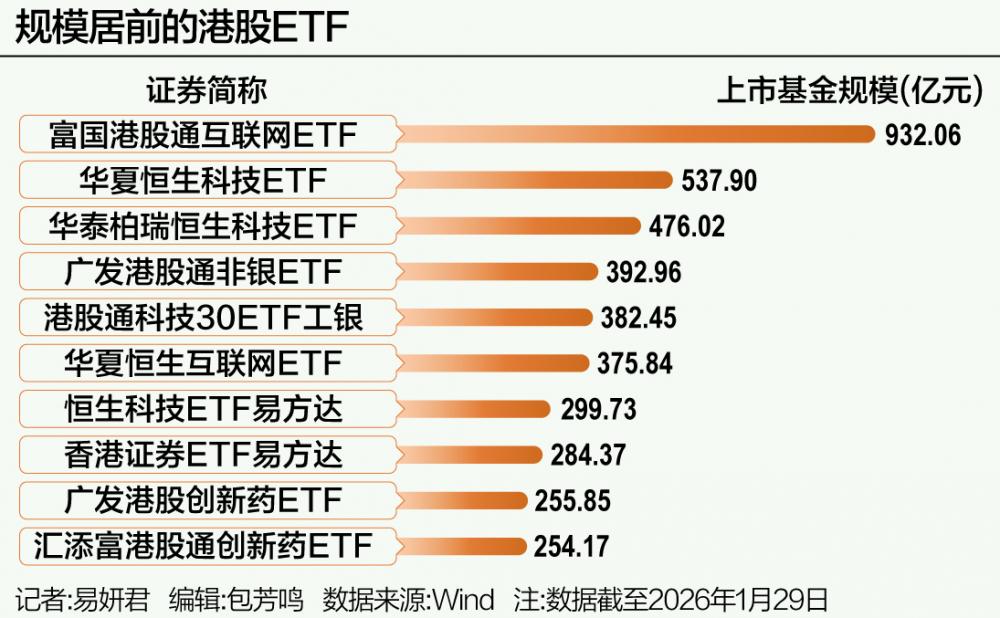
Core Insights - The cross-border ETFs have seen significant inflows into Hong Kong's technology sector, with over 160 ETFs attracting a net inflow of 28.389 billion yuan since the beginning of 2026, primarily into technology-themed products [1][4][5] - The total scale of Hong Kong ETFs has approached 800 billion yuan, marking an increase of nearly 79 billion yuan since the end of 2025, driven by both net subscriptions and fund value growth [1][6] - Public fund managers have reported at least 28 new Hong Kong-themed funds since the start of 2026, with a strong focus on technology, healthcare, and consumer sectors [1][7][9] Fund Inflows - The technology-themed ETFs have been the main drivers of capital inflow, with net inflows of 16.052 billion yuan for technology ETFs and 9.916 billion yuan for internet-themed ETFs, accounting for approximately 90% of total net inflows [5] - Ten ETFs have attracted over 1 billion yuan each, with eight of them focused on technology, indicating a strong preference for this sector among investors [4][5] Fund Performance - Most Hong Kong ETFs have recorded positive returns since the beginning of 2026, with several healthcare and non-bank financial ETFs exceeding a 10% return [6] - The increase in fund size and net value has contributed to the rapid expansion of the Hong Kong ETF market, which has grown by approximately 11% since the end of 2025 [6] New Fund Launches - The new funds reported include a variety of types such as ETFs, index funds, and mixed funds, with a significant emphasis on technology and healthcare themes [8][9] - Fund managers are actively exploring investment opportunities in the Hong Kong market, particularly in sectors with high growth potential [10] Long-term Investment Focus - Analysts highlight three key areas for long-term investment: technology, upstream resources, and companies expanding internationally, with a particular emphasis on the technology sector's growth potential [11][12]
开年超283亿资金涌入港股ETF
21世纪经济报道· 2026-01-30 14:23
Core Viewpoint - The article highlights a significant inflow of funds into Hong Kong's technology sector through cross-border ETFs, indicating a growing interest in technology-themed investments as the market rebounds in early 2026 [1][3]. Fund Inflows and Performance - Since the beginning of 2026, over 160 Hong Kong ETFs have seen a net inflow of 28.389 billion yuan, with approximately 90% of this capital directed towards technology-themed products such as the Hong Kong Internet ETF and the Hang Seng Technology ETF [1][3][4]. - The total scale of Hong Kong ETFs has approached 800 billion yuan, marking an increase of nearly 79 billion yuan since the end of 2025, representing an 11% growth [6]. Product Development - At least 28 new Hong Kong-themed funds have been reported by public fund managers since the start of 2026, focusing primarily on technology, healthcare, and consumer sectors, with technology funds being the most prominent [1][8][9]. - The top 10 funds attracting significant capital include several technology ETFs, with inflows exceeding 10 billion yuan for products like the GF Hong Kong Non-Bank ETF and the FT Hong Kong Internet ETF [4][5]. Fund Performance - Most Hong Kong ETFs have recorded positive returns since the beginning of 2026, with several funds in the healthcare and non-bank sectors achieving returns over 10% [5][6]. - The performance of technology-themed ETFs has been particularly strong, with the Hong Kong Internet ETF and the Hang Seng Technology ETF yielding returns of approximately 8.9% and 8%, respectively [5]. Long-term Investment Outlook - The article emphasizes the long-term growth potential of the technology sector in Hong Kong, driven by global capital and talent influx, as well as favorable trends in artificial intelligence and innovation [10][11]. - The article also notes the potential for investment in upstream resources and companies expanding internationally, indicating a broader strategy for capital allocation in the Hong Kong market [10].

A股港股医药表现不同,原因是啥?|第432期直播回放
银行螺丝钉· 2026-01-30 13:45
Group 1 - The pharmaceutical industry has various sub-sectors, with the most funds allocated to three main areas: healthcare, biotechnology, and innovative drugs [3][16] - The healthcare sub-sector includes medical services and medical devices, such as hospitals and equipment like pacemakers and syringes [4][5][6] - The biotechnology sub-sector focuses on companies in gene diagnostics, biopharmaceuticals, blood products, and human biotechnology, including vaccines [7][8][9] - The innovative drugs sub-sector is primarily related to pharmaceuticals, with many companies involved in both biotechnology and innovative drugs [10][11] Group 2 - Over the past 20 years, the A-share pharmaceutical industry has experienced six cycles of bull and bear markets, with the latest cycle starting in 2024 [18][19] - The A-share pharmaceutical index has shown limited growth recently, underperforming compared to the broader market, while the Hong Kong pharmaceutical index has significantly outperformed the Hang Seng Index [22][24] - The differences in performance between A-share and Hong Kong pharmaceutical sectors are attributed to variations in fundamentals and valuations [25][26] Group 3 - The A-share pharmaceutical sector is currently in a recovery phase, with a modest year-on-year profit growth of a few percent, while the Hong Kong pharmaceutical sector is in a boom phase with strong profit recovery [41][43] - Investment in the pharmaceutical industry should focus on undervalued opportunities, with a recommendation to buy during low valuation periods and hold until high valuation [46][48] - It is advised to limit exposure to individual industry or thematic investments to 15-20% for stability [49]

BD炒作彻底翻篇了
3 6 Ke· 2026-01-30 13:08
Core Insights - The collaboration between CSPC Pharmaceutical Group and AstraZeneca has resulted in unexpected outcomes, particularly the large scale of the business development (BD) deal exceeding market expectations [1][2] - Despite the substantial financial terms of the agreement, including a $1.2 billion upfront payment and potential milestone payments totaling up to $18.5 billion, the market reacted negatively, with CSPC's stock price dropping significantly [2][3] Summary by Sections Business Development Deal - CSPC's agreement with AstraZeneca is one of the largest in the history of Chinese innovative pharmaceuticals, with a total potential deal value of $18.5 billion [2] - The deal includes a $1.2 billion upfront payment, which is the second-largest in overseas licensing transactions among Chinese pharmaceutical companies [2][3] - The potential milestone payments are subject to uncertainties related to research progress and market sales, making them less reliable [2] Market Reaction - Following the announcement, CSPC's stock price fell by 10.2%, with its A-share subsidiary also experiencing a decline of over 17% [2][3] - This negative market response contrasts sharply with previous instances where pre-announced BD deals led to significant stock price increases, indicating a shift in market sentiment towards BD announcements [3][6] Changing Market Dynamics - The previous effectiveness of BD announcements as a catalyst for stock price increases has diminished, as the pharmaceutical sector has transitioned from a "negative expectation" phase to a more normalized valuation [5][7] - The market has begun to anticipate BD news, leading to preemptive stock price adjustments that result in profit-taking once the announcements are made [6][7] Future Outlook - The long-term prospects for the pharmaceutical sector remain strong, driven by the inherent performance potential of innovative drug assets [9][10] - Continuous policy support and improving fundamentals for companies are expected to foster a favorable environment for growth, shifting focus back to performance and fundamentals rather than BD speculation [10]
野村东方国际证券2026年A股策略展望
野村东方国际证券· 2026-01-30 11:11
Core Insights - The article highlights the significant correlation between the performance of global markets in 2025 and advancements in AI computing power, with the US stock market leading the gains due to its AI development [3] - The liquidity landscape has changed, with participation from insurance funds, passive funds, and high-net-worth individuals driving market strength, contrasting with previous bull markets that relied on leveraged funds and thematic/active funds [3][6] - For 2026, the A-share market is expected to experience structural differentiation, characterized by industry, profit and loss, and domestic versus external demand disparities [5][6] Group 1: Market Performance and Trends - The US stock market performed best in 2025, followed by South Korea and Japan, due to active AI-related industries [3] - The Hang Seng Tech Index, with a high proportion of AI cloud business, attracted significant capital allocation [3] - A-share micro-cap stocks and the banking sector showed strong performance supported by improved liquidity [3] Group 2: Structural Differentiation in A-shares - The A-share market is anticipated to enter a second phase of structural differentiation in 2026, with the tech sector's profit contributions continuing to encroach on financial and real estate sectors [5] - Despite overall profit growth in A-shares, more than half of the companies may experience declining profit growth [5] - Companies with high overseas revenue contributions (over 20%) are expected to account for more than 25% of net profit, indicating a shift in market dynamics [5][6] Group 3: Profit and Revenue Forecasts - The net profit growth forecast for the CSI 300 Index has been raised to 7.2% and 8.4% for 2026 and 2027, respectively, with profits expected to be the main contributor to returns [7] - Revenue growth forecasts for the CSI 300 Index have been adjusted to 5.3% and 10.6% for 2026 and 2027, respectively [7] - The financial sector's high profit base may pose a drag on overall profit growth for the CSI 300 [7] Group 4: Investment Focus Areas - Investors are advised to focus on three main lines: 1. "Intelligent manufacturing going global," emphasizing high-value manufacturing sectors such as AI hardware, innovative pharmaceuticals, new energy, automotive, engineering machinery, and military industries [9] 2. "Aesthetic consumption going global," highlighting opportunities in Chinese consumer goods, including inbound tourism, short dramas, cultural and creative toys, mobile games, console games, and new-style tea beverages [9] 3. "Incremental capital becoming passive," focusing on the marginal liquidity increase from balanced funds and individual investors increasing their holdings in ETFs [9]

港股复盘|1月行情收官 港股强劲上行 恒指创四年半新高
Mei Ri Jing Ji Xin Wen· 2026-01-30 10:44
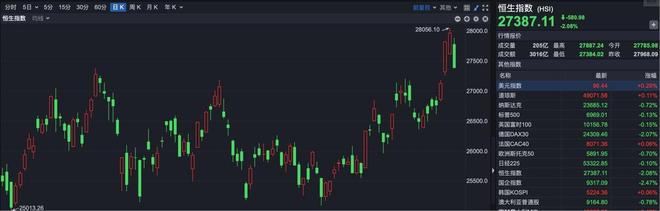
Market Performance - The Hang Seng Index closed at 27,387.11 points, down 580.98 points, a decline of 2.08%, despite a monthly increase of nearly 7% and reaching a nearly four-and-a-half-year high earlier in the week [1] - The Hang Seng Tech Index closed at 5,718.18 points, down 122.92 points, a decline of 2.10% [3] Sector Performance - Gold stocks experienced significant declines due to fluctuations in international precious metal prices, with Shandong Gold down over 14%, Jiangxi Copper down over 10%, and several others including Zijin Mining and Zhaojin Mining down over 9% [5] - Technology stocks broadly declined, with Kuaishou and Xiaomi down over 3%, Tencent and Alibaba down over 2%, and others like Baidu, Lenovo, Meituan, JD.com, and Bilibili down over 1% [6] - Oil stocks also saw a general decline, with PetroChina down over 1% [6] - Solar energy stocks weakened, with Flat Glass down over 6%, and innovative drug concepts mostly fell, with CSPC Pharmaceutical down over 10% [6] Market Sentiment and Regulatory Actions - Spot gold and silver prices dropped significantly, with gold falling below $5,120 per ounce and silver below $108 per ounce, leading to several gold-related companies issuing risk warnings about significant price deviations from market indices [7] - Regulatory measures, such as increased margin requirements by the Shanghai Futures Exchange, aim to cool the speculative atmosphere in the market [7] Future Outlook - CITIC Securities anticipates that the downward adjustments in earnings expectations and funding disturbances affecting the Hong Kong stock market will conclude, predicting a continuation of the spring market trend since late December 2025, with large-cap stocks expected to perform relatively well before the Lunar New Year [9] - Industrial growth sectors supported by policy direction are expected to outperform [9] - Industrial funds believe that technology assets in the Hong Kong market hold significant allocation value for both domestic and international investors due to their scarcity and relatively low valuations, with potential for diverse investment trends in 2026 [9]
港股不再只是“捡便宜”,国海富兰克林徐成:看重性价比,更看重长期盈利确定性
Xin Lang Cai Jing· 2026-01-30 10:28
Core Viewpoint - The Hong Kong stock market has transitioned from a phase dominated by sentiment-driven adjustments to a more rational valuation phase supported by policy and earnings recovery, with a focus on profitability, dividends, and industry structure rather than just being "cheap" [1][3] Group 1: Market Dynamics - The market is characterized by a stark contrast between high-dividend, strong cash flow assets and growth-oriented sectors influenced by global liquidity and thematic sentiment [1][3] - The global AI wave is reshaping capital flows and industry structures, with competition intensifying around computing power, algorithms, and application scenarios [1][7] - Institutional investors are increasingly focused on reassessing the cost-effectiveness of Hong Kong and Asian assets along the AI industry chain as valuations are no longer at extreme lows [1][3] Group 2: Investment Strategy - The investment strategy emphasizes understanding macroeconomic conditions, corporate competitiveness, and earnings volatility rather than solely relying on low valuations [3][10] - The focus has shifted from "valuation recovery" to identifying companies with potential earnings improvement in a gradually recovering macro environment [3][10] - The investment approach is characterized by a balance between high-dividend and high-growth sectors, allowing for dynamic switching between different styles [10][11] Group 3: Sector Insights - The internal demand sector is expected to have significant upside potential if stronger consumer support policies are introduced, although broad opportunities may be limited due to mixed macro data and slowing population growth [5][11] - Specific sectors like travel, leisure services, and experience-based consumption may see recovery and growth driven by policy support [5][11] - The hardware segment of the AI industry, particularly in memory and high-end manufacturing, is highlighted as a key area for investment due to its stable competitive landscape and high demand [7][8] Group 4: Risk Management - The investment philosophy includes a focus on safety margins and avoiding excessive concentration in single themes, with a preference for companies that demonstrate clear advantages in both valuation and earnings [10][11] - The approach to risk control involves monitoring individual stock valuations and overall portfolio beta exposure, adjusting positions based on macroeconomic and policy changes [11][12] - The emphasis is on identifying undervalued companies with long-term competitive advantages that may be overlooked or mispriced in the current market environment [12]
20cm速递|算力硬件午后持续走高!创业板50ETF华夏(159367)上涨2.58%,同类产品最低费率档
Mei Ri Jing Ji Xin Wen· 2026-01-30 06:17
Core Insights - The article highlights a significant increase in computing hardware stocks, particularly in the ChiNext 50 ETF, driven by strong performance from companies like Tianfu Communication and New Yisheng, amidst a tight AI computing supply situation reported by Microsoft and Meta [1] Group 1: Company Performance - The ChiNext 50 ETF rose by 2.58%, with Tianfu Communication increasing over 14%, New Yisheng up over 6%, and Zhongji Xuchuang rising over 5% [1] - Microsoft reported a capital expenditure of $37.5 billion for Q4, while Meta's capital expenditure was $22.137 billion, both exceeding market expectations [1] Group 2: Industry Trends - Microsoft and Meta indicated that the AI computing supply tightness will persist throughout 2026 [1] - Meta raised its full-year capital expenditure forecast for 2026 to $125 billion, representing a 73% year-on-year increase [1] - Guosen Securities forecasts that 2026 will be a pivotal year for domestic hard technology, with ongoing iterations in AI model reasoning capabilities and a supply-demand imbalance in computing and storage hardware [1] Group 3: Market Outlook - The ChiNext 50 Index focuses on sectors such as information technology, new energy, fintech, and pharmaceuticals, with constituent stocks primarily consisting of leading technology companies [1] - These sectors align with national policy directions and global technological development trends, showcasing high growth potential and innovation, which are core competitive advantages of the ChiNext 50 Index [1]
