贵金属

Search documents
黄金白银大涨 韩国综合指数创新高
2 1 Shi Ji Jing Ji Bao Dao· 2026-02-23 00:38
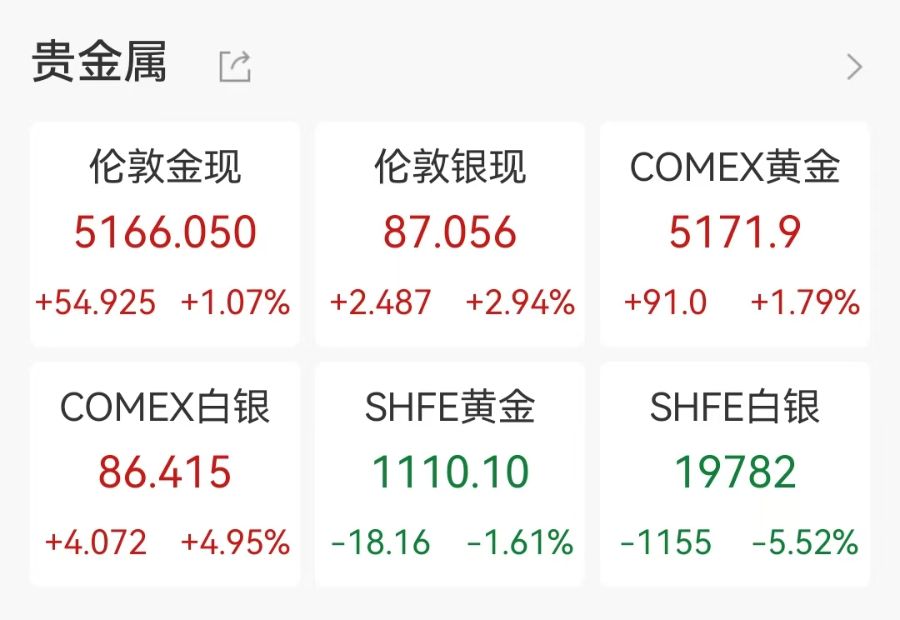
截至7:15,现货黄金报5148.75美元/盎司,日内涨0.74%。 2月23日,金银开盘双双拉升。 韩国综合指数涨幅扩大至2%报5925.54点,再创历史新高。三星电子股价上涨逾3%。 现货黄金日内涨超1%,突破5160美元/盎司。现货黄金涨2.94%,一度涨超3%。 纽约期银日内涨近5%,纽约期金涨超1.7%。 | 贵金属 | | | | --- | --- | --- | | 伦敦金现 | 伦敦银现 | COMEX黄金 | | 5166.050 | 87.056 | 5171.9 | | +54.925 +1.07% +2.487 +2.94% +91.0 +1.79% | | | | COMEX白银 | SHFE黄金 | SHFE自银 | | 86.415 | 1110.10 | 19782 | | +4.072 +4.95% -18.16 -1.61% -1155 -5.52% | | | 现货黄金日内涨幅近1%,报5157.499美元/盎司。现货白银涨超2.4%,纽约期银涨4.63%。 | 贝尔西 | | | | --- | --- | --- | | 伦敦金现 | 伦敦银现 | COMEX黄金 ...

揭秘!2026年,到底谁在操控黄金白银的过山车行情?
Sou Hu Cai Jing· 2026-02-22 23:22
Core Viewpoint - The precious metals market in 2026 is experiencing extreme volatility driven by geopolitical conflicts, central bank gold purchases, the credibility of the US dollar, and speculative funds, leading to significant price fluctuations in gold and silver [1] Group 1: Four Key Drivers of the Bull Market - The performance of gold is influenced by four key factors: economic expansion, risk and uncertainty, opportunity cost, and momentum, which are currently resonating with unprecedented intensity [3] - Central banks globally are significantly increasing their gold purchases, with net buying for 16 consecutive years and annual purchases exceeding 1,000 tons from 2022 to 2024, indicating a structural shift in gold pricing logic [5] - Emerging market central banks are accelerating "de-dollarization" and viewing gold as a hedge against geopolitical risks and declining dollar credibility, with their gold reserves still having substantial growth potential [5] - The market is currently focused on the Federal Reserve's interest rate cut path, which is expected to influence short-term gold prices, while a long-term trend of dollar depreciation is anticipated [6][9] Group 2: Geopolitical Risks and Supply-Demand Dynamics - Geopolitical risks are becoming a normalized backdrop for the market, with ongoing conflicts like the Russia-Ukraine situation and tensions in the Middle East driving demand for gold as a safe-haven asset [11] - Silver's demand is surging due to its industrial applications in sectors like renewable energy, while supply remains rigid, leading to a structural supply shortage in the silver market [13] - The available silver inventory has decreased significantly, with only about 200 million ounces left in the London market, down 75% from 2019 highs, creating conditions for extreme price volatility [13] Group 3: Short-Term Catalysts for Silver's Surge - The recent 60% surge in silver prices in January can be attributed to a liquidity crisis and speculative funds taking advantage of the low available inventory, leading to price manipulation [14] - Major institutions have increased their net long positions in silver, creating a feedback loop of rising prices and further buying, which has driven the recent price spike [16] Group 4: Future Outlook for Precious Metals - The long-term outlook for precious metals remains optimistic due to ongoing factors like de-dollarization, central bank gold purchases, and persistent geopolitical risks, with some institutions predicting gold could exceed $6,000 and silver could reach $133 [18] - High volatility is expected to be a constant in 2026, with potential for significant price corrections in a strong bull market, necessitating cautious investment strategies [20] - Investors are advised to view gold as a stabilizing asset in their portfolios and to manage risk carefully, especially in light of the current market dynamics [22]

节后A股开盘必看!三大主线已明牌,这个变数不得不防
Sou Hu Cai Jing· 2026-02-22 04:30
Domestic Policy - Domestic consumption has been elevated to unprecedented importance, with a focus on boosting consumption through special actions and expanding the supply of quality goods [1] - Key sectors benefiting from this policy include home appliances, cultural tourism, municipal infrastructure, and new infrastructure [1] - Visa exemptions for Canada and the UK starting February 17 are expected to boost inbound tourism and duty-free shopping in the short term, with long-term trends favoring service trade openness [1] Platform Economy - The State Administration for Market Regulation has engaged with major platforms like Alibaba and Douyin, emphasizing the need to avoid cutthroat competition and adhere to promotional regulations, which is a long-term benefit for compliant leading companies [2] - ByteDance's Doubao model 2.0 Pro has been released, directly competing with GPT-5.2, significantly reducing reasoning costs, indicating that domestic AI models are entering a practical phase [2] Industrial Upgrades - Humanoid robots gained popularity due to a Spring Festival performance, with Tesla's third-generation robot set to launch in Q1, and domestic companies like Yushutech and UBTECH making breakthroughs in control algorithms and motor performance [2] - The global data center investment boom is projected to reach $320 billion by 2025, a 74% increase, driven by demand for AI and cloud computing, benefiting data center construction and related energy and cooling equipment [2] International Developments - The U.S. tariff policy has shifted, with the Supreme Court rejecting comprehensive tariffs but Trump proposing a 10% global baseline tariff and threatening an additional 15%-30% on automobiles, impacting sectors heavily reliant on exports to the U.S. [2] - The deterioration of U.S.-Iran relations has heightened geopolitical tensions, igniting safe-haven demand for precious metals, with gold surpassing $5,100 per ounce and silver rising over 7% [3] Market Sentiment and Capital Flow - The market anticipates that the Federal Reserve may tolerate higher inflation, leading to a bearish sentiment on the dollar, which enhances the attractiveness of RMB assets, as evidenced by a net inflow of 13.28 billion yuan from northbound funds before the Spring Festival [3] - The M2 money supply grew by 9.0% in January, with social financing stock growth at 8.2%, and the central bank injecting 600 billion yuan before the holiday, indicating healthy liquidity [3] - Historical data shows a 75% probability of the Shanghai Composite Index rising in the first five trading days after the Spring Festival, with an average increase of 1.2% [3] Investment Focus - Key investment directions post-holiday include technology growth sectors such as AI models, humanoid robots, and data centers, driven by both policy and technological advancements [3] - Policy beneficiaries include domestic demand stimulation, infrastructure investment, and leading companies in the platform economy [3] - Safe-haven assets like gold and silver, along with undervalued high-dividend stocks, are recommended to hedge against geopolitical risks [3]
帮主早观察:黄金暴涨、AI分化,周末这三件事必须看懂
Sou Hu Cai Jing· 2026-02-22 03:32
Group 1 - The core issue revolves around the recent changes in Trump's tariff policy, where the Supreme Court ruled against the previous tariffs, leading to a new 10% tariff on global goods for 150 days, with potential increases to 15% [3] - The tariffs affect approximately 20% of U.S. imports, impacting countries like China, Mexico, the EU, and Vietnam, which raises concerns about inflation risks rather than alleviating them [3] - The recent economic data shows a significant slowdown, with the U.S. GDP growth for Q4 last year at only 1.4%, much lower than the expected 2.8%, contributing to fears of stagflation [3] Group 2 - OpenAI's adjustment of its total computing power expenditure target to $600 billion by 2030 has been misinterpreted as a cut of $800 billion, highlighting a misunderstanding of the time frame and scope of the figures [4] - AI stocks in Hong Kong have surged, with companies like Zhizhu and MINIMAX seeing significant increases in market value, indicating a shift in investment focus towards companies that can deliver tangible results [4] - The storage chip market is experiencing a seller's market, with SK Hynix reporting a four-week inventory and ongoing price increases due to high demand driven by AI [4] Group 3 - Public funds are preparing to enter the market with over 90 billion yuan, focusing on "technology growth" and "Chinese advantages," indicating a long-term bullish outlook on the tech industry led by AI [5] - The investment strategy for 2026 is expected to be driven by both "risk aversion and growth," with gold serving as a hedge against uncertainty and AI as a growth driver [6] - The storage sector is highlighted as a key indicator of the computing power market, with rising prices and supply shortages signaling potential opportunities for investors [7]

金银价再度大涨!国内金饰价格逼近1600元/克,专家提醒
Sou Hu Cai Jing· 2026-02-21 12:08
Group 1 - The core viewpoint of the articles highlights a significant increase in gold and silver prices, with spot gold returning to $5,100 per ounce and silver rising by 7.8% on February 21, marking a notable recovery since the price drop on January 30 [1][3] - Domestic gold jewelry prices have also seen a substantial increase, with major brands pricing above 1,550 yuan per gram, and China Gold's price reaching 1,588 yuan per gram [1][3] - The rise in gold and silver prices is attributed to three main factors: escalating geopolitical tensions increasing risk aversion, weak U.S. economic data leading to renewed expectations for Federal Reserve rate cuts, and strong physical demand supported by ongoing central bank purchases [3][4] Group 2 - The market is expected to maintain a strong oscillation in the short term, with geopolitical and policy expectations creating trading opportunities [3] - The long-term outlook for gold and silver suggests a high-level oscillation with a central tendency moving upward, without a single-sided surge, supported by the rate cut cycle, central bank purchases, and geopolitical uncertainties [3][4] - For ordinary investors, it is recommended to focus on gold as a value-preserving asset, avoiding blind speculation and leverage, and to consider investing in gold ETFs or bullion with a strategy of gradual accumulation and long-term holding [4]
马年新春节金银缘何喜迎开门红 | 说商道市
Chang Sha Wan Bao· 2026-02-21 04:28
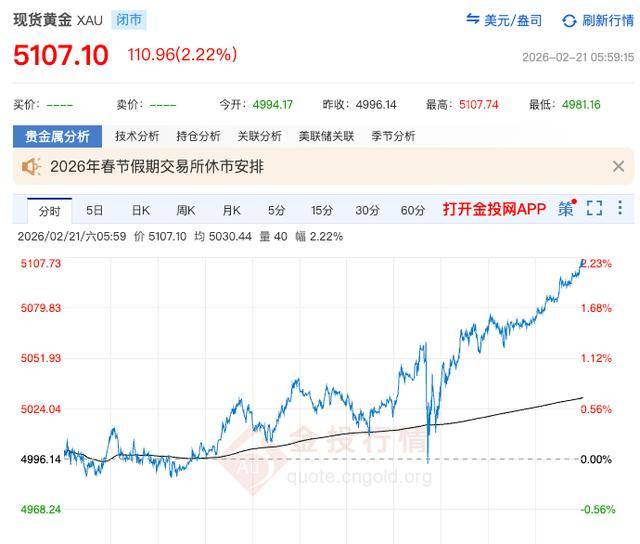
Core Viewpoint - The recent surge in gold and silver prices is attributed to a confluence of monetary cycles, central bank actions, safe-haven demand, and supply-demand dynamics, indicating a robust long-term bullish trend in precious metals [2][3]. Group 1: Market Performance - As of February 20, gold prices reached $5050 per ounce, marking a 2.4% increase during the holiday period, while silver prices rose to $84.35 per ounce, with an 8.19% increase, significantly outperforming gold [1]. - Domestic gold prices also saw a rise, with T+D gold closing at 1108.5 yuan per gram and retail prices surpassing 1550 yuan per gram, reflecting increased physical and investment demand [1]. Group 2: Underlying Factors - The expectation of interest rate cuts by the Federal Reserve has anchored price levels, with market predictions suggesting a reduction of 50 to 75 basis points by 2026, enhancing the appeal of non-yielding assets like gold [2]. - Central bank gold purchases are providing a rigid support, with 95% of global central banks planning to increase their gold reserves, maintaining an average monthly purchase of 60 to 70 tons [2]. - Geopolitical tensions and rising credit risks are driving safe-haven demand, as the U.S. debt exceeds $38 trillion, weakening dollar credit and prompting investments in gold to hedge against uncertainties [2]. - Supply constraints are tightening, with global gold mine production growth below 2% and rising extraction costs, while investment, industrial, and reserve demand continue to expand, leading to a widening supply-demand gap [2]. Group 3: Future Outlook - The bullish trend for gold and silver is expected to persist, although short-term volatility may increase, with institutions like Goldman Sachs projecting gold prices to reach $5400 per ounce, and JPMorgan and UBS raising targets to $6200 to $6500 per ounce [3]. - The A-share market is likely to experience a clear transmission effect from the strong performance of gold and silver, benefiting gold mining companies such as Zijin Mining, Shandong Gold, and Hunan Gold, which are expected to see significant earnings elasticity [3]. - The precious metals sector is anticipated to serve as a defensive asset in the face of increased market volatility, providing a hedge against fluctuations in growth and cyclical stocks [3].




黄金、白银,暴涨
Zhong Guo Ji Jin Bao· 2026-02-21 00:11
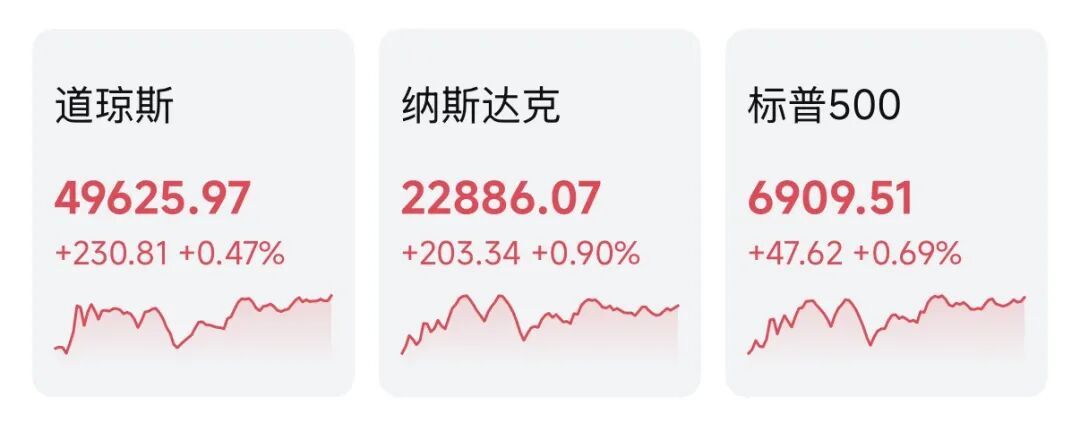
Group 1: Market Reactions - The U.S. Supreme Court ruled that Trump's tariffs were illegal, positively impacting the market, leading to a collective rise in major U.S. stock indices [1] - The Dow Jones Industrial Average increased by 0.47% to 49,625.97 points, the Nasdaq Composite rose by 0.9% to 22,886.07 points, and the S&P 500 gained 0.69% to 6,909.51 points [1] Group 2: Tariff and Economic Outlook - Following the Supreme Court's decision, President Trump announced a 10% global tariff on trade partners, while some existing tariff categories remain effective [3] - Thousands of businesses and importers are expected to seek refunds for tariffs paid, amounting to up to $170 billion [3] - U.S. Treasury Secretary Scott Bessenet indicated that tariff revenues are projected to remain "virtually unchanged" by 2026, with alternative mechanisms being utilized [3] - Economic growth for Q4 2025 was reported at 1.4%, significantly below the market expectation of 2.8%, with an annual growth rate of 2.2%, the lowest since 2021 [3] Group 3: Precious Metals Market - Gold prices surged over 2% to reclaim $5,100, while silver experienced a significant increase of 8% [4] - As of the latest data, COMEX gold futures were reported at $5,130, and COMEX silver futures at $84.57, reflecting an 8.93% rise [4] Group 4: Cybersecurity Sector Performance - Multiple cybersecurity stocks experienced significant declines, with AKAM dropping over 14%, Cloudflare down over 8%, and CrowdStrike nearly 8% [7] - The decline was influenced by Anthropic's introduction of a new security feature in its Claude AI model, which can identify security vulnerabilities in code [7] - The new feature, while beneficial for detecting vulnerabilities, also poses risks as it may assist attackers in exploiting these vulnerabilities [7]
今日国际国内财经新闻精华摘要|2026年2月21日
Sou Hu Cai Jing· 2026-02-21 00:07
International News - The U.S. Supreme Court rejected President Trump's comprehensive tariff policy under the International Emergency Economic Powers Act, ruling it lacks clear legal authorization, which may lead to the U.S. needing to refund up to $170 billion in tariff revenues [1] - In response, Trump plans to sign an order imposing a 10% global baseline tariff on all countries, expected to take effect in three days, and threatens additional tariffs of 15% to 30% on automobiles [2][3] - U.S. Treasury Secretary Mnuchin stated that tariff revenues are expected to be around $130 billion, falling short of the $175 billion target, while the Illinois governor has submitted a request for an $8.6 billion tariff refund for approximately 5.1 million households [6][7] - Geopolitical tensions with Iran are escalating, with Trump demanding an agreement within 10-15 days, and reports suggest a potential limited military strike by the U.S. [8] - The U.S. military has deployed the USS Gerald R. Ford carrier strike group to the Mediterranean, joining the USS Abraham Lincoln, along with 17 ships and dozens of aircraft to the Middle East [9][10][11][12] Market Overview - Safe-haven sentiment has driven significant increases in precious metal prices, with spot gold rising 2.15% to $5,104.90 per ounce, and New York futures surpassing $5,130 per ounce, marking a daily increase of 2.65% [13][14][15][16][17] - Silver prices also surged, with spot silver breaking $84 per ounce and New York futures exceeding $85 per ounce, showing daily increases of 7.21% and 8.67% respectively [13][14][15][16][17] - Palladium futures surpassed $1,800 per ounce, with a daily increase of 4.54% [13][14][15][16][17] - The Commodity Futures Trading Commission (CFTC) reported that bearish sentiment towards the dollar has reached its highest level since 2021 [18] - U.S. stock markets saw gains, with the Dow up 0.48%, Nasdaq up 0.90%, and S&P up 0.71%, while major European indices also rose, including Germany's DAX30 up 0.92% and France's CAC40 up 1.39% [19][20] Corporate Developments - OpenAI plans to invest approximately $600 billion in computing power by 2030 [21] - Google is exploring the expansion of its AI chip market to compete with Nvidia [22] - Amazon reported that hackers used AI tools to breach over 600 firewalls across 55 countries in five weeks, aiming to deploy ransomware [23] Economic Data - The Federal Reserve's Musalem noted ongoing corporate cost pressures and public inflation concerns, while Bostic indicated that interest rate hikes may be considered if inflation rises [24][25][26][27] - U.S. inflation expectations for February showed a one-year rate of 3.4% and a five-to-ten-year rate of 3.3%, both slightly below expectations [28] Domestic News - The Nasdaq China Golden Dragon Index fell 0.05%, with significant declines in stocks such as Tims China down 5.61% and Huya down 5.71% [30][31]
在短期波动中把握被“错杀”品种的布局机会 | 策马点金
Qi Huo Ri Bao· 2026-02-20 23:43
Core Viewpoint - The global commodity market in 2025 exhibited a clear structural differentiation, with precious metals leading the market, while non-ferrous and new energy metals also performed well. The year 2026 is expected to see a moderate economic recovery and a more accommodative liquidity environment, with investment strategies focusing on selecting sectors and controlling pace as key to success [1][3]. Group 1: Economic Outlook - The global economy is projected to recover moderately in 2026, with an upward trend in the global manufacturing cycle and a stable domestic economy despite differentiation. Inflation and corporate profits are likely to rise moderately [3]. - The Federal Reserve's interest rate cuts are expected to lower global short-term rates, further enhancing the upward potential of the global manufacturing cycle [3]. Group 2: Market Characteristics - The core feature of the capital market in 2026 will be a multi-dimensional "K" type differentiation, characterized by strong external factors versus weak internal factors, old versus new economy, AI versus non-AI, and supply bottlenecks versus supply elasticity [3][4]. - Precious metals and non-ferrous metals are anticipated to be the main asset allocation varieties in 2026 [3][4]. Group 3: Precious Metals - The allocation value of precious metals continues to rise, making them one of the main varieties for 2026. The ongoing geopolitical uncertainties and the U.S. strategic shift towards Europe and South America are expected to enhance gold's safe-haven and allocation value [4]. - The growth in gold ETFs, particularly in European countries, reflects the increasing allocation value of gold [4]. Group 4: Non-Ferrous Metals - The pricing logic of non-ferrous metals is undergoing reconstruction, with a likely upward trend in price centers in 2026. Demand from sectors such as new energy, data centers, and infrastructure investment is driving this change, while traditional real estate demand is declining [4]. - Major countries, led by the U.S. and China, are focusing on resource and key mineral reserves, which will significantly alter short-term supply-demand balance and drive non-ferrous metal prices higher [4]. Group 5: Black and Energy Chemical Sectors - The black metal sector is expected to present limited investment opportunities in 2026, with a tendency towards oscillation due to significant supply elasticity in the industrial chain [5]. - The energy chemical sector offers opportunities primarily in the stock market, with a focus on left-side interventions as capacity cycles peak. The polyester industry is noted for its relatively better fundamentals [5]. Group 6: Geopolitical Factors - Despite an overall optimistic outlook for the commodity market in 2026, a single upward trend is unlikely. Geopolitical disturbances are identified as a key factor influencing market rhythm, with a pattern of "seasonal price increases and actual declines" expected to continue [6][7]. - Geopolitical conflicts may create short-term panic, leading to indiscriminate declines in asset valuations, but these are not expected to evolve into systemic risks. Investors are encouraged to seek out undervalued assets during these periods [7].
大涨150%后又大跌35%,白银的过山车,开年还能捡漏上车吗?
Sou Hu Cai Jing· 2026-02-20 12:01
Core Viewpoint - The silver market experienced extreme volatility in 2025 and early 2026, driven by liquidity influx, strong industrial demand, and self-reinforcing market sentiment, leading to a dramatic price surge followed by a sharp decline [1][3][5][8]. Group 1: Liquidity and Market Dynamics - In 2025, the Federal Reserve's interest rate cuts led to a surge in liquidity, attracting significant capital into the silver market, which has a total market value only one-tenth that of gold [3]. - The influx of retail and speculative investors, drawn by low prices, resulted in unprecedented premiums for silver funds and record-high open interest in COMEX silver futures [3]. - The market's structure became increasingly crowded with long positions, setting the stage for a sharp correction when prices began to fall [9]. Group 2: Industrial Demand - Silver transitioned from being a mere precious metal to a critical industrial component, particularly in the photovoltaic sector, which consumed about one-sixth of the global silver production in 2025 [4]. - The demand for silver surged due to advancements in high-efficiency battery technologies and the expansion of data centers and electric vehicles, while supply remained rigid due to the nature of silver extraction [4]. - The London Bullion Market Association reported that deliverable silver stocks fell to levels sufficient for only 1.2 months of global consumption, indicating a precarious supply situation [4]. Group 3: Market Sentiment and Price Fluctuations - By the end of 2025, social media buzz around silver investments created a speculative bubble, with prices soaring over 140% throughout the year [5]. - On January 29, 2026, silver prices peaked at $121.65 per ounce before a sudden collapse triggered by the nomination of a hawkish Federal Reserve chair, which reversed market expectations for further rate cuts [8]. - The market's fragile structure led to a cascade of forced liquidations, resulting in a record single-day price drop of over 35%, with prices plummeting to near $74 [9]. Group 4: Long-term Supply and Demand Outlook - Despite the short-term volatility, the World Silver Survey projected a supply deficit of 67 million ounces in 2026, indicating persistent structural demand from industries like photovoltaics and AI [11]. - The rising silver prices have pressured manufacturers, particularly in the photovoltaic sector, to innovate and reduce silver usage, potentially impacting long-term demand growth [15]. - Silver's dual role as both an industrial metal and a financial asset creates a complex market dynamic, with its price sensitivity to monetary policy and industrial demand [12][15].