金属

Search documents
工业金属板块走高 南山铝业触及涨停
2 1 Shi Ji Jing Ji Bao Dao· 2025-11-06 01:53
Core Viewpoint - The industrial metals sector is experiencing an upward trend, with Nanshan Aluminum hitting the daily limit increase, and other companies such as Chang Aluminum, China Aluminum, Minfa Aluminum, and Mingtai Aluminum also seeing gains [1] Group 1 - The industrial metals sector is rising [1] - Nanshan Aluminum has reached its daily limit increase [1] - Other companies in the sector, including Chang Aluminum, China Aluminum, Minfa Aluminum, and Mingtai Aluminum, are following suit with price increases [1]

广发期货日评-20251105
Guang Fa Qi Huo· 2025-11-05 05:42
Report Summary 1) Report Industry Investment Ratings The report does not provide an overall industry investment rating. Instead, it offers specific investment suggestions for various futures contracts in different sectors. 2) Core Views - The A-share market is in a repricing adjustment after the quarterly report release, with trading sentiment being cold and the direction unclear [2]. - Bond interest rates are expected to have a lower fluctuation range, and investors can consider appropriate long - positions on 10 - year Treasury bonds on dips [2]. - Precious metals are under pressure from liquidity tightening and a stronger dollar, with gold and silver showing different short - term trends [2]. - The shipping index is expected to be volatile in the short term, and long positions on the 12 - contract are recommended on dips [2]. - The steel and iron ore markets have complex supply - demand situations, with different trading strategies for each contract [2]. - The energy and chemical sector has diverse trends, with some products like MEG expected to decline and others having different trading opportunities [2]. - The agricultural product market is affected by factors such as supply and demand and policy details, with different trading suggestions for each product [2]. - Special and new energy products also have their own price trends and corresponding trading strategies [2]. 3) Summary by Related Catalogs Financial Futures - **Stock Index Futures**: After the market's upward movement and profit - taking, there is a slight correction. It is recommended to wait and see as the direction is not clear [2]. - **Treasury Bond Futures**: The central bank's bond - buying scale is lower than expected. The 10 - year Treasury bond active bond 250016.IB may fluctuate between 1.75% - 1.8%. Long positions on dips and positive arbitrage strategies are suggested [2]. - **Precious Metals Futures**: Gold has short - term downward pressure but buying support. It can be bought on dips below 3900 dollars (900 yuan). Silver may fall to the previous low of 45 dollars (11000 yuan), and short - term observation is recommended [2]. Commodity Futures - **Shipping Futures**: The container shipping index (European line) is short - term volatile, and long positions on the 12 - contract are recommended on dips [2]. - **Steel and Iron Ore Futures**: For steel, a long - coal and short - coil strategy is recommended for the January 2026 contract. For iron ore, short positions are recommended on rallies for the 2601 contract, with a reference range of 760 - 810, and a 1 - 5 positive arbitrage is also suggested [2]. - **Energy and Chemical Futures**: Different products have different trends. For example, PX and PTA have limited rebound space, and short positions on rallies are recommended; MEG is expected to decline, and holding out - of - the - money call options and 1 - 5 reverse arbitrage are suggested [2]. - **Agricultural Product Futures**: Products like soybeans, corn, and palm oil have different price trends and trading strategies. For example, long positions in the 2601 soybean contract should be held cautiously, and the palm oil may test the 8500 - yuan support [2]. - **Special and New Energy Futures**: Glass offers short - long opportunities by observing the spot market; industrial silicon and polysilicon have price fluctuation ranges, and lithium carbonate is expected to be weak [2].
帮主郑重:大宗商品集体“降温”?油价金价齐跌,中长线该怎么看?
Sou Hu Cai Jing· 2025-11-05 03:26
Group 1 - The commodity market is experiencing a collective adjustment, with oil prices dropping after a four-day increase, and basic metals like copper and aluminum also declining [1][3] - WTI crude oil fell below $61, a decrease of 0.8%, primarily due to a strong dollar and concerns over supply surplus, as OPEC+ announced no production increase for the first quarter [3][4] - Copper prices dropped 2.4% at one point, closing down 1.8% at $10,663.5 per ton, as supply concerns eased following positive news from Chile's national copper company [3][4] Group 2 - Gold prices fell by 1.7% to $3,934 per ounce, influenced by a strong dollar and a cautious stance from the Federal Reserve regarding interest rate cuts [4] - The recent decline in commodity prices is attributed to short-term factors such as the dollar's strength and changing supply expectations, rather than a long-term trend shift [5] - Recommendations for long-term investors include monitoring actual supply changes in oil, focusing on metals linked to "hard demand" like copper, and waiting for clearer signals from the Federal Reserve before making moves in gold [5]


中金2026年展望 | 大宗商品:秩序新章的三重奏(要点版)
中金点睛· 2025-11-04 23:48
Core Viewpoint - The article discusses the reshaping of global trade patterns due to the 2025 U.S. tariff policy, leading to increased asset volatility and economic uncertainty, while also highlighting opportunities in the commodity market amidst geopolitical tensions and industry innovations [2]. Group 1: Geopolitical Risks and Supply Challenges - Geopolitical tensions and resource protectionism are expected to further challenge the already fragile supply elasticity in energy and metal markets [4]. - The decline in upstream investment in global energy and metals has persisted for nearly a decade, with capital expenditures decreasing compared to 2024 levels, which may suppress investment willingness among upstream companies [5]. - The copper market is experiencing supply constraints due to insufficient upstream investment, while the oil market is facing a potential turning point in non-OPEC production due to declining investment and rising costs [5][10]. Group 2: Strategic Security and Demand Dynamics - The focus on strategic security is increasing, with energy transition and reserve construction becoming essential trends, potentially providing resilience for strategic commodity resources [12]. - The demand for green transition metals and biofuels is expected to grow, driven by policies in countries like Indonesia, Malaysia, the U.S., and Brazil [13]. - Non-OECD countries are showing increased demand for oil reserves and gold purchases, reflecting a heightened concern for resource security amid rising geopolitical uncertainties [16]. Group 3: Emerging Demand and Industrialization - Emerging demand is gaining momentum, particularly from AI investments and the industrialization of emerging economies, which may drive the next supercycle in commodities [17]. - The ongoing restructuring of trade patterns and industrial divisions is expected to support the industrialization processes in emerging economies, with India and Belt and Road countries likely to be key drivers of future demand [19]. - The resilience in exports of intermediate goods, such as steel from China, indicates a marginal uplift in commodity demand [19]. Group 4: Commodity Market Outlook for 2026 - Despite high macroeconomic uncertainties, the supply disruptions and localized demand changes may lead to a marginal improvement in the oversupply situation in the commodity market by 2026 [24]. - Non-ferrous and precious metals are anticipated to continue their upward trend, with copper facing both long-term capital expenditure constraints and short-term supply disruptions [24]. - Oil and agricultural products are expected to rebound due to cost support and supply risks, while black metals may face continued pressure from domestic demand slowdowns [25].

收评:沪指跌0.41% 福建本地股领涨 金属股领跌
Xin Hua Cai Jing· 2025-11-04 07:30
Market Performance - On November 4, the three major stock indices in Shanghai and Shenzhen opened lower, with the Shanghai Composite Index experiencing a slight rise before consolidating, while the ChiNext Index declined after filling a gap [1] - By the end of the trading day, the Shanghai Composite Index closed at 3960.19 points, down 0.41%, with a trading volume of approximately 852.9 billion; the Shenzhen Component Index closed at 13175.22 points, down 1.71%, with a trading volume of about 1062.8 billion; the ChiNext Index closed at 3134.09 points, down 1.96%, with a trading volume of around 481.3 billion [1] Sector Performance - The Fujian and banking sectors led the gains, while tourism and the snow industry saw significant increases; however, metal stocks experienced notable adjustments, leading to declines in non-ferrous and lithium sectors [1] - The PEEK materials, sci-tech growth sectors, and AI mobile PC sectors also saw significant declines [1] Institutional Insights - According to institutional views, the current market volatility is seen as a buildup of momentum for the year-end and cross-year market trends, with expectations of clearer directions following a period of consolidation [2] - Recommendations include focusing on high-growth sectors such as semiconductors, consumer electronics, artificial intelligence, robotics, and low-altitude economy for potential investment opportunities [2] Policy Developments - The National Health Commission and other departments released guidelines to promote and regulate the application of "AI + healthcare," aiming to establish high-quality data sets and intelligent applications in healthcare by 2027, with full coverage of intelligent diagnostic assistance by 2030 [3] - The guidelines emphasize the creation of a robust AI application standard system in healthcare, aiming to enhance the quality of the health industry [3] Strategic Directions - The State-owned Assets Supervision and Administration Commission (SASAC) emphasized the need to cultivate emerging industries and open new growth avenues, focusing on upgrading traditional industries and fostering a modern industrial system centered on advanced manufacturing [4] - The SASAC also highlighted the importance of technological self-reliance and innovation, advocating for deep integration of technological and industrial innovation to stimulate new productive forces [4]
中美经贸谈判对大宗商品影响几何?
2025-11-03 15:48
Summary of Conference Call Records Industry Overview - The conference call discusses the impact of US-China trade negotiations on the commodity market, particularly focusing on copper and soybean markets [3][4][6]. Key Points on Copper Market - Global supply risks from free ports have driven copper prices up, with expectations of a structural shortage in the market due to low inventory and long-term demand from new energy sectors [4][6]. - Currently, there are no signs of copper being overbought, indicating potential for continued price increases [4]. Key Points on Gold Market - Recent gold price declines are attributed to reduced risk aversion and hawkish signals from the Federal Reserve, leading to a downward adjustment in December rate cut probabilities [4][5]. - Central bank gold purchases have slowed, contributing to short-term price pressures, but gold remains attractive as a long-term hedge against uncertainty [5]. Key Points on Soybean Market - The projected soybean production for the 2025-2026 season is 117 million tons, but this may be adjusted due to the USDA shutdown [6]. - Soybean exports are expected to be 45.86 million tons, with approximately 13 million tons directed to China. However, insufficient prior purchases from China have created a surplus pressure of about 12 million tons for US farmers [6][7]. - The forecast for US soybean export pressure in 2025 is between 10 to 12 million tons, significantly influenced by US-China procurement agreements [7][8]. Price Dynamics and Scenarios - Three scenarios for soybean price movements are proposed: 1. **Conservative Estimate**: If tariffs remain and first-quarter purchases are below 3 million tons, prices may quickly decline [8]. 2. **Baseline Scenario**: If imports range between 6 to 8 million tons, prices may stabilize around 1,100 cents per bushel [8]. 3. **Optimistic Scenario**: If China purchases around 12 million tons in the first quarter, prices could rise above 1,150 cents, potentially reaching 1,200 cents [8]. Chinese Soybean Market Dynamics - The Chinese soybean market is shifting from gap pricing to cost pricing, with ample supply leading to price declines in Q4 [9]. - If US-China relations improve in Q1, prices may stabilize based on Brazilian and US soybean procurement costs, with potential for profit recovery [9][10]. Impact of Chinese Procurement on Futures - The pace of Chinese soybean procurement directly affects the March futures contracts. Slow procurement and insufficient margins may lead to price increases post-Spring Festival [10][11]. Agricultural Planting Decisions - Rising soybean prices may shift planting decisions towards soybeans over corn, creating a seesaw effect in planting areas [12]. Conclusion - The conference call highlights the interconnectedness of US-China trade negotiations, commodity pricing, and agricultural production decisions, emphasizing the need for close monitoring of procurement agreements and market dynamics.
A股迎大变局,政策调整提速,降税利好真来?
Sou Hu Cai Jing· 2025-11-01 16:49
Core Viewpoint - The recent surge in A-shares on October 29 is accompanied by underlying concerns, suggesting that the market's enthusiasm may be short-lived and could lead to a pullback [1][25]. Market Performance - On October 29, A-shares saw a significant increase in trading volume, rising from 1.2 trillion to 2.29 trillion, indicating a lively market atmosphere, but this volume spike may not be a reliable signal of sustained growth [1][5]. - The market index crossed the 4000-point mark, with technical indicators suggesting overbought conditions, which typically necessitate a correction to consolidate the trend [3][5]. Sector Analysis - The market is experiencing a clear sector divergence, with cyclical sectors like energy, metals, and photovoltaics performing well, while defensive sectors such as beverages and liquor are declining [9][11]. - Institutional investors are showing a preference for sectors like AI and automotive components, while also significantly buying into photovoltaics and quantum technology [11][17]. External Influences - The upcoming Federal Reserve meeting on October 30 is expected to influence market sentiment, with a general anticipation of a 25 basis point rate cut, adding uncertainty to the market [13][17]. - Concurrently, geopolitical factors, such as Trump's comments on tariffs and fentanyl, introduce additional market uncertainties [15][21]. Policy Support - Recent measures from the State Administration of Foreign Exchange to facilitate cross-border trade and initiatives from the Beijing Securities Regulatory Commission to attract long-term capital are seen as solid policy support for the A-share market [15][17]. - These policy actions are expected to alleviate external trade pressures and provide a more stable influx of long-term capital into the A-share market [17][21]. Investment Strategy - The recommendation is to wait for a market pullback and stabilization before increasing positions, emphasizing a cautious approach rather than aggressive buying [7][25]. - Maintaining a controlled position and avoiding impulsive trading decisions is highlighted as a prudent strategy in the current market environment [23][25].

三季报发出了积极信号
Zheng Quan Shi Bao· 2025-10-31 18:15
Group 1 - The importance of quarterly reports is generally lower compared to annual and semi-annual reports, but the analysis of the third-quarter reports reveals many positive signals that could drive the stock market [1] - Technology stocks have shown significant performance this year, with some companies experiencing profit increases of over 300%, alleviating concerns about high static price-to-earnings ratios [1][2] - The performance of companies in the upstream raw materials sector, such as metals and coal, has also improved, indicating a potential recovery in the overall economic landscape [2] Group 2 - High-end manufacturing companies have demonstrated strong performance, reflecting the resilience of the Chinese economy and providing guidance for long-term investment [3] - Despite overall economic stabilization, some sectors, particularly consumer and real estate, continue to face challenges, highlighting the uneven recovery and the need for caution regarding underperforming companies [3] - The third-quarter reports signal a positive outlook for the A-share market, emphasizing that company performance will ultimately determine market trajectory [3]
工业金属板块10月31日跌2.07%,常铝股份领跌,主力资金净流出21.92亿元
Zheng Xing Xing Ye Ri Bao· 2025-10-31 08:36
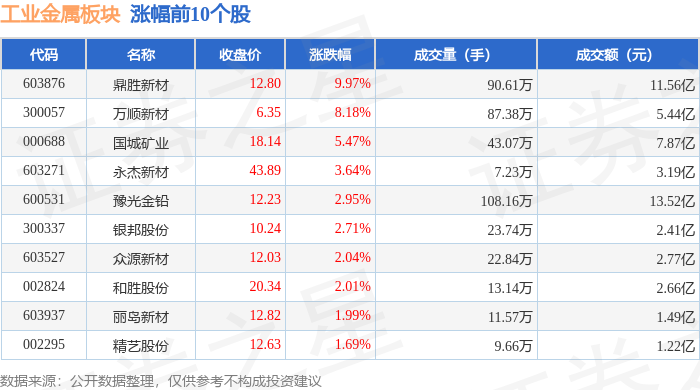
Market Overview - On October 31, the industrial metal sector declined by 2.07%, with Chang Aluminum leading the drop [1] - The Shanghai Composite Index closed at 3954.79, down 0.81%, while the Shenzhen Component Index closed at 13378.21, down 1.14% [1] Stock Performance - Notable gainers in the industrial metal sector included: - Ding Sheng New Materials (603876) with a closing price of 12.80, up 9.97% [1] - Wan Shun New Materials (300057) at 6.35, up 8.18% [1] - Guocheng Mining (000688) at 18.14, up 5.47% [1] - Major decliners included: - Chang Aluminum (002160) at 5.63, down 9.92% [2] - Jiangxi Copper (600362) at 41.09, down 5.21% [2] - Tongling Nonferrous Metals (000630) at 5.29, down 4.17% [2] Trading Volume and Capital Flow - The industrial metal sector experienced a net outflow of 2.192 billion yuan from institutional investors, while retail investors saw a net inflow of 1.92 billion yuan [2][3] - The trading volume for Ding Sheng New Materials reached 906,100 shares, with a transaction value of 1.156 billion yuan [1] - Chang Aluminum had a trading volume of 2,092,200 shares, with a transaction value of 1.204 billion yuan [2] Individual Stock Capital Flow - Ding Sheng New Materials had a net inflow of 180 million yuan from institutional investors, while retail investors had a net outflow of 50.19 million yuan [3] - Jiangxi Copper saw a net outflow of 64.12 million yuan from retail investors [3] - Wan Shun New Materials had a net inflow of 41.32 million yuan from institutional investors, with a slight outflow from retail investors [3]





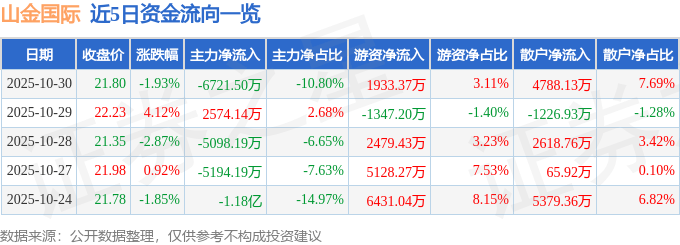
股票行情快报:山金国际(000975)10月30日主力资金净卖出6721.50万元
Sou Hu Cai Jing· 2025-10-30 15:25
Core Viewpoint - The stock of Shanjin International (000975) has shown a decline of 1.93% as of October 30, 2025, with significant net outflows from major funds, indicating potential concerns among institutional investors [1][3]. Financial Performance - For the first three quarters of 2025, Shanjin International reported a main revenue of 14.996 billion yuan, a year-on-year increase of 24.23% [2]. - The net profit attributable to shareholders reached 2.46 billion yuan, up 42.39% year-on-year, while the net profit excluding non-recurring items was 2.446 billion yuan, reflecting a 36.96% increase [2]. - In Q3 2025 alone, the company achieved a main revenue of 5.75 billion yuan, a 3.3% increase year-on-year, and a net profit of 864 million yuan, up 32.43% year-on-year [2]. Market Position - Shanjin International's total market capitalization stands at 60.533 billion yuan, ranking third in the non-ferrous metal industry [2]. - The company has a price-to-earnings ratio (P/E) of 18.46, significantly lower than the industry average of 43.65, indicating a potentially undervalued stock [2]. - The company's return on equity (ROE) is 17.87%, which is higher than the industry average of 12.47%, showcasing strong profitability [2]. Fund Flow Analysis - On October 30, 2025, major funds experienced a net outflow of 67.215 million yuan, accounting for 10.8% of the total transaction volume, while retail investors saw a net inflow of 47.8813 million yuan, representing 7.69% of the total [1][3]. - Over the past five days, the stock has seen fluctuating fund flows, with notable outflows from major funds on several days, indicating mixed investor sentiment [1]. Institutional Ratings - In the last 90 days, 16 institutions have rated the stock, with 13 buy ratings and 3 hold ratings, suggesting a generally positive outlook among analysts [3]. - The average target price set by institutions for the stock is 23.56 yuan, indicating potential upside from the current trading price [3].