高端制造

Search documents
利好!美联储降息,专家提示中国股市的五大机会
Feng Huang Wang Cai Jing· 2025-10-30 03:32
Group 1 - The Federal Reserve has lowered the target range for the federal funds rate from 4.00%-4.25% to 3.75%-4.00%, a decrease of 25 basis points, and has decided to end quantitative tightening (QT) [1] - The global stock market momentum has significantly rebounded with the Fed restarting the interest rate cut cycle, which typically benefits risk assets when the economy is not in recession [1] - Current asset market valuations are high, with stock price-to-earnings ratios generally exceeding historical averages by more than one standard deviation, indicating potential market volatility due to the "FOMO" phenomenon, particularly in AI-related sectors [1] Group 2 - Interest in the A-share market among individual investors in mainland China is rising, with a trend of shifting from bank deposits to non-bank financial institutions, indicating increased participation in the stock market [2] - Foreign institutional investors remain underweight in the Chinese market, although the degree of underweight has narrowed; a clearer recovery signal in corporate earnings is needed to sustain upward momentum in the stock market [2] - Five key focus areas for industry selection include: 1) Continued development of the AI industry chain, with improved competition in the internet sector; 2) Strengthening of China's manufacturing advantages and breakthroughs in critical technologies; 3) Positive marginal changes in China's medical policies benefiting the biopharmaceutical sector; 4) Improved profit outlooks in chemicals and raw materials due to "anti-involution"; 5) Potential capital shifts from high-dividend sectors like telecommunications, banking, and utilities to cyclical and growth assets [2]
金信基金市场点评:站稳4000点再出发
Xin Lang Ji Jin· 2025-10-29 09:47
Group 1: Market Performance - The Shanghai Composite Index rose by 0.70%, surpassing the 4000-point mark, while the ChiNext Index increased by 2.93% and the North Star 50 surged by 8.41%, marking the largest single-day gain in nine months [1] - The surge in the new energy sector, particularly in photovoltaic and energy storage stocks, was driven by signs of an industry cycle bottoming out and strong demand exceeding expectations [1][2] Group 2: Economic Indicators - In September, the industrial added value above designated size grew by 6.5% year-on-year, accelerating by 1.3 percentage points compared to the previous value; GDP growth for the first three quarters was 5.2%, with consumption and manufacturing investment as key drivers [2] - The profits of industrial enterprises above designated size increased by 3.2% year-on-year in the first three quarters, marking the highest cumulative growth rate since August of the previous year [2] Group 3: Policy and Strategic Outlook - The "14th Five-Year Plan" emphasizes technological self-reliance and advanced manufacturing upgrades, indicating that the deep integration of technology and industry will be a primary engine for economic growth in the next five years [2] - The capital market is expected to benefit from the listing and financing of quality technology companies, as well as increased investments from industrial capital and institutional funds [2] Group 4: Investment Strategy - Investors are encouraged to focus on sectors aligned with national strategies and industry trends, such as semiconductor equipment and materials, AI computing power and applications, high-end manufacturing, and new energy storage and lithium batteries [3]
博时基金市场异动陪伴10月29日:沪指站上4000点,创业板指涨超2.9%
Xin Lang Ji Jin· 2025-10-29 07:37
Market Performance - The A-share market experienced a significant rally, with the Shanghai Composite Index surpassing 4000 points and the ChiNext Index rising over 2.9% on October 29 [1][2]. Core Insights - The release of the "14th Five-Year Plan" draft, emphasizing "extraordinary measures" and "self-reliance in technology," has notably boosted market sentiment, highlighting the importance of technological innovation in national strategy [2]. - Signs of easing tensions in US-China relations, along with an upcoming summit between the two nations, are expected to reduce external uncertainties and improve risk appetite [2]. - Regulatory bodies, including the central bank and the China Securities Regulatory Commission, have reiterated their commitment to supportive monetary policies and reforms, which has helped stabilize market confidence [2]. Investment Opportunities - The "14th Five-Year Plan" provides a clear investment direction for the A-share market, with a focus on technology sectors such as integrated circuits, high-end machinery, and advanced instruments [2]. - There is an anticipated increase in policy support for key areas like basic software and advanced materials, which may exceed expectations [2]. - Companies in the upstream materials, core components, and basic software sectors are likely to benefit from policy and financial support, leading to a potential systematic uplift in technology sector valuations [2]. Future Outlook - The recovery of risk appetite in the A-share market is supported by both external factors, such as improved US-China relations, and internal factors, including the implementation of the "14th Five-Year Plan" and the performance of Q3 earnings [3]. - The balance between risk prevention and reform in financial regulatory policies will be crucial, along with the pace of long-term capital entering the market [3]. - Overall, in a context of positive policy expectations and a relatively loose liquidity environment, structural opportunities in the market are prominent, particularly in high-end manufacturing, digital economy, and green technology sectors [3].

十年来上证指数重上4000点 政策助力科技类苏企整体活跃
Xin Hua Ri Bao· 2025-10-29 00:43
Group 1 - The Shanghai Composite Index broke the 4000-point mark for the first time in ten years, reaching a high of 4010.73 points on October 28, 2023, driven by positive signals from the 2025 Financial Street Forum and the "14th Five-Year Plan" emphasizing technological self-reliance [1] - The total trading volume for the day was 2.15 trillion yuan, with significant contributions from AI hardware and optical modules, as well as new materials and minor metals [1] - A total of 72 stocks hit the daily limit up, with notable gains in technology and regional attributes, particularly in Jiangsu province where companies in electronics, new materials, and high-end manufacturing saw substantial increases [1] Group 2 - Huatai Securities indicated that technology remains the main focus of the market in the short term, while multiple brokerages, including CITIC Securities, highlighted that the "14th Five-Year Plan" outlines a clear growth path for A-shares through technological breakthroughs and industrial upgrades [2] - Several executives from Jiangsu-listed companies expressed their commitment to focusing on the development and layout in areas such as digital technology, space economy, high-end manufacturing, domestic consumption, and biotechnology under the guidance of policy [2] - The capital market is expected to empower the technology sector, potentially leading to the emergence of a number of global leading enterprises within the A-share technology segment [2]



武汉“雨林生态”培育一批“行业第一股”
Chang Jiang Ri Bao· 2025-10-29 00:26
Core Insights - Wuhan Heyuan Biotechnology Co., Ltd. has successfully launched on the Sci-Tech Innovation Board, becoming the first company to produce human serum albumin from rice, marking a significant breakthrough in China's biopharmaceutical upstream materials [1][5] - The surge of hard-tech companies in Wuhan, including several "industry firsts," reflects a systematic breakthrough in the city's innovation ecosystem cultivated over years [2][5] Company Developments - Heyuan Biotechnology's proprietary rice endosperm cell bioreactor technology has rewritten the history of human serum albumin extraction, reducing reliance on plasma and lowering drug prices through technological advancements [5] - In the past two months, six hard-tech companies from Wuhan have entered the capital market, showcasing the city's strong innovation momentum [5] Industry Trends - During the 14th Five-Year Plan period, the number of high-tech enterprises in Wuhan increased from over 8,000 to 16,000, with a focus on hard-tech sectors such as optoelectronic information and biomedicine [6] - Wuhan has established four national and nine provincial characteristic industrial clusters, with plans to cultivate approximately 15 more high-concentration, strong R&D capability clusters in advanced semiconductors and humanoid robotics [8] Capital and Investment - The government has established multi-level technology finance ecosystems, with annual investments exceeding 4 billion yuan focused on early-stage and hard-tech investments [10] - Innovative funding mechanisms, such as the "patient capital" model, allow for high-risk investments in seed and angel projects, with a maximum loss tolerance of 100% [10][11]


中金:宏观走势和投资机会——简评“十五五”规划建议
中金点睛· 2025-10-28 23:50
Macro Perspective - The "15th Five-Year Plan" serves as a crucial transitional phase towards achieving the 2035 modernization goals, with a target GDP growth rate of approximately 4.4% annually from 2026 to 2035 to double the economic output compared to 2020 levels [3][4] - The new environment presents several changes, including breakthroughs in technological innovation, a downward adjustment in financial cycles, and increased geopolitical conflicts, necessitating a focus on supply-side optimization and domestic demand [4][5] Technological Innovation and Industrial Development - The construction of a modern industrial system is emphasized as the material and technical foundation for Chinese-style modernization, with a focus on enhancing efficiency and security within the industrial chain [5][6] - The plan highlights the importance of traditional industries while also fostering emerging sectors such as new energy, aerospace, and advanced manufacturing, with specific attention to future industries like quantum technology and hydrogen energy [6][7] Domestic Demand and Consumption - The plan aims to significantly increase the resident consumption rate, focusing on both supply-side and demand-side measures to stimulate consumption [9][10] - Key policies include improving the consumption system, enhancing infrastructure for consumer services, and expanding the supply of quality consumer goods and services [9][10] Open Economy and International Cooperation - The "15th Five-Year Plan" emphasizes a more proactive and autonomous approach to opening up the economy, with a focus on expanding market access and promoting balanced trade development [12][13] - Financial openness is highlighted as a critical area, with a goal to enhance the international status of the Chinese currency and improve the capital account [13][14] Green Transition and Carbon Neutrality - The plan identifies the "15th Five-Year Plan" period as critical for achieving carbon peak goals, with a focus on controlling coal and oil consumption and implementing a dual control system for carbon emissions [16][17] - The expansion of the national carbon market and promotion of green consumption are also key components of the strategy [17][18] Fiscal and Tax Reforms - Fiscal reforms during the "15th Five-Year Plan" will focus on enhancing sustainability and the effectiveness of active fiscal policies, including optimizing the tax structure and increasing public service spending [18][19] - The plan aims to improve the social security system and reduce reliance on general budget subsidies, thereby enhancing fiscal sustainability [19][20] Capital Market Outlook - The capital market is expected to exhibit a "long-term" and "steady" trend during the "15th Five-Year Plan," supported by government emphasis on market development and favorable economic conditions [37] - Key sectors to watch include digital technology, high-end manufacturing, and consumer sectors, with a focus on innovation and quality upgrades [38]

政策助力科技类苏企整体活跃
Xin Hua Ri Bao· 2025-10-28 21:16
Group 1 - The Shanghai Composite Index broke the 4000-point mark for the first time in ten years, reaching a high of 4010.73 points on October 28, 2023, driven by positive signals from the 2025 Financial Street Forum and the "14th Five-Year Plan" emphasizing technological self-reliance [1] - The market saw a total trading volume of 2.15 trillion yuan, with significant contributions from AI hardware and optical modules, while new materials and small metals also experienced gains [1] - Among individual stocks, 72 reached the daily limit up, with notable performances from companies in the electronics, new materials, and high-end manufacturing sectors, particularly in Jiangsu province [1] Group 2 - Huatai Securities indicated that technology remains the main focus of the market in the short term, while multiple brokerages, including CITIC Securities, highlighted the "14th Five-Year Plan" as providing a clear growth path for A-shares through technological breakthroughs and industrial upgrades [2] - Several listed companies in Jiangsu expressed intentions to focus on the development and layout in areas such as digital technology, space economy, high-end manufacturing, domestic consumption, and biotechnology under policy guidance [2] - The capital market is expected to empower the technology sector, potentially leading to the emergence of a number of global leading enterprises in the A-share market [2]
宜兴度假区(杭州湾)创新合作中心启动
Xin Hua Ri Bao· 2025-10-28 20:36
Core Insights - The Yixing Yangxian Ecological Tourism Resort held an autumn industry cooperation development meeting, marking the launch of the Hangzhou Bay Innovation Cooperation Center, which aims to integrate industrial and technological resources for investment attraction [1][2] - The Yangxian Digital Nomad Community was officially announced, focusing on creating cultural and creative communities and new consumption industry bases in specific areas, thereby attracting various types of young talents [1][2] Group 1 - The Hangzhou Bay Innovation Cooperation Center will serve as a core hub for Yixing, gathering quality enterprises, technological projects, and advanced industrial elements [1] - The center will leverage resources from universities and external talents to foster talent development for Yixing enterprises [1] - The development meeting aims to promote Yixing's advantages and learn from advanced regional development concepts [1] Group 2 - Strategic cooperation agreements were signed between the resort area and several central state-owned enterprises or their subsidiaries, opening new pathways for cooperation [2] - The resort area showcased 10 investment cooperation projects across various sectors, including high-end manufacturing, environmental energy, medical devices, biotechnology, high-end elderly care, and new materials [2] - Yixing aims to create a more favorable business environment with competitive policies and quality services to attract diverse stakeholders [2]
多行业联合解读十五五规划建议稿
2025-10-28 15:31
Summary of Key Points from Conference Call Records Industry or Company Involved - The records primarily discuss the **Fifteenth Five-Year Plan** (十五五规划) and its implications across various industries, including technology, energy, manufacturing, and real estate. Core Points and Arguments 1. **Economic Growth Targets**: The plan sets a GDP growth target of 4.7% to double the GDP by 2035, with a short-term goal of maintaining a 5% growth rate in the initial years [1][3][4] 2. **Focus on Manufacturing and Innovation**: The plan emphasizes transforming innovation into manufacturing power, placing industry as the top priority followed by innovation [1][3] 3. **Consumer Spending and Domestic Demand**: There is a strong push to increase consumer spending and enhance domestic demand as a primary driver of economic growth, with specific targets for consumer rates [1][4] 4. **Digital Transformation Support**: The government will provide subsidies and tax reductions to support the digital transformation of manufacturing and basic software sectors, creating opportunities for companies in these fields [1][6] 5. **New Energy Development**: The plan highlights the development of a new energy system focusing on hydrogen, electric energy, and solid-state batteries, indicating investment opportunities in these areas [1][7][8] 6. **Metal Industry Outlook**: The copper and aluminum sectors are expected to benefit from increased demand for energy storage and efficient power utilization materials, with a positive outlook for these metals [2][10] 7. **Investment in High-End Manufacturing**: Key areas include integrated circuits, high-end instruments, and industrial mother machines, with recommendations to focus on leading domestic manufacturers [15] 8. **Real Estate Market Dynamics**: The real estate market shows complexity, with core cities performing better than others. The plan emphasizes tailored policies for different cities and improving housing quality [24] Other Important but Possibly Overlooked Content 1. **Artificial Intelligence Integration**: The plan includes a significant focus on AI, aiming to integrate it across various sectors, indicating a shift towards smart transformation rather than traditional digitalization [5][6] 2. **Energy Security**: The importance of energy security is reiterated, especially in light of geopolitical risks, with a long-term positive outlook for oil and gas sectors [13] 3. **Emerging Technologies**: The plan identifies brain-computer interfaces as a key area for development, with significant market growth expected and a focus on clinical applications [22] 4. **Financial Sector Opportunities**: The banking sector is highlighted for its potential growth, driven by increased credit demand in green loans and technology sectors [23] This summary encapsulates the essential insights from the conference call records, providing a comprehensive overview of the Fifteenth Five-Year Plan's implications across various industries and investment opportunities.
国信证券荀玉根:“买好的”看科技主线 “买得好”关注地产、券商、白酒消费
Zhi Tong Cai Jing· 2025-10-28 11:47
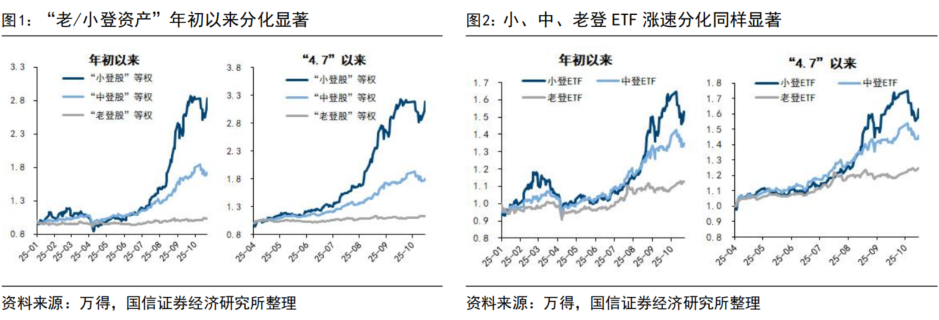
Core Viewpoint - The report by Guosen Securities highlights an extreme divergence between "old" and "new" assets in the market, emphasizing that high growth does not necessarily equate to high investment returns, and that finding fundamentally sound valuation opportunities can lead to significant returns [1][2]. Group 1: Performance Divergence - Since 2025, "small new stocks" have significantly outperformed "old stocks," with the "small new stock" portfolio rising by 183.8% compared to just 3.9% for "old stocks" [2]. - From April 7, 2025, "small new stocks" surged over 200%, while "old stocks" only increased by 13.6% [2]. - The "small new ETF" has risen by 53.1% since 2025, while the "old ETF" has only seen a 13.1% increase [2]. Group 2: Valuation and Market Activity - As of October 24, the PE ratio for "small new" sectors like electronics and computing is at the 99th percentile since 2019, while "old" sectors like real estate and liquor are at the 56th percentile [8]. - The trading volume for "small new" sectors has increased to 33%, while "old" sectors have dropped to below 2.8%, indicating a significant divergence in market activity [8]. Group 3: Investment Strategy - The report stresses the importance of not only selecting high-quality stocks ("buy good") but also ensuring they are purchased at favorable valuations ("buy well") to achieve high returns [11]. - Historical examples illustrate that higher growth does not guarantee better returns, as seen in the comparison between IBM and New Jersey Standard Oil from 1950 to 2003 [11][12]. - The banking sector has shown resilience, with a decline of only 3.9% compared to a 31.1% drop in the overall market, highlighting the potential for finding undervalued stocks with solid fundamentals [15]. Group 4: Market Trends and Seasonal Effects - The current market is characterized by a "small new stock" era, but there are seasonal opportunities for "old stocks," particularly in real estate, liquor, and brokerage sectors [20][29]. - Historical bull markets have shown that each cycle has a leading sector that aligns with prevailing economic trends, with AI and technology being the current focus [21]. - Seasonal effects suggest that value sectors may outperform in the fourth quarter, with historical data indicating a 64% success rate for value over growth during this period [23].