焦炭

Search documents
黑色建材日报-20250808
Wu Kuang Qi Huo· 2025-08-08 00:34
黑色建材日报 2025-08-08 钢材 黑色建材组 陈张滢 从业资格号:F03098415 交易咨询号:Z0020771 0755-23375161 chenzy@wkqh.cn 万林新 从业资格号:F03133967 0755-23375162 wanlx@wkqh.cn 赵 航 从业资格号:F03133652 0755-23375155 zhao3@wkqh.cn 螺纹钢主力合约下午收盘价为 3231 元/吨, 较上一交易日跌 3 元/吨(-0.09%)。当日注册仓单 93491 吨, 环 比增加 4235 吨。主力合约持仓量为 162.8167 万手,环比减少 24402 手。现货市场方面, 螺纹钢天津汇总 价格为 3320 元/吨, 环比减少 10/吨; 上海汇总价格为 3360 元/吨, 环比减少 10 元/吨。 热轧板卷主力 合约收盘价为 3440 元/吨, 较上一交易日跌 11 元/吨(-0.31%)。 当日注册仓单 70915 吨, 环比减少 0 吨。主力合约持仓量为 142.8587 万手,环比减少 31588 手。 现货方面, 热轧板卷乐从汇总价格为 3470 元/吨, 环比减少 0 元 ...
黑色金属日报-20250807
Guo Tou Qi Huo· 2025-08-07 11:40
Report Industry Investment Ratings - Thread steel: ★☆☆, representing a bullish bias but low operability on the trading floor [1] - Hot-rolled coil: ★☆☆, indicating a bullish bias but low operability on the trading floor [1] - Iron ore: ☆☆☆, suggesting a relatively balanced short - term long/short trend and poor operability, with a recommendation to wait and see [1] - Coke: ★☆★, implying a certain bullish trend [1] - Coking coal: ★☆☆, showing a bullish bias but low operability on the trading floor [1] - Silicon manganese: ★☆☆, indicating a bullish bias but low operability on the trading floor [1] - Ferrosilicon: ★☆★, suggesting a certain bullish trend [1] Core Views - The overall steel market has complex supply - demand relationships. With the "anti - involution" influencing the trading floor, the market sentiment is cautious after sharp fluctuations [2] - Iron ore is expected to trade in a high - level range in the short term due to factors such as supply recovery, stable demand, and macro uncertainties [2] - Coke is expected to rise in the short term, with its price being significantly affected by the "anti - involution" policy expectations [3] - Coking coal is likely to see continued destocking in the short term, with high volatility and limited downside space, and caution is advised when chasing up [5] - Silicon manganese and ferrosilicon prices are affected by the "anti - involution" policy expectations, and attention should be paid to the pressure near previous highs [6][7] Summary by Related Catalogs Steel - Thread steel: This week, apparent demand and production increased, and inventory continued to accumulate. The overall market sentiment is cautious after sharp fluctuations, and the trading floor is mainly influenced by the "anti - involution" [2] - Hot - rolled coil: Demand dropped significantly, production declined, and inventory continued to accumulate. The overall demand in the downstream industries is weak, and the trading floor is affected by the overall commodity market trend [2] Iron Ore - Supply: Global shipments are expected to increase seasonally in August, domestic arrivals have increased month - on - month, and port inventories have stabilized with no obvious pressure to accumulate in the short term [2] - Demand: Terminal demand is weak due to weather, but steel mills have insufficient motivation to cut production actively, and the demand for iron ore replenishment still exists. Future policy - driven production cuts need to be monitored [2] - Macro: There are still uncertainties in overseas trade, and the bullish sentiment from domestic "anti - involution" has cooled down. The short - term trend is expected to be high - level consolidation [2] Coke - Supply: The sixth round of price increase is pending, production has slightly decreased, and overall inventory has continued to decline slightly [3] - Demand: Downstream molten iron production remains high during the off - season, and traders have good purchasing intentions [3] - Market: The price is significantly affected by the "anti - involution" policy expectations, and it is expected to rise in the short term with high volatility [3] Coking Coal - Supply: Production has slightly increased, the spot auction market has improved, and overall inventory has decreased month - on - month, with production - end inventory dropping significantly [5] - Demand: Downstream molten iron production remains high during the off - season [5] - Market: The price is affected by the "anti - involution" policy expectations, with high volatility and limited downside space in the short term. Caution is needed when chasing up [5] Silicon Manganese - Supply: Weekly production has been increasing, but the rate is lower than expected. Manganese ore prices have slightly increased this week, and it is expected to accumulate inventory in the second half of the year [6] - Demand: Molten iron production remains above 240, and the demand is relatively high. In July, supply exceeded demand, and the on - balance - sheet inventory continued to decline [6] - Market: The price is affected by the "anti - involution" policy expectations, and attention should be paid to the pressure near previous highs [6] Ferrosilicon - Supply: Supply has slightly increased, and the market trading volume is average, with on - balance - sheet inventory slightly increasing [7] - Demand: Molten iron production has slightly decreased but remains above 240. Export demand is around 30,000 tons, and the secondary demand has slightly declined. Overall demand is acceptable [7] - Market: The price follows the trend of silicon manganese and is affected by the "anti - involution" policy expectations. Attention should be paid to the pressure near previous highs [7]
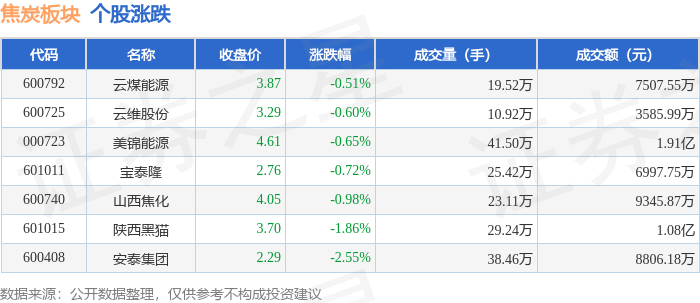
焦炭板块8月7日跌0.96%,安泰集团领跌,主力资金净流出4713.26万元
Zheng Xing Xing Ye Ri Bao· 2025-08-07 08:32
从资金流向上来看,当日焦炭板块主力资金净流出4713.26万元,游资资金净流出902.33万元,散户资金 净流入5615.58万元。焦炭板块个股资金流向见下表: 证券之星消息,8月7日焦炭板块较上一交易日下跌0.96%,安泰集团领跌。当日上证指数报收于 3639.67,上涨0.16%。深证成指报收于11157.94,下跌0.18%。焦炭板块个股涨跌见下表: | 代码 | 名称 | 收盘价 | 涨跌幅 | 成交量(手) | 成交额(元) | | --- | --- | --- | --- | --- | --- | | 600792 | 云煤能源 | 3.87 | -0.51% | 19.52万 | > 7507.55万 | | 600725 | 云维股份 | 3.29 | -0.60% | 10.92万 | 3585.99万 | | 000723 | 美锦能源 | 4.61 | -0.65% | 41.50万 | 1.91亿 | | 601011 | 宝泰隆 | 2.76 | -0.72% | 25.42万 | 6997.75万 | | 600740 | 山西焦化 | 4.05 | -0.98% | 23.1 ...


双焦月报:反内卷情绪降温,宽幅震荡-20250807
Hong Ta Qi Huo· 2025-08-07 07:26
Report Industry Investment Rating - Not provided in the document Core Viewpoint - In the short term, as the anti - involution sentiment cools down, the pricing logic of coking coal and coke returns to fundamentals. The supply of coking coal is affected by the "over - production inspection" policy and pre - parade restrictions in September, while the cost support for coke remains. On the demand side, steel mills have high profits and no production cuts, with rigid demand remaining high. For coking coal, the price is expected to run in a wide and strong range of 1030 - 1300. For coke, the price is expected to run in a wide and volatile range of 1600 - 1800 [5][83] Summary by Related Catalogs Macro Interpretation - **Domestic Market**: Frequent market news amplifies market sentiment. Policies such as the coal production inspection notice issued by the National Energy Administration in 2025 and the "276 - workday production plan" of Wanjie Coal Industry have affected the market [8][9] - **Coal Supply**: From January to June 2025, the cumulative output of raw coal increased year - on - year, but the daily output of sample mines decreased month - on - month. Although coal mine profits have improved and there is a possibility of increased production, the impact of the "over - production inspection" policy and pre - parade restrictions needs to be continuously monitored [10] - **Coking Coal Imports and Exports**: From January to June 2025, the cumulative import volume of coking coal decreased year - on - year but increased slightly month - on - month. The import volume of Mongolian, Australian, Russian, and Canadian coking coal all increased marginally [16] - **Coking Coal Inventory**: As of August 7, 2025, the inventory of sample mines and ports decreased, while the inventory of independent coking enterprises and steel enterprises increased. The inventory has shifted downward, and the coking coal price is supported [26] - **Coke Supply**: From January to June 2025, the coke output increased year - on - year. As of August 7, 2025, the daily output of independent coking enterprises remained flat, while that of steel enterprises decreased slightly. Affected by the rising price of coking coal, the profit of coking enterprises has shrunk, and the market supply has tightened marginally [35] - **Coke Imports and Exports**: From January to June 2025, the cumulative export volume of coke decreased year - on - year. Global economic slowdown and other factors suppress the export demand for coke, but the impact on the domestic market is small [44] - **Coke Inventory**: As of August 7, 2025, the total coke inventory decreased, with the inventory of independent coking enterprises decreasing significantly, that of steel enterprises decreasing slightly, and that of ports increasing. The inventory has shifted downstream, and the market has shifted to on - demand procurement [47] - **Iron Element Demand**: As of August 7, 2025, the daily output of molten iron by steel enterprises remained high, and the consumption of five major steel products was at a low level in recent years. The inventory of five major steel products was in the process of destocking. Although some steel mills had short - term maintenance, the overall production willingness of steel mills did not decline significantly [56] - **Iron Element Terminal Demand**: From January to July 2025, national fixed - asset investment increased year - on - year, with infrastructure and manufacturing investment increasing and real estate development investment decreasing. High - temperature and rainy weather and weak capital improvement restricted the recovery of demand. The apparent demand for rebar in August is expected to decline [64] - **Basis and Term Structure**: Recently, the coking coal and coke futures have fluctuated at low levels. The basis of coking coal and coke has fallen from high levels. For both, the contango structure has steepened, and cross - month arbitrage can conduct reverse arbitrage. Attention can be paid to the positive arbitrage entry opportunities when the basis strengthens [74]
广发期货日评-20250807
Guang Fa Qi Huo· 2025-08-07 07:03
Report Summary 1. Report Industry Investment Ratings No specific overall industry investment ratings are provided in the report. However, specific investment suggestions are given for each variety: - **Buy Suggestions**: Index futures (sell far - month contracts), Treasury bonds (buy on dips), Precious metals (low - buying for silver, hold gold long - positions), Iron ore (buy on dips), Coking coal (buy on dips, 9 - 1 calendar spread), Coke (buy on dips, 9 - 1 calendar spread), Copper (hold), Aluminum (range - trading), Zinc (range - trading), Nickel (range - trading), Urea (buy on dips, quick profit - taking), PTA (range - trading, TA1 - 5 reverse spread, expand processing margin), PP (range - trading, stop - loss for previous short - positions), Maize (long - position for 01 contract), Industrial silicon (hold call options), Polysilicon (hold call options) [2] - **Sell Suggestions**: Gold (sell put options below 760 yuan), Steel (sell on rallies), Container shipping index (sell on rallies), Alumina (range - trading), Crude oil (wait for geopolitical clarity), Caustic soda (hold short - positions), PVC (stop - loss for short - positions), Pure benzene (observe or short - term long), Styrene (range - trading), Synthetic rubber (observe), LLDPE (short - term long), Cotton (reduce near - month short - positions, hold 01 short - positions), Eggs (long - term short), Apples (observe around 7800), Glass (hold short - positions), Carbonate lithium (observe cautiously) [2] 2. Core Views - **Market Environment**: The second round of China - US trade talks extended tariff exemption clauses, and the Politburo meeting's policy tone was consistent with the previous one, causing short - term market expectation differences. The policy negatives were exhausted in early August, and the capital market became looser [2]. - **Market Trends**: Index futures continued to rise, TMT regained popularity; Treasury bonds were expected to oscillate upward; Precious metals' upward trend slowed down; The container shipping index was expected to be weak; Steel and iron ore prices fluctuated; Non - ferrous metals were supported by fundamentals; Energy and chemical products showed different trends; Agricultural products were affected by factors such as production expectations and inventory; Special and new energy products had their own characteristics in price movements [2]. 3. Summary by Variety **Financial** - **Index Futures**: Continued to rise, with TMT heating up again. Recommended selling far - month contracts and shorting MO put options with strike prices of 6300 - 6400, with a mild bullish view [2]. - **Treasury Bonds**: With policy negatives exhausted and loose funds, they were expected to oscillate upward. Suggested buying on dips and paying attention to July economic data [2]. - **Precious Metals**: Gold's upward trend slowed down, and silver was affected by market sentiment. Gold long - positions were held above 3300 dollars (770 yuan), and silver was bought at low levels around 36 - 37 dollars (8700 - 9000 yuan) [2]. **Industrial** - **Container Shipping Index (EC)**: Expected to be weakly oscillating, with a strategy of selling on rallies [2]. - **Steel and Iron Ore**: Steel turned to oscillation, and iron ore followed steel price fluctuations. Suggested buying on dips for iron ore and using a long - coking coal and short - iron ore strategy [2]. - **Non - ferrous Metals**: Copper was supported by fundamentals, and the price range was 77000 - 79000; Aluminum was oscillating, and the range was 20000 - 21000; Zinc was oscillating in a narrow range, and the range was 22000 - 23000; Nickel was oscillating strongly, and the range was 118000 - 126000 [2]. **Energy and Chemical** - **Crude Oil**: Weakly oscillating, with a strategy of waiting for geopolitical clarity. Support levels were [63, 64] for WTI, [66, 67] for Brent, and [490, 500] for SC [2]. - **Urea**: There was a game between export drive and weak domestic consumption. The short - term strategy was to buy on dips and take quick profits, and exit long - positions if the price did not break through 1770 - 1780 [2]. - **PTA**: With low processing fees and limited cost support, it was expected to oscillate in the range of 4600 - 4800. TA1 - 5 was treated with a reverse spread, and the processing margin was expanded at a low level (around 250) [2]. **Agricultural** - **Soybean Meal and Maize**: Maize was oscillating weakly, and the 01 contract of soybean meal was held long due to import concerns [2]. - **Palm Oil**: The price pulled back due to expected inventory increases. Observed whether P09 could stand firm at 9000 [2]. - **Cotton**: The downstream market was weak. Near - month short - positions were reduced, and 01 short - positions were held [2]. **Special and New Energy** - **Glass**: The spot sales weakened, and the contract was held short [2]. - **Industrial Silicon and Polysilicon**: Both were oscillating upward, and call options were held [2]. - **Carbonate Lithium**: The price was pulled up by news, but there were uncertainties in the mining end. It was mainly observed cautiously [2].
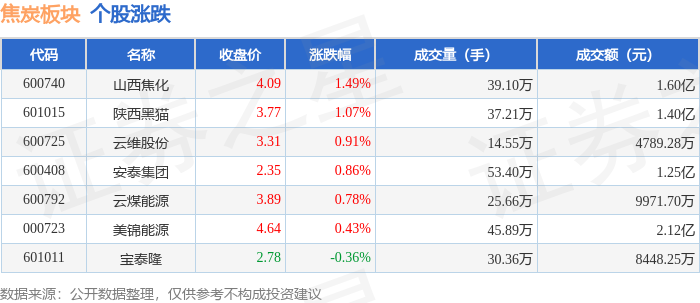
焦炭板块8月6日涨0.73%,山西焦化领涨,主力资金净流入4849.41万元
Zheng Xing Xing Ye Ri Bao· 2025-08-06 08:41
Market Overview - The coke sector increased by 0.73% on August 6, with Shanxi Coking Coal leading the gains [1] - The Shanghai Composite Index closed at 3633.99, up 0.45%, while the Shenzhen Component Index closed at 11177.78, up 0.64% [1] Individual Stock Performance - Shanxi Coking Coal (600740) closed at 4.09, up 1.49% with a trading volume of 391,000 shares and a turnover of 160 million yuan [1] - Shaanxi Black Cat (601015) closed at 3.77, up 1.07% with a trading volume of 372,100 shares and a turnover of 140 million yuan [1] - Yunwei Co. (600725) closed at 3.31, up 0.91% with a trading volume of 145,500 shares and a turnover of 47.89 million yuan [1] - Antai Group (600408) closed at 2.35, up 0.86% with a trading volume of 534,000 shares and a turnover of 125 million yuan [1] - Yunmei Energy (600792) closed at 3.89, up 0.78% with a trading volume of 256,600 shares and a turnover of 99.71 million yuan [1] - Meijin Energy (000723) closed at 4.64, up 0.43% with a trading volume of 458,900 shares and a turnover of 212 million yuan [1] - Yutailong (601011) closed at 2.78, down 0.36% with a trading volume of 303,600 shares and a turnover of 84.48 million yuan [1] Fund Flow Analysis - The coke sector saw a net inflow of 48.49 million yuan from main funds, while retail funds experienced a net outflow of 36.71 million yuan [1] - Main fund inflows for Shanxi Coking Coal amounted to 26.12 million yuan, while retail funds had a net outflow of 13.35 million yuan [2] - Meijin Energy had a main fund inflow of 16.78 million yuan, with retail funds seeing a net outflow of 1.55 million yuan [2] - Shaanxi Black Cat recorded a main fund inflow of 12.27 million yuan, with retail funds experiencing a net outflow of 12.54 million yuan [2] - Yunmei Energy had a main fund inflow of 3.04 million yuan, while retail funds saw a net outflow of 6.06 million yuan [2]

中信期货晨报:国内商品期货涨跌互现,焦煤跌幅居前-20250806
Zhong Xin Qi Huo· 2025-08-06 05:24
1. Report Industry Investment Rating No relevant content provided. 2. Core Viewpoints of the Report - Overseas macro: Market concerns about US employment and economic slowdown are rising, leading to an increase in expectations for Fed rate cuts in the second half of the year, which is favorable for gold. In the long term, the weak US dollar pattern continues, and attention should be paid to non - US dollar assets [5]. - Domestic macro: In the context of stable and progressive domestic economic operation in the first half of the year, the overall tone of the Politburo meeting in July is to improve the quality and speed of using existing policies, with relatively limited incremental policies. The composite PMI in July remains above the critical point [5]. - Asset viewpoints: For domestic assets, there are mainly structural opportunities. In the second half of the year, the policy - driven logic is strengthened, and the probability of incremental policy implementation is higher in the fourth quarter [5]. 3. Summary by Related Catalogs 3.1 Financial Market and Commodity Price Changes - **Equity Index Futures**: The CSI 300 futures closed at 4029.6, down 0.68% daily, 2.10% weekly, 0.68% monthly, up 7.77% quarterly, and 2.77% year - to - date. The Shanghai 50 futures and the CSI 500 futures also showed different degrees of decline, while the CSI 1000 futures rose 0.07% daily [3]. - **Treasury Bond Futures**: The 2 - year, 5 - year, 10 - year, and 30 - year treasury bond futures had different price changes, with the 10 - year treasury bond futures down 0.05% daily [3]. - **Foreign Exchange**: The US dollar index was at 98.69, down 1.36% daily, 1.04% weekly. The US dollar intermediate price had a 2 - pip daily increase [3]. - **Interest Rates**: The 10 - year Chinese government bond yield was 1.71, up 0.2 bp daily. The 10 - year US government bond yield was 4.23, down 14 bp daily [3]. - **Commodities**: In the domestic commodity market, coal rose 1.93% daily, while industrial silicon fell 2.97% daily. In the overseas commodity market, NYMEX WTI crude oil was at 67.26, down 3.03% daily [3]. 3.2 Macro Analysis - **Overseas Macro**: In the first half of the week, market bets on Fed rate cuts declined due to better - than - expected Q2 GDP, tariff easing, and hawkish signals from the Fed's July meeting. However, the July non - farm payrolls were below expectations, increasing market concerns about the US economic downturn and Fed rate cuts. Key events to watch include US inflation data in August, the Jackson Hole meeting, and subsequent non - farm payrolls [5]. - **Domestic Macro**: After the Politburo meeting in July, the overall policy tone focuses on using existing policies more effectively, with relatively few incremental policies. The composite PMI in July remains above the critical point, and attention should be paid to the progress of economic negotiations between the US and other economies [5]. 3.3 Asset Views - **Domestic Assets**: There are mainly structural opportunities. Policy - driven logic will be strengthened in the second half of the year, and the probability of incremental policy implementation is higher in the fourth quarter [5]. - **Overseas Assets**: Market concerns about US employment and economic slowdown are rising, increasing expectations for Fed rate cuts in the second half of the year, which is favorable for gold. In the long term, the weak US dollar pattern continues, and attention should be paid to non - US dollar assets [5]. 3.4 Sector and Variety Analysis - **Financial Sector**: Stock index futures are expected to rise in a volatile manner, stock index options will be volatile, and treasury bond futures will also be in a volatile state [6]. - **Precious Metals Sector**: Gold and silver are in a short - term adjustment phase and are expected to be volatile [6]. - **Shipping Sector**: The container shipping to Europe route is in a state of game between peak - season expectations and price - rise implementation, and is expected to be volatile [6]. - **Black Building Materials Sector**: Most varieties such as steel, iron ore, and coke are expected to be volatile, with their fundamentals and market sentiments changing [6]. - **Non - ferrous and New Materials Sector**: Most non - ferrous metal varieties are expected to be volatile, affected by factors such as supply disturbances and policy expectations [6]. - **Energy and Chemical Sector**: Crude oil supply is increasing, and domestic chemical products are expected to benefit from stable - growth expectations. Most varieties are expected to be volatile, while asphalt and high - sulfur and low - sulfur fuel oils are expected to decline [8]. - **Agricultural Sector**: Most agricultural products are expected to be volatile, affected by factors such as weather, trade policies, and supply - demand relationships [8].
"反内卷"提振大宗商品市场 政策驱动行业从"价格战"转向价值重估
Zhong Guo Jing Ji Wang· 2025-08-06 02:17
Group 1: Policy and Market Response - The Central Financial Committee's recent meeting emphasized the need to regulate low-price disorderly competition among enterprises and promote product quality improvement [1] - In response to the "anti-involution" policy, industries such as photovoltaic, cement, steel, and coke have begun to reduce production and increase prices [1][4] - The National Development and Reform Commission and the State Administration for Market Regulation have proposed amendments to the Price Law to standardize market pricing and address "involution-style" competition [1][4] Group 2: Commodity Market Trends - Major commodity futures, including coking coal, coke, polysilicon, industrial silicon, glass, and soda ash, have seen significant price increases, with polysilicon rising by 50% in July and reaching a record high of 53,000 yuan/ton [1][4] - The market is experiencing a shift from "anti-involution driven" to "stock replenishment driven," with expectations of further price increases as downstream demand rises [4][5] - Analysts predict that most commodity futures will experience a comprehensive rebound in the third quarter, driven by policy support and improved market conditions [5] Group 3: Industry Challenges and Opportunities - The chemical industry is facing a cycle of low-price competition, which undermines profitability and restricts R&D investment, leading to a lack of product value enhancement [2] - The Ministry of Industry and Information Technology is set to introduce plans to stabilize growth in key industries, focusing on structural adjustments and the elimination of outdated production capacity [2][3] - The "anti-involution" policy aims to enhance market order and promote industry upgrades, directing resources towards high-efficiency sectors and improving global competitiveness [6]
煤焦:焦价5轮提涨落地,盘面震荡加剧
Hua Bao Qi Huo· 2025-08-05 09:03
Report Industry Investment Rating - Not provided Core Viewpoints - Market speculation sentiment has cooled, and with exchange rule restrictions, coal prices are gradually returning to rationality. Fundamentals have improved, but short - term price fluctuations have intensified. It is recommended to wait and see [3] Summary by Related Catalog Market Conditions - Yesterday, coal - coke futures prices fluctuated sharply and closed higher in the late session. The spot market price was lagging behind the futures and remained relatively strong, with the 5th round of coke price increase implemented yesterday [2] Supply - side - Last week, coal production in Shanxi mines decreased, with some mines reducing output due to underground problems and completion of monthly tasks. Regarding the tracking of over - production issues, regions in Shanxi (except Lvliang) received documents and started verifying production. The impact on short - term coking coal output may be limited, but the long - term impact on coal mine production should be noted. The Australian coal import window closed again, and Mongolian coal customs clearance declined after a brief surge [2] Demand - side - Last week, the raw material replenishment actions of coking plants and steel mills slowed down slightly. The available days of coking coal inventory in factories stabilized after rising from a low level. Last week, the profitability rate of steel mills was 65.37%, a 1.73 - percentage - point increase from the previous week and a 58.88 - percentage - point increase year - on - year. The daily average pig iron output was 2.4071 million tons, a decrease of 15,200 tons from the previous week but an increase of 40,900 tons year - on - year [2]
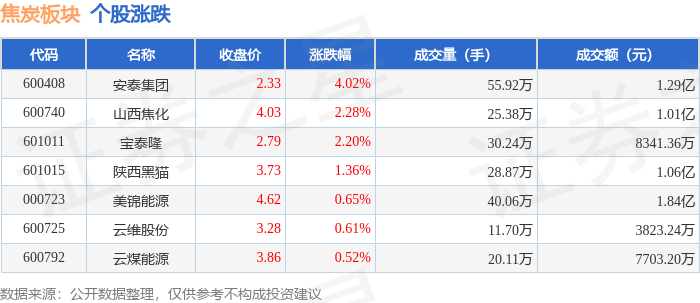
焦炭板块8月5日涨1.34%,安泰集团领涨,主力资金净流入1578.05万元
Zheng Xing Xing Ye Ri Bao· 2025-08-05 08:37
| 代码 | 名称 | 主力净流入 (元) | 主力净占比 游资净流入 (元) | | 游资净占比 散户净流入 (元) | | 散户净占比 | | --- | --- | --- | --- | --- | --- | --- | --- | | 600740 山西焦化 | | 1618.21万 | 16.07% | -355.34万 | -3.53% | -1262.87万 | -12.54% | | 600408 | 安泰集团 | 912.38万 | 7.09% | 94.29万 | 0.73% | -1006.67万 | -7.82% | | 601015 陕西黑猫 | | 483.31万 | 4.54% | -201.67万 | -1.90% | -281.64万 | -2.65% | | 601011 | 宝泰隆 | 247.70万 | 2.97% | 2.45万 | 0.03% | -250.15万 | -3.00% | | 600725 | 云维股份 | -31.89万 | -0.83% | -39.45万 | -1.03% | 71.33万 | 1.87% | | 600792 | 云煤能源 ...