白酒

Search documents
传茅台拟提高飞天出厂价,茅台及大商辟谣!
Xin Lang Cai Jing· 2026-02-25 05:01
另外,茅台酒四川经销商亦表示:"目前没有收到任何通知"。 责任编辑:郭栩彤 2月25日,有消息称,飞天茅台出厂价由1169元/瓶上调至1299元/瓶。 对此,新浪财经《酒业内参》问询了茅台方面,其表示:"未收到相关消息,若涨价将公开,一切以公 告为准。" ...

春节,关税与AI
2026-02-25 04:14
Summary of Conference Call Notes Company/Industry Involved - The discussion revolves around the macroeconomic environment, particularly focusing on the Chinese market and its interactions with global markets, including the U.S. and Japan. Key Points and Arguments Macroeconomic Changes - The U.S. Supreme Court's decision to overturn Trump's tariffs based on the EPA has created a notable impact, although the overall market reaction has been muted due to prior expectations of such a ruling [1][7][11]. - The performance of major asset classes during the Spring Festival period showed that commodities, particularly oil and gold, performed relatively well, while the Hong Kong stock market, especially the Hang Seng Tech Index, lagged significantly [1][2][3]. Market Performance - The U.S. stock market, particularly small-cap stocks, has shown resilience, while tech stocks have struggled to regain their footing after recent adjustments [2][3]. - The Hong Kong market has been characterized by a significant underperformance of tech stocks, attributed to concerns over the differentiation between new and old technology companies [2][3]. Capital Flows - There has been a notable inflow of foreign capital into the Chinese market, particularly from the Asia-Pacific region, although this has not been reflected in the performance of the Hong Kong market [4][5]. - The inflow of foreign capital has been sustained for six consecutive weeks, indicating a growing preference for Chinese assets, despite a slowdown in the pace of inflows recently [4][5]. U.S. Tariff Policies - The recent changes in U.S. tariff policies, particularly the Supreme Court's ruling, have led to a slight decrease in the overall tariff rate, which is now approximately 13.4% [11][12]. - The implications of these tariff changes are complex, as they may lead to further negotiations and adjustments in trade policies, creating uncertainty in the market [9][12]. Economic Indicators - U.S. GDP growth for the fourth quarter was reported at an annualized rate of 1.4%, significantly lower than the previous quarter's 4.4%, influenced by government shutdowns and trade dynamics [17][18]. - The PCE data released showed slight inflationary pressures, but overall, inflation is not expected to pose a significant threat to the Federal Reserve's monetary policy [19][20]. Chinese Economic Outlook - The Chinese financial data indicates a mixed picture, with M1 growth reflecting a recovery in the capital market, but overall credit demand remains weak [24][25]. - Consumer spending during the Spring Festival showed moderate growth, with expectations for continued recovery, but structural issues in consumer spending power remain [26][27]. Future Considerations - The upcoming Two Sessions and the visit from Trump are anticipated to be critical events that could influence market dynamics and policy directions [28]. - The overall outlook for the Hong Kong market remains cautious, with expectations of a potential slowdown in the credit cycle in the second quarter of the year [25][29]. Other Important but Possibly Overlooked Content - The differentiation in performance between various sectors, particularly in technology, highlights the need for investors to focus on specific companies and their competitive positioning within the market [30][31]. - The discussion emphasizes the importance of understanding the underlying economic fundamentals rather than solely relying on capital flow data, which can be lagging indicators [6][19]. This summary encapsulates the key insights and data points from the conference call, providing a comprehensive overview of the current market landscape and future expectations.
未知机构:春节后首个交易日市场普涨机构赎回含权资产202602224春-20260225
未知机构· 2026-02-25 03:45
Summary of Conference Call Notes Industry Overview - The conference call discusses the performance of the A-share market post-Spring Festival, highlighting a general upward trend with a 1.06% increase in the market on the first trading day after the holiday, outperforming the Hang Seng Tech and Nasdaq indices during the same period [1][1]. Key Points and Arguments Market Performance - The A-share market showed strong performance compared to overseas markets, with significant gains in cyclical sectors such as oil and gas, which rose by 5.53%, and other sectors like building materials, chemicals, non-ferrous metals, coal, and steel leading the gains [1][1]. - Specific sub-sectors like fiberglass and phosphorus saw increases exceeding 8% [1][1]. - In contrast, the AI software sector experienced a downturn, with notable declines in stocks like Adobe, CRM, and Autodesk, which saw maximum drawdowns of up to 30% due to the release of multiple large models [3][3]. AI Sector Insights - The hardware segment of AI remains robust despite the software downturn, with technologies like CPO (Co-Packaged Optics) expected to achieve mass production by year-end, benefiting various components such as optical engines and silicon photonics [3][3]. - The market is currently awaiting a "killer product" in AI, with uncertainty surrounding its arrival and impact on the sector [3][3]. Consumer Sector Dynamics - The decline in box office revenue during the Spring Festival period has negatively impacted film stocks, with companies like China Duty Free Group facing significant losses after losing operational rights at key airports [4][4]. - However, there was a noticeable increase in offline consumer activity during the extended holiday, with growth in foot traffic, shipping, and tourism-related spending, indicating potential for recovery despite low consumer confidence [4][4]. Additional Important Content Institutional Behavior - On the first trading day post-holiday, institutions exhibited a net redemption trend, with a subscription to redemption ratio of 45% to 55% [5][5]. - There was a net redemption in rights-embedded assets, while bond funds saw net subscriptions, indicating a shift in investment strategy among institutions [6][6]. - Active equity funds experienced a net redemption of 0.15%, primarily driven by sales from wealth management and insurance sectors, while sectors like electric new energy, chemicals, and non-ferrous metals saw increased allocations [6][6]. Debt and Bond Market - The convertible bond market faced a net redemption of 1.37%, with significant selling from brokers and trusts [7][7]. - Short-term bonds also saw a net redemption of 1.24%, reflecting a cautious approach among investors [8][8]. Overall Market Sentiment - The overall sentiment in the market appears cautious, with institutions adjusting their portfolios in response to recent market dynamics and sector performances [5][5][6][6].
大市“开门红”,白酒逆市调整,春节旺季结束淡季该怎么走?
Nan Fang Du Shi Bao· 2026-02-25 03:04
Core Viewpoint - The white liquor industry is experiencing a market adjustment post-Spring Festival, with a notable decline in stock prices despite a stable overall market performance in A-shares [1][4]. Group 1: Market Performance - On February 24, the white liquor sector opened at 2669.58 points but closed at 2619.94 points, down 0.94% [1]. - From February 6, the white liquor sector has shown a downward trend, with 6 out of 7 trading days in February recording losses [1]. - Major brands like Kweichow Moutai and Wuliangye saw declines, with Moutai closing at 1466.8 yuan per share, down 1.25% [1]. Group 2: Consumer Behavior and Pricing - During the Spring Festival, Kweichow Moutai's Feitian Moutai was in high demand, with significant sales and limited availability reported [2]. - The latest batch price for Feitian Moutai is between 1700 yuan and 1730 yuan per bottle, while retail prices have stabilized above 1800 yuan [2]. - Products priced between 100 yuan and 300 yuan are also experiencing strong sales, driven by consumer gatherings [2]. Group 3: Industry Trends - The white liquor market is exhibiting a "dumbbell-shaped" growth pattern, with strong sales at both the high-end and low-end, but core mid-range products are under pressure [3]. - High-end brands like Moutai and Wuliangye are showing resilience, with some segments experiencing double-digit growth despite overall declines [4]. - Analysts predict that the white liquor sector is at a cyclical bottom, with potential for marginal recovery in 2026, particularly in the second half of the year [5]. Group 4: Future Outlook - The industry is expected to face challenges in the off-season following the Spring Festival, with high inventory levels and a need for strategic adjustments [4][6]. - Many industry players are adopting a cautious stance, emphasizing the need for careful inventory management and maintaining price stability [6].




春节消费分化,出行服务亮眼
Ge Long Hui· 2026-02-25 02:09
Core Viewpoint - The consumption during the 2026 Spring Festival shows a differentiated performance, with sectors like hotels, scenic spots, and high-end liquor performing well, while retail and box office results are generally average. The overall consumption recovery is ongoing, with a focus on potential fiscal stimulus policies in the short term [1]. Travel Sector - The 2026 Spring Festival features a 9-day holiday, leading to increased travel with a trend of "returning home first, then traveling." The favorable weather conditions contributed to a 5.2% year-on-year increase in cross-regional mobility during the first 20 days of the Spring Festival travel period. Hotel occupancy rates averaged 51.4%, with a 3.3 percentage point increase year-on-year, and average daily rates (ADR) rose by 10.1% to 293.1 yuan. Revenue per available room (RevPAR) increased by 17.6% to 150.1 yuan, exceeding pre-holiday expectations [2]. Liquor Sector - The liquor market aligns with expectations, showing a continued trend of differentiation. High-end brands like Moutai and Wuliangye performed significantly better than mid-tier brands. The demand structure has shifted, with a stable demand during the Spring Festival concentrated in the price segment below 300 yuan. The solid performance during the Spring Festival is expected to support steady sales throughout the year, indicating a potential recovery opportunity for leading brands [3]. Retail Sector - Retail performance was impacted by travel, with a reported 8.6% increase in average daily sales for key retail and catering enterprises compared to the previous year. The jewelry market showed mixed results, with significant growth in specific areas like Shenzhen, where foot traffic surged over 30%. However, overall customer flow was lower than the previous year due to the long holiday and high travel numbers [4]. Investment Strategy - The investment strategy emphasizes short-term focus on turning points and long-term structural changes. The current low expectations and resilient consumption trends are expected to enhance investment preferences in the consumption sector. The year 2026 is seen as a critical year for establishing the consumption industry's recovery. A "barbell strategy" is recommended, balancing service consumption with high-dividend assets while monitoring opportunities in the supply chain as CPI turns positive [6][7].
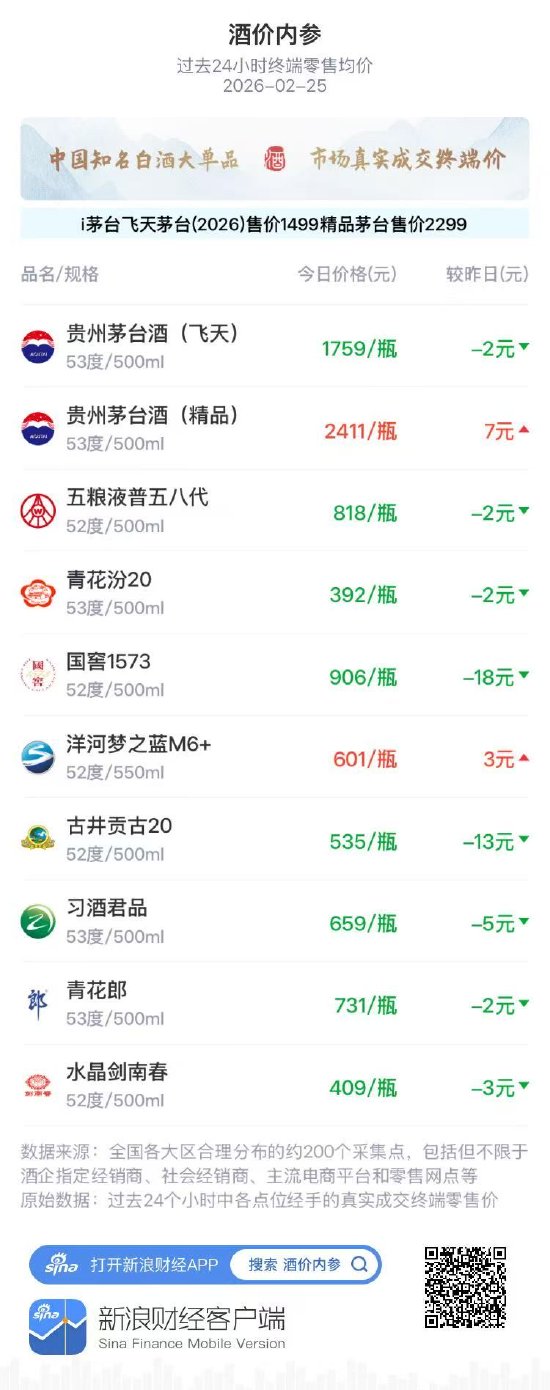
酒价内参2月25日价格发布,精品茅台逆势上涨7元
Xin Lang Cai Jing· 2026-02-25 02:01
Core Viewpoint - The Chinese white liquor market is experiencing a significant price correction, with the average retail price of the top ten products declining as of February 25, indicating a cautious market sentiment following the post-holiday price surge [1]. Price Trends - The total price for a package of one bottle from each of the top ten products is 9,221 yuan, which represents a decrease of 37 yuan from the previous day, marking a new low for the week [1]. - Out of the top ten products, eight saw price declines while two experienced price increases, reflecting a cautious market atmosphere [1]. Specific Product Performance - Moutai's premium product increased by 7 yuan per bottle, serving as a key support for the market [1]. - Yanghe Dream Blue M6 saw a slight increase of 3 yuan per bottle, continuing its narrow fluctuation trend [1]. - The most significant decline was observed in Guojiao 1573, which dropped by 18 yuan per bottle, following a previous five-day price increase [1]. - Other notable declines included: - Gujing Gong 20 down by 13 yuan - Xijiu Junpin down by 5 yuan - Shuijing Jian'nan Chun down by 3 yuan - Several other products, including Feitian Moutai and Wuliangye, saw minor decreases of 2 yuan each [1][6]. Industry Developments - The Ministry of Industry and Information Technology, the Ministry of Human Resources and Social Security, and the State Administration for Market Regulation jointly issued the "Guidance on Quality Improvement and Upgrading of the Brewing Industry (2026-2030)," marking the beginning of a high-quality development path for the Chinese liquor industry [3]. - The guidance outlines seven key areas for improvement, including enhancing raw material supply, boosting technological innovation, and optimizing industry structure, with 21 specific tasks identified [3].


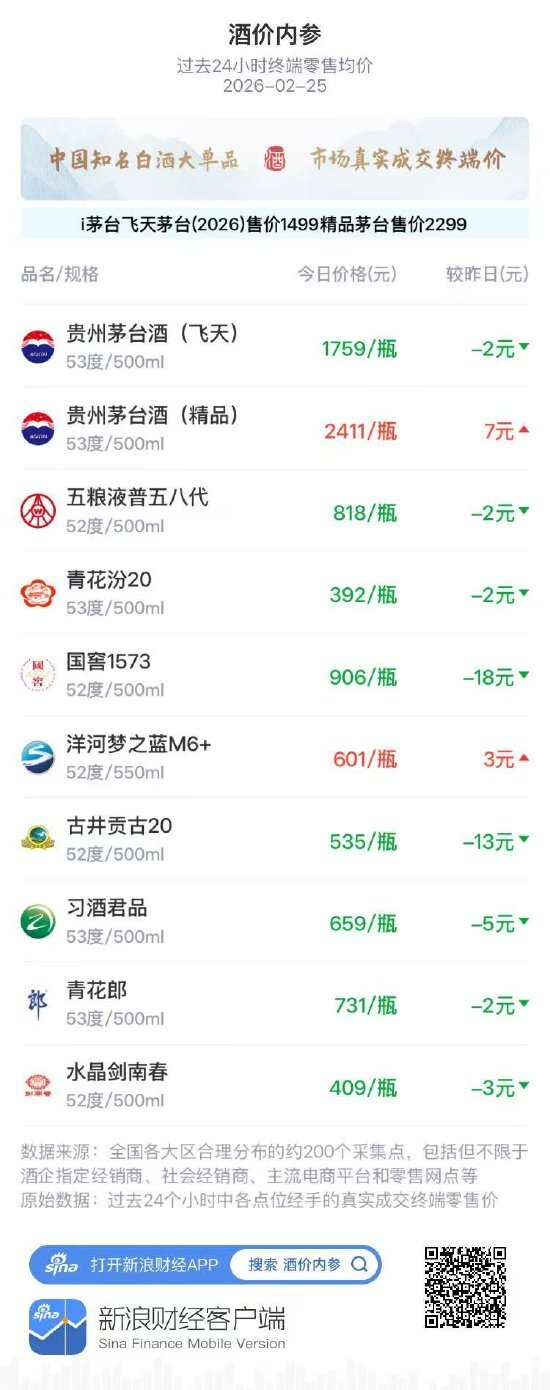
酒价内参2月25日价格发布,洋河梦之蓝M6+小幅上涨3元
Xin Lang Cai Jing· 2026-02-25 01:42
Core Viewpoint - The Chinese white liquor market is experiencing a significant price correction, with the average retail price of the top ten products dropping, indicating market pressure following the holiday price increases [1][6][7]. Price Trends - As of February 25, the total retail price for a package of the top ten liquor products is 9,221 yuan, a decrease of 37 yuan from the previous day, marking a new low for the week [1][6][7]. - Out of the top ten products, eight saw price declines while two experienced price increases, reflecting cautious market sentiment [1][7]. Individual Product Performance - Moutai's premium variant increased by 7 yuan per bottle, serving as a key support for the market [1][7]. - Yanghe Dream Blue M6+ rose by 3 yuan per bottle, continuing its narrow fluctuation trend [1][7]. - The largest decline was observed in Guojiao 1573, which fell by 18 yuan per bottle, indicating a significant downward shift after a previous five-day price increase [1][7]. - Other notable declines included: - Gujing Gong 20 down by 13 yuan - Xijiu Junpin down by 5 yuan - Shuijing Jian'nan Chun down by 3 yuan - Several other brands, including Feitian Moutai and Wuliangye, saw minor decreases of 2 yuan each [1][7][12]. Market Data Collection - The price data is sourced from approximately 200 collection points across various regions, including designated distributors, social distributors, e-commerce platforms, and retail outlets, ensuring a comprehensive and objective representation of the market [2][8]. Industry Developments - A recent report highlighted the release of the "Guidance on Quality Improvement and Upgrading of the Brewing Industry (2026-2030)" by three government departments, marking the beginning of a high-quality development path for the Chinese liquor industry [9]. - The guidance outlines seven key areas for improvement, including enhancing raw material supply, boosting technological innovation, and optimizing industry structure, with 21 specific tasks identified [9].
食品饮料行业2025年信用回顾与2026年展望
新世纪评级· 2026-02-25 01:25
Investment Rating - The food and beverage industry is rated as stable for 2025 and 2026 [1] Core Insights - The food and beverage industry in China includes various sub-industries such as agriculture, food processing, and beverage manufacturing, closely linked to economic development, population structure, and consumer preferences. Despite ongoing economic pressures and weak consumer demand, the industry continues to grow, although revenue growth rates are declining and profitability is weakening [1][6] - The agricultural sector shows a steady increase in grain planting area and production, with major crops like rice, wheat, and corn maintaining a balance between supply and demand. However, some crop prices are under pressure due to supply-demand dynamics and international trade conditions [24][25] - The food manufacturing sector is experiencing stable growth, with overall profitability remaining flat. The industry is characterized by increasing fixed asset investments and a slight increase in total assets [52][53] Summary by Sections 1. Industry Performance - The food and beverage industry has a total asset value of 8.42 trillion yuan at the end of 2024, with a year-on-year growth of 3.59%. The industry’s revenue for 2024 is 9.07 trillion yuan, showing a slight decline of 0.20% year-on-year [7][11] - By the end of September 2025, the industry’s total assets increased to 8.61 trillion yuan, with a revenue of 6.71 trillion yuan, reflecting a year-on-year growth of 1.75% [7][11] 2. Agricultural Sector - The agricultural sector's total output value reached 162,787.5 billion yuan in 2024, with a year-on-year growth of 2.7%. The grain planting area for 2024 and 2025 is projected to be 11,931.9 million hectares and 11,940.9 million hectares, respectively [24][25] - Grain production is expected to increase, with total grain output for 2024 and 2025 estimated at 70.65 million tons and 71.49 million tons, respectively [27] 3. Feed Industry - The feed industry is experiencing growth in production, influenced by the recovery of the livestock sector. The total industrial feed production for 2024 is 31,503.1 million tons, showing a year-on-year decline of 2.1% [45] - The feed prices are expected to remain low due to fluctuations in raw material prices and weak downstream demand [49] 4. Food Manufacturing - The food manufacturing sector continues to grow, with total assets reaching 2.41 trillion yuan by September 2025, reflecting a 4% increase year-on-year. The revenue for the first three quarters of 2025 is 1.63 trillion yuan, with a slight decrease in profit margins [52][53] 5. Livestock Industry - The livestock sector is under pressure, with pork prices gradually declining. The production of beef is increasing, while sheep meat production is decreasing due to weak demand [56][58] - The overall production of meat is expected to grow, with pork production for 2024 and 2025 estimated at 5,706.03 million tons and 5,938 million tons, respectively [58]

中信证券:白酒存在贝塔修复机会 建议重点增配品牌龙头
Xin Lang Cai Jing· 2026-02-25 00:50
Group 1 - The core viewpoint of the report indicates that the consumption during the Year of the Horse Spring Festival shows a differentiated performance, aligning with expectations [1] - Sectors such as hotels, scenic spots, and high-end liquor exhibit a favorable level of prosperity, while retail and box office performances are generally average due to the impact of travel diversion [1] - The company maintains the perspective that consumption is in a process of self-recovery, stabilizing with differentiation, and suggests that short-term consumption opportunities may arise from potential fiscal stimulus policies [1] Group 2 - For 2026, the report emphasizes focusing on the wealth effect transmission in the equity market and the operational turning point opportunities driven by supply-side optimization [1] - Long-term allocations should continue to pay attention to structural changes within the market [1]

又双叒崩了,26年消费还有戏吗?
3 6 Ke· 2026-02-25 00:13
Core Viewpoint - The consumer sector in China is facing significant challenges, particularly in the liquor and service industries, with disappointing performance during the recent Spring Festival, leading to a cautious outlook for 2026 [3][11]. Group 1: Consumer Performance - The Spring Festival has historically been a peak consumption period, but this year, key sectors like liquor and services have shown weak performance, with liquor sales down by 10-15% [5][11]. - Despite some recovery in sales for high-end liquor brands like Moutai and Wuliangye, the overall market sentiment remains low, indicating a lack of confidence among investors [5][7]. - The service sector, particularly travel and hospitality, has shown some positive data, with significant increases in hotel occupancy and revenue during the holiday period [8][9]. Group 2: Market Sentiment and Economic Indicators - The release of a government document aimed at upgrading the liquor industry did not positively impact market sentiment, as investors remain skeptical about its practical effects [7]. - The overall economic environment is perceived as challenging, with many consumers reporting difficulties in business and a general decline in job security and income expectations [12][14]. - The real estate market continues to decline, which is affecting consumer confidence and spending, with expectations for stabilization potentially not occurring until late 2024 [12][13]. Group 3: Future Outlook - The consumer sector is unlikely to see significant improvement until the real estate market stabilizes, which is crucial for boosting overall economic sentiment and consumer spending [12][13]. - The upcoming financial reports in March and April are expected to reflect continued weak performance in the consumer sector, suggesting that investors should remain cautious [14].