
健康

Search documents
利好!财政政策“大礼包”,提高个人消费贷贴息标准,实施民间投资专项担保计划
Zhong Guo Zheng Quan Bao· 2026-01-20 05:05
Core Viewpoint The Ministry of Finance and other departments have announced multiple policy measures aimed at extending financial support for service industries, personal consumption, and small and micro enterprises, with a focus on enhancing loan interest subsidies and expanding the scope of support. Group 1: Loan Interest Subsidy Policies - The loan interest subsidy for service industry entities has been extended until December 31, 2026, with a maximum subsidy of 10 million yuan for new loans issued in 2026, and a subsidy rate of 1% for a maximum period of one year [2][4] - The personal consumption loan interest subsidy policy has also been extended to December 31, 2026, with the removal of the previous limits on single loan subsidies and cumulative consumption subsidies [4][5] - The annual interest subsidy for fixed asset loans to eligible small and micro enterprises will be 1.5 percentage points, with a maximum loan amount of 50 million yuan per entity [8] Group 2: Special Guarantee Plans - A special guarantee plan for private investment has been introduced with a total quota of 500 billion yuan, to be implemented over two years, aimed at supporting small and micro enterprises in various sectors [5][6] - The plan will cover loans for equipment purchases, technological upgrades, and other operational needs, including expansions in sectors such as health, tourism, and digital services [5][6] Group 3: Equipment Update Loan Policies - The equipment update loan interest subsidy policy has been optimized, allowing for a 1.5 percentage point subsidy on fixed asset loans for equipment updates, applicable for loans issued until December 31, 2026 [7][8] - The policy will also include support for new technology innovation loans starting from 2026 [7]
四部门:延长服务业经营主体贷款贴息政策实施期限 将数字、绿色、零售3类消费领域纳入支持范围
智通财经网· 2026-01-20 04:21
Core Viewpoint - The Ministry of Finance, Ministry of Commerce, People's Bank of China, and Financial Regulatory Bureau have announced an optimization of the loan interest subsidy policy for service industry operators, expanding support to new sectors and extending the policy's implementation period until December 31, 2026 [1][3]. Group 1: Policy Extension and Support - The implementation period for the loan interest subsidy policy has been extended to December 31, 2026, with loans issued between March 16, 2025, and December 31, 2025, following the existing subsidy guidelines [3][4]. - The maximum loan amount eligible for interest subsidies has been increased to 10 million yuan per borrower, with a subsidy period not exceeding one year and an annual subsidy rate of 1% [4][5]. Group 2: Expanded Support Areas - The policy now includes three additional consumption sectors: digital, green, and retail, alongside the existing eight sectors such as catering, health, and tourism [4][5]. - The digital sector corresponds to "Internet and related services" and "digital content services," while the green sector includes categories like "property management" and "green transportation" [4][5]. Group 3: Banking and Operational Mechanisms - A total of 21 national banks and various commercial banks are designated as eligible institutions for processing these loans, enhancing the accessibility of the subsidy program [5][6]. - The operational mechanism will be optimized to improve efficiency, including a joint review process among financial institutions and regulatory bodies [6][7]. Group 4: Financial Management and Reporting - The subsidy funds will be managed through a "pre-allocation + settlement" method, ensuring timely disbursement and settlement of funds between banks and provincial finance departments [6][7]. - Banks are required to report on the execution of the policy monthly, detailing loan issuance and subsidy usage, to ensure transparency and accountability [8].
财政部:延长服务业经营主体贷款贴息政策实施期限至2026年12月31日
Xin Lang Cai Jing· 2026-01-20 03:58
Core Viewpoint - The Ministry of Finance has announced an extension of the loan interest subsidy policy for service industry operators until December 31, 2026, with specific provisions for loans issued between March 16, 2025, and December 31, 2025 [1][2]. Group 1: Policy Extension - The implementation period for the loan interest subsidy policy is extended to December 31, 2026 [1][2]. - Loans issued during the period from March 16, 2025, to December 31, 2025, will follow the guidelines set forth in the relevant policy documents [1][2]. - The possibility of further extending the policy after its expiration will be considered based on circumstances [1][2]. Group 2: Subsidy Details - The maximum loan amount eligible for interest subsidy in 2026 is set at 10 million yuan per borrower [1][2]. - The interest subsidy period is capped at one year, with an annual subsidy rate of 1% [1][2]. - The funding for the subsidy will be shared by the central government (90%) and provincial governments (10%) [1][2]. Group 3: Expanded Support Areas - The policy now includes three additional consumption sectors: digital, green, and retail, alongside the existing eight sectors [1][2]. - The digital sector corresponds to "Internet and related services" and "digital content services" as per the national economic industry classification [1][2]. - The green sector includes categories such as "property management" under energy-efficient and green building standards, "car rental," and "logistics services" that meet green criteria [1][2]. - The retail sector is defined according to the national economic industry classification under "retail industry" [1][2]. - The cultural and entertainment sector has been adjusted to exclude manufacturing sub-sectors as defined by specific industry codes [1][2].
“降温”稳节奏不改趋势 五大主线锚定2026年投资方向
Zhong Guo Zheng Quan Bao· 2026-01-19 21:11
Group 1 - The A-share market has shown strong performance at the beginning of 2026, driven by a combination of market trends, seasonal factors, and recovery in overseas markets [1][2] - Recent market fluctuations are attributed to the implementation of counter-cyclical adjustment policies and profit-taking in popular sectors, which are considered healthy adjustments that do not alter the overall upward trend [1][2] - The macroeconomic environment is expected to support five key investment themes for the year: the artificial intelligence industry chain, high-dividend assets, anti-involution sectors, domestic demand expansion, and resource sectors [1][5] Group 2 - The spring market rally is historically supported by liquidity and valuation drivers, typically lasting around 57 days, with the current phase still in its early stages [2] - Positive performance in overseas markets, particularly in Japan and South Korea, has significantly boosted investor sentiment in the A-share market [2] - Recent adjustments in the A-share market, including changes in financing margin ratios, are aimed at curbing excessive leverage and maintaining a stable upward trend [2][3] Group 3 - Investment strategies must adapt to changing market conditions, emphasizing the importance of position management and avoiding excessive leverage [3][4] - Investors are encouraged to develop independent judgment capabilities to avoid speculative traps and focus on fundamental research [3][4] - The market is transitioning from a speculative phase to one driven by fundamentals, with a focus on true technological growth and value [3][4] Group 4 - Four strategic recommendations for the pre-Spring Festival period include maintaining moderate positions, adopting a barbell strategy for asset allocation, focusing on specific technology sectors, and enhancing individual stock fundamental research [4] - The artificial intelligence industry chain is expected to shift towards application opportunities in 2026, with a focus on sectors like media and computing [5] - High-dividend assets remain a stable investment choice, with sectors such as white goods, banking, and utilities providing low volatility and steady returns [5] Group 5 - The anti-involution sector is entering a phase driven by fundamentals, with industries like coal, steel, and lithium batteries expected to see improved performance due to industry consolidation [5] - The expansion of domestic demand should focus on new consumption areas such as health, sports, and travel, which are expected to benefit from policy support [5] - Resource sectors, particularly strategic and industrial metals, are anticipated to experience valuation recovery in 2026, presenting potential investment opportunities [5][6]
上海“十五五”:增强内需主动力、壮大服贸优势
第一财经· 2026-01-19 15:24
Core Viewpoint - Shanghai's "15th Five-Year Plan" emphasizes high-quality development and the construction of five key centers to enhance its global economic and competitive standing [1][4]. Group 1: Economic Development Goals - The main goals of Shanghai's economic and social development include significant achievements in high-quality development, new advancements in urban core functions, breakthroughs in high-level reform and opening up, and improvements in social civilization [4]. - The plan highlights the importance of domestic demand as a primary driver of economic growth, with a focus on enhancing the international consumption center [4][5]. Group 2: Service Industry and Consumption - Shanghai aims to expand service consumption, particularly in cultural, tourism, sports, and health sectors, while promoting innovative consumption models and enhancing the quality of service supply [5][6]. - Recent policies emphasize the integration of service industry development with consumption growth, aiming to shift from scale expansion to value enhancement in the service sector [7]. Group 3: Trade and Global Positioning - The plan outlines strategies to strengthen Shanghai's role as a global trade hub, including optimizing trade structures and enhancing service trade capabilities [8][9]. - Shanghai's foreign trade statistics indicate a significant increase, with total foreign trade reaching 4.51 trillion yuan in 2025, a year-on-year growth of 5.6%, and exports growing by 10.8% [9][10]. Group 4: Shipping and Logistics - The "15th Five-Year Plan" includes initiatives to solidify Shanghai's status as a global shipping hub, focusing on modern shipping services and digital transformation [11]. - Plans to develop a world-class shipping exchange and enhance maritime services are part of the strategy to support the international trade center [11].


上海“十五五”规划建议:大力发展文化、旅游、体育、健康等改善型服务消费
Zheng Quan Shi Bao Wang· 2026-01-18 23:54
Core Viewpoint - The Shanghai Municipal Committee has released recommendations for the 15th Five-Year Plan, emphasizing the implementation of strategies to expand domestic demand and enhance consumption [1] Group 1: Consumption Strategies - The plan includes a continuation of special actions to boost consumption and the development of Shanghai as an international consumption center [1] - There is a focus on expanding service consumption, particularly in cultural, tourism, sports, and health sectors, to improve the quality of service supply [1] - The initiative promotes green and smart consumption, aiming to upgrade and expand product consumption [1] Group 2: Innovation and Integration - Encouragement for innovation in consumption models and formats, promoting the integration of online and offline consumption [1] - The plan supports the development of "AI + consumption," intellectual property derivative products, and interactive, immersive, and experiential consumption [1] - There is a push for the growth of the live-streaming economy and the deep integration of culture, tourism, commerce, and sports [1] Group 3: Economic Environment and Infrastructure - The recommendations include optimizing the consumption environment and advancing the construction of world-class business districts [1] - Development of distinctive commercial streets and enhancement of tax refund and cross-border payment convenience to increase inbound consumption [1] - The plan aims to create an all-age-friendly quality living circle to better match supply and demand in consumer goods, stimulating consumption potential among the elderly and youth [1]
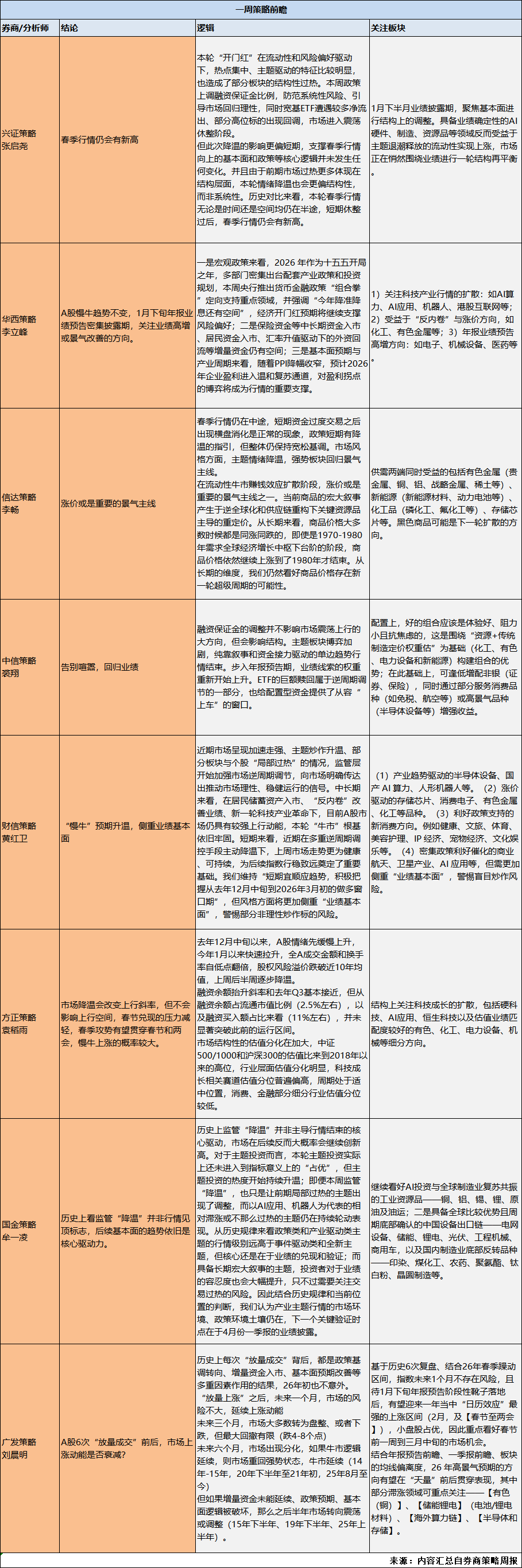
A股分析师前瞻:后市指数行情依旧值得期待,结构上更关注业绩线
Xuan Gu Bao· 2026-01-18 14:42
Core Viewpoint - The current market sentiment is driven by liquidity and risk appetite, leading to a concentration of hot sectors and thematic investments, which has resulted in structural overheating in some areas [1][2] Group 1: Market Trends - The recent "opening red" market rally is characterized by significant liquidity and heightened risk preferences, with a clear focus on thematic investments [1][2] - The adjustment of financing margin ratios aims to prevent systemic risks and guide the market back to rationality, while broad-based ETFs have experienced significant net outflows, indicating a market entering a phase of consolidation [1][2] - Historical comparisons suggest that the current spring market rally is still in its early stages, with potential for new highs following a short-term correction [1][2] Group 2: Sector Focus - Analysts emphasize that the upcoming earnings reporting period will shift focus back to performance indicators, particularly in sectors expected to show high growth or improved conditions, such as electronics, machinery, and pharmaceuticals [1][2] - The adjustment in financing margins is not expected to impact the overall upward trend of the market but will affect sector dynamics, with increased competition among thematic sectors [2][3] - The focus on sectors benefiting from the "anti-involution" trend and price increases includes chemicals and non-ferrous metals, with a particular emphasis on high-growth areas in the upcoming earnings forecasts [2][3] Group 3: Investment Strategies - The market is expected to maintain a "slow bull" trend, with a focus on performance fundamentals as the primary driver of investment decisions, while cautioning against irrational speculative activities [2][3] - The anticipated earnings reports in late January are expected to catalyze significant market movements, particularly in sectors with strong performance indicators [2][3] - The overall market sentiment remains positive, with expectations of continued upward momentum despite short-term fluctuations, driven by fundamental improvements and policy support [2][3]
财信证券宏观策略周报(1.19-1.23):“慢牛”预期升温,侧重业绩基本面-20260118
Caixin Securities· 2026-01-18 13:18
Group 1 - The market is showing signs of strengthening, with increased thematic speculation and some sectors and stocks becoming "locally overheated," prompting regulatory measures to enhance counter-cyclical adjustments [4][7] - The A-share market has strong upward momentum due to factors such as increased household savings entering the market, improved performance from "anti-involution" efforts, and a new wave of technological industrial revolution [4][7] - The report maintains a "short-term trend-following" strategy, emphasizing the importance of focusing on performance fundamentals while being cautious of irrational speculation risks [4][7] Group 2 - Investment opportunities are identified in sectors driven by industrial trends such as semiconductor equipment, domestic AI computing, and humanoid robots [4][7] - Price-driven sectors such as storage chips, consumer electronics, non-ferrous metals, and chemicals are highlighted as potential areas for investment [4][7] - New consumption directions supported by favorable policies, including health, cultural tourism, sports, beauty care, IP economy, pet economy, and cultural entertainment, are recommended for attention [4][7] Group 3 - The report notes that the China Securities Regulatory Commission emphasizes timely counter-cyclical adjustments and strict enforcement against excessive speculation to promote stable market operations [4][7] - The People's Bank of China has introduced eight policy measures to support economic structural transformation, including lowering interest rates on various structural monetary policy tools [8][9] - December's social financing data exceeded expectations, with new social financing of 22,075 billion yuan, although the structure still requires optimization [10] Group 4 - December's import and export data showed positive performance, with exports increasing by 6.6% year-on-year, driven by seasonal demand and global AI investment trends [11] - The report indicates that there is a potential "rush to export" in the first quarter of 2026 due to adjustments in export tax rebate policies, although this may partially preempt demand in the second quarter [11] Group 5 - The report highlights the importance of monitoring employment performance and the independence of the Federal Reserve as key factors influencing the Fed's interest rate path [12][13] - The report concludes that recent counter-cyclical measures have laid a solid foundation for stable market performance moving forward, with a focus on sectors such as non-ferrous metals and technology growth [4][7]
天猫「扶优」一年,新品牌迎来黄金时代
36氪· 2026-01-13 10:14
Core Insights - The article highlights a significant growth in the consumer market, with 150,000 new merchants entering the market and 276 new brands achieving over 100 million in sales in 2025, contrary to the prevailing narrative of consumption downgrade [3][10][15] - The report indicates that the number of brands achieving over 100 million in sales within three years of opening has reached a historical high, with a year-on-year increase of over 40% for brands that achieved this milestone in their opening year [3][10] Group 1: New Brand Growth - In 2025, there were 15,000 high-quality merchants entering the market, marking a historical high for new brand creation on Tmall [4][10] - A total of 5,026 new brands achieved over 10 million in sales in 2025, showcasing a broad industry explosion rather than a singular focus on specific sectors [21][22] - The apparel sector led with 22% of new brands, followed by home appliances, home improvement, 3C digital products, and health sectors, each contributing nearly 400 new brands [22] Group 2: Market Dynamics - The report emphasizes a shift in the "profit-making logic," moving away from reliance on low prices and high-volume sales to a focus on product quality and brand differentiation [15][19] - The success of brands like Xu Cuihua and Tongpin illustrates the importance of product quality and consumer engagement, as they have thrived by addressing specific consumer pain points rather than competing on price [28][29] - The article notes that the consumer market is not "cooling down," but rather becoming more selective, rewarding brands that can meet evolving consumer demands [19][38] Group 3: Future Opportunities - The report outlines potential opportunities for 2026, including advancements in AI hardware, smart jewelry, and technology-driven home appliances, indicating a shift towards products that enhance emotional and practical value [40][43] - The demand for quality products continues to rise, with consumer quality indices showing consistent growth over the past ten quarters, suggesting a robust market for innovative brands that cater to young consumers [43][44] - The article concludes that the future will favor brands that adhere to long-term strategies and respond to consumer needs with solid innovation [44]

美银:AI仍为中国互联网最大增长亮点 腾讯控股为行业首选
Zhi Tong Cai Jing· 2026-01-13 06:16
Core Viewpoint - The report from Bank of America Securities indicates that stock performance will remain differentiated this year, with the artificial intelligence sector expected to outperform the market again, while virtual consumption in entertainment and travel will continue to outperform physical e-commerce [1] Group 1: Market Trends - The macroeconomic environment is weak, putting pressure on consumer spending (e-commerce) and corporate spending (advertising), which remains a drag on the industry [1] - Chinese internet stocks are seen as having attractive valuations, providing a buffer against downside risks, with a forecasted price-to-earnings ratio of 18 times, lower than the ten-year average of 23 times, the Nasdaq 100's 26 times, and the "Big Seven" in the US stock market at 31 times [1] Group 2: Stock Preferences - The company prefers stocks in artificial intelligence and online gaming over e-commerce, with Tencent Holdings (00700) being the top pick due to its growth driven by AI applications, stable market competition, excellent shareholder returns, and attractive valuation [1] - Alibaba (09988) is identified as the best investment target in China's artificial intelligence sector and the top choice among Chinese e-commerce stocks [1] - Baidu-SW (09888) is considered attractive in the AI field, with value release on the right track [1] - In the digital entertainment sector, the company favors online gaming, recommending Bilibili-W (09626) and Tencent Music-SW (01698) [1] - Within specific sectors, JD Health (06618) and Trip.com (09961) are viewed positively [1]



