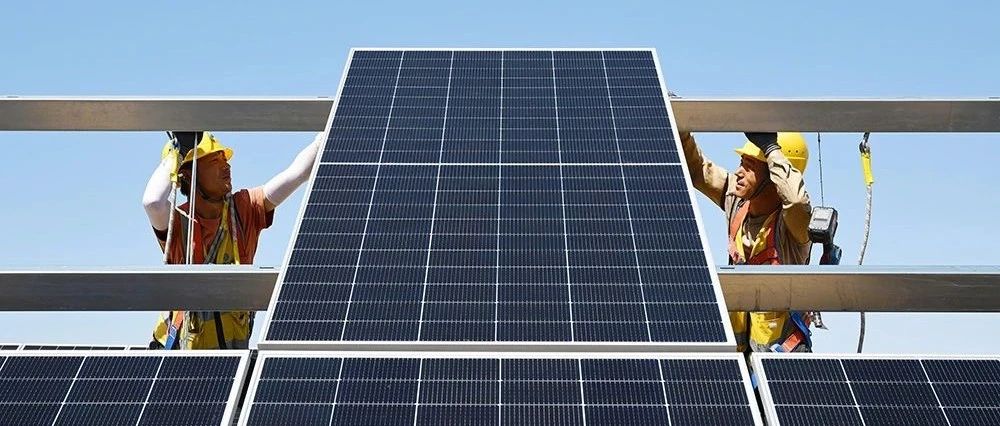
光伏组件

Search documents
1-6月全球动力电池同比增长37.3%,7月硅片主动控产稳价 | 投研报告
Zhong Guo Neng Yuan Wang· 2025-08-18 09:40
Group 1: Market Performance - The electric equipment and new energy sector increased by 5.84% this week, ranking 4th in terms of performance, outperforming the Shanghai Composite Index [1][2] - The industrial control automation index saw the highest increase at 7.43%, while the nuclear power index experienced the largest decline at 1.52% [1][2] Group 2: New Energy Vehicles - In the first half of 2025, global power battery installation volume reached 504.4 GWh, a year-on-year increase of 37.3% [2] - CATL led the market with an absolute advantage, achieving 190.9 GWh, followed by BYD with 89.9 GWh and LG Energy with 47.2 GWh [2] - Honeycomb Energy showed remarkable growth, with a year-on-year increase of 208%, reaching an installation volume of 12.9 GWh, making it the fastest-growing company among the top 10 [2] Group 3: New Energy Generation - In the first half of 2025, the top 10 global module manufacturers had a total shipment of approximately 247.9 GW, reflecting a year-on-year increase of 10% [3] - The shipment focus remains on the domestic market, with China accounting for about 58% of shipments [3] - TOPCon modules have become the main product among the top suppliers, while BC and HJT technologies did not feature in the top ten due to certain manufacturers not being included [3] Group 4: Electric Equipment and Industrial Control - The State Grid Corporation of China announced the 2025 fifth batch of procurement, which includes 425 bidding packages and a total of 20.66 million items, with 17.46 million being electric meters [4] - The demand for electric meters increased by 12% year-on-year but decreased by 45% compared to the previous period [4] Group 5: Companies to Watch - Key companies to monitor include CATL, Keda Li, Daikin Heavy Industries, Haili Wind Power, Deye Shares, Liangxin Shares, Shenghong Shares, Xiamen Tungsten New Energy, Xuch Electric, and Mingyang Electric [5]

内卷式竞争:怎么看,怎么办?
Jing Ji Guan Cha Wang· 2025-08-18 09:13
Core Viewpoint - Major platforms such as Meituan, Ele.me, and JD.com have jointly committed to resisting vicious competition and regulating promotional behaviors, marking a significant response to regulatory signals and a potential shift towards sustainable development in the industry [1] Group 1: Concept and Classification of "Involutionary Competition" - "Involution" refers to a complex internal development process that leads to increased complexity without qualitative change, often resulting in resource wastage and industry deterioration [2][3] - "Involutionary competition" is defined as excessive competition for limited market share that fails to enhance efficiency or create new value, leading to a waste of resources and a vicious cycle within the industry [2][3] Group 2: Types of "Involutionary Competition" - Horizontal involutionary competition manifests as price wars among peer companies, significantly compressing profit margins and damaging industry health [3][4] - Vertical involutionary competition occurs when dominant firms exert pressure on upstream and downstream partners, transferring costs and risks, which can lead to a low-quality, low-price, and low-efficiency cycle [4][5] Group 3: Causes of "Involutionary Competition" - Shrinking internal and external demand due to factors like trade tensions and demographic changes has led to increased price competition among firms [6][7] - Local government policies that prioritize short-term growth metrics over sustainable practices have exacerbated the issue, encouraging firms to engage in irrational competition [8][9] - The lure of China's vast market encourages aggressive strategies that prioritize market share over profitability, leading to a "winner-takes-all" mentality [10] - Scale economies and network effects drive firms to engage in price wars to achieve cost advantages, often at the expense of long-term stability [11] - Distorted financial valuation logic prioritizes growth over profitability, pushing firms to adopt aggressive pricing strategies to attract investment [12] - Cultural factors, such as the belief in "thin profit and high sales," contribute to a competitive environment that favors price cuts over value enhancement [13][14] Group 4: Strategies to Address "Involutionary Competition" - Expanding internal and external demand through policy reforms and enhancing consumer confidence is crucial to alleviating price competition [16][17] - Restructuring industrial policies and local incentives to focus on high-quality growth rather than short-term metrics can mitigate involutionary pressures [18][19] - Redefining competition boundaries and incentive structures in the unified market to prioritize value over price is essential [20][21] - Regulating platform governance and ensuring fair competition can prevent monopolistic behaviors that lead to systemic inefficiencies [21] - Reforming financial valuation logic to emphasize long-term value creation over short-term growth can help curb involutionary practices [22] - Promoting cultural change within organizations to prioritize sustainable growth and value creation over mere sales volume is necessary [23][24]
市场过热了吗?——A股一周走势研判及事件提醒
Datayes· 2025-08-17 16:03
Core Viewpoint - The recent market sentiment has shifted from a slow bull to a fast bull, with significant capital inflows and historical highs in net purchases from both domestic and foreign investors [2][30]. Group 1: Market Dynamics - On a single day, main funds net bought over 100 billion yuan, while southbound funds net bought over 30 billion HKD, marking a historical high [2]. - The trading volume of northbound funds also saw a substantial increase, indicating heightened market activity [2]. - Concerns about market overheating are present, but indicators suggest that the current bull market has not yet peaked [4]. Group 2: Key Indicators - The absolute turnover rate is currently around 4%, which is typical for strong market conditions, suggesting that the current bull market is expected to be robust [4]. - The long-term trend of turnover rates indicates that the market is still climbing, with no signs of reaching a peak yet [4]. - The financing balance relative to the free float market value is at a median level, indicating that leveraged funds still have room to grow [5]. Group 3: Economic Context - Despite lower-than-expected economic indicators, the stock market remains strong, driven by liquidity rather than short-term economic fluctuations [13]. - The People's Bank of China has shown a cautious attitude towards further monetary easing, with no immediate plans for rate cuts unless there are unexpected actions from the Federal Reserve [12]. Group 4: Sector Performance - The most favored sectors by market funds include non-bank financials, electronics, and computers, with significant net inflows recorded [31]. - Conversely, sectors such as defense, banking, and public utilities experienced the largest net outflows [31]. Group 5: Industry Trends - The textile, apparel, and commercial trade sectors are currently in a recession quadrant, while the computer and steel industries are in an expansion quadrant [35]. - The pharmaceutical, media, and commercial trade sectors are expected to see an increase in their economic outlook over the next six months, while the banking and agricultural sectors may experience a decline [36].







每日收评创业板指涨超2.6%!大金融方向集体爆发,指南针、同花顺双双创下历史新高
Sou Hu Cai Jing· 2025-08-15 09:15
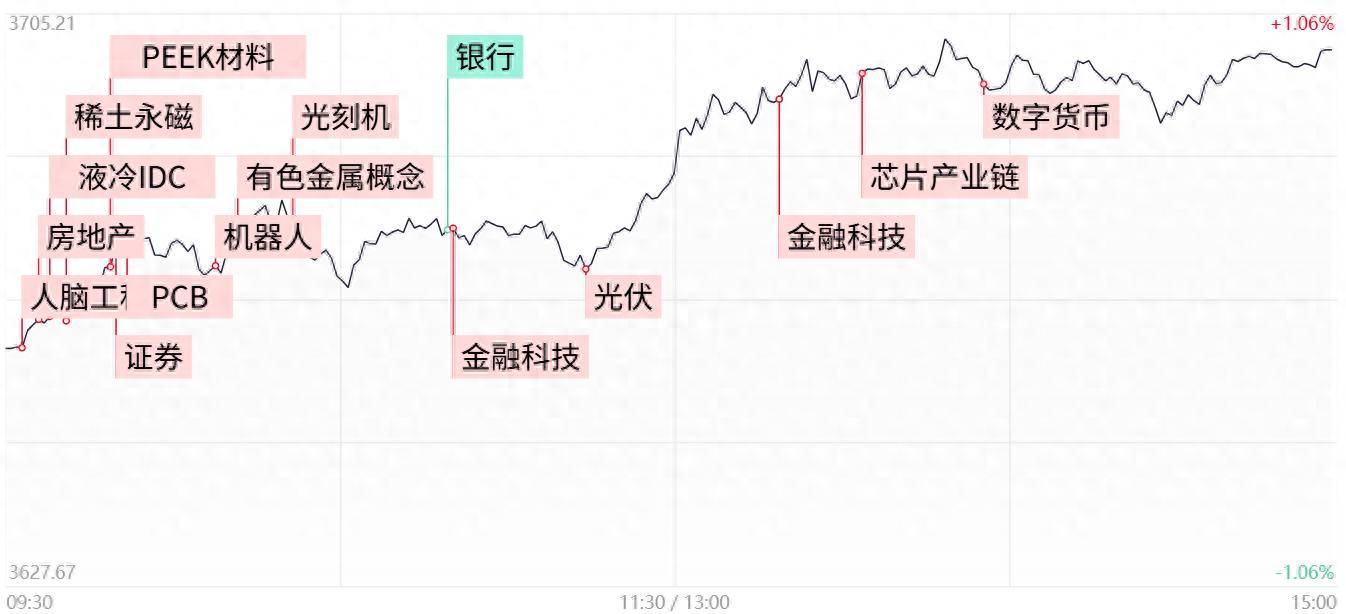
Market Overview - The market experienced a rebound with the ChiNext Index leading the gains, as the Shanghai and Shenzhen stock exchanges recorded a total trading volume of 2.24 trillion yuan, a decrease of 34.6 billion yuan from the previous trading day [1] - Over 4,600 stocks rose, with the majority of sectors seeing gains, particularly in the brokerage and fintech sectors, which saw significant increases [1][2] Sector Performance - The brokerage and fintech sectors surged, with notable stocks such as Changcheng Securities and Tonghuashun hitting historical highs [1][2] - The PCB and liquid cooling server concepts also saw a resurgence, with stocks like Chuanhuan Technology reaching their daily limit [1][2] - The photovoltaic sector rebounded, with stocks like Oujing Technology hitting their daily limit, indicating a positive trend in this area [1][2] Individual Stock Highlights - The market showed strong profitability with over 4,600 stocks rising, and more than 150 stocks increasing by over 9% [5] - The liquid cooling sector saw a notable rebound, with stocks like Dayuan Pump Industry recording five consecutive gains [5] - The data center sector strengthened, with stocks such as Chuanhuan Technology and Kexin Information reaching their daily limit [5] Future Market Analysis - The three major indices closed in the green, with the Shenzhen Component and ChiNext Index successfully surpassing their previous highs, indicating strong market support [7] - The active participation of large financial stocks has sparked broader market enthusiasm, suggesting a favorable environment for attracting new capital [7] - The continuation of trading volumes above 2 trillion yuan is crucial for sustaining momentum in the market, particularly in sectors like AI, large finance, and robotics [7] Key News Highlights - Photovoltaic component prices have risen to 0.7 yuan/W, with a shortage of 710W large components reported, contrasting with the price of approximately 0.66 yuan/W at the end of June [3][10] - The increase in prices is attributed to rising upstream polysilicon raw material costs and limited production capacity among certain manufacturers [3][10] - Southbound funds recorded a net purchase of 35.876 billion HKD, marking the highest single-day net inflow on record [11]

A股,又大涨了!还有更大空间?
Zheng Quan Zhi Xing· 2025-08-15 08:33
Market Overview - The A-share market experienced a strong rebound, with the ChiNext Index leading the gains, up 2.61% [1][2] - Major financial stocks, particularly in the brokerage and fintech sectors, saw significant increases, with stocks like Zhinan Compass and Tonghuashun reaching historical highs [1][2] - The overall market showed a mixed performance with over 4,600 stocks rising, while the total trading volume in the Shanghai and Shenzhen markets was 2.24 trillion yuan, a decrease of 34.6 billion yuan from the previous trading day [1] Financial Sector Performance - The non-bank financial sector, particularly brokerage stocks, experienced a notable surge, with a net buying of 8.917 billion yuan in the securities sector, marking it as the top sector for capital inflow [2] - Recent earnings reports from small and medium-sized brokerages indicated substantial profit growth, with Jianghai Securities reporting a 13-fold increase in net profit, driven primarily by proprietary trading [2] - Analysts from Western Securities expressed optimism about the growth potential of brokerage firms, citing improved risk appetite and ongoing capital inflows [2] Solar Energy Sector - The photovoltaic sector is witnessing a rebound, with reports of component shortages and price increases, as the price for first-tier components reached 0.7 yuan/W, up from 0.66 yuan/W in June [3] - The liquid cooling server and data center segments are also attracting significant investment, indicating a favorable outlook for technology stocks [3] Capital Inflows - Both domestic and foreign capital are increasingly flowing into the Chinese stock market, with domestic institutional participation reaching historical highs [4][5] - The number of new institutional accounts has surged, reflecting a strong interest in equity funds, particularly in sectors like electronics, pharmaceuticals, and military [5] - Foreign fund inflows have accelerated, with net inflows rising from 1.2 billion USD in June to 2.7 billion USD in July, driven by passive funds [6] Market Outlook - Analysts maintain a positive outlook for the A-share market, suggesting that the current bull market is not over and has room for further growth [7] - The average P/E ratios for the Shanghai Composite and ChiNext indices are at mid-levels compared to the past three years, indicating potential for medium to long-term investments [7] - The market is expected to benefit from a favorable liquidity environment and a potential weakening of the US dollar, which could attract more foreign investment [7] Investment Strategy - Investment strategies should focus on sectors showing upward trends due to industrial catalysts, particularly in technology growth areas and dividend-paying stocks with attractive yields [8] - As the market experiences a positive cycle of capital inflow and rising stock prices, attention should be given to the upcoming mid-year earnings reports for further market direction [8]
券商首席热议!“反内卷”如何提振市场内生动力?
Zheng Quan Shi Bao Wang· 2025-08-13 05:51
Group 1 - The core viewpoint is that "involution" leads to declining corporate profits and industry development issues, necessitating the restriction of inefficient behaviors and encouraging innovation and quality products for sustainable growth [1][2] - The comprehensive governance of "involution" is crucial for the current Chinese economy, as irrational price competition creates a negative feedback loop affecting macroeconomic stability [2] - "Involution" has resulted in reduced R&D spending and lower quality of goods and services, contradicting the goal of high-quality development [2][4] Group 2 - From a global perspective, Chinese companies possess strong global supply capabilities, but some engage in "race-to-the-bottom" competition, which can be counterproductive [3] - The "anti-involution" policy is expected to be implemented gradually, with a focus on industry self-regulation and tailored approaches for different sectors [4][5] - Key industries such as new energy vehicles, photovoltaic components, and e-commerce platforms are identified as focal points for addressing supply-demand imbalances [7] Group 3 - Emerging industries like photovoltaics, new energy vehicles, and lithium battery storage are anticipated to benefit from improved competitive dynamics under the "anti-involution" policies [6][7] - The policy aims to enhance product quality standards and prevent local government subsidies from fostering low-quality competition [5] - The overall expectation is that as related policies are introduced, the competitive landscape will improve, enhancing the profitability and cyclical resilience of leading companies in these sectors [6][7]
【高盛】变革中的中国:聚焦产能周期-延迟的转折点
Sou Hu Cai Jing· 2025-08-10 02:39
Core Insights - Goldman Sachs report focuses on the current state and trends of China's capacity cycle in seven key manufacturing industries, indicating that despite short-term policy stimuli, the core issue of overcapacity remains unchanged, and the cyclical turning point has been delayed [1][2][24] Industry Overview - Five out of the seven key industries still have capacity exceeding global demand, with structural issues such as dispersed supply and flattening cost curves persisting [1][2][24] - Significant domestic demand stimulus policies, such as trade-in programs, have temporarily supported tail-end companies, with electric vehicles and air conditioning sectors seeing demand boosts of 16% for 2025 [1][32] Capacity Cycle and Turning Points - The "Three Principles" framework (cash profit margins, capital expenditure adjustments, demand outlook) suggests that most industries are further from their cyclical bottoms, leading to a delayed turning point and potential negative cyclical risks in the future [1][34] - The photovoltaic industry is closest to a turning point but still requires 6 to 12 months for a demand shift, while the electric vehicle sector faces weak profits and steep cost curves, necessitating market consolidation [1][34] Supply Structure and Consolidation Potential - Most industries remain fragmented, and the flattening cost curves hinder consolidation efforts, with the cash profit margin gap between leading and trailing firms narrowing [2][31] - Chinese companies are accelerating overseas capacity expansion to mitigate trade friction, with projections indicating that by 2028, overseas capacity could account for 0.5% to 14% of total Chinese capacity [2][27] Demand Dynamics - Demand front-loading effects from policy stimuli are significant, with the photovoltaic sector experiencing a "rush to install" and electric vehicle inventory replenishment driving short-term industry prosperity, though sustainability is questionable [2][30] - If demand stimulation declines post-2026, some industries may revert to the imbalanced levels seen in 2023-24 [2][24] Future Outlook - The rebalancing process of China's manufacturing capacity cycle is delayed due to policy interventions, with industry consolidation reliant on external factors such as global demand expansion and supply-side reforms [2][24] - Leading firms' advantages in cost control and market share, along with deepening overseas capacity layouts, will be critical variables influencing future industry dynamics [2][24]

无锡老板柳敬麒,再度冲击A股
3 6 Ke· 2025-08-06 00:26
Core Viewpoint - The acquisition of control by Boda He Yi over San Chao New Materials marks a significant shift in the company's ownership structure, with implications for its future operations and financial health [1][2][10]. Group 1: Company Ownership and Financial Moves - San Chao New Materials announced a share transfer agreement with Boda He Yi, resulting in a change of controlling shareholder and actual controller to Liu Jingqi [1]. - The company plans to issue 12.475 million A-shares to Boda He Yi, raising up to 250 million yuan for working capital and bank loan repayment, which will increase Boda He Yi's stake to 24.83% [1][2]. - Following the announcement, San Chao New Materials' stock price surged by 7.10% on August 5, closing at 25.80 yuan per share [2]. Group 2: Business Performance and Growth Areas - San Chao New Materials has seen revenue growth from 248 million yuan in 2021 to 481 million yuan in 2023, with a turnaround from a net loss of 75.01 million yuan to a profit of 26.91 million yuan [3]. - The company has invested in domestic equipment for silicon cutting production, expanding its capacity significantly, with a new project producing 150 million kilometers of silicon cutting wire in 2023 [3]. - The semiconductor precision diamond tool business of its subsidiary Jiangsu Sanjing achieved revenue of 38.86 million yuan in 2024, marking a 67.54% increase [6]. Group 3: Industry Challenges and Future Outlook - The photovoltaic industry is facing significant challenges, with many companies experiencing losses due to oversupply and falling prices, particularly in the silicon cutting wire segment [6][9]. - San Chao New Materials reported a revenue decline of 27.49% in 2024, with a net loss of 141 million yuan, indicating the impact of the industry's downturn [6]. - The company plans to deepen its involvement in the semiconductor industry, focusing on consumables and equipment, as a potential new growth area [7].

80后”无锡富豪,斥资7亿元拿下“金刚线第一股
2 1 Shi Ji Jing Ji Bao Dao· 2025-08-05 11:58
21世纪经济报道记者曹恩惠 超硬材料专家、"70后"邹余耀,欲将国内第一家金刚线上市公司三超新材(300554)(300554.SZ)的控制 权转让。 接手的是"80后"无锡富豪柳敬麒,其为目前光伏组件企业博达新能的实控人。 而这也引发了业内关于三超新材易主后是否会迎来光伏资产注入的猜想。 不过,就在三超新材公布易主当晚,博达新能相关人士回应称:"柳总的投资平台收购上市公司控股 权,不涉及博达新能或相关业务。一切以公告信息为准。" 21世纪经济报道记者注意到,这是博达新能实际控制人柳敬麒第二次冲击资本市场。 2023年,以工程施工业务为核心的A股公司交建股份(603815)(603815.SH)曾发布定增方案,拟收购博 达新能70%的股权,但这项并购案于2024年终止。 而与2023年的定增交易所不同的是,柳敬麒若顺利拿下三超新材,无论其未来是否会注入博达新能,其 主动权都将掌握在自己手中。 "三步走"拿下控制权 根据三超新材8月4日晚间发布的一系列公告,柳敬麒拟通过"三步走"的方式拿下该公司控制权。 考虑到第二期股权交易单价不低于第二期标的股份转让协议签署日三超新材股份大宗交易价格的下限且 不低于第一期股份 ...
“反内卷”上升至国家战略行动
财富FORTUNE· 2025-07-25 13:13
Core Viewpoint - The article discusses the significant revision of the Price Law in China, addressing the challenges of "involution" in various industries and the government's strategic shift towards regulating irrational price competition and promoting orderly exit of excess capacity [1][5][8]. Group 1: Price Law Revision - The National Development and Reform Commission and the State Administration for Market Regulation have jointly released a draft for the revision of the Price Law, marking the first major update in 27 years [1]. - The draft aims to tackle the new economic challenges, including the prevalence of market-formed prices and the emergence of new economic models, while addressing issues of irrational low-price competition [1][2]. Group 2: Involution and Its Impact - "Involution" is characterized by excess capacity leading to continuous downward pressure on prices, resulting in irrational competition among enterprises [2]. - The Producer Price Index (PPI) in China has been in a downward trend for three consecutive years, indicating a significant supply-demand imbalance [2]. Group 3: Industry Responses - The solar photovoltaic industry has seen a dramatic price drop of 70% over two years, despite record production, highlighting the adverse effects of overcapacity [4]. - Various industries, including glass and cement, are witnessing collective production cuts and regulatory measures to combat involution, indicating a government-led "capacity reduction 2.0" initiative [4][6]. Group 4: Government Regulation and Market Dynamics - The central government is shifting its focus from merely subsidizing struggling enterprises to establishing rules that allow market mechanisms to function effectively [5]. - The recent signals from the government regarding "anti-involution" have led to significant price increases in upstream resources like polysilicon and coking coal, with related stock markets showing positive reactions [6]. Group 5: Future Market Outlook - Some market participants anticipate a "反内卷" bull market in 2025, driven by industry consolidation and restructuring, although concerns about the sustainability of A-share market growth remain [7]. - The process of reducing excess capacity may initially suppress output and employment, but it is essential for long-term economic health and stability [7][8].