
高耗能行业

Search documents
50.1%!重返扩张区间
Jin Rong Shi Bao· 2026-01-04 04:24
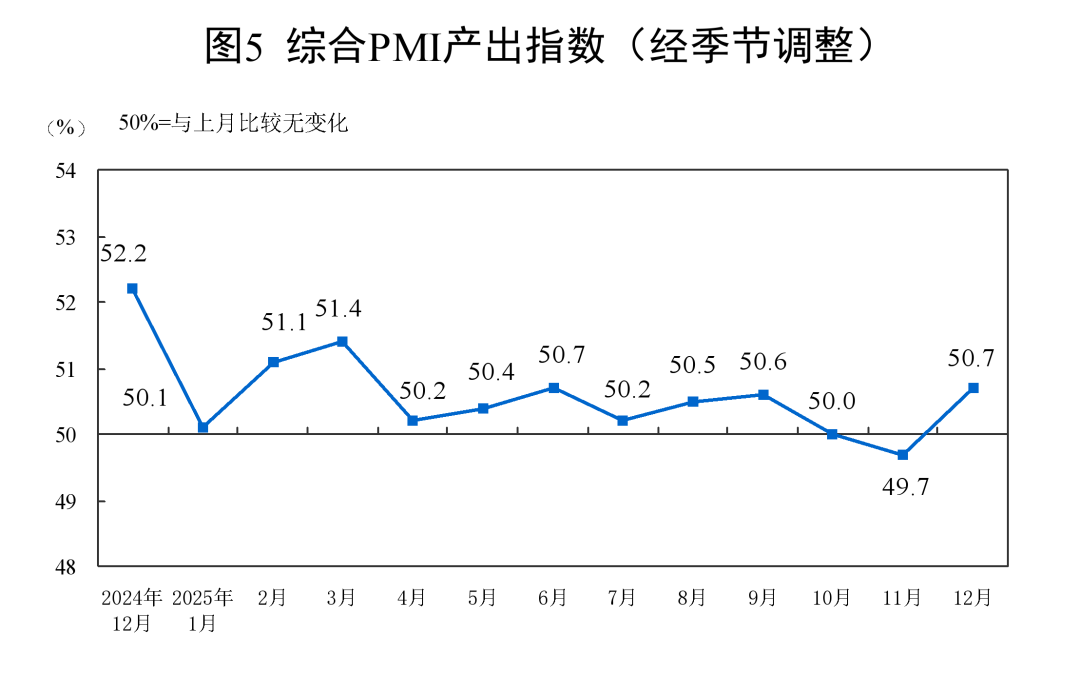
Core Viewpoint - The Purchasing Managers' Index (PMI) for December indicates a recovery in China's economic activity, with all three major indices entering the expansion zone for the first time since April [1][4]. Manufacturing Sector - The manufacturing PMI rose to 50.1%, an increase of 0.9 percentage points from the previous month, exceeding market expectations [7]. - The production index and new orders index were reported at 51.7% and 50.8%, respectively, both showing significant increases of 1.7 and 1.6 percentage points [7]. - The new export orders index increased by 1.4 percentage points to 49.0%, indicating a recovery in domestic demand [7]. - Large enterprises' PMI returned to the expansion zone at 50.8%, while medium-sized enterprises' PMI rose to 49.8%, and small enterprises' PMI fell to 48.6% [7]. Key Industries - High-tech manufacturing PMI reached 52.5%, up 2.4 percentage points, indicating positive growth trends [8]. - Equipment manufacturing and consumer goods industries both reported PMIs of 50.4%, entering the expansion zone [8]. - The construction industry PMI significantly increased to 52.8%, up 3.2 percentage points, marking a return to expansion after five months [15]. Non-Manufacturing Sector - The non-manufacturing business activity index was 50.2%, an increase of 0.7 percentage points from the previous month [12]. - The service sector PMI was reported at 49.7%, a slight increase of 0.2 percentage points, with certain sectors like telecommunications and financial services showing strong growth [12]. - The construction industry's business activity expectation index was 57.4%, indicating optimism among construction firms [16]. Overall Economic Outlook - The comprehensive PMI output index rose to 50.7%, indicating overall expansion in production and business activities compared to the previous month [16]. - The service sector's business activity expectation index increased to 56.4%, reflecting enhanced confidence in future market development [16].

经济景气水平总体回升
Xin Lang Cai Jing· 2026-01-01 16:40
Core Viewpoint - The manufacturing and non-manufacturing sectors in China showed signs of recovery in December 2025, with key indices rising above the expansion threshold, indicating improved economic conditions [1][4]. Manufacturing Sector - In December 2025, the Manufacturing Purchasing Managers' Index (PMI) reached 50.1%, marking the first time it entered the expansion zone since April [1]. - Among the 21 surveyed industries, 16 reported an increase in PMI compared to the previous month, indicating improved production and operational conditions [1]. - The production index and new orders index were 51.7% and 50.8%, respectively, both showing significant increases of 1.7 and 1.6 percentage points from the previous month [1]. - High-tech manufacturing PMI was 52.5%, up 2.4 percentage points, indicating positive growth trends [3]. - Equipment manufacturing and consumer goods industries both recorded PMIs of 50.4%, rising by 0.6 and 1.0 percentage points, respectively [3]. - The procurement activity accelerated with a procurement volume index of 51.1%, entering the expansion zone [2]. Non-Manufacturing Sector - The Non-Manufacturing Business Activity Index was 50.2%, an increase of 0.7 percentage points, indicating an improvement in the non-manufacturing sector's economic conditions [4]. - The new orders index for non-manufacturing rose to 47.3%, up 1.6 percentage points, reaching the highest level this year [4]. - The business activity expectation index for non-manufacturing was 56.5%, reflecting a continuous increase for three months, indicating rising market confidence [4]. - The construction industry saw a significant improvement, with the business activity index at 52.8%, up 3.2 percentage points from the previous month [4]. Composite Index - The Composite PMI Output Index reached 50.7%, an increase of 1.0 percentage point, indicating overall expansion in production and operational activities [5].
PMI三大指数均升至扩张区间—— 我国经济景气水平总体回升
Jing Ji Ri Bao· 2026-01-01 01:52
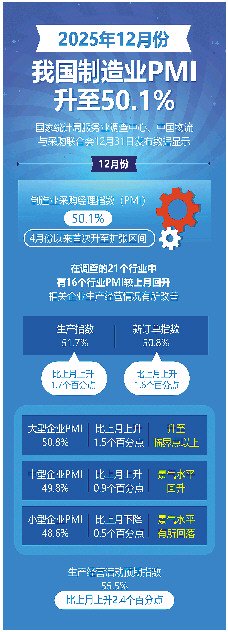
Core Viewpoint - The overall economic sentiment in China is improving, as indicated by the rise in key indices for manufacturing and non-manufacturing sectors, suggesting a recovery in economic activity [1][2][4]. Manufacturing Sector - In December 2025, the Manufacturing Purchasing Managers' Index (PMI) reached 50.1%, marking its first entry into the expansion zone since April 2025, with 16 out of 21 surveyed industries showing improvement [1][2]. - The New Orders Index rose to 50.8%, increasing by 1.6 percentage points, indicating a significant recovery in market demand after five months below 50% [2]. - The Production Index increased to 51.7%, up by 1.7 percentage points, reflecting a positive expansion in manufacturing activities [2]. - High-tech manufacturing PMI was reported at 52.5%, up by 2.4 percentage points, indicating a favorable growth trend [2]. - Large enterprises' PMI reached 50.8%, up by 1.5 percentage points, with both production and new orders indices exceeding 52% [3]. Non-Manufacturing Sector - The Non-Manufacturing Business Activity Index rose to 50.2%, up by 0.7 percentage points, indicating an improvement in the non-manufacturing sector [4]. - The Business Activity Expectation Index for non-manufacturing reached 56.5%, reflecting a continuous upward trend and strong market expectations [4][5]. - The construction industry saw a significant improvement, with the Business Activity Index at 52.8%, up by 3.2 percentage points, driven by favorable weather and upcoming holidays [4]. Economic Outlook - Experts suggest that the combination of effective economic policies and market dynamics is fostering a positive outlook for the manufacturing sector, with expectations for steady qualitative and quantitative growth in 2026 [3][5].
PMI三大指数均升至扩张区间 我国经济景气水平总体回升
Jing Ji Ri Bao· 2026-01-01 01:42
Core Viewpoint - The overall economic sentiment in China is improving, as indicated by the rise in manufacturing and non-manufacturing indices, suggesting a recovery in economic activity and market confidence [1][2][4]. Manufacturing Sector - In December 2025, the Manufacturing Purchasing Managers' Index (PMI) reached 50.1%, marking its first entry into the expansion zone since April 2025, with 16 out of 21 surveyed industries showing improvement [1][2]. - The New Orders Index rose to 50.8%, increasing by 1.6 percentage points, indicating a release of market demand after five months below 50% [2]. - The Production Index increased to 51.7%, up by 1.7 percentage points, reflecting a positive expansion in manufacturing activities [2]. - High-tech manufacturing PMI was reported at 52.5%, up by 2.4 percentage points, indicating a favorable growth trend [2]. - Large enterprises' PMI reached 50.8%, up by 1.5 percentage points, with significant increases in both production and new orders indices [3]. Non-Manufacturing Sector - The Non-Manufacturing Business Activity Index rose to 50.2%, up by 0.7 percentage points, indicating an improvement in non-manufacturing activities [4]. - The Business Activity Expectation Index for non-manufacturing reached 56.5%, reflecting a continuous upward trend and strong market expectations [4]. - The construction sector showed significant improvement, with the Business Activity Index at 52.8%, up by 3.2 percentage points, driven by seasonal factors and project acceleration [4]. Economic Outlook - Experts indicate that the combination of effective economic policies and market dynamics is expected to lead to steady growth in the manufacturing sector in 2026, with both qualitative and quantitative improvements anticipated [3][5].
2025年12月PMI数据点评:PMI逆季节性回升,预期改善
GUOTAI HAITONG SECURITIES· 2025-12-31 13:12
Manufacturing PMI Insights - In December 2025, the Manufacturing PMI rose to 50.1%, an increase of 0.9 percentage points from November, marking the first time it entered the expansion zone since April 2025[8] - Among the 21 surveyed industries, 16 reported an increase in PMI compared to November, driven by improved trade conditions and proactive inventory preparations ahead of the Spring Festival[8] - The production index and new orders index contributed 0.43 and 0.48 percentage points to the PMI, respectively, indicating a positive shift in manufacturing activity[10] Demand and Supply Dynamics - The new orders index reached 50.8%, up 1.6 percentage points from November, marking its return to the expansion zone for the first time since the second half of the year[14] - The production index also increased to 51.7%, reflecting a 1.7 percentage point rise, driven by stronger demand and improved business sentiment[14] - The raw material purchase price index decreased to 53.1%, down 0.5 percentage points, alleviating cost pressures for downstream manufacturing[17] Non-Manufacturing Sector Performance - The service sector's business activity index slightly increased to 49.7%, up 0.2 percentage points from November, with significant variation across industries[20] - The construction sector saw a notable rise, with the business activity index reaching 52.8%, an increase of 3.2 percentage points, attributed to favorable weather and upcoming holidays[23] Policy Outlook and Risks - Macro policies are expected to be more proactive in 2026, with early issuance of local government debt limits and investment plans totaling approximately 295 billion yuan[27] - A risk remains in the real estate sector, where demand still needs to be stimulated to support broader economic recovery[28]
国内观察:2025年12月PMI:制造业PMI逆势走强下的亮点
Donghai Securities· 2025-12-31 11:21
Group 1: PMI Overview - In December, the manufacturing PMI rose to 50.1%, up from 49.2% in the previous month, while the non-manufacturing PMI increased to 50.2%, from 49.5%[2] - The December PMI's unexpected strength is attributed to multiple factors, including positive expectations from recent important meetings, easing trade frictions, and increased pre-holiday inventory demand[2] - The manufacturing PMI's month-on-month increase of 0.9 percentage points (pct) significantly exceeds the five-year average decline of 0.3 pct for the same period[2] Group 2: Supply and Demand Dynamics - The production index rose to 51.7% (+1.7 pct), returning above the threshold, while the new orders index increased to 50.8% (+1.6 pct), marking the first time since June that it is above the threshold[2] - The new export orders index also saw a notable increase, rising to 49.0% (+1.4 pct), matching the high point of March this year[2] - The price index showed divergence, with the main raw material purchase price index at 53.1% (-0.5 pct) and the factory price index at 48.9% (+0.7 pct), indicating faster downstream replenishment compared to upstream[2] Group 3: Sector Performance - High-tech manufacturing PMI rose to 52.5% (+2.4 pct), significantly above the overall level, driving the increase in the overall manufacturing PMI[2] - Consumer goods PMI reached 50.4% (+1.0 pct), slightly higher than the overall PMI increase, supported by strong performance in sectors like computer communication and textile manufacturing[2] - The construction PMI was notably strong at 52.8% (+3.2 pct), outperforming seasonal expectations due to favorable weather conditions and pre-holiday construction activity[3]
12月PMI关键指标现积极信号
21世纪经济报道· 2025-12-31 09:37
作者丨冉黎黎 编辑丨陈洁 12月31日,国家统计局发布2025年12月中国采购经理指数运行情况。12月份,制造业采购 经理指数(PMI)为50.1%,为2025年4月份以来首次升至扩张区间。 国家统计局服务业调查中心首席统计师霍丽慧表示,12月份,生产指数和新订单指数分别 为51.7%和50.8%,比上月上升1.7个和1.6个百分点,特别是新订单指数下半年以来首次升 至临界点以上,制造业产需两端均较上月明显扩张。 中泰证券研究所政策团队首席分析师杨畅对21世纪经济报道记者表示,新订单与新出口订 单的差值为1.8个百分点(前值为1.6个百分点),表明内需出现修复。 中国民生银行首席经济学家温彬进一步对21世纪经济报道记者表示,前期稳增长政策继续 落地显效,叠加外部不确定性阶段性缓释,带动内外需同步好转。 此外,霍丽慧介绍,在调查的21个行业中有16个行业PMI较上月回升,相关企业生产经营情 况 有 所 改 善 。 高 技 术 制 造 业 、 装 备 制 造 业 、 消 费 品 行 业 PMI 分 别 为 52.5% 、 50.4% 、 50.4%,分别较上月回升2.4、0.6、1.0个百分点。预期指数也升至较高 ...

12月PMI数据点评:景气重返扩张区间
Mai Gao Zheng Quan· 2025-12-31 07:29
Group 1: Manufacturing Sector - December Manufacturing PMI recorded at 50.1%, up 0.9 percentage points from the previous month, marking the first entry into the expansion zone since April 2025[2] - Production index rose to 51.7%, an increase of 1.7 percentage points, while new orders index reached 50.8%, up 1.6 percentage points, indicating improved production and demand[12] - Large enterprises' PMI increased to 50.8%, up 1.5 percentage points, supporting the manufacturing recovery, while small enterprises' PMI fell to 48.6%, reflecting ongoing challenges[18] Group 2: Non-Manufacturing Sector - December Non-Manufacturing Business Activity Index rose to 50.2%, returning to the expansion zone, showing improvement from November[3] - Construction PMI recorded at 52.8%, up 3.2 percentage points, driven by favorable weather and accelerated project progress[25] - Service sector Business Activity Index increased to 49.7%, still in contraction, with significant variation across industries, indicating a slow recovery[25] Group 3: Economic Outlook - Overall PMI data for December reflects a phase of economic recovery, confirming the effectiveness of growth stabilization policies[5] - Anticipated economic expansion supported by upcoming consumption peaks and infrastructure projects, alongside a special bond issuance plan of 62.5 billion yuan to stimulate consumption[5] - Risks include potential delays in policy implementation, slow global economic recovery, and insufficient domestic demand[6]
关键指标现积极信号!50.1%重返扩张区,12月PMI暖了
2 1 Shi Ji Jing Ji Bao Dao· 2025-12-31 06:56
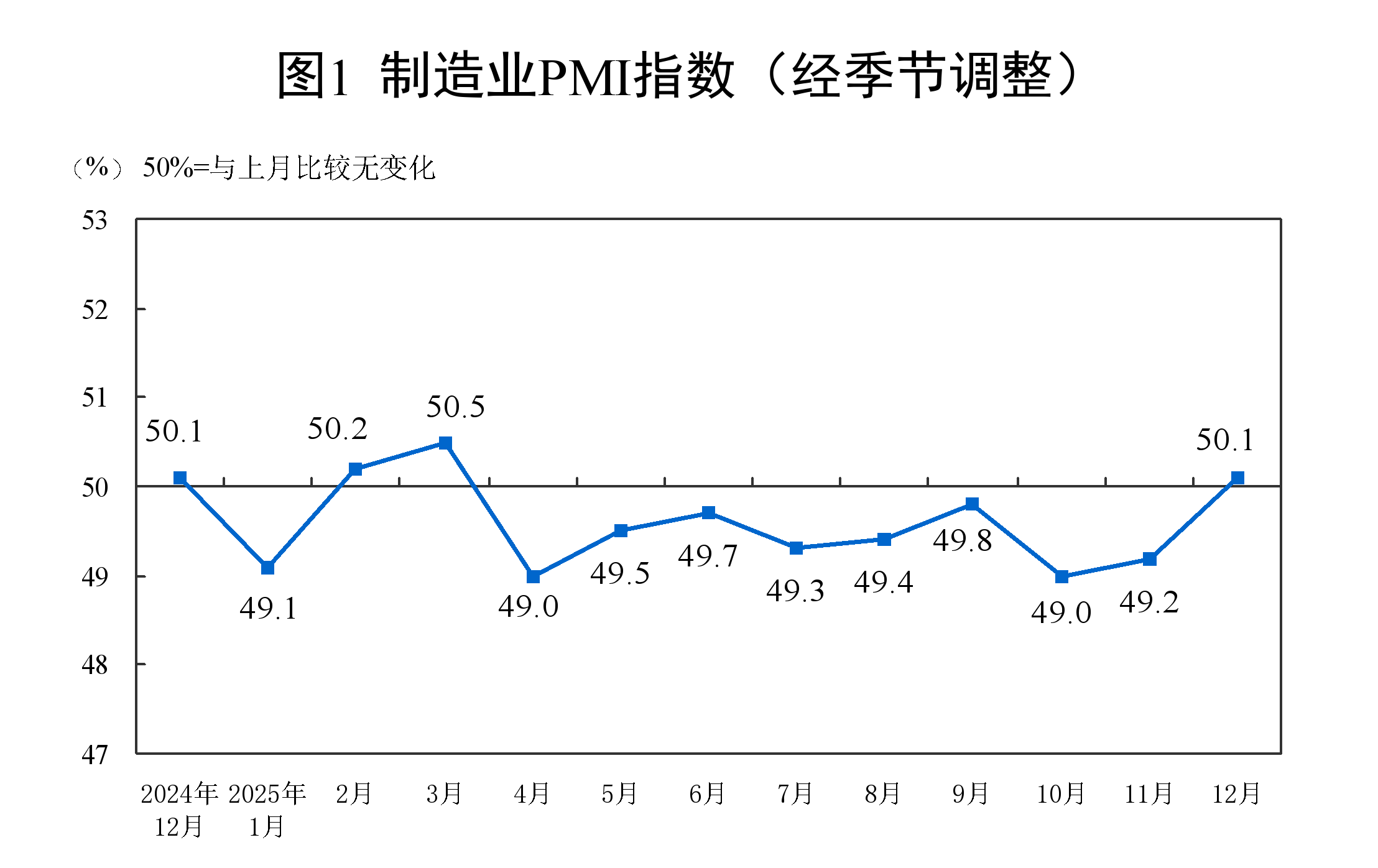
Core Viewpoint - The manufacturing Purchasing Managers' Index (PMI) in China rose to 50.1% in December 2025, marking the first expansion since April 2025, indicating a recovery in both production and demand [1][5]. Group 1: Manufacturing PMI Overview - The manufacturing PMI increased by 0.9 percentage points from the previous month, reaching the expansion zone [5]. - The production index and new orders index were reported at 51.7% and 50.8%, respectively, both showing significant month-on-month increases [6][7]. - In 2025, the monthly manufacturing PMI figures were 49.1%, 50.2%, 50.5%, 49%, 49.5%, 49.7%, 49.3%, 49.4%, 49.8%, 49.0%, 49.2%, and 50.1% [5]. Group 2: Sector Performance - Among the 21 surveyed industries, 16 showed an increase in PMI compared to the previous month, indicating improved business conditions [2][8]. - High-tech manufacturing, equipment manufacturing, and consumer goods sectors reported PMIs of 52.5%, 50.4%, and 50.4%, respectively, all above the expansion threshold [2][8]. - The new export orders index rose to 49.0%, up 1.4 percentage points, although it remains below the expansion threshold [7][9]. Group 3: Economic Indicators - The production activity expectation index reached 55.5%, indicating increased confidence among manufacturing enterprises regarding market development [10]. - The supplier delivery time index was reported at 50.2%, suggesting that the delivery times for raw materials are improving [9]. - The inventory indices for finished products and raw materials showed signs of recovery, with finished product inventory rising to 48.2% and raw materials inventory at 47.8% [9].
50.1%!时隔8个月,重回扩张区间
Zheng Quan Shi Bao· 2025-12-31 06:01
Core Viewpoint - The Purchasing Managers' Index (PMI) for China's manufacturing and non-manufacturing sectors showed signs of recovery in December, indicating an overall improvement in economic conditions [1][3]. Manufacturing Sector - The manufacturing PMI rose to 50.1% in December, up 0.9 percentage points from the previous month, marking its first increase above 50% after eight consecutive months below this threshold [3]. - Among 13 sub-indices, production, new orders, and new export orders indices showed increases, with rises ranging from 0.1 to 2.4 percentage points [3]. - High-tech manufacturing PMI reached 52.5%, up 2.4 percentage points, indicating a positive growth trend [4]. - The equipment manufacturing and consumer goods sectors both recorded PMIs of 50.4%, rising by 0.6 and 1.0 percentage points respectively [4]. Non-Manufacturing Sector - The financial sector's business activity index and new orders index both exceeded 60%, indicating enhanced financial support for the real economy [6]. - The construction sector's business activity index rose to 52.8%, up 3.2 percentage points, ending a four-month period below 50% [6]. Business Expectations - The manufacturing production activity expectation index reached 55.5%, up 2.4 percentage points, the highest since April 2024 [8]. - The service sector's business activity expectation index increased to 56.4%, reflecting continued optimism among businesses [8]. - The central economic work conference has laid out clear policies for economic development in 2026, which are expected to provide guidance and momentum for macroeconomic growth [8]. Economic Outlook - The overall economic environment is expected to improve in 2026, supported by a stable trade environment and proactive economic policies [9]. - The "14th Five-Year Plan" is anticipated to guide economic and social development over the next five years, with a focus on enhancing investment and consumption demand [9].