
家居

Search documents
第八届进博会圆满结束,贸发局两展馆成展场焦点
Feng Huang Wang Cai Jing· 2025-11-11 05:24
Group 1: Event Overview - The Hong Kong Trade Development Council (HKTDC) participated in the China International Import Expo (CIIE) for the eighth consecutive year, establishing the "Hong Kong Food Pavilion" and "Hong Kong Services Pavilion" to showcase Hong Kong's brand and professional service advantages [1][2] - The expo facilitated over 1,000 business matching meetings, helping several Hong Kong companies secure immediate orders and sign cooperation agreements with mainland enterprises [1][2] - The HKTDC organized a promotional event titled "Hong Kong: The Preferred Platform for Mainland Enterprises Going Global," attracting 500 representatives from various sectors including innovation and technology, healthcare, and professional services [1][2][7] Group 2: Pavilion Highlights - The "Hong Kong Food Pavilion" featured 33 companies and covered an area of 1,000 square meters, showcasing a variety of food products and utilizing live streaming to enhance brand visibility, achieving over one million exposures on platforms like JD.com and Douyin [3][4] - The "Hong Kong Services Pavilion" included 21 companies and spanned 500 square meters, highlighting Hong Kong's strengths in innovation technology, medical technology, financial and professional services, and logistics [5][6] Group 3: Business Outcomes - Companies such as Yichuang Food Technology successfully signed significant contracts with mainland firms during the expo, focusing on areas like probiotic food technology and plant-based protein innovation [4][5] - New exhibitors like the Wine World Trading Platform signed a memorandum of cooperation with a Shanghai cross-border e-commerce service company to enhance supply chain management in mainland China [6] - Established brands like Kampery Development secured multiple cooperation intentions with wholesalers and e-commerce clients, indicating strong interest from professional buyers [5] Group 4: Networking and Collaboration - The promotional event featured key speakers including Hong Kong's Chief Executive and representatives from various government bodies, emphasizing Hong Kong's role as a bridge for mainland enterprises to access global markets [7][8] - Interactive discussions involved prominent figures from Hong Kong and mainland enterprises, focusing on leveraging strengths in innovation, finance, and professional services to seize overseas market opportunities [8]
从“东方之约”到“世界机遇”:高水平开放的进博实践
Xin Hua She· 2025-11-11 02:34
Core Points - The 8th China International Import Expo (CIIE) is being held in Shanghai from November 5 to 10, showcasing a record scale and serving as a platform for high-level opening and global cooperation [2][15] - China has become the world's second-largest consumer and import market, emphasizing its commitment to high-level opening and market expansion [3][8] - The CIIE aims to provide new opportunities for global cooperation and economic growth, enhancing China's role as a major market for international trade [4][38] Group 1: Event Overview - The CIIE features participation from 155 countries, regions, and international organizations, with over 4,108 foreign enterprises exhibiting across an exhibition area exceeding 430,000 square meters [15] - The event includes 290 Fortune 500 companies and industry leaders, with approximately 450,000 registered attendees [15] - The expo has seen a significant increase in participation from developing countries, with a 23.1% rise in exhibitors from Belt and Road Initiative countries [42] Group 2: Economic Impact - The CIIE serves as a platform for international procurement, investment promotion, cultural exchange, and open cooperation, injecting confidence and momentum into the global economy [13][38] - The event has facilitated the participation of 170 companies and 27 institutions as "full attendance" exhibitors over the past eight years, reflecting China's commitment to high-level opening [17] - The expo has also created opportunities for small and medium-sized enterprises (SMEs) to enter the Chinese market through initiatives like the "cross-border e-commerce selection platform" [44] Group 3: Innovation and Technology - The CIIE is recognized as a global launchpad for new products and technologies, with 461 new products, technologies, and services showcased, including advancements in low-altitude economy and artificial intelligence [29][31] - The event features a dedicated innovation incubation area aimed at helping global startups explore the Chinese market [33] - Notable technological exhibits include electric vertical takeoff and landing aircraft and humanoid robots, highlighting the diverse future of mobility and innovation [35][37] Group 4: Cultural Exchange - The CIIE not only serves as a trade platform but also as a venue for cultural and ideological exchange, exemplified by events like the dual-city exhibition between Chongqing and Düsseldorf [23] - The expo has expanded its focus on sustainable development, particularly for global southern countries, promoting inclusive growth and resilience [40][42] - The event has also provided a space for showcasing cultural products, such as Ethiopian coffee, enhancing cultural ties between participating nations [42]

中金:产业趋势与流动性助推牛市 港股市场长期受益
智通财经网· 2025-11-11 00:17
Core Viewpoint - The Chinese market in 2025 is expected to exceed expectations, characterized as a bull market driven by industry trends (AI), fundamental improvements, and liquidity narratives [1][2] Macroeconomic Environment - The concept of "excess liquidity" is driving the pursuit of "scarce assets," with liquidity remaining abundant but the credit cycle shifting to oscillation or even slowdown [2] - The recognition of "scarce assets" changes with the credit cycle, impacting the types of assets that attract investment [2][3] Liquidity and Scarcity - The current situation in China is characterized by a coexistence of deflation and localized inflation, with excess liquidity leading to significant asset price differentiation [3][4] - The key questions for future market judgments are whether the liquidity environment has been damaged and if scarce assets can expand to a broader range [3][4] Credit Cycle and Asset Expansion - The credit cycle is expected to oscillate and slow down, making it difficult for scarce return assets to expand significantly [5][6] - The government’s role in stimulating credit expansion is limited, and structural issues remain a challenge for long-term growth [6][7] Market Trends - The Hang Seng Index's dynamic valuation is currently at 11.4 times, indicating that the market is not "cheap" and future index space will require earnings recovery rather than relying solely on valuation expansion [8][9] - The overall earnings growth is projected to be modest, with a baseline scenario estimating a 3% growth in 2026 [9] Investment Strategy - The company suggests maintaining a moderate allocation to dividend assets to counterbalance the weak credit cycle expansion [10] - Focus on sectors that can still expand credit, such as AI technology, new energy, and innovative pharmaceuticals, while underweighting real estate and consumer goods [10][11]
中金2026年展望 | 港股:“牛市”的下一步
中金点睛· 2025-11-10 23:38
Core Viewpoint - The Chinese market in 2025 is characterized as a bull market driven by industry trends (AI), fundamental improvements, and liquidity narratives, with significant contributions from risk premiums and structural performance [2][17]. Group 1: Market Dynamics - The market's performance is influenced by excess liquidity chasing scarce return assets, leading to significant structural changes and asset rotation [25][26]. - The Hang Seng Index and Hang Seng Tech Index saw a 30% increase, primarily driven by risk premiums rather than earnings growth [17][18]. - Structural characteristics include significant contributions from a small number of stocks, with 15 stocks accounting for 70% of index gains, while many others underperformed [2][19]. Group 2: Liquidity Environment - The liquidity environment remains abundant, with macro, micro, and external liquidity factors contributing to the current state [28][30]. - Macro liquidity is characterized by low interest rates and a loose monetary policy, while micro liquidity reflects a lack of effective demand leading to capital stagnation [28][30]. - External liquidity is expected to remain loose in the first half of 2026, influenced by the Federal Reserve's interest rate policies and the ongoing "de-dollarization" narrative [34][35]. Group 3: Scarce Assets and Credit Cycle - The concept of "scarce assets" is determined by the credit cycle, with different phases affecting asset preferences, such as fixed-return assets during credit contraction and growth assets during recovery [3][36]. - The current credit cycle is expected to experience fluctuations, making it challenging for scarce return assets to expand broadly across the market [40][41]. - The government’s fiscal policies are limited in scope, with structural preferences affecting the ability to stimulate traditional demand sectors [45][46]. Group 4: Sector Outlook - Emerging demand sectors, particularly in technology and AI, are projected to maintain high growth, although expectations may be overly optimistic [41][42]. - Traditional demand sectors, such as real estate and consumer goods, are likely to weaken again after a brief recovery, primarily due to low income expectations and cost-return mismatches [43][44]. - Fiscal spending is expected to be limited but may shift structurally to support sectors with higher growth potential, such as technology and innovation [45][46].

银发经济升温:进博会绽放适老新活力,政策市场双轮驱动产业未来 | 聚焦2025进博会
Hua Xia Shi Bao· 2025-11-10 13:41
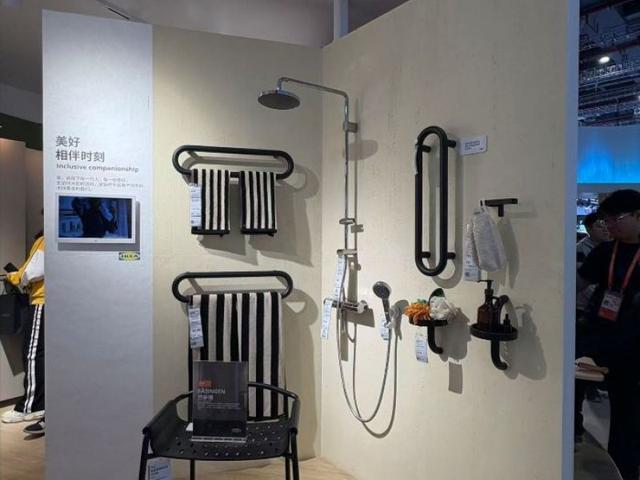
Core Viewpoint - The "silver economy" is gaining attention at the China International Import Expo, with various exhibitors showcasing products and solutions aimed at addressing the challenges of an aging population, indicating a significant market potential and societal need for comprehensive support [2][3][6]. Industry Overview - China's elderly population is large and growing rapidly, with the silver economy market expected to reach 8.3 trillion yuan in 2024 and surpass 20 trillion yuan by 2030 [3][6]. - Sales of elderly nutrition and health products, as well as health monitoring devices, have seen significant growth, with increases of 30.1% and 7.5% respectively in the first half of the year [3]. Company Initiatives - IKEA is actively exploring collaborative models with social designers, care centers, communities, and government agencies to support the silver economy, launching the "Elderly-Friendly Living" project in Shanghai in 2024, which has already served over 2,000 elderly families [2][8]. - The company has introduced over 500 lower-priced elderly-friendly products, with sales of these items increasing by over 50% compared to the previous year, indicating strong consumer demand [8]. Product Innovations - IKEA has designed specific areas in its showroom for the elderly, including the BÄSINGEN series, which features safety-focused bathroom products [3][4]. - Panasonic is integrating technology with elderly care solutions, showcasing a sleep system that uses smart sensors to monitor sleep data and adjust environmental parameters for better comfort [4][6]. Market Trends - The silver economy is being recognized as a new economic growth driver, with policies supporting its development, as highlighted in the recent national planning documents [6][7]. - The industry is witnessing a shift towards addressing the needs of the elderly, with companies like IKEA and Panasonic leading the way in product development and service offerings [8][9]. Challenges and Opportunities - Despite the positive outlook, the silver economy faces challenges such as a shortage of skilled workers in the elderly care sector, which impacts service quality and standardization [9]. - There is a growing emphasis on training and developing a new generation of care professionals to meet the increasing demand for elderly services [9].
关键词读懂“十五五” |银发经济升温 进博会绘就“适老”新图景
Yang Guang Wang· 2025-11-10 12:26
Core Insights - The development of the silver economy is a crucial measure to address population aging, enhance the well-being of the elderly, and promote high-quality economic growth [1][5] Group 1: Policy and Strategic Direction - The Central Committee of the Communist Party of China has emphasized the importance of developing the silver economy in its 15th Five-Year Plan, indicating a clear direction for growth in this sector [1] - The Chinese government is elevating the response to population aging as a national strategy, with significant measures to support the development of the silver economy outlined in the "Opinions on Developing the Silver Economy to Enhance the Well-being of the Elderly" [5] Group 2: Market Trends and Innovations - The 2024 United Nations World Population Prospects predicts that by 2030, the elderly population in China will reach 369 million, accounting for 26.4% of the total population, highlighting the growing market potential for silver economy products and services [5] - Recent trends show a significant increase in social attention and market interest in the silver economy, with a notable rise in the number of business entities, industry scale, and consumer spending [5][6] - New business models are emerging, integrating silver economy services with various sectors such as culture, education, fashion, and finance, leading to rapid growth in online shopping and live-streaming sales among the elderly [5][6] Group 3: Technological Advancements - The integration of technology into products for the elderly is becoming increasingly important, with innovations in home safety, smart lighting, and health management solutions tailored to the needs of older adults [2][3][4] - Companies are expanding the use of medical products from healthcare institutions to community and home settings, enhancing the accessibility of professional medical solutions for elderly care [3][4] - The development of silver technology is focused on areas such as AI-enabled precision medicine, chronic disease management, and digital elderly care platforms, although challenges remain in data collaboration and talent shortages [7]
(第八届进博会)进博会“银发经济”浪潮涌动
Zhong Guo Xin Wen Wang· 2025-11-10 11:07
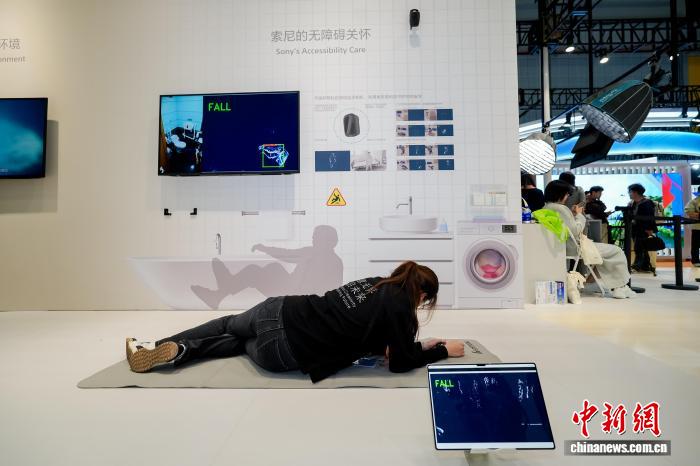
Core Insights - The "silver economy" is emerging as a central theme at the 8th China International Import Expo, highlighting the strategic focus of global companies on aging-related innovations and market opportunities [1][5] Demographic Trends - By the end of 2024, the elderly population aged 60 and above in China is projected to reach 310 million, accounting for 22% of the total population, with those aged 65 and above reaching 220 million, or 15.6% [1] Industry Innovations - IKEA has introduced six home living zones designed for the elderly, emphasizing inclusive design to enhance autonomy and safety, supported by insights from the "2025 Intergenerational Friendly Home Trend Report" [1] - Otis has launched the Gen3™ Comfort smart elevator, addressing the needs of elderly residents with larger buttons, spacious cabins, and enhanced safety features through the Otis ONE digital maintenance system [2] - Philips has developed the Anrui series, focusing on the physiological needs of the elderly, utilizing smart lighting and advanced sensors to monitor and alert for fall risks and abnormal behaviors [2] - Sony's AI fall detection device uses EVS chip technology to analyze skeletal movements rather than images, ensuring privacy while providing timely safety responses in sensitive areas [5] Market Opportunities - The consumption needs of the elderly are shifting from "survival" to "development" and "enjoyment," indicating a significant market potential [5] - L'Oréal has initiated the "New Age Beauty" forum, promoting a cultural shift towards redefining beauty in the context of longevity, emphasizing that aging should be viewed as an opportunity rather than a challenge [5] - Insights from industry leaders suggest that the new elderly demographic possesses economic power, time, and high expectations, representing a strategic market opportunity [5] Conclusion - The expo serves as a platform for innovative solutions in the "silver economy," demonstrating that this market extends beyond basic needs to encompass a wide range of lifestyle enhancements, integrating functionality with emotional well-being and social inclusivity [6]
家居业“冰火两重天”,“出海”寻求新出路?
3 6 Ke· 2025-11-10 03:31
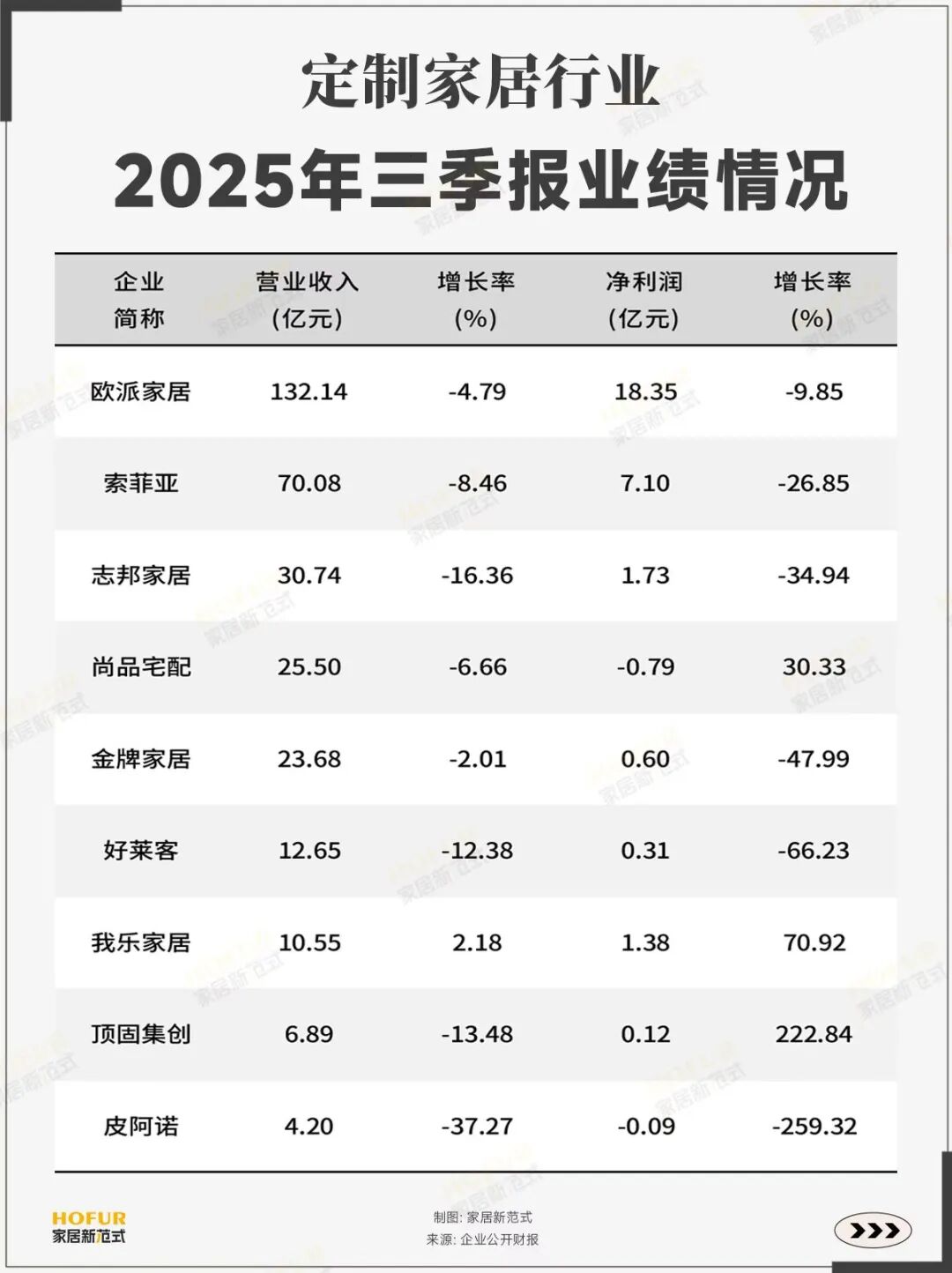
Core Viewpoint - The home furnishing industry is undergoing a significant transformation characterized by a stark performance divide among companies, with increasing market competition and revenue pressures across various segments [1][2]. Revenue Decline - In Q3 2025, all segments of the home furnishing industry faced revenue declines, including custom furniture, soft furniture, and building materials [2]. - Notable revenue figures include: - Oppein Home: 13.214 billion, down 4.79% - ZBOM Home: 3.074 billion, down 16.36% - Sofia: 7.008 billion, down 8.46% [3][5]. Performance Metrics - Key performance metrics for various companies in Q3 include: - Oppein Home: Revenue 13.214 billion, Net Profit 1.835 billion, both down - ZBOM Home: Revenue 3.074 billion, Net Profit 0.173 billion, both down - Rabbit Baby: Revenue 6.319 billion, down 2.25%, Net Profit 0.635 billion, up 29.02% [3][5][6]. Market Trends - The home furnishing market is shifting towards higher quality-price ratios, personalized designs, and comprehensive space solutions, demanding enhanced product development and service capabilities from companies [9]. - Leading companies are adopting a "one-stop" model and utilizing AI design tools to improve customer engagement and sales conversion rates [9][10]. Channel Structure Adjustment - The online channel has evolved into a core platform for brand promotion, lead generation, and precise marketing, with some stores incorporating live streaming to enhance customer interaction [10]. - Consumer expectations for product quality, environmental sustainability, and personalization are rising, influencing company strategies [10]. International Expansion - Many home furnishing companies are increasingly looking to international markets for growth, transitioning from light asset trials to heavy asset investments [11]. - Companies like Gold Medal Home and ZBOM Home are expanding their overseas presence, establishing subsidiaries and local production bases to reduce costs [11][12][14]. Strategic Adjustments - Companies capable of "going global" are encouraged to adjust their market strategies, focusing on precise, specialized, and targeted market development [14].


深圳市末石科技有限公司成立 注册资本50万人民币
Sou Hu Cai Jing· 2025-11-09 21:24
Core Insights - Shenzhen Moshi Technology Co., Ltd. has been established with a registered capital of 500,000 RMB [1] - The company is involved in a wide range of business activities including electronic product sales, home goods manufacturing, and automotive parts manufacturing [1] Company Overview - The legal representative of the company is Yan Xianggang [1] - The general business scope includes sales and manufacturing of various products such as home appliances, furniture, toys, and sports equipment [1] - The company does not have any licensed business projects [1]
把中国市场当成“健身房” 外企在进博会“卷”起来了
Jing Ji Guan Cha Wang· 2025-11-08 13:48
Group 1 - The competitive landscape in the Chinese market requires foreign companies to continuously innovate and adapt to maintain their competitiveness, as highlighted by Amcor's president for Greater China and North Asia, She Xin [1] - Amcor showcased over 300 packaging products at the China International Import Expo, indicating a strong focus on innovation to meet local market demands across various sectors such as snacks, pet food, cosmetics, and pharmaceuticals [1] - The emphasis on speed and cost-effectiveness in the Chinese market drives companies to integrate cost considerations deeply into their innovation processes, leveraging technologies like polymers to enhance efficiency while maintaining product quality [1] Group 2 - The rise of the "lazy economy" and health-conscious consumer trends in China has led to new competitive focuses, such as the development of convenient and safe packaging solutions like Amcor's microwave self-venting bags [2] - Amcor's design innovations in fast-moving consumer goods (FMCG) aim to enhance emotional value, such as packaging that facilitates easy consumption and storage, thereby improving the overall consumer experience [2] Group 3 - The trend towards pre-prepared meals is irreversible, with industry players needing to address both convenience and quality, as emphasized by Silver Fern Farms' new product launch at the expo [3] - Standardized production in the pre-prepared meal sector can lead to more consistent quality compared to traditional dining options, reflecting a shift towards industry regulation and consumer demand for higher standards [3] Group 4 - The growing health consciousness among consumers has made "health" and "environmental sustainability" critical themes for companies, as demonstrated by Zhongrun Changjiang's introduction of antibiotic-free fresh chicken and eco-friendly packaging solutions [4] - The new packaging design reduces plastic usage by 60% and carbon emissions by approximately 30%, showcasing a commitment to sustainability through innovative material use [4] Group 5 - The aging population's needs are increasingly being recognized by foreign companies, with IKEA focusing on the convenience and safety of living spaces for the elderly through thoughtful product design [5] - IKEA's successful product launches at the expo, such as the electric sofa, illustrate the company's ability to leverage the event's exposure to drive significant sales growth in its product categories [5]
