家电制造

Search documents
驼铃远去 风笛响起——“钢铁驼队”续写开放新篇章
Zhong Guo Jin Rong Xin Xi Wang· 2025-11-16 13:05
Core Viewpoint - The Xi'an International Port has transformed into a key logistics hub connecting Europe and Asia through the China-Europe Railway Express, achieving significant growth in freight volume and operational efficiency over the past decade [1][2]. Group 1: Operational Achievements - The Xi'an International Port has seen over 30,000 China-Europe Railway Express trains dispatched since its inception in 2013, maintaining the highest operational metrics in the country for several consecutive years [1]. - In 2024, the port set a record with 24 trains dispatched within a 24-hour period, showcasing its operational efficiency [2]. - The port's annual throughput capacity has reached 5.4 million TEUs (Twenty-foot Equivalent Units) after three expansions, covering an area of 5,600 acres with 59 operational lines [2]. Group 2: Strategic Developments - The implementation of a multi-channel strategy has been crucial for maintaining high operational speed, with new routes significantly reducing transport times from over 40 days to approximately 15 days [2]. - The collaboration with Kazakhstan's Almaty port has created a dual-hub linkage, enhancing cost efficiency and operational effectiveness by matching cargo and container sources accurately [2]. Group 3: Digital Transformation - The introduction of a comprehensive service platform has simplified international freight processes, allowing users to book cargo space and complete customs procedures online, akin to an e-commerce experience [3]. - The "Smart Logistics Supervision System" has been launched, enabling low-risk cargo to enjoy 24-hour automatic clearance, significantly reducing processing times from four hours to mere seconds [3][4]. Group 4: Economic Impact - The China-Europe Railway Express has catalyzed the integration of various industries, including automotive manufacturing and smart home appliances, in Xi'an and its surrounding areas [5]. - The Xi'an Chang'an International Port has attracted 380 companies in the cross-border e-commerce sector, with dedicated trains operating over 500 times and achieving a transaction volume exceeding 10.5 billion yuan [6]. - The establishment of a "three-in-one" industrial chain by Xi'an Aijiu Grain and Oil Industrial Group has facilitated the import of 92,000 tons of high-quality agricultural products from Kazakhstan in the first ten months of the year [6].
外资,开始躺平收租了
首席商业评论· 2025-11-16 04:12
Core Insights - The article discusses the trend of foreign companies in China shifting from direct operations to a model of leasing their brands and operations to local partners, indicating a strategic retreat from aggressive market engagement [5][15]. Group 1: Strategic Moves by Foreign Companies - Starbucks has entered into a joint venture with Boyu Capital to operate its retail business in China, valuing the deal at approximately $4 billion [5]. - Decathlon is also rumored to be evaluating the opening of part of its equity in the Chinese market, reflecting a broader trend among foreign firms [7]. - Historical examples include McDonald's selling its controlling stake in China for $2.08 billion in 2016 and Philips selling its home appliance business for €4.4 billion (approximately 34 billion RMB) in 2021 [7][9]. Group 2: Market Challenges - The Chinese market has become increasingly competitive, with Starbucks reporting an 11% drop in same-store sales in Q2 of fiscal year 2024, leading to a decline in both customer spending and transaction volume [9]. - Decathlon, while still growing, is experiencing a slowdown in growth rates due to competition from local brands and online retailers [9]. Group 3: Complexity of Local Operations - The article highlights that managing operations in China has become more complex, requiring local insights and rapid decision-making that foreign companies may struggle to provide [11]. - Yum China, after its spin-off, has successfully localized its product offerings, achieving record revenues and profits [11][12]. Group 4: Shift to Brand Leasing - Foreign companies are realizing that their most valuable asset in China is their brand, leading them to adopt a model where they lease their brand and provide technical services, which generates high margins with low operational risk [13]. - For instance, McDonald's has a brand licensing agreement that allows it to earn 2-5% of sales from its franchisee in China, translating to an estimated annual income of 2-3 billion RMB based on 2023 sales figures [13]. Group 5: Implications of the New Model - This shift to a leasing model benefits foreign companies by allowing them to maintain brand presence while securing cash flow without the operational burdens [14]. - Local teams face both opportunities and challenges as they take on the operational responsibilities of these international brands, which may lead to a shift in corporate culture and operational priorities [14][15].



客厅里的智能战争
经济观察报· 2025-11-14 15:08
Core Viewpoint - The competition in the home appliance market is intensifying as traditional companies like Midea, Gree, Haier, and Hisense seek new growth through AI technology, product line expansion, and internationalization, while tech companies like Huawei and Xiaomi leverage their established smart ecosystem advantages to increase competition [2][3]. Group 1: Market Dynamics - Traditional home appliance companies are exploring new growth points through AI technology and expanding product lines [2][3]. - Tech companies are intensifying competition in the home appliance market by leveraging their smart ecosystem advantages [2][3]. - The shift towards a fully smart home environment is becoming evident, with consumers increasingly interested in integrated smart solutions [12]. Group 2: Consumer Behavior - Consumers are showing a preference for smart appliances, with features like AI voice control being particularly appealing to families with children and elderly members [6]. - There is a noticeable shift in consumer purchasing habits, with many moving from foreign brands to domestic brands due to the increasing expectations for smart features [6][7]. - Consumers are facing challenges with compatibility between different brands' smart systems, which complicates the integration of smart home devices [7]. Group 3: Technological Advancements - Home appliances are evolving from "single product intelligence" to "whole home intelligence," with systems like Midea's "Xiao Mei AI" integrating various smart functions [9][10]. - The interaction between vehicles and home systems is being developed, allowing for seamless integration and control of home environments from vehicles [11]. - The trend towards smart home integration is expected to continue, with significant growth projected in the smart home market over the next few years [12]. Group 4: Industry Trends - Major players in the home appliance sector, including Gree, Midea, Haier, and Hisense, are adapting to the blurred lines between home appliances and broader home ecosystems [14]. - The retail landscape is shifting, with smart home products being prominently displayed alongside traditional appliances to attract consumer interest [14]. - The release of technological potential in the home appliance sector is expected to reshape global competition, allowing Chinese companies to gain a more advantageous position in the market [15].




保障房≠基础住宅!海尔智家携手中国建研院共建安居幸福家
Quan Jing Wang· 2025-11-14 10:28
Core Insights - The article discusses the need to elevate the quality of affordable housing beyond merely meeting basic living standards, addressing the growing demand for better living conditions among the public [1] Group 1: Housing Quality Improvement - The "Anju Happiness Home" model room, created by Haier Smart Home and the China Academy of Building Research, provides a high-quality solution to the challenges faced in the affordable housing sector [1][3] - The model adheres to the "365 Good House System," focusing on three core values: safety and durability, comfort and usability, and economic practicality [1][2] Group 2: Health and Safety Features - The model room includes advanced health and safety features such as a dual-ion antibacterial bath heater for continuous purification and a high-temperature sterilization electric water heater to ensure hygiene [2] - A washing machine with mite removal functionality contributes to a comprehensive health protection network for residents [2] Group 3: Space Optimization and Comfort - Haier's products are designed to maximize space efficiency, exemplified by a slim refrigerator occupying only 0.49 square meters while offering a capacity of 501 liters [2] - The living room features a television with triple eye protection certification and a fan light that provides natural light-like illumination, enhancing comfort [2] Group 4: Economic and Energy Efficiency - The products focus on energy efficiency and cost-effectiveness, with the electric water heater utilizing AI-3D technology for 8.5 times capacity increase and energy savings [2] - Appliances like the fan light and refrigerator have received national一级能效 certification, significantly reducing household energy consumption [2] Group 5: Industry Implications - The collaboration between Haier Smart Home and the China Academy of Building Research demonstrates that high-quality housing does not necessarily equate to high costs, providing a replicable model for upgrading the quality of affordable housing in China [3]

TCL智家:拟在泰国建设生产基地,新增冰箱产能140万台
2 1 Shi Ji Jing Ji Bao Dao· 2025-11-14 10:09
Core Viewpoint - TCL Smart Home is expanding its production capacity to meet market demand and optimize its global production layout by establishing a new manufacturing base in Thailand, which will enhance its competitive advantage and risk resilience [1] Group 1: Production Capacity - The company's current production capacity is primarily located in Zhongshan and Hefei, with a high utilization rate [1] - The new production base in Thailand is expected to add 1.4 million units of refrigerator capacity and 300,000 units of freezer capacity [1] Group 2: Market Strategy - The establishment of the Thailand production base is part of the company's strategy to strengthen its competitive position in the market [1] - The completion of the Hefei home appliance supporting factory aligns with the company's efforts to enhance its manufacturing capabilities [1] Group 3: Industry Context - The announcement follows the upcoming full production of the high-end wind-cooled refrigerator smart manufacturing project by Oma, which is set to produce 2.8 million units annually starting in the first half of 2025 [1]


TCL智家(002668) - 2025年11月12-14日投资者关系活动记录表
2025-11-14 09:48
Sales and Revenue Performance - In Q3 2025, TCL's refrigerator and freezer sales reached 4.16 million units, a slight decrease of 4.4% year-on-year [2] - Washing machine sales totaled 1.01 million units, showing a year-on-year increase of 1.3% [2] - Total revenue for Q3 2025 was 4.869 billion CNY, down 2.3% compared to the previous year [2] Cash Flow and Inventory Management - For the first nine months of 2025, the net cash flow from operating activities was 1.93 billion CNY, an increase of 576 million CNY year-on-year [3] - As of September 2025, inventory decreased by 24.3% compared to the beginning of the year, with a reduction of 346 million CNY in the inventory of Oma refrigerators [3] Profitability and Strategic Initiatives - The net profit attributable to shareholders for the first nine months of 2025 was 977 million CNY, reflecting a year-on-year growth of 18.5% [3] - The company is actively expanding into overseas markets, particularly in the Middle East, Africa, and Latin America, achieving significant results in the UK, Brazil, and Spain [3] - Product structure optimization and the introduction of new products contributed to a 1.52% increase in gross margin [3] Research and Development - The R&D expense ratio for the first nine months of 2025 was 3.6%, a year-on-year increase of 0.1%, positioning the company among the top in the domestic appliance industry [3] Production Capacity and Future Plans - Current production capacity is primarily located in Zhongshan and Hefei, with plans to expand capacity in Thailand to enhance production efficiency [4] - The company has successfully launched a high-end refrigerator production project with an annual capacity of 2.8 million units [4] Dividend Policy - The company has not yet distributed dividends but emphasizes the importance of shareholder returns, with retained earnings meeting legal distribution conditions [5]
建设银行青岛市分行:服务“两新”多维发力 点燃消费“新引擎”
Xin Lang Cai Jing· 2025-11-14 07:19
Core Viewpoint - Consumption is identified as the "main engine" driving economic growth, with a focus on boosting domestic demand and achieving high-quality development as a priority for economic work in 2025 [1] Group 1: Economic Policy and Strategy - The Central Economic Work Conference emphasizes the importance of significantly boosting consumption and improving investment efficiency as key strategies for expanding domestic demand [1] - The State Council's action plan for 2024 includes four major initiatives: equipment updates, old-for-new consumption, recycling, and standard upgrades [1][5] Group 2: Digital Transformation and Financial Services - The Qingdao branch of China Construction Bank is actively developing a digital operating system for personal consumption business, utilizing financial technology to enhance customer engagement and service efficiency [2] - The branch has issued 1.7 billion yuan in personal loans, serving over 42,500 households, demonstrating the effectiveness of its digital strategy [2] Group 3: Consumer Support Initiatives - The bank has launched various promotional activities targeting daily consumption scenarios, achieving over 1 million transactions and enhancing brand influence [4] - The bank's support for consumer financing includes tailored products like "Jianyi Loan," which has provided timely assistance to individuals facing financial difficulties [3] Group 4: Green Consumption and Industrial Upgrading - The bank is facilitating green consumption through innovative financial tools, including a 1.5 billion yuan green bond issuance aimed at promoting energy-efficient home appliances [7] - The Qingdao branch has also supported the development of smart agricultural equipment, projecting an annual output value increase of 1.2 billion yuan [6] Group 5: Comprehensive Financial Ecosystem - The bank is transitioning from traditional credit support to a comprehensive empowerment model that integrates policy response, scenario reconstruction, and ecosystem cultivation [8] - By aligning financial services with national strategies, the bank aims to stimulate consumption and support high-quality economic development [8]

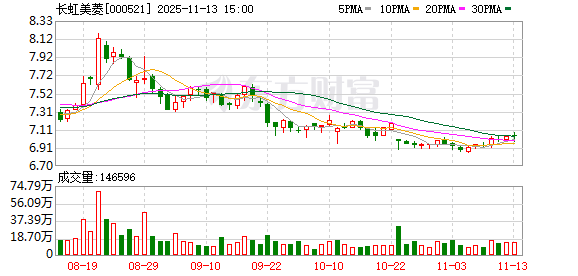
长虹美菱:公司下属联营企业成立的智能家居公司正常开展业务
Zheng Quan Ri Bao· 2025-11-13 11:43
Core Viewpoint - Changhong Meiling's subsidiary, Sichuan Zhiyi Home Network Technology Co., Ltd., is successfully conducting business in the smart home sector [2] Group 1 - The company responded to investor inquiries on November 13, confirming the normal operations of its smart home business [2]

外资,开始躺平收租了
Sou Hu Cai Jing· 2025-11-13 11:12
Core Insights - Starbucks has officially announced a partnership with Boyu Capital to establish a joint venture for its retail operations in China, with Boyu holding up to 60% equity and Starbucks retaining 40%, based on a valuation of approximately $4 billion [1][2] Group 1: Market Dynamics - The Chinese market has shifted from a blue ocean to a highly competitive red ocean, making it increasingly difficult for foreign companies to generate profits [5][11] - Starbucks reported an 11% decline in same-store sales in Q2 of fiscal year 2024, with both average transaction value and volume decreasing, leading to significant pressure on the company [5][6] - Other foreign brands, such as Decathlon, are also facing challenges from local competitors and e-commerce, resulting in slowed growth [5][6] Group 2: Strategic Shifts - Many foreign companies are opting to relinquish control and introduce local capital, transforming their operations into a rental model, which allows them to lock in profits while minimizing operational risks [4][10] - The trend of foreign companies transitioning to a "rent-seeking" model reflects a broader strategy of financial conversion, allowing them to maintain brand presence while securing cash flow [10][11] Group 3: Local Market Adaptation - Successful local operations, as seen with Yum China, demonstrate that localized strategies can lead to impressive financial performance, with innovative product offerings tailored to local tastes [6][7] - The complexity of managing operations in China has increased, prompting foreign companies to hand over operational control to local teams who are more adept at navigating the market [8][9] Group 4: Brand Value and Profitability - The core asset for foreign companies in China is their brand, which can generate significant revenue through licensing and brand management agreements, often resulting in high margins [9][10] - For instance, McDonald's receives a franchise fee of 3% to 5% of sales from its Chinese operations, translating to an estimated annual income of $2 to $4 billion based on 2023 sales figures [9][10] Group 5: Future Implications - The shift towards a rental model signifies the end of an era where foreign companies could easily dominate the Chinese market solely based on brand and capital advantages [10][11] - This transition indicates that local capital and operational capabilities are becoming increasingly important in managing global brands within China [11][12]
打不动了?淘宝牵线,小米、海信合伙开公司!电视开机率跌破30%后,10年冤家也和好了
Sou Hu Cai Jing· 2025-11-13 08:52
Core Viewpoint - Xiaomi and Hisense, long-time competitors in the TV market, have formed a partnership by co-founding a new company called "Zhi Ping Shi Jie" in Hangzhou, marking a significant shift in their relationship after years of rivalry [1][5]. Group 1: Background of Rivalry - The rivalry between Xiaomi and Hisense dates back to 2015, when Xiaomi claimed to be the top smart TV brand in terms of sales, prompting a rebuttal from Hisense [2][3]. - The competition escalated over the years, with both companies engaging in various disputes, including a three-year legal battle where Hisense was ordered to pay Xiaomi 500,000 yuan and issue a public apology [4]. Group 2: Formation of New Company - The new company "Zhi Ping Shi Jie" has significant backing, with Xiaomi holding an 18% stake through "Hanxing Chuangye" and Hisense holding 15% through "Ju Haokan" [1]. - The CEO of TV Taobao, Wang Lei, is identified as the actual controller of the new company, indicating a strategic move to foster collaboration in a challenging market [5]. Group 3: Market Conditions - The TV market has seen a drastic decline, with TV usage rates dropping from 70% in 2016 to below 30% in 2022, and sales volume decreasing by 8.3% year-on-year in the first half of 2025, alongside a 6.1% drop in sales revenue [6][7]. - The current market conditions have prompted major players in the home appliance sector to seek partnerships, as exemplified by recent collaborations between Haier and Xiaomi, and Hisense and Midea [7].