电子

Search documents
中上协:1月末上市公司境内股份总市值114.5万亿 全市场五个板块总市值均创近5年历史新高
智通财经网· 2026-02-26 08:07
Market Overview - As of the end of January, the total market capitalization of listed companies in China reached 114.5 trillion yuan, marking a historical high for all five market segments in the past five years [1] - The median market capitalization of listed companies increased by 7% to 6.976 billion yuan compared to the previous month [1] Company Listings - In January, there were 9 new IPOs, raising a total of 9.053 billion yuan, with 8 of these being manufacturing companies [1] - The number of listed companies in the domestic stock market reached 5,484, with 2,306 on the Shanghai Stock Exchange, 2,886 on the Shenzhen Stock Exchange, and 292 on the Beijing Stock Exchange [1] Industry Composition - The number of state-controlled listed companies accounted for 27% of the total, while privately-controlled companies made up 63% [2] - The manufacturing sector had 3,751 listed companies, reflecting a net increase of 99 companies since the beginning of the year [2] Regional Distribution - The top three regions for listed companies were Jiangsu (723), Zhejiang (608, excluding Ningbo), and Beijing (480), with 7 regions seeing an increase in company numbers and 1 region experiencing a decrease [2] Market Trends - The number of companies with a market capitalization exceeding 1 trillion yuan increased by 1, while those exceeding 100 billion yuan rose by 115 [1] - The number of companies with market capitalizations below 50 million yuan and 20 million yuan decreased by 141 and 45, respectively [1] International Listings - In January, 3 A-share companies listed in Hong Kong, all from the electrical, electronic, and communications sectors [2] - There were 1,871 Chinese concept companies listed in major overseas markets as of January [2]
中上协:1月末上市公司境内股份总市值114.5万亿元 全市场五个板块总市值均创近5年历史新高
Mei Ri Jing Ji Xin Wen· 2026-02-26 08:07
Core Insights - As of January 31, 2026, there are 5,484 listed companies in China's domestic stock market, with 2,306 on the Shanghai Stock Exchange, 2,886 on the Shenzhen Stock Exchange, and 292 on the Beijing Stock Exchange [1] - In January, there were 9 new IPOs raising a total of 9.053 billion yuan, predominantly from manufacturing companies [1] - The total market capitalization of listed companies reached 114.5 trillion yuan, with all five market segments achieving a historical high in the past five years [1] Market Dynamics - The number of companies in the top 50 by market capitalization in the electronics, communications, and pharmaceutical sectors has increased to 15, nearly doubling compared to the beginning of the previous year [1] - In January, one company with a market capitalization exceeding 1 trillion yuan was added, along with five companies exceeding 100 billion yuan, and 115 companies exceeding 10 billion yuan [1] - Conversely, there was a reduction of 141 companies with market capitalizations below 5 billion yuan and 45 companies below 2 billion yuan [1] Valuation Metrics - The median market capitalization of listed companies at the end of January was 6.976 billion yuan, reflecting a 7% increase from the previous month [1]
20cm速递|高景气成长板块上行,科创创业ETF国泰(588360)涨超1%
Mei Ri Jing Ji Xin Wen· 2026-02-26 07:12
Core Viewpoint - The high-growth sectors are experiencing upward movement, with the Guotai Sci-Tech Innovation ETF (588360) rising over 1% [1] Group 1: Industry Overview - The broad-based Sci-Tech Innovation and Entrepreneurship 50 Index covers 50 emerging industry listed companies with large market capitalization and good liquidity from the Sci-Tech Board and the Growth Enterprise Market [1] - The industry distribution focuses on core hard technology fields such as power equipment and new energy, electronics, pharmaceuticals, and computers, which are key areas for cultivating and developing emerging and future industries [1] - These sectors are currently supported by national industrial policies and financial resources, indicating a high-growth phase with active technological innovation and significant long-term growth potential [1] Group 2: Investment Potential - The constituent stocks of the index are leading companies in their respective sub-sectors, expected to benefit from industrial upgrades and domestic substitution trends, showcasing strong profit growth potential and investment value [1] - The Guotai Sci-Tech Innovation ETF (588360) tracks the Sci-Tech Innovation 50 Index (931643), which has a daily price fluctuation limit of 20% [1] - The index selects 50 emerging industry listed companies with larger market capitalizations to reflect the overall performance of representative emerging industries, focusing on sectors like electronics, power equipment, communications, and biomedicine, emphasizing technological attributes and innovative growth [1]


主力资金流入前20:胜宏科技流入17.49亿元、沪电股份流入14.35亿元
Jin Rong Jie· 2026-02-26 06:14
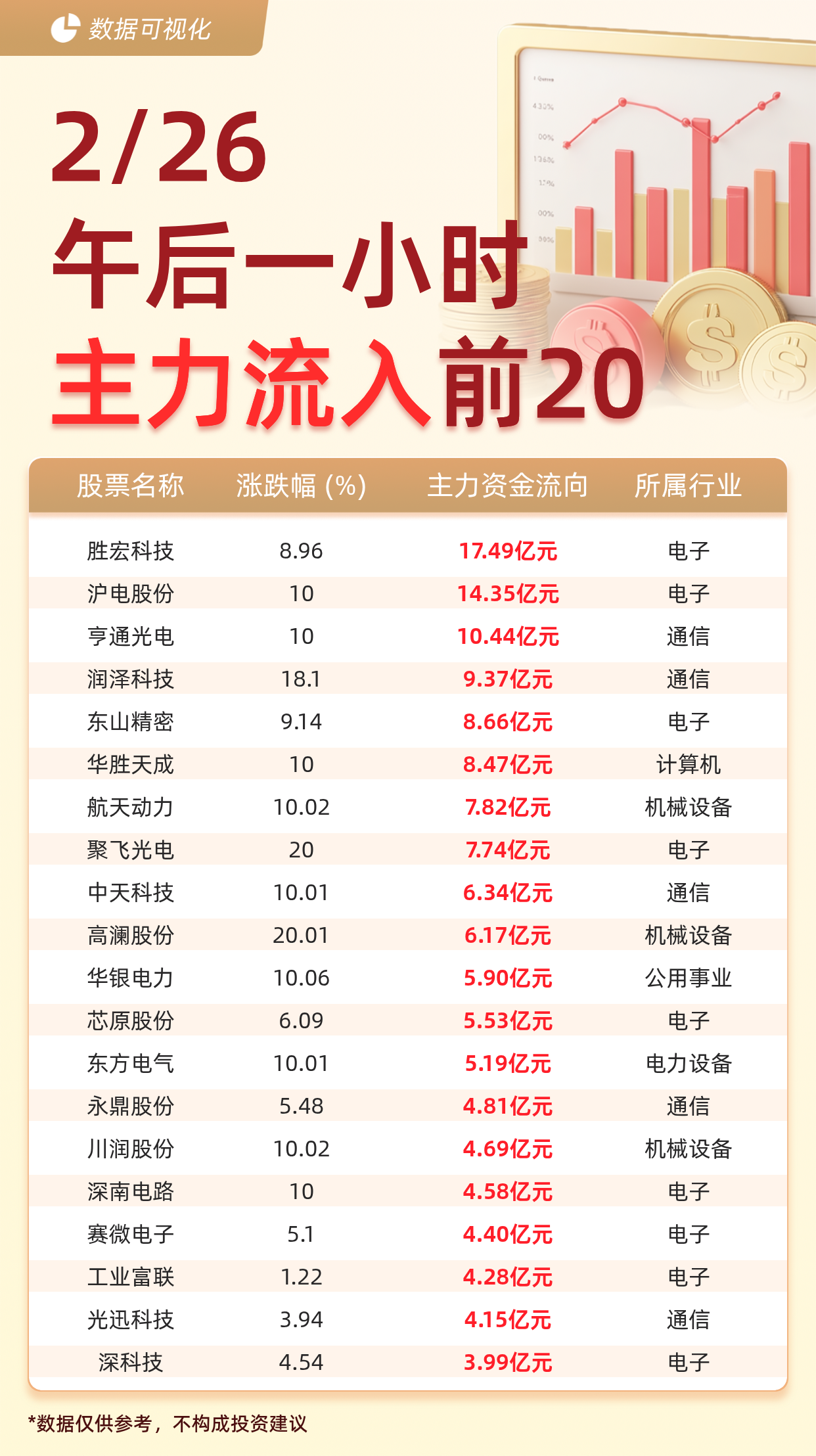
据交易所数据显示,截至2月26日午后一小时,主力资金流入前20的股票分别为: 胜宏科技(17.49亿元)、 沪电股份(14.35亿元)、 亨通光电(10.44亿 元)、 润泽科技(9.37亿元)、 东山精密(8.66亿元)、 华胜天成(8.47亿元)、 航天动力(7.82亿元)、 聚飞光电(7.74亿元)、 中天科技(6.34亿 元)、 高澜股份(6.17亿元)、 华银电力(5.90亿元)、 芯原股份(5.53亿元)、 东方电气(5.19亿元)、 永鼎股份(4.81亿元)、 川润股份(4.69亿 元)、 深南电路(4.58亿元)、 赛微电子(4.40亿元)、 工业富联(4.28亿元)、 光迅科技(4.15亿元)、 深科技(3.99亿元)。 | 芯原股份 | 6.09 | 5.53亿元 | 电子 | | --- | --- | --- | --- | | 东方电气 | 10.01 | 5.19亿元 | 电力设备 | | 永鼎股份 | 5.48 | 4.81亿元 | 通信 | | 川润股份 | 10.02 | 4.69亿元 | 机械设备 | | 深南电路 | 10 | 4.58亿元 | 电子 | | 塞微电子 | ...


PCB大爆发,沪电股份涨停,创历史新高!寒武纪登顶A股吸金榜,电子ETF(515260)盘中拉升2.3%冲击5连阳
Xin Lang Cai Jing· 2026-02-26 05:56
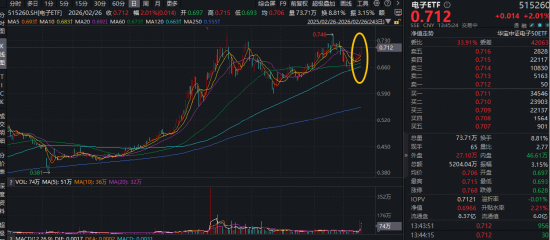
Core Viewpoint - The electronic ETF (515260), which has nearly 28% exposure to Nvidia's supply chain, experienced a significant price increase, rising nearly 2.3% intraday and currently up 2.01%, marking five consecutive days of gains [1][14]. Industry Summary - The PCB (Printed Circuit Board) sector is leading the gains, with major stocks like Huadian Co. and Shenzhen South Circuit reaching their daily limit, while Dongshan Precision rose over 9% and Shenghong Technology increased by more than 8% [3][14]. - Nvidia reported impressive quarterly revenue of $68 billion and provided strong guidance, with CEO Jensen Huang stating that AI capabilities are at a turning point, directly translating computing power into revenue [4][14]. - The electronic sector saw a net inflow of 28.252 billion yuan, leading among 31 first-level industries in the Shenwan classification, with Cambrian Technology attracting 3.238 billion yuan, topping the A-share capital inflow rankings [5][15]. Company Insights - The PCB is considered the "skeleton and blood vessels" of AI servers, with the value of ordinary server PCBs around 800 yuan, while AI server PCBs can reach between 6,000 to 12,000 yuan, representing a value increase of 5 to 10 times [6][16]. - According to CITIC Securities, the PCB industry's benefits will continue to extend from cloud applications to end-user devices, with significant growth expected in AI servers and related technologies [6][16]. - The electronic ETF (515260) tracks a popular technology index, with major tech companies like Apple, Nvidia, and Google holding significant weightings of 45.19%, 27.87%, and 21.85% respectively, indicating strong ties to global tech growth [6][16]. Investment Tools - The electronic ETF (515260) and its linked funds passively track the electronic 50 index, heavily investing in semiconductor and consumer electronics sectors, including AI chips, automotive electronics, and PCBs [8][18]. - The ETF is a financing and interconnectivity tool, providing an efficient way to invest in core assets within the electronic sector [8][18].


利好突袭 涨停潮来了
Zhong Guo Ji Jin Bao· 2026-02-26 05:04
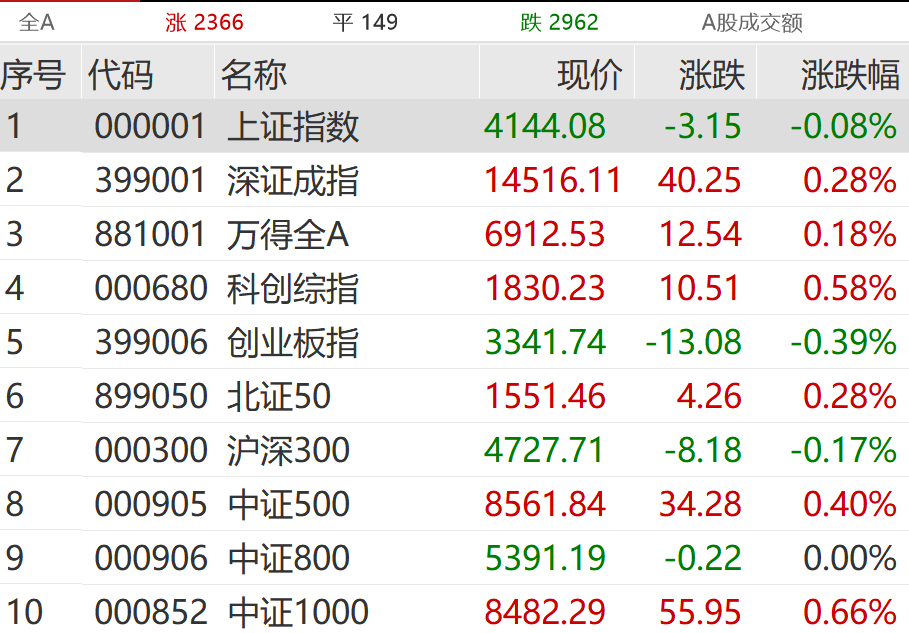
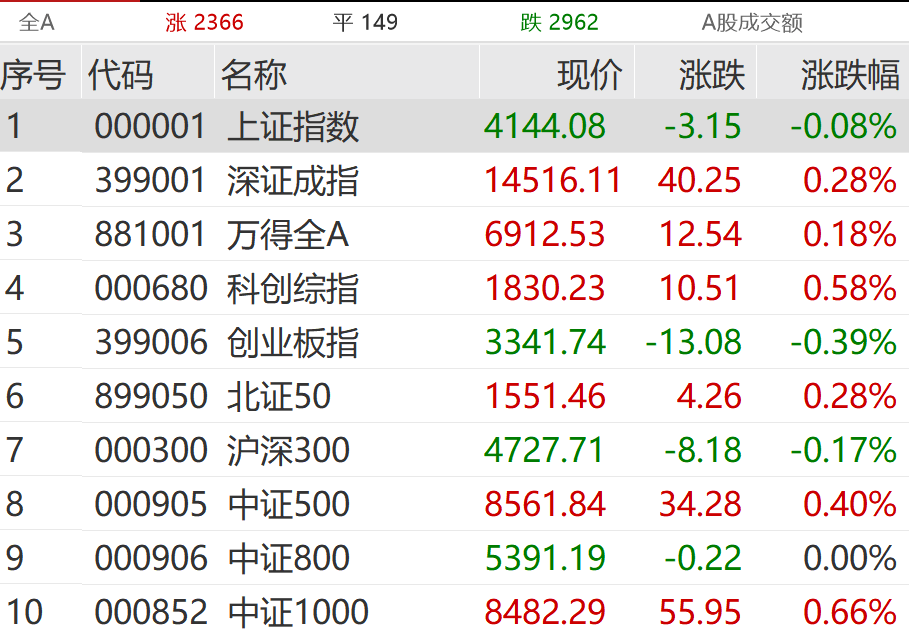
Market Overview - A-shares experienced mixed fluctuations, with the Shanghai Composite Index down 0.08% to 4144.08, while the Shenzhen Component rose 0.28% to 14516.11 [2][3] - The total market turnover reached 1.65 trillion yuan, showing an increase compared to the previous day, with 2366 stocks rising and 2962 stocks falling [2] Sector Performance - The computing hardware sector saw significant gains, with stocks related to circuit boards, optical communication, and computing leasing becoming active [3][6] - Conversely, the lithium battery sector experienced a downturn, with major stocks like CATL and others dropping over 5% [10][12] Notable Stocks - Several stocks in the computing hardware sector hit their daily limit, including Guanghe Technology, Dazhu Laser, and Zhongtian Technology, with increases of around 10% [6][7] - ShenNan Circuit reached a price of 290.14 yuan per share, with a total market value approaching 200 billion yuan [8] Lithium Battery Sector - The lithium battery sector faced a decline, with stocks such as Penghui Energy and Yahua Group falling by over 9% and 8% respectively [10][11] - A report indicated that Zimbabwe's mining department has imposed a ban on lithium ore exports, which could lead to a short-term supply shortage and potentially drive lithium prices up [12] Hong Kong Market - The Hong Kong market saw a decline, but stocks under Li Ka-shing's "Cheung Kong Group" rose against the trend, with Cheung Kong Infrastructure and Power Assets increasing by over 5% [14][16] - The sale of the UK Power Networks business by the "Cheung Kong Group" generated over 110 billion HKD, which will be used for future investments and acquisitions [16]

利好突袭,涨停潮来了
Sou Hu Cai Jing· 2026-02-26 05:01
Market Overview - A-shares experienced mixed fluctuations, with the Shanghai Composite Index down 0.08% and the Shenzhen Component Index up 0.28% as of midday trading on February 26 [1][2] - The total market turnover reached 1.65 trillion CNY, with 2,366 stocks rising and 2,962 stocks falling [5] Sector Performance - The electronic sector saw a significant rally, particularly in computing hardware stocks, with companies like Huadian Co. hitting a historical high and a total market capitalization exceeding 160 billion CNY [9][10] - The lithium battery sector faced a downturn, with major players like CATL dropping over 5% during intraday trading [16][19] Notable Stocks - Huadian Co. reached a peak price of 85.36 CNY, marking a 10% increase and a total market value of 164.26 billion CNY [10] - Shenzhen South Circuit Co. also hit a limit-up price of 290.14 CNY, approaching a market capitalization of 200 billion CNY [11] - Other notable gainers in the computing hardware sector included companies like Guanghe Technology and Dazhu Laser, both achieving limit-up prices [8] Hong Kong Market - The Hong Kong market saw the "Cheung Kong Group" stocks rise against the trend, with Cheung Kong Infrastructure and Power Assets Holdings increasing by over 5% [26][27] - The sale of UK Power Networks by the Cheung Kong Group generated over 110 billion HKD, which will be used for future investments and acquisitions [27] Industry Insights - Nvidia's recent earnings report highlighted a robust demand for AI computing power, indicating a significant growth trajectory for the sector [14] - The semiconductor materials market is also experiencing price increases, with a 30% rise in prices for copper foil substrates and adhesive films announced by Resonac [14] Lithium Market Developments - Zimbabwe's mining department has issued a ban on lithium ore exports, which is expected to tighten supply and potentially drive lithium prices higher [24]
长城基金汪立:关注内需价值、新兴科技、大金融三大方向
Xin Lang Cai Jing· 2026-02-26 04:48
Core Viewpoint - The A-share market is expected to stabilize and rebound, supported by multiple positive factors including declining risk-free rates, comprehensive domestic demand policies, and improving export expectations [1][4]. Group 1: Market Conditions - The A-share market welcomed a "good start" with all three major indices opening higher on the first trading day after the holiday [1][4]. - Factors supporting the market include a decline in risk-free rates and ongoing capital market reforms, which create a favorable liquidity environment for A-shares [1][4]. - Domestic demand policies are being prioritized, with expectations for traditional domestic demand sectors to gradually improve, supported by both policy and fundamental factors [1][4]. Group 2: Economic Outlook - The outlook for China's economy in 2026 is expected to improve significantly, driven by breakthroughs in domestic new technology industries and accelerated globalization [1][4]. - The focus of economic work is shifting towards domestic demand, with expectations of recovery in consumption, rising prices, and stabilization in the real estate sector [1][4]. Group 3: Investment Strategies - Emerging technology is identified as a key investment theme, with value stocks also expected to see a resurgence [1][4]. - Specific sectors to focus on include consumer services, food and beverage, and building materials within the domestic demand space, as well as internet, media, computing, robotics, electronics, and military industries in the emerging technology sector [2][5]. - The financial sector, particularly brokerage and insurance, is highlighted as a stabilizing force in the market, benefiting from the ongoing growth in wealth management demand [2][6].
超预期!PCB、CPO大爆发
Xin Lang Cai Jing· 2026-02-26 03:39
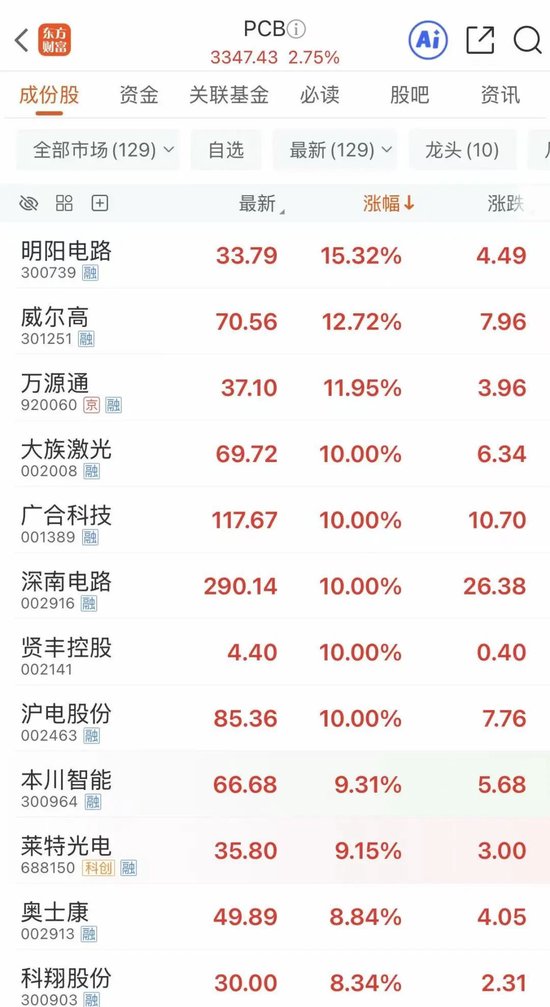
Core Viewpoint - The stock market is experiencing significant activity in computing hardware stocks, particularly in the PCB and CPO sectors, with notable price increases observed in various companies [1][6]. PCB Sector Summary - The PCB concept has seen a substantial rise, with companies like Mingyang Circuit up over 15%, Weier High up over 12%, and several others including Dazhu Laser, Guanghe Technology, and Huadian Co., Ltd. reaching the 10% limit up [1][6]. - Specific stock performances include: - Mingyang Circuit: 33.79, up 15.32% [7] - Weier High: 70.56, up 12.72% [7] - Dazhu Laser: 69.72, up 10.00% [7] - Huadian Co., Ltd.: 117.67, up 10.00% [7] - Shenzhen South Circuit: 290.14, up 10.00% [7] CPO Sector Summary - The CPO concept is leading the A-share market, with stocks like Jieput and Jufei Optoelectronics hitting the 20% limit up, and others like Zhongtian Technology and Hengtong Optoelectronics also reaching the limit up [2][3]. - Specific stock performances include: - Jieput: 242.46, up 20.00% [8] - Jufei Optoelectronics: 9.30, up 20.00% [8] - Zhili Fang: 85.65, up 12.06% [8] - Zhongtian Technology: 27.59, up 10.01% [8] Nvidia's Financial Performance - Nvidia's latest quarterly earnings report shows total revenue of $68.13 billion for Q4 of fiscal year 2026, exceeding analyst expectations of $66.2 billion, with earnings per share at $1.62, surpassing the forecast of $1.53 [4][9]. - The company projects revenue of $78 billion for Q1 of fiscal year 2027, with a variance of 2%, not accounting for data center revenue from China [4][9]. - Analyst Yu Yang from Huachuang Securities highlights that Nvidia's performance boosts confidence in the AI computing power outlook, benefiting the upstream hardware supply chain, particularly PCB manufacturers [4][9].


资金风向标 | 25日两融余额增加238.70亿元 电子行业获融资净买入居首
Sou Hu Cai Jing· 2026-02-26 01:45
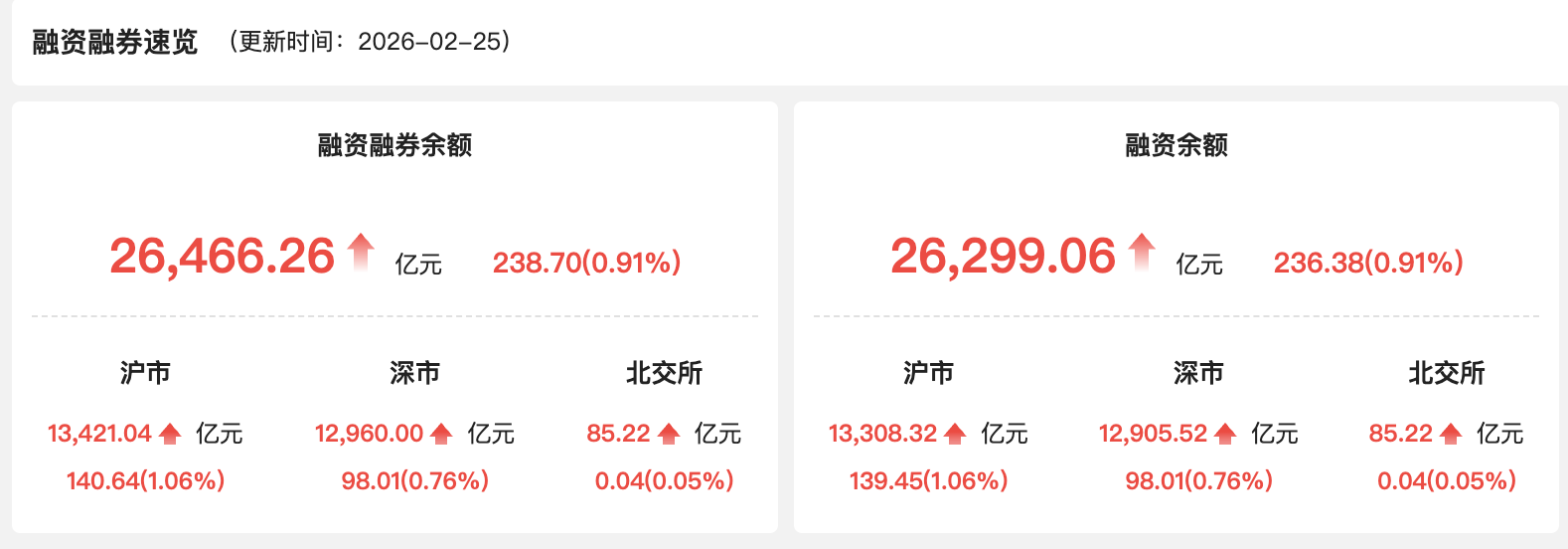
Group 1 - The total margin balance of A-shares reached 26,466.26 billion yuan on February 25, increasing by 238.70 billion yuan from the previous trading day, accounting for 2.52% of the A-share circulating market value [1] - The margin trading volume on the same day was 2,474.56 billion yuan, an increase of 193.33 billion yuan from the previous trading day, representing 9.97% of the total A-share trading volume [1] Group 2 - Among the 31 primary industries in Shenwan, 25 industries experienced net financing inflows, with the electronics industry leading at a net inflow of 4.096 billion yuan [3] - Other industries with significant net financing inflows included non-ferrous metals, basic chemicals, defense and military industry, non-bank financials, and communications [3] Group 3 - A total of 76 stocks had net financing inflows exceeding 100 million yuan, with Northern Rare Earth leading at a net inflow of 936.31 million yuan [4] - Other notable stocks with high net financing inflows included Tongfu Microelectronics, Huagong Tech, Shenghong Technology, Feilihua, Baosteel, Yuntianhua, Zijin Mining, Yongtai Technology, and China Rare Earth [4]